A Mary Poppins Story for Coloring 

Dear Reader,  

When I first read Mary Poppins and Mary Poppins Comes Back (which were printed in one volume) as a child, I was not able to enjoy the original illustrations by Mary Shepard, as they were not included in the Bulgarian translation published in 1980. Instead, they were replaced by illustrations by Lyuben Dimanov

I don’t think I liked Dimanov’s illustrations as a child because I have no memory of them, and I do remember a lot of the illustrations from my childhood books. All I remember is that the book was very thick, and it felt like proof that I was really good at reading.   It was only a couple of years ago when I retrieved an old copy of my childhood edition of Mary Poppins that I realized the original illustrations were not in it. 

Now that I am acquainted with the original illustrations, I find it difficult to enjoy Dimanov’s interpretations of the characters. For one, I find the figures a bit too angular, and their proportions too exaggerated. Moreover, in my opinion, he took his artistic liberties to the extreme. In fact, one has to wonder if he even read the stories, or how he could portray Mary Poppins with long, curly, flowing hair like a lion’s mane. 

I’m certain P.L. Travers would have been upset if she had seen these illustrations—or maybe she did. I wish I could show them to her and ask her opinion. What we do know is that she was very particular about how Mary Poppins was depicted and insisted on her being represented exactly as she had imagined her. 

In fact, P.L. Travers was so particular about the character, and Mary Shepard was such an inexperienced artist at the start of the project, that the emergence of Mary Poppins in visual form was not without its growing pains.

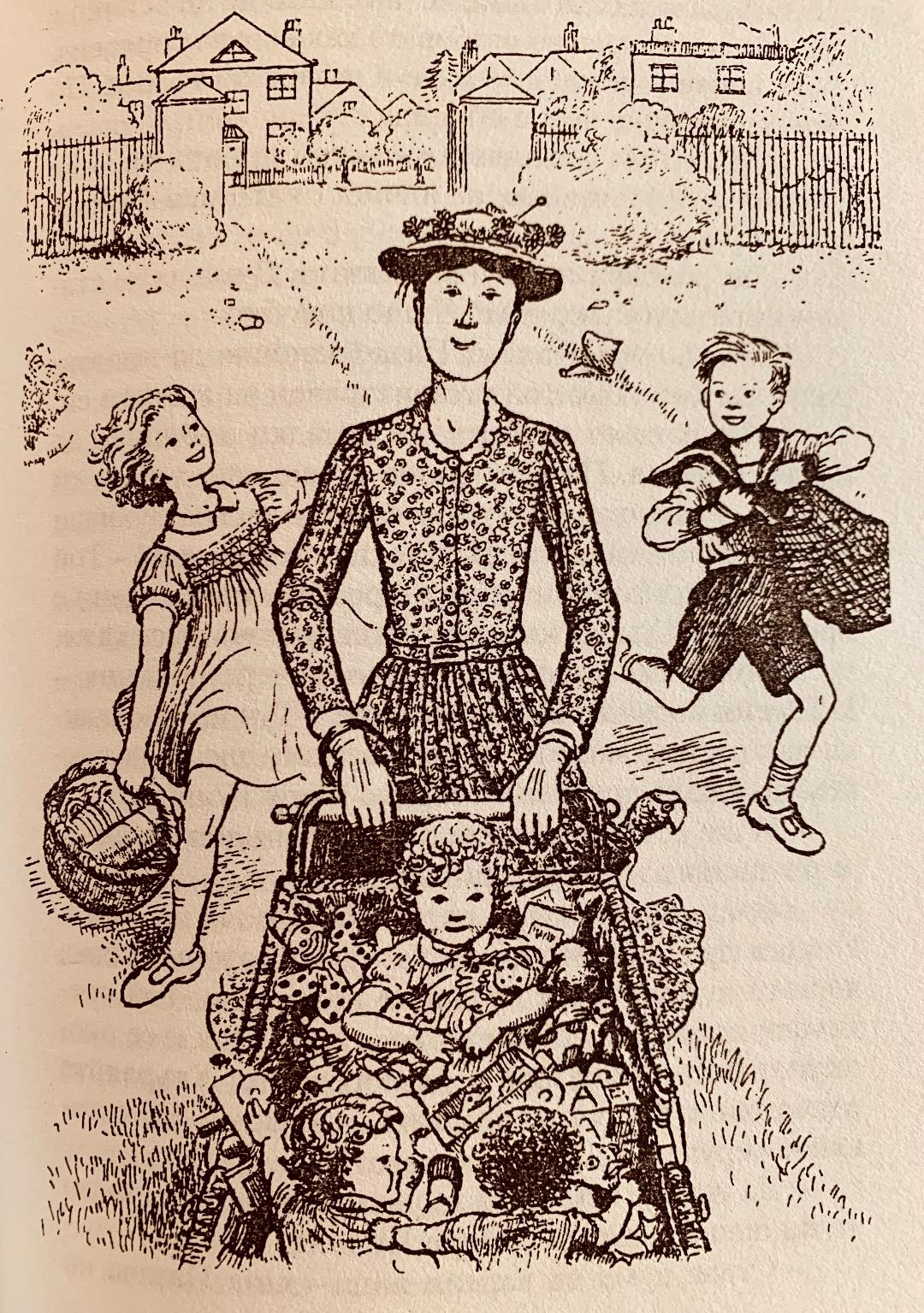
P.L. Travers wanted Mary Poppins to be plain, yet graceful, and to help the young visual artist grasp her vision of the character, they took many walks in the park to observe nannies pushing prams. Yet despite Shepard’s heartfelt efforts, P.L. Travers was not satisfied with the sketches and it wasn’t until she found a wooden doll with bright black hair, bright blue eyes, and a turned-up nose, and showed it to Shepard, that Mary Poppins finally took shape. 

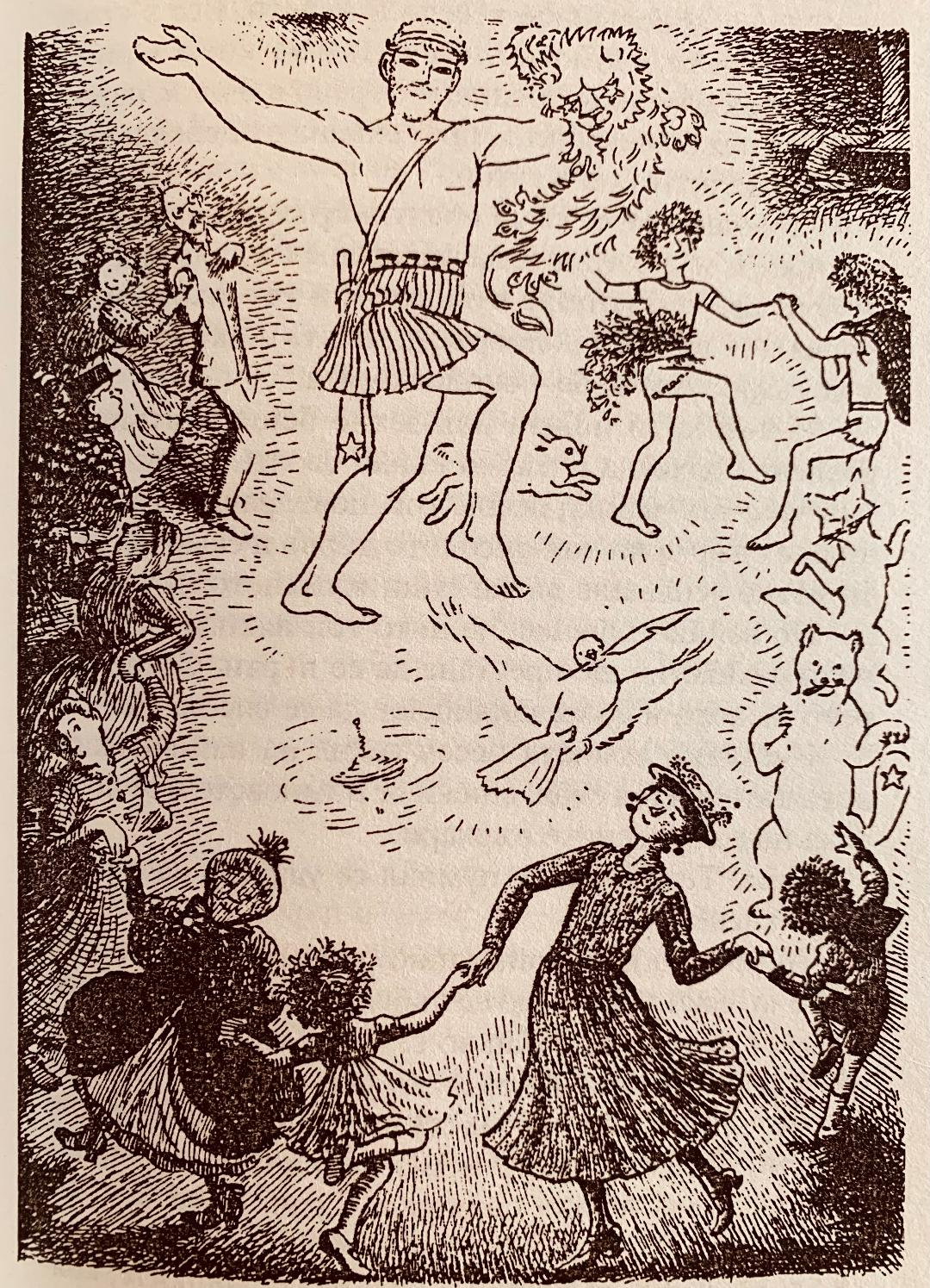
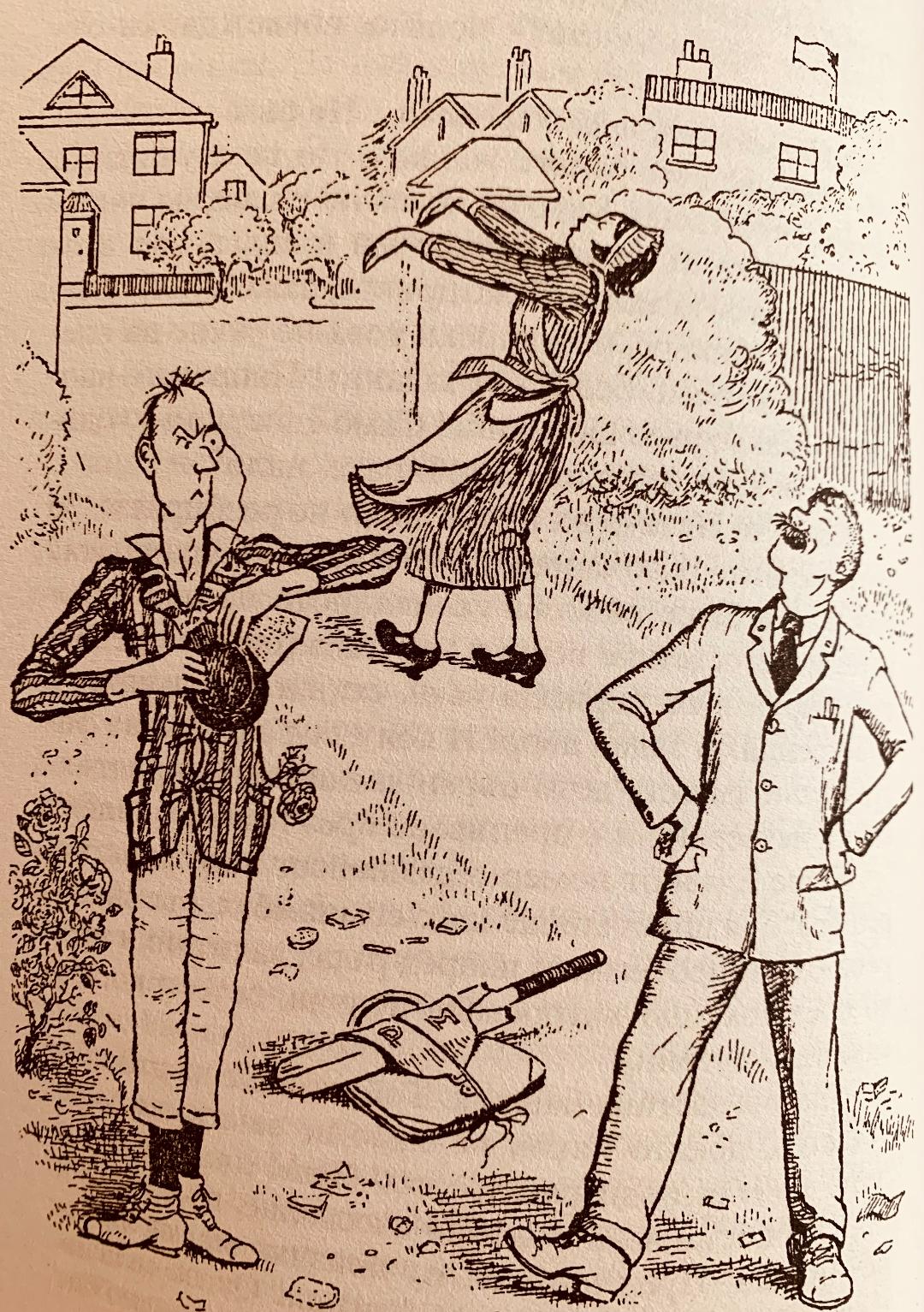
The working relationship between P.L. Travers and Mary Shepard spanned over 50 years, during which Shepard illustrated all the Mary Poppins books, including the Latin translation of Mary Poppins, a children’s cookbook, an alphabet book, and a coloring book published in 1969. I had been searching online for this coloring book for a long time, and then, one day, I was fortunate enough to find an unused copy on Facebook Marketplace of all places.  


Oh, the joy of finding it and coloring the illustrations! Of course, I kept the original coloring book pristine and worked on photocopied pages, in case anyone is curious. I want to keep it as a collectible, but I also love the idea of having the chance to color the illustrations again whenever the mood strikes. The time I spent coloring reminded me of how much I loved it as a child. It also reminded me of my struggles of not crossing over the lines—though, as it turns out, I still struggle with that! But perfection isn’t the point. The point is enjoyment and playfulness at any age! 

While coloring the pictures, I suddenly noticed something interesting in one of the illustrations that struck me as quite indicative of the nature of the relationship between Mary Shepard and P.L. Travers. Reportedly their relationship was a difficult one, P.L. Travers being portrayed as domineering and Mary Shepard as an underestimated, self-effacing artist. I believe that a glimpse of their relationship dynamic is reflected in one of the illustrations in the story “Balloons and Balloons”. This story first appears in the second book Mary Poppins Comes Back first published in 1935. Below is a picture of the illustration from the book. 

The picture shows several of the Mary Poppins characters holding balloons with their names on them, floating through the air, with Mary Poppins as the central figure holding the largest balloon. But if you look up closely you will notice the two intruders in this picture.  In the bottom left corner, you can see P.L. Travers and Mary Shepard joining the party. According to P.L. Travers, as she once told an interviewer, it was Mary Shepard’s idea to include them both in the illustration. (Personally, I think this was a genius idea.)  

Notice how, in this picture, the two women are facing each other. Mary Shepard’s figure is slightly smaller, and her body curves in a way that seems to mold to the shape of P.L. Travers’ figure.  Now, look at the picture below from the 1969 coloring book, keeping in mind that at the time, Shepard was bitter about not receiving any money from Disney for the movie adaptation of the character. 

The figures are notably different in size and body language. P.L. Travers is larger and holds a bigger balloon. Her body flows gracefully through the air, with the string of her balloon twirling as she holds it effortlessly, without any strain. On the other hand, Mary Shepard, much smaller, is holding onto a short, tight string and appears tense, as if hanging on for dear life. Not only that, but she has her back turned to P.L. Travers. 

I wonder if P.L. Travers noticed these changes in their positioning in the illustration, or if this detail completely escaped her, or if she would have even cared about it. I haven’t had the chance to delve deeper into their relationship, so I’m relying on what others have written about the subject and while I’m aware that I’m speculating on the comparative interpretation of these two illustrations, it was, nevertheless,  a fun insight to gain from my interaction with A Mary Poppins Story for Coloring.  

As for P.L. Travers’s view that ‘what counts most is the text, not the picture,’ I both agree and disagree with her. It all depends on the angle from which you look at the question. Of course, there would be no picture of Mary Poppins without the story, but for children, the illustrations are almost as important as the text. 

Perhaps it’s because P.L. Travers never intended the books to be read solely by children that she prioritized the text. Or, maybe it was because she was human and fallible, and possessive of Mary Poppins. After all, she once told an interviewer that a fictional character is like a child to an author. One thing is certain: despite their differences, both P.L. Travers and Mary Shepard must have both gained something positive from their collaboration. Otherwise, why continue for fifty years? 

I hope you enjoyed reading this blog post and that you’ll subscribe to my blog, so you don’t miss the next installment. While I can’t commit to a regular posting schedule, one thing I can promise is that I’ll continue writing about all things Mary Poppins and P.L. Travers.  


About P.L. Travers’s Visit to Montreal  

Dear Reader, 

I am thrilled to share with you some biographical facts hidden in P.L. Travers’s book ‘I Go by Sea, I Go by Land’.  I first read this fictionalized account of her evacuation from the UK to the United States during WWII in 2018.

Briefly, for those who are unfamiliar with the book, it is written in the form of diary entries from 11-year-old Sabrina who recounts her and her brothers’ evacuation to the United States during the Second World War. Sabrina and her brother are accompanied on their journey by Pel, a family friend who is a writer and the mother of a baby named Romulus. As revealed by Valerie Lawson in her biography of P.L. Travers, ‘Mary Poppins She Wrote’ Pel stands for P.L. and Romulus for P.L. Travers’s adopted son Camilus.   

My second reading of ‘I Go by Sea, I Go by Land’ proved more fruitful than my first one. (This tends to happen when revisiting books.) At the very beginning of the book P.L. Travers writes that ‘the experiences recorded in the book are authentic’ and as the story is ‘a personal record (…) certain names have necessarily been altered.’ Taking P.L. Travers’s statement to the letter, I approached the story with the mindset of a detective, meticulously following every clue and detail. What follows is what I discovered about P.L. Travers’s visit to Montreal in the autumn of 1940.  

Montreal is where my parents and I settled after leaving Bulgaria in the early 1990s, and although I no longer live in the city, it is where I work during the week and where I often spend time with friends. You can imagine the excitement I felt when I connected the dots between the hints in the book about the locations P.L. Travers visited and the people she encountered during her stay.   

During her visit to Montreal, P.L. Travers stayed at the Windsor Hotel, where other famous authors, such as Charles Dickens and Mark Twain, had sojourned before her, although the story doesn’t say if she was aware of it. This is how she described the lobby of the hotel in ‘I Go by Sea, I Go by Land’ in the words of Sabrina who writes in her diary that the Hotel ‘is just like a Cathedral inside’.  

Below is a picture of the lobby of the Windsor Hotel in 1878 taken by William Notmam and you can see why Sabrina (P.L. Travers) compares it to a Cathedral.  

The Windsor Hotel was one of Canada’s most impressive buildings of the Second Empire style and was considered the best hotel in all the Dominion. It was a magnificent nine-story structure of sandstone and granite which span along the entire block of René-Lévesque (then Dorchester) Boulevard and Cypress Street, between Stanley and Peel (then Windsor) streets. To its guests it offered “palatial splendor with its gold-embossed lobby, six restaurants, two ballrooms, concert hall and 382 luxurious guest-rooms”.

Unfortunately, a fire devastated the hotel in 1957 and “the damages caused to the South wing were so great that the structure had to be demolished on August 12, 1959. All that remained was its 1908 North Annex – this portion of the former hotel still stands today.” 

Below is a picture I took of it for this blog post.


Now, let’s turn to another revealing entry in Sabrina’s diary. She writes about how, upon their arrival at the hotel, they are greeted by the Red Cross. When Pel signs her name, a Red Cross representative named Letty recognizes her, suggesting that Pel is a famous author, and invites her to lunch at her home. Then the reader learns that Letty has four children, all boys and that her husband is ‘a famous doctor’ called Kent.  

When Dr. Kent comes home, he offers the guests “cocktails of lemonade and coco-cola” and then takes Pel and the children for a drive to show them the river (Saint Lawrence River). At the end of the drive, at Pel’s request, he drops them off at the Cathedral. This is what Sabrina writes in her diary: ‘So she and James and I went in and there was water in two enormous sea-shells, very beautiful and fluted.’ 

The Cathedral in question is Mary Queen of the World Cathedral, which stands diagonally opposite form the Windsor building.

At its entrance stand two seashells filled with holy water. Below are the pictures I took for this blog:   

Who was Dr. Kent?  

Well, in my opinion, he could only have been Dr. Wilder Penfield, a neurosurgeon who revolutionized brain treatment. He became famous for his epilepsy operation, which came to be known as the “Montreal Procedure”. 

I find his physical description in the book quite perceptive; it is exactly the impression Dr. Penfield gave me when I watched a documentary about him.  

“He has the kind of face that makes you want to keep on looking at him. Very kind and twinkly and it seems to say to you ‘There now. Everything is all right. Don’t worry.’” 

Dr. Penfield was born in 1891 in a middle-class family in Wisconsin, United States. He studied at Princeton and Oxford. He initially sought to establish his career in the United States, but it was not easy for a junior surgeon in an emerging medical field. At that time Montreal was a city with an internationally famous medical community but with no full-time brain surgeon. The only full-time brain surgeon in Canada had set up in Toronto.  

The Royal Victoria Hospital went shopping for a brain surgeon in New York and in 1928 Dr. Penfield came to Montreal. In 1934, with the combined help of the Rockefeller Foundation, the City of Montreal and the Quebec government, he founded the Montreal Neurological Institute which is still in existence today.

Dr. Penfield had four children, two boys and two girls, who in 1940 were aged 22, 21, 14 and 13. In my opinion, P.L. Travers tried to keep Dr. Penfield’s identity anonymous by changing the genders of two of his children in the story.  

But, there is another clue in “I Go by Sea, I Go by Land” that points in the direction of Dr. Penfield.  During WWII his wife, Helen Kermott Penfield, was deeply engaged with a volunteer group helping émigrés from war-stricken Europe. She had joined the circle of the bourgeois Christian women of the United Church on February 20, 1940. In affiliation with St. James Church this group started a refugee committee which met on regular basis and Mrs. Penfield became very active from 1940 until 1943. On a pragmatic level she liaised with the Canadian Red Cross and arranged for collections of clothes and groceries. It seems more than likely that Letty was, in fact, Mrs. Penfield. 

When considered together, these elements make a compelling case for a meeting between P.L. Travers and Dr. Penfield. Unfortunately, Dr. Penfield’s children have all passed away, so I couldn’t validate my theory. However, the coincidences are too significant to dismiss. 

I hope you enjoyed reading this blogpost as much as I enjoyed writing it, and that you will come back to read more about P.L. Travers and Mary Poppins.  


Jane Yolen: Behind the Scenes of a Visit with the Real Mary Poppins

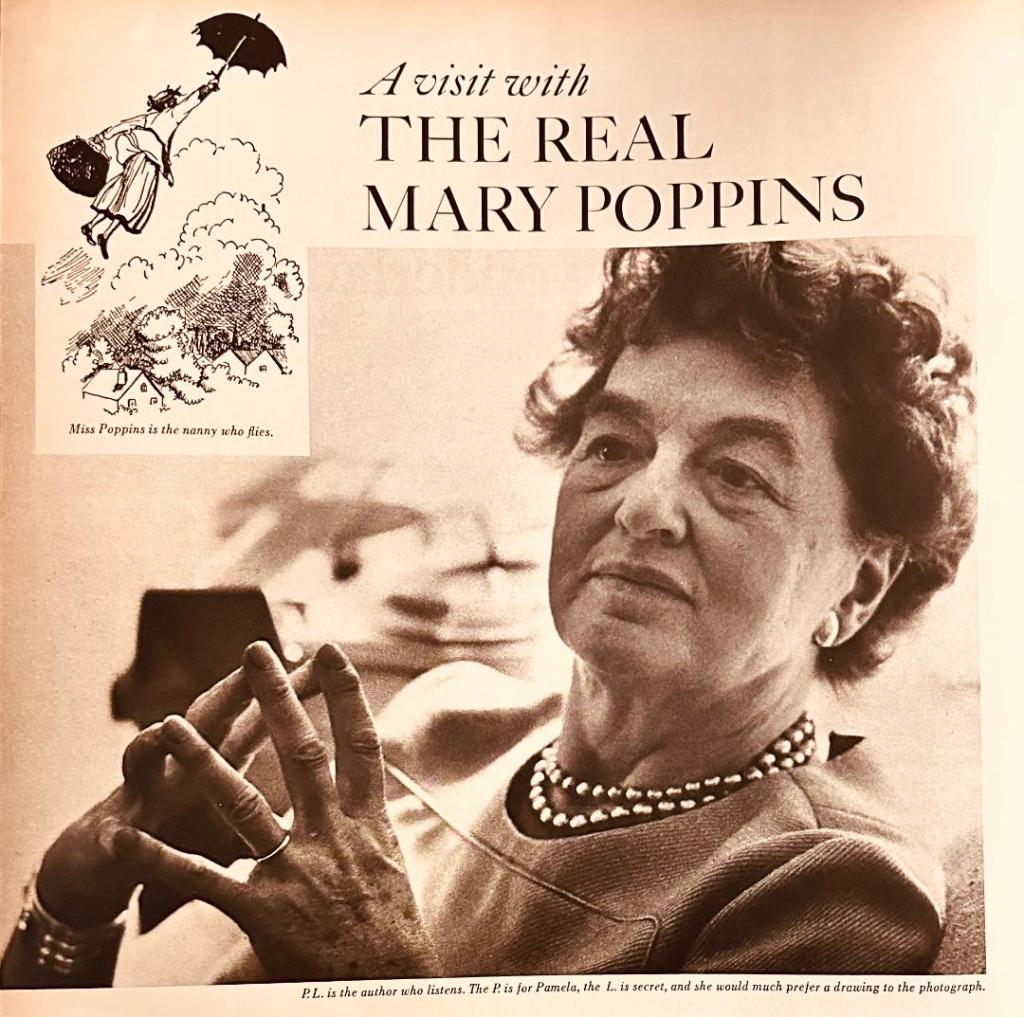
Picture from Look Magazine, December 13, 1966

Dear Reader, 

I am thrilled to tell you all about my recent conversation with renowned author Jane Yolen who had the opportunity to meet with P.L. Travers on two occasions, the first of which happened back in 1966. But first, let me share a bit about Yolen’s literary work.  

Yolen has written over 400 books for children and adults and is the recipient of many literary awards among which are the Caldecott Medal, two Nebula Awards, three World Fantasy Awards, the World Fantasy Association’s Lifetime Achievement Award and the Science Fiction Writers of America’s Grand Master Award.

She, like P.L. Travers, is a poet with a deep love for fairy tales and has penned several unique retellings and re-imaginings of these timeless stories, infusing them with her own creative touch.  I’ll delve deeper into her retelling of Sleeping Beauty and her novel Curse of the Thirteenth Fey in a future blog post. As you may know, Sleeping Beauty was P.L. Travers’s favorite fairy tale, which she explored and analysed (pondered) in her 1975 book, About Sleeping Beauty.  

Yolen first met P.L. Travers in 1966 on the famous night when Look Magazine was covering an open house evening with her and a few students from Smith College. At the time P.L. Travers was a writer-in-residence at Smith College and, according to Valerie Lawson, she was not having a good time there.  

An article titled “A Visit with the Real Mary Poppins” by Joseph Roddy, was published in Look Magazine on December 13, 1966. A hint of P.L. Travers’s difficulty to connect with the students echoes in the lines of Roddy’s article: ‘P.L. – she would prefer being Anon but will endure the initials – gets the ones who memorized Blake, pondered Camus, are awash in The Hobbit and know every move Mary Poppins made.’ He goes on to write: ‘The talk leaps across centuries every night P.L. has open house in a dormitory suite brightened only by handsome girls and snappy lines.’   

According to Yolen’s recollections, there were about fifteen women present, along with the journalist and the photographer from Look Magazine. Yolen was a sort of VIP guest that evening. She, her husband, and their four-month-old baby were accompanying P.L. Travers’s goddaughter, who had a personal invitation to the event.   

Yolen’s first impression of P.L. Travers was that she behaved much like the Mary Poppins from the books—whom Yolen had read and loved as a child.  

Today, people who have not read the books think of Mary Poppins as the pleasant and charming character from the movies. Then, if they read the books, they are taken aback by the harsher version of the original character. I notice this contrast frequently on social media and I think that it is unfortunate because the expectations set by the movies prevent the readers from appreciating the depths and complexities of the original character.  

Mary Poppins is more than just a caregiver in the stories; she acts as a mediator between worlds, initiating the Banks children to the mysteries of life. This dual role creates a fascinating split-personality dynamic that captivates children and adds to the mystery of Mary Poppins’s magic. As a child I never questioned why Mary Poppins could be strict and abrupt with the Banks children; I instinctively understood that it was all part of a playful facade. Beneath it all, she was a good fairy, and I knew that the Banks children felt the same way.  

As an adult rereading the Mary Poppins stories and learning about P.L. Travers’s life and spiritual beliefs, I realize that Mary Poppins could be no other way in our world. While others may have different interpretations of the character, the true magic of Mary Poppins lies precisely in her paradoxical nature. The same is true for P.L. Travers herself. 

According to Yolen’s recollections of that memorable night, both aspects of P.L. Travers’s character came to the forefront. The anecdotes that follow are not reported in Roddy’s article. 

A young student, who had the audacity to begin a question by admitting she hadn’t read the books but had only seen the film, was administered a spoon full of vinegar by P.L. Travers: ‘Then Dear, you KNOW NOTHING, and I suggest you do not say another word.’  ‘It felt almost like she had cursed the poor girl,’ said Yolen, ‘she was reduced to stunned silence’.  

Admittedly, there might have been a gentler way to handle the situation, but the fact is that, two years earlier, the Disney film had left a deep wound in P.L. Travers’ psyche—one that had not yet begun to heal (no matter how much money she got out of it, people keep bringing up this argument all the time…) The young student was likely unaware of all this, but who attends a writer’s event without having read their work and then feels entitled to express opinions? Isn’t that rather rude as well?

As for the movie, Yolen recalls watching it with her husband in London and enjoying the music. She did however find Dick Van Dyke’s Cockney accent rather strange, and she thought that the Mary Poppins of her childhood would never sing, “A spoonful of sugar makes the medicine go down.” She was right. 

Mary Poppins never explains or sugarcoats anything. If medicine is required, it is administered with a stern demeanor that accepts no opposition, as the Banks children discover in the very first story “East Wind”. It is only after they swallow the medicine that they realize that it has magically transformed into their favorite flavor. For Jane it is lime-juice cordial, for Mickael it is strawberry ice and for the twins John and Barbara it is milk. This is the way of the real Mary Poppins.  

Another amusing incident during the screening of the film by Yolen and her husband – and one that I’m sure P.L. Travers would have enjoyed hearing about – occurred when Yolen’s husband, a passionate bird watcher, suddenly stood up and exclaimed loudly during the scene where Julie Andrews is singing with the chirping audio-animatronic bird on her finger, ‘But this isn’t a British robin; it’s an American robin!’ The audience responded with laughter and approval. 

Now let’s go back to the open house evening of 1966. After casting her chilling spell on the poor girl who knew nothing about Mary Poppins, P.L. Travers shape-shifted into a protective, motherly figure toward  Yolen and her 4-month-old baby. When the baby began to cry, Yolen, not wanting to disturb the event, considered leaving, but P.L. Travers wouldn’t hear of it. She directed Yolen to her bedroom, where she could use the rocking chair and feed her daughter in peace. “She didn’t ask,” Yolen recalled, “she told,” and that, in fact, felt comforting. “It felt like I was in safe hands,” just as the Banks children felt safe in the care of Mary Poppins.   

Years later, Yolen participated in a fundraising event for Parabola, a magazine co-founded by Ellen Dooling Draper and P.L. Travers. The event took place in New York, and Joseph Campbell was also in attendance. As a young writer and a collaborator of the magazine, Yolen was invited to the event. Unfortunately, her opportunities to engage with P.L. Travers were limited to brief exchanges of greetings, as P.L. Travers was busy hosting and entertaining the magazine’s patrons, revealing yet another side of her personality, the practical, business side! 
Yolen recalls how Joseph Campbell leaped onto a chair and captivated the audience for more than half an hour with stories from around the world on the theme of giving. As I listened to Yolen’s vivid recounting, (she really is a great storyteller) I couldn’t help but yearn to travel back in time and experience the event firsthand. I wish I could have witnessed P.L. Travers’s reaction to Campbell’s performance. She, for some unknown reason, disliked him. It may have been motivated by feelings of rivalry; she was human, after all. Campbell was a scholar and a recognized expert in mythology, while she was self-taught, and although equally knowledgeable about myths and fairy tales, was not as popular as him. There may have been other reasons, but for now, they remain unknown.  

It is fascinating to me how the paths of these two women writers intersected and how they were connected by their shared interests in fairy tales and love of poetry. One of Yolen’s poems, “Land of Miracles,” would certainly have been enjoyed by P.L. Travers, both for its origins and its message. 

The poem was inspired by a serendipitous incident during a walk in a cemetery in Ireland. Yolen, who enjoys strolling in cemeteries, remembers how, on one such walk, she stumbled and steadied herself by leaning on a gravestone. She felt a sudden, electrifying sense of otherworldlines and then she realized with astonishment that the gravestone she had leaned on was that of the great magician and poet W.B. Yeats. This unexpected encounter inspired Yolen to write: 

‘Yes, poetry matters. 
Words matter. 
Great buildings tumble. 
But story remains.’ 

You can read the full poem here:

I am deeply grateful for Jane Yolen’s generosity and for taking the time to reminisce about P.L.Travers, and I hope you enjoyed reading this blog post as much as I enjoyed writing it. 

Until next time…

Mary Poppins and “The Three Little Foxes” by Mary Tourtel 

Dear Reader, 

Recently, I revisited a transcript of a conversation between P.L. Travers and Janet Graham that took place in P.L. Travers’s home on June 23, 1965. I like to do that occasionally. Although I love discovering new information about P.L. Travers and Mary Poppins, and all things related to them, rereading materials I’ve gathered over the years allows me to notice things I did not see the first time. Frequently, and to my enjoyment, the information I glean sends me into another tunnel in the rabbit hole in which I fell nine years ago, and I hope you enjoy being taken along on this exploratory journey. 

The title of the interview is “A Conversation About Sorrow,” and it is one of my favorite P.L. Travers interviews. All her interviews are interesting and provide much food for thought, but I notice that their quality depended a lot on the chemistry between her and the interviewer. Luckily for us readers, when she liked the journalist, she was more talkative, and I get the impression from this conversation that she did like Janet Graham.  

Today, I want to tell you about “The Three Little Foxes” by Mary Tourtel,  a book that P.L. Travers kept with her since she was 7 years old.  On the flyleaf of her book someone wrote the name of Mary Poppins, but according to P.L. Travers, it was not she who wrote it. 

In the transcript “A Conversation About Sorrow” there is a handwritten note in the margin: “start of Mary Poppins”. It is right next to the passage in the interview where P.L. Travers told Janet Graham that her sister had mentioned that, as a child, P.L Travers told her siblings stories about Mary Poppins. However, P.L. Travers didn’t believe her sister to be right. She said, “I think she is having very clever hindsight”. 

We will never know who wrote the name of Mary Poppins on the flyleaf. It is possible that her son Camillus wrote it when he was a young boy. He must have seen the book in his mother’s library and, knowing that she wrote the Mary Poppins stories, could have written it himself. I know I used to scribble things in books as a child, but of course, all this is just a speculation on my part.  

P.L. Travers loved the story of “The Three Little Foxes”. She said, “It was a lovely story. Three Foxes called Ringo, Bingo and Lubilee – What beautiful names, Ringo Bingo and Lubilee. They were great family names; my mother was always calling us those names. She had the kind of mind quotations stuck in.” 

And that is all she said about the story in the interview. What was it about? What did the little foxes do? Why did she like it so much to keep it with her all this time? Was it because of her fond memories of her mother, or was it something else? 

I wanted to find out, and luckily, I managed to find an old (and affordable) copy on the Internet. It did not have ‘Mary Poppins’ written on its flyleaf, (I secretly wished it did!), but at least I now know the story and can speculate about why she might have liked it. I wonder who has her copy of the book now?  

“The Three Little Foxes” tells the story of three brothers who decide to leave their cozy home and seek adventure in the world. In fact, it is the two oldest brothers, Ringo and Bingo, who are bored and need a change of scenery. Meanwhile Lubilee, the youngest brother, is quite content at home and doesn’t really have time for boredom. He is busy in the kitchen cooking and taking care of his brothers.  But when the older brothers decide to leave their home, he must follow them, albeit unwillingly. 

The three brothers meet a frog who tells them that if they are in search of adventure, maybe they could rescue the Fox Princess, who is kept hostage by the Old Bear Ogre. The three little foxes must go see the Queen of the Rabbits, who knows of a secret entrance to the grounds of the Bear Ogre’s castle. The Queen agrees to help them and orders one of her guards to lead the brothers through a secret passage leading to the garden where the Fox Princess likes to spend time.  

When the three brothers arrive at the entrance of the passage, which turns out to be a long and winding tunnel, it is only Lubilee who musters enough courage to follow the guard. Scared Ringo and Bingo remain behind.  

Lubilee succeeds in finding the garden and meets with the Fox Princess who, at that precise moment, happens to be strolling there. He tells the princess that he and his brothers have come to save her, but she warns him that the task is going to be difficult. The Ogre keeps her locked up in a lonely tower.  

It was at this point in the narrative that I failed to follow the logic of the story. It is unclear (and frankly does not make much sense) why the Princess does not run off with Lubilee towards the secret tunnel and out of the garden right there and then. Instead, she tells Lubilee where the Ogre hides the key to her tower. It is in a box he uses as a footstool while sitting on his chair.  

Lubilee goes back to his brothers, tells them all about the Princess and the key, and they come up with a plan on how to gain entrance into the Ogre Castle. They present themselves as acrobats who want to perform before the Bear Ogre.  

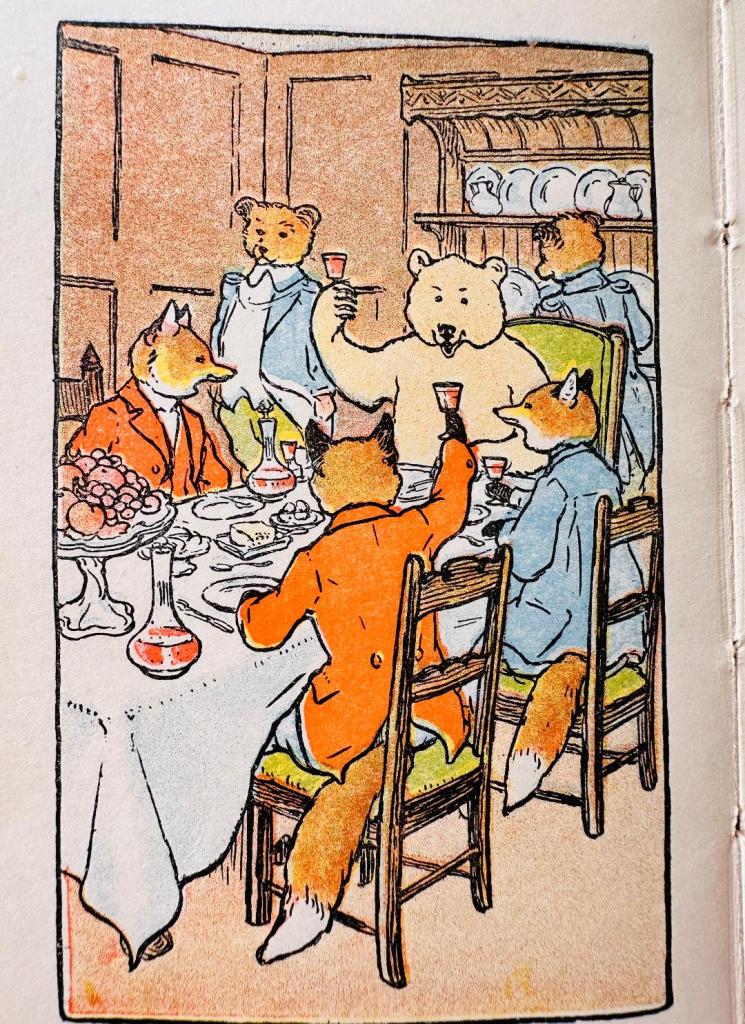
During their performance, which consists of the two older brothers standing on their heads while Lubilee spins plates on sticks, the Bear Ogre sits comfortably in his chair with his feet on the footstool. However, their chance comes when Bear Ogre invites them to stay over for dinner and a little dance.  

After dinner, the Bear Ogre wants to show his abilities too and he begins to dance the Keel Row. He is so taken by his dancing that he does not notice little Lubilee taking the key from the box in the footstool.  

As soon as the little foxes find themselves outside of the castle, Ringo and Bingo start quarrelling over who should marry the Princess. In the meantime, Lubilee runs towards the tower and frees the Princess. 

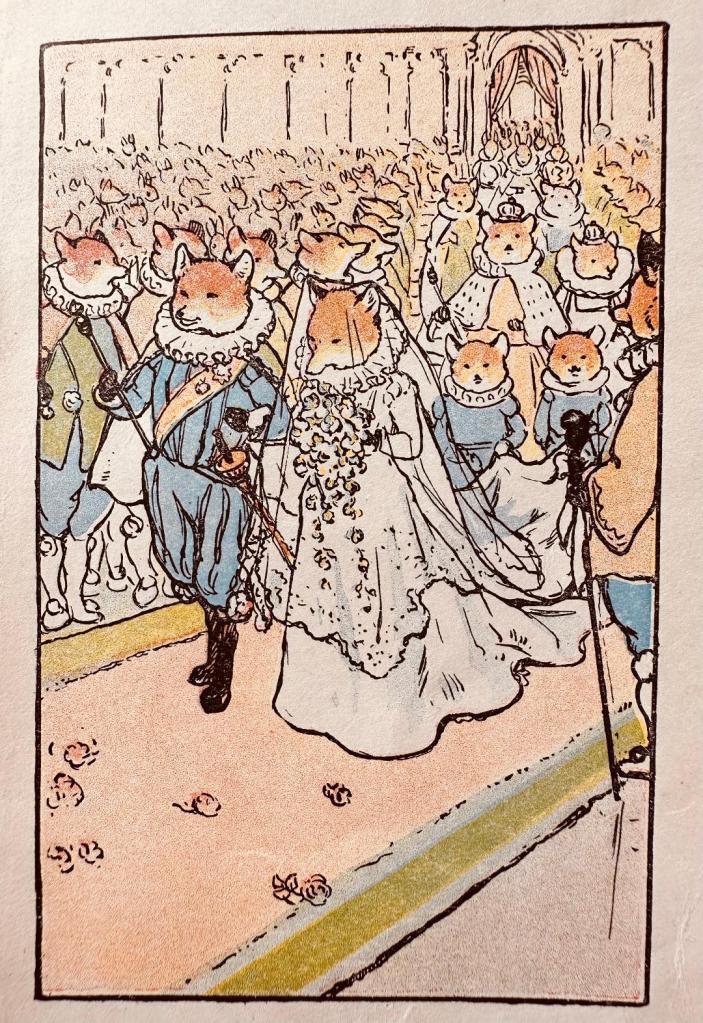
The Fox King was so glad that he called his Queen, gathered his court together and made Lubilee a Prince on the spot.  Lubilee and the Princess become husband and wife.

When Ringo and Bingo finally find their way to the Fox King’s City, they begin to tell everyone who wants to hear that they were the ones who saved the Princess, and that Prince Lubilee is an impostor. Their slander lands them in a dungeon, but then good-hearted Lubilee frees them and appoints Ringo his Prime Minister, and Bingo the Commander-in-Chief of his Army. This decision seems very unwise to me…and could potentially propel Lubilee on another hero’s journey. Maybe I will try my hand at writing a sequel…but who will illustrate it? 

P.L. Travers wrote an essay titled “The Youngest Brother”, it was first published in ‘Parabola’ on the theme of the Trickster in 1979 and then in “What the Bee Knows” in 1989. She reflects on the character of the youngest brother in fairy tales, who is often depicted as a simpleton, meaning, as she tells us, innocent and blessed. He is not yet burdened with knowledge and pride. He eagerly offers and accepts help from others, no matter how strange they may appear. 

She goes on to explain the usual sequence in these types of stories, which “The Three Little Foxes” follows closely. 

The stories always begin with a quest, something that only the three brothers can undertake. However, the usual mistake of the two older brothers is that they believe success in their quest depends solely on themselves. Consequently, they often find themselves imprisoned at the beginning of the story, unable to continue their quest.  

In these stories, P.L. Travers tells us, there is also an imprisoned princess who is the youngest brother’s complementary figure. Then, the youngest brother is wronged by the older brothers who are envious and greedy, just like Ringo and Bingo in the story, and things can become quite dangerous; all can be lost.  

In the end, the youngest brother forgives his brothers’ sins.  P.L. Travers links this pattern of forgiveness to Plato’s myth of the Cave: “... where those who have risen to the light go down again to rescue others who still live with the shadows.”  

The third and youngest brother in fairy tales is always in service of something else than himself and does not think he knows it all like his older brothers, who consider themselves to be men of the world who know their way about it.  

Knowing tells us P.L. Travers is achieved through unknowing. Learning through experience, the man becomes a child – pure at heart. 

She also links the progress of the youngest brother through his quest to Gurdjieff’s Law of Seven and the concept of repairing the past in the present. Although original and interesting, this calls for a separate blog post. 

I hope you enjoyed this post and will come back again to read some more about P.L. Travers and Mary Poppins.  

Until next time… 

Christmas with P.L. Travers and Andersen 

Hello Dear Reader,  

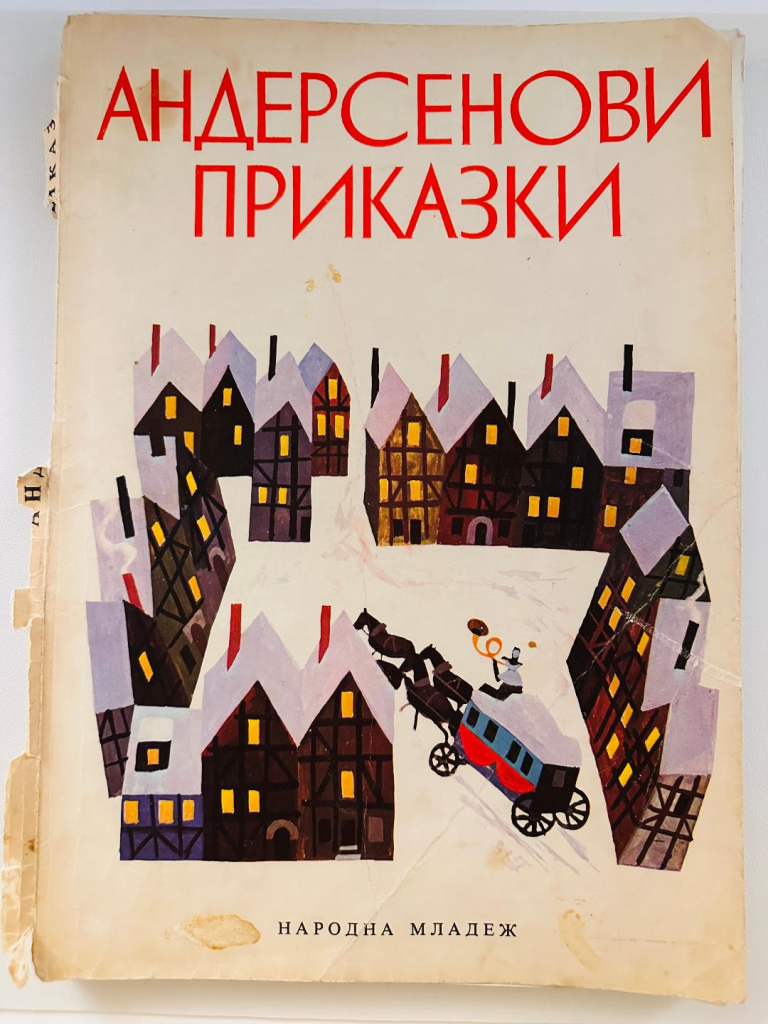
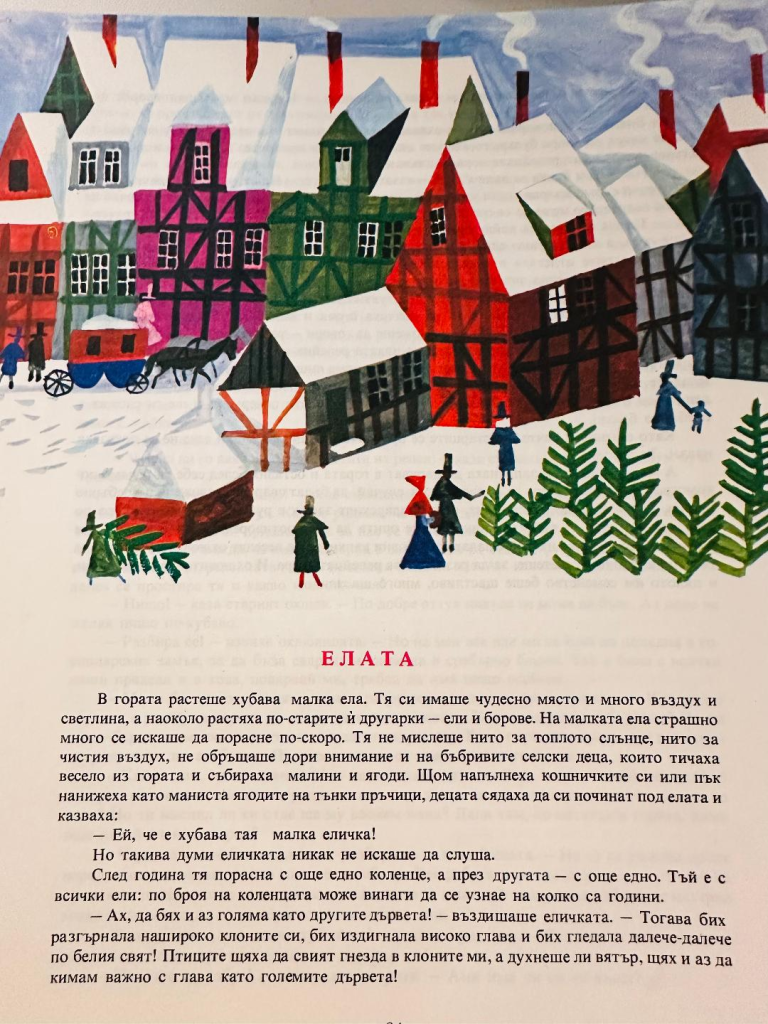
The idea for this blogpost came to me a few days ago as I was rereading a fairy tale “The Fir Tree” from one of my old childhood books, “Andersen’s Fairy Tales” (Bulgarian translation). Above is a picture of my tattered old book, it is missing some pages and that is not surprising at all because the glue is mostly gone, and the pages no longer hold together.  

In fact, this is not the actual copy I had as a child, but it is the exact edition which I found thanks to the Internet and ordered all the way to Canada. This book was published in 1977 and was illustrated by Lyuben Zidarov who, apparently, was the oldest working illustrator in Bulgaria, and who died this year at the venerable age of 100.

In all honesty these were not my favorite illustrations, I have other books in my childhood collection of fairy tales with illustrations which I enjoyed much more as a child. Looking now at Zidarov’s illustrations I can appreciate their beauty and his childlike vision and technique, but as a child I did not want to look at pictures that reminded me of my own drawings which I always found rather disappointing because they never looked like what I had in mind.  

Reading Andersen’s fairy tales as a child is something that I share with P.L. Travers. She writes in “The Black Sheep”, an essay first published in The New York Times in 1965 and then republished in her last book “What the Bee Knows”, about enjoying his stories as a child, “I even wallowed in it, yet I never could quite understand why I felt no better for it.” she writes.  
As an adult and writer, herself, P.L. Travers did not appreciate the tortures Anderson inflicted on his fictional characters; these torments she perceived to be disguised as piety and to have a demoralizing effect on the reader. The other reproach she made to Andersen was that he never invented a strong villain, that all he wrote about were white sheep, “…some clean, some dirty, but a homogenous flock”. She preferred, she wrote, the strong contrast of the Grimm’s fairy tales. 

I tend to agree with P.L Travers on many things and she has been a great posthumous teacher for me. Yet, when it comes to Andersen, we seem to hold different views. Andersen’s fairy tales are undoubtedly heart-wrenching, but there is so much meaning in them, and he possessed such an incredible talent as a storyteller that I find it difficult to conceive that she was oblivious to it all. Sometimes I wonder if she genuinely meant her harsh critique, or if she enjoyed expressing strong opinions to shock the reader and prompt reflection.  

And I see a connection here that I would have loved to discuss with P.L. Travers. Andersen seems to teach through pain; his use of emotional torture aims to awaken the reader to a deeper truth. I wish I could ask P.L. Travers how his technique differs from the one used by her beloved spiritual teacher Gurdjieff who said that one can only awaken through conscious suffering?  
When I first read “The Fir Tree” as a child, I thought it was a sad and strange New Year’s Eve story about a New Year’s tree abandoned in the attic after the celebrations and later burned outside in the yard. (I say New Year because in the 1980’s we did not celebrate Christmas in Bulgaria; religion was forbidden by the communist regime. Instead, we celebrated the New Year and decorated a fir tree, and Santa Clause was not Santa Clause but Father Frost.) Anyhow, I simply turned the page and conveniently forgot about the story of the fir tree, as I couldn’t fathom a New Year’s Eve without a New Year’s tree in the house. It was that easy.   

But it was not that easy the second time around. As I reread the story I almost agreed with P.L. Travers on the subject of Andersen. It made me so very sad, and I wanted to be joyful – it is Christmas after all, the most joyful time of the year. Why take a Christmas tree and use it as a metaphor for our fleeting lives and our inability to appreciate the moment?

For some reason, I couldn’t just forget about it as I closed the pages of the book. I felt really upset, but then, I should have known better than to read a story by Andersen during the Holidays, especially one that I knew had a sad ending. I knew it was not fair for me to be upset with Andersen; it was not like he had forced the book into my hands. There was only one thing I could do to free myself from the strong emotions, and that was to write this post.  

I will summarize the story briefly here for those of you who are not familiar with it. It is about a small fir tree so eager to grow up and be like the other tall fir trees in the forest that it does not notice the fresh air and the sunshine, nor the birds and the rabbits playing around it, or the pink clouds in the sky. However, it does notice that sometimes the tall fir trees get cut down and taken away to some mysterious place, and it wants to know where.   

One day, the sparrows tell the little fir tree that they had seen the greatest splendor imaginable through the windows in town. They had seen fir trees beautifully decorated with gilded apples, gingerbread, toys and candles standing in the middle of warm rooms. The fir tree begins to long for a warm room in town.   

The day comes when the fir-tree is finally cut down and taken to a house. Nets cut out of colored paper and filled with sweets are hung on its branches. Gilded apples and walnuts are fastened to the tree, and many colorful candles are fixed to its branches. The tree begins to anticipate what happens next and  longs for the candles to be lit. All the questioning and longing cause the bark of the tree to ache, much like a headache would have done had the tree been human instead. 

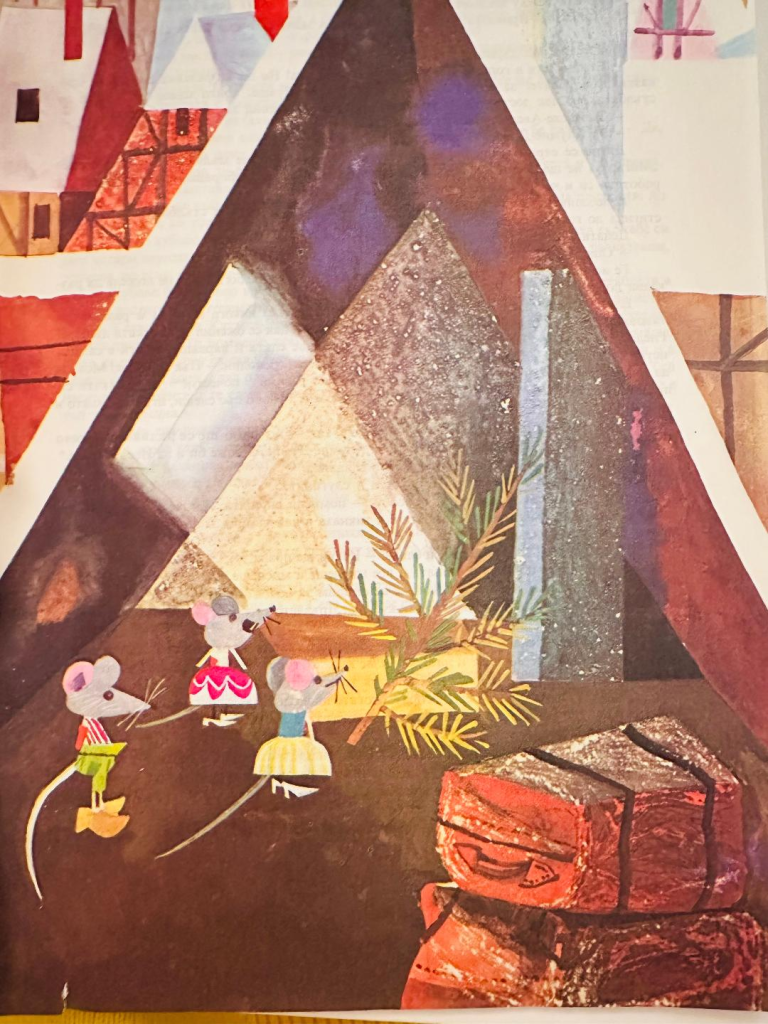
Then the candles are lit, the children come and take down the sweets and the toys hung on the branches, and the whole thing is over before the tree can even realize it. The next day, the tree is thrown in the attic where it stays for many days. The tree is sad and lonely, but one day, mice come to see it, and it begins to tell them the story of its life – where it came from and how it got to the house. All the while, it realizes that what it had was wonderful; only it did not know it back then.  Not long after, the tree is taken outside and is chopped and burned in the fire under a large copper. The End.  

There is such a profound truth in this story, yet those who can truly feel the sadness of it are probably those who had gone through enough of life to awaken to the realization that all stories come to an end, and there is nothing else but the present moment. I wonder if those who need the lesson can get it from a story, or is it that we always need to learn from experience? This too is a question that I would have loved to ask P.L. Travers? 

I cannot say I was much wiser than the fir tree when I was younger, and it is perhaps my own grief over time wasted in futile projections that made me react so strongly when I read the story. A consolation, at least, is that we do not have a real Christmas tree in our home. I decided many years ago that it was a waste to cut down a living tree just to decorate it for a few days and then discard it without a second thought. I decided to not participate in this trade, and I wonder now, was my decision somehow influenced unconsciously by this story that I had read as a child? I think now that it is possible.

May you all fully enjoy the present moment this Christmas without projecting into the future or into the past. Although, in some cases, as in the case of Scrooge, that may be advisable… After all, what do I know? 

Merry Christmas! 

Halloween with P.L. Travers

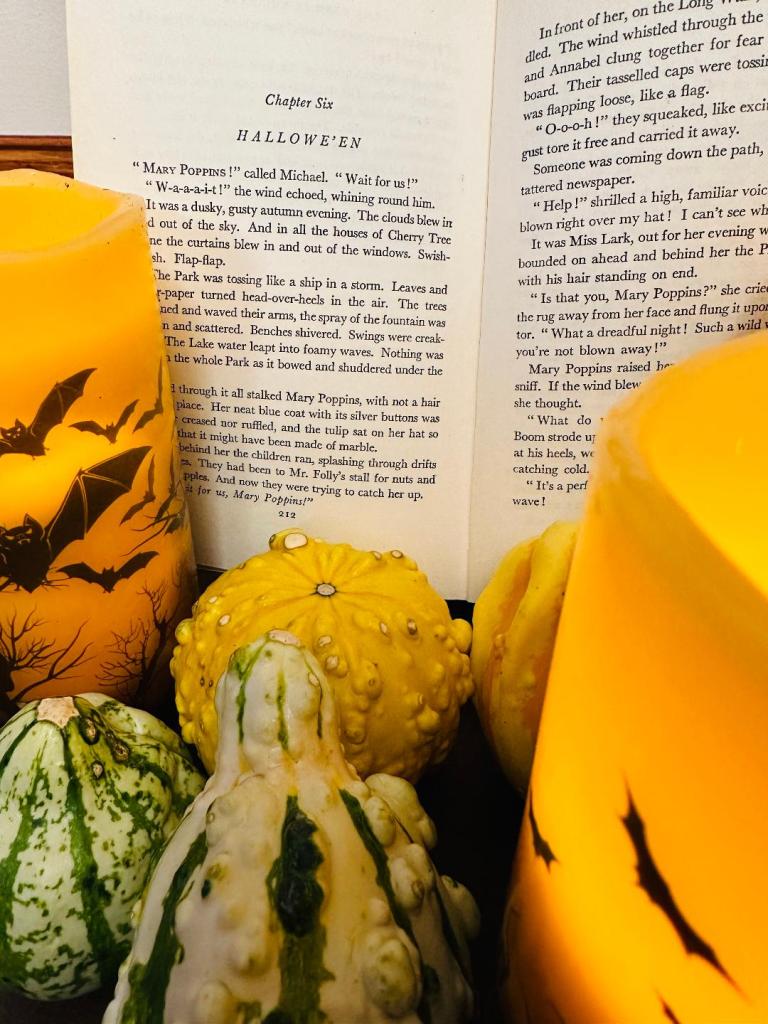
During her stay as a writer-in-residence at Smith College in Northampton, Massachusetts in the autumn of 1966, P.L. Travers was invited to give a lecture about myths, fairy tales and their connection to everyday life. The following year the lecture was published in ‘The Quarterly Journal (Library of Congress, USA) and later in 1989 included in P.L. Travers’s compilation of essays published under the title ‘What the Bee Knows’.    

Because the lecture happened on Halloween, P.L. Travers concluded with a brief comment on its history, which she told the audience began as a pagan celebration of the dead and later on was integrated into a Christian celebration by one of the Popes, ‘Boniface IV, perhaps, in the seventh century, who decided to do away with all the pagan saturnalia and turn it from what it so significantly was, into a commemoration of the saints and martyrs’. 

Normally I should have taken her word on the matter, she knew so much and I so little in comparison, yet for some unknown reason I felt compelled to do a quick factual check. To my surprise I discovered that it was not Pope Boniface IV in the seventh century, but Pope Gregory III, in the eighth who decided to morph the old beliefs into the new Christian religion. 

Obviously, her historical reference was wrong but getting the dates right was beside the point she wanted to make, and in all fairness, she did use the word ‘perhaps’, meaning she was not sure of the factual accuracy of her statement. Yet, its truthfulness remains, the old beliefs were indeed transmuted into the new system of beliefs but were unfortunately, in her opinion, deprived of their essential purpose. Luckily, people knew better than Pope Gregory III and a version of this pagan celebration remained to our days.  

In ‘Only Connect’ P.L. Travers acknowledged our human need to remember the dead and to come to grips with our own grieving and fears of death and the unknown. These needs, old as humanity, need an outlet, a ritual to allow us to turn our faces back to life.  

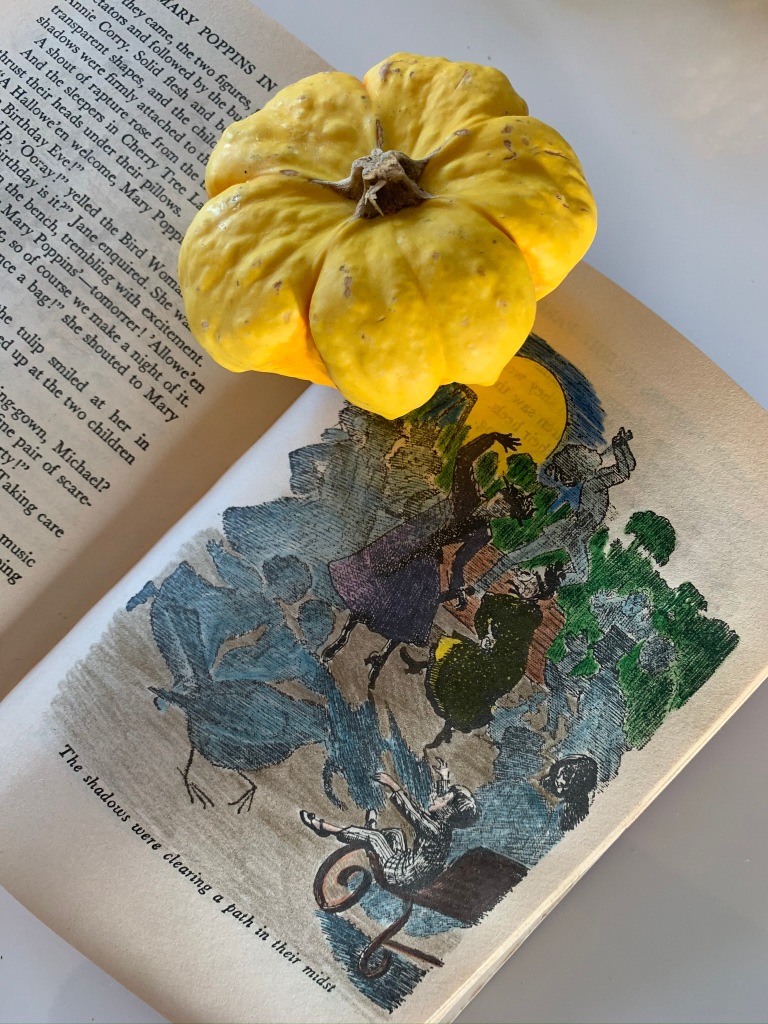
From time immemorial, stories are what allows us to create meaning out of our human experiences, and fairy tales were for P.L. Travers the guideposts in our personal lives. Then, it is only normal that she had written her own version of this pagan celebration in Hallowe’en a story in Mary Poppins in the Park, where not ghosts but the shadows of characters from fairy tales come to party in the Park under a Blue Full Moon. I have written about this story before, and you can read the blogposts here and here.

Now rereading ‘Only Connect’ leads me to believe that the idea for the story may well have been inspired by her own observations of the modern ritual of trick-or-treating; a night when children in the guise of fairy tales characters, heroes and villains, hand in hand, roam the streets at night in search of treats.

Happy Halloween!  

A Little-Known Friendship 

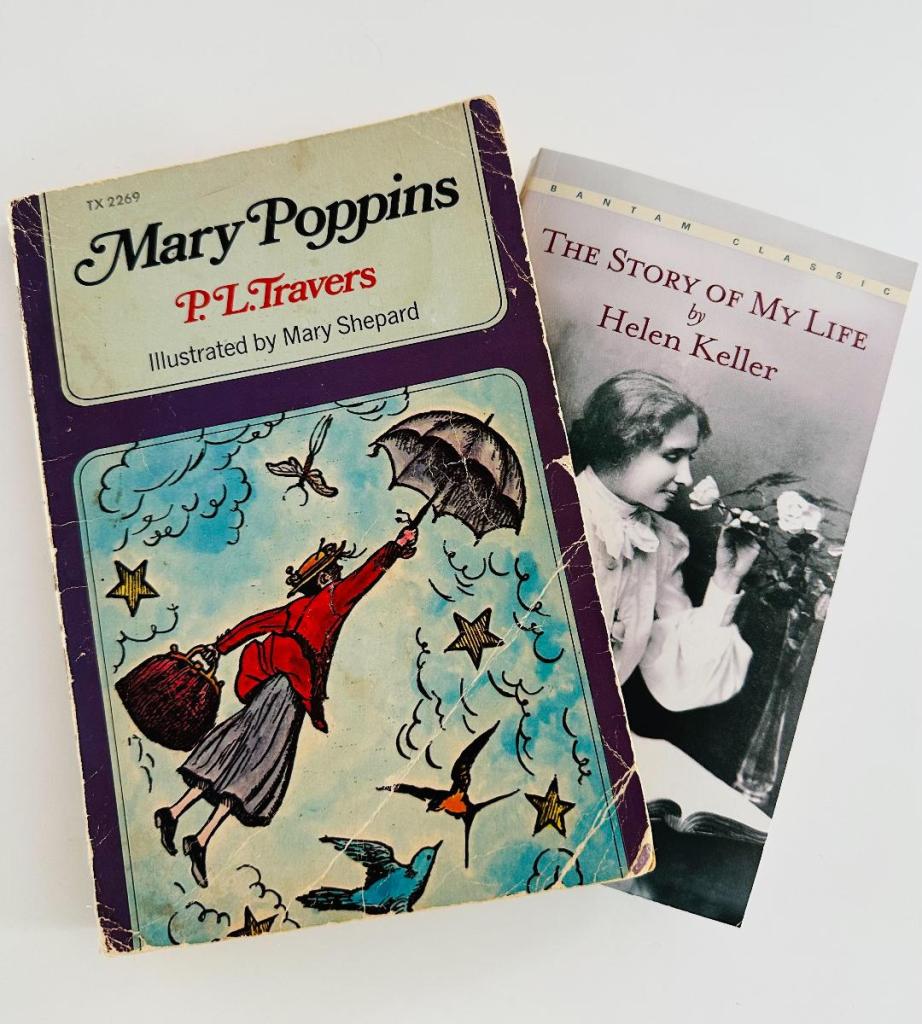
The friendship between P.L. Travers and Helen Keller is a little-known fact and one that was brought to my attention by a generous reader of this blog. I am forever grateful to my readers who share my interest in the world of P.L. Travers and Mary Poppins and freely share their knowledge with me.

A few letters kept in the archives of Helen Keller reveal that she and Polly Thomson stayed at P.L. Travers’s home during their visit to the UK in 1946. Helen Keller recollects the visit in these words: 

How often Polly and I recall the cozy evenings we spent with you, Camillus, and Moya by the fire in that dear, war-tried little house, surrounded by objects upon which your artistry has bestowed a fairy grace! “

And in another letter: 

I prefer to tell you how two pilgrims in search of ways to succor the war-blinded of Europe were rested and cheered by their visits with you, Moya and darling Camillius. Besides taking you to our hearts we loved your house, bomb-wounded yet warm and sweet to the core, your fire crackling with a cheery message of peace that shall someday inundate all homes, the simple hospitality making us feel natural and free instead of feeling “guests,” and the talk on whose wings the hours flew unnoticed.

The connections I make from reading P.L. Travers’s interviews and writings usually require time and effort, and although I enjoy the process, I must admit that it is immensely satisfying, albeit I feel a little mischievous, to read P.L. Travers’s private thoughts on matters she never discussed in interviews. 

Her correspondence with Helen Keller contains candid details about her relationship with her son, Camillus, and her feelings about single motherhood. In her interviews P.L. Travers rarely talked about Camillus and when she did, it was indirectly, by making references to a boy she knew well or a boy dear to her heart. This may appear strange, but I believe that she was trying to avoid questions about his adoption.  

The adoption of Camillus is discussed in P.L. Travers’s biography Mary Poppins She Wrote by Valerie Lawson, as well as in the documentaries about her life, and so I am not going to delve into the details of the adoption here, but just mention briefly, for those of you who are not familiar with the story, that P.L. Travers never told Camillus that he was adopted and that he had a twin brother, and other siblings. At the age of seventeen he discovered the truth when his twin brother came knocking on P.L. Traver’s door.  

As you can imagine Camillus was hurt and felt betrayed by the person he trusted most in life. His anger was mighty, and he never completely forgave her. This was a terribly sad and tragic event for both and P.L. Travers’s biggest regret in life was that she had not been a good enough mother for Camillus.  

And maybe from the outside one can say that she should have made better choices when it came to her son, the truth is she could not have done differently because she did what she could, what she thought was best, based on the level of awareness she had at the time.  

In her letters to Helen Keller, P.L. Travers writes about teaching Camillus how to swim and row during their summer vacation in Ireland and in the Wales, and how she is teaching him to handle a canoe on the Regent Park Lake. She mentions that he is taking violin lessons and “being very musical and with a good ear.”  

But what I find most interesting in this correspondence is that P.L. Travers appears to have been nostalgic of Camillus’s earliest childhood years. It is almost as if she was grieving the loss of their deepest connection, feeling the bond between them beginning to weaken as he was growing up and losing touch with the dreamland of fairytales. In a way they no longer shared a common way of perceiving the world. Camillus, like most of us when growing up, was interested in the external affairs of life and of becoming, whereas P.L. Travers always kept one foot in the land of myth and fairy tales, and looked for a deeper meaning of life, beyond the illusion of the ordinary. She wrote to Helen Keller: 

He, when he first heard poetry, was enchanted by it, but now at the age of eight only wants it now and then. He is so busy being a gangster one moment, supervisor another, a policeman the next. Everything now is acting and there is very little dreaming. The house shakes with his thundering feet, he is always coming from or going somewhere and only at night remembers that he has a mother and is still small enough to sit in her lap and be rocked in the rocking chair.”  

This sentiment of hers was so strong that it made its way in Every Goose a Swan in Mary Poppins in the Park. Camillus is the Boy in the story. The Boy is engrossed in pretend play, he is a fearsome one- eyed pirate, but then when the Tramp dares him to go to Dead Man’s Drop he suddenly remembers that he has a mother, that if he leaves she would be anxious and that after all she was making pancakes and it was better for him to stop acting and be his other self. 

Another interesting aspect of this correspondence with Helen Keller is P.L. Travers’s frankness about her difficulties as a single parent, the frustrations of domestic life, and her difficulty at reconciling it all with her deep need to write.  

Helen, you will understand how sad I have been at having to face the possibility of sending Camillus to boarding school. I aways wanted to keep him at home with me and let him go to a day school. But daily living becomes ever more difficult in England and the almost impossibility of finding anybody to help in the house will probably make it imperative. (…) I have broached the subject with him and his cheerful reply was “I will hit you if you do send me away!” However, as he grows I think he will quite like the idea and I hope to find a simple loving school which will not try and mould his abundant nature into too conventional a pattern. Then perhaps I shall have time to write.”

The boarding school she chose for Camillus was Dane Court Preparatory School for boys in Surrey. Joy Davidson, the wife of C.S. Lewis, sent her own two sons there after consulting P.L. Travers over tea. P.L. Travers’s high praise confirmed Joy Davidson’s impression of the school.  

The one she liked best was Dane Court, in Surrey, about twenty miles southeast of London. It was the most expensive, “gracious, well-established, comfortable without being luxurious and modern without being faddist,” having adopted a progressive policy of not “whack(ing) the children.” 

Poet, Seeker, and the Woman Who Captivated C.S. Lewis, by Abigail Santamaria. 

In conlusions, P.L. Travers did what she could to give Camillus a good education and a good start in life.

There are other things in the letters that will probably prompt me to write other blogposts, but this is it for this one, and I sincerely hope you enjoyed reading it.  

Tarot and Mary Poppins   

I read Mary Poppins and Mary Poppins Comes Back by P.L. Travers as a child in the early 1980’s in Bulgaria, but when I reread the stories in their original versions a few years ago, and discovered the other books in the series, I was amazed by P.L.Travers’s imagination. As a child I enjoyed the magic in the stories, but I did not give much thought to the author, although the name was on the cover of my book.  

As an adult, however, I wondered where P.L. Travers got her whimsical ideas from. When asked about the origin of her magical nanny, she never gave a straight answer. This may be partially explained by her desire to keep people away from her private life. Afterall, she did say in one interview that Mary Poppins was the story of her life, and that she had taken every precaution to cover her tracks. But then in other interviews she said that no one really knows where ideas come from. Her statement about the mystery of the creative writing process is echoed by other contemporary writers such as Philip Pullman and Elizabeth Guilbert. 

In Creativity, the Psychology of Discovery and Invention, psychologist Mihaly Csikszentmihalyi brings light to some interesting facts about our human creativity, such as the existence of certain commonalities in the personality traits of creatives.  

Csikszentmihalyi explains in his book that the creative process does not occur in a vacuum. Most of the time we build on old ideas by combining and reorganizing them in new ways, or by applying ideas from one domain to another. However, the mystery of creation remains. How exactly we combine ideas and morph them into new ones in our minds and why they take the forms they take is still a conundrum. 

All P.L. Travers’s writings are sprinkled with esoteric, mythological and fairy tales’ references, as these were her literary and spiritual pursuits. I love dwelling in the world of Mary Poppins and P.L. Travers, and I find the process of uncovering these references in the stories most enjoyable. Yet, I am fully aware that I can only uncover some of the components of the stories and link them to her personal beliefs and interests, without ever being able to explain how she incorporated and organized them into the whimsical Mary Poppins adventures.  

I believe that she herself was not entirely conscious of the creative process. Her writing was, at its core, unconscious writing. Her ideas sprang from deep within and then she polished the form. This is at least how I understand her statement about writing Mary Poppins because she was there to be written about. Besides, the adventures in the books all have a dreamlike quality to them, and I doubt this can be achieved to such an extraordinary level of artistry only by rational thinking. 

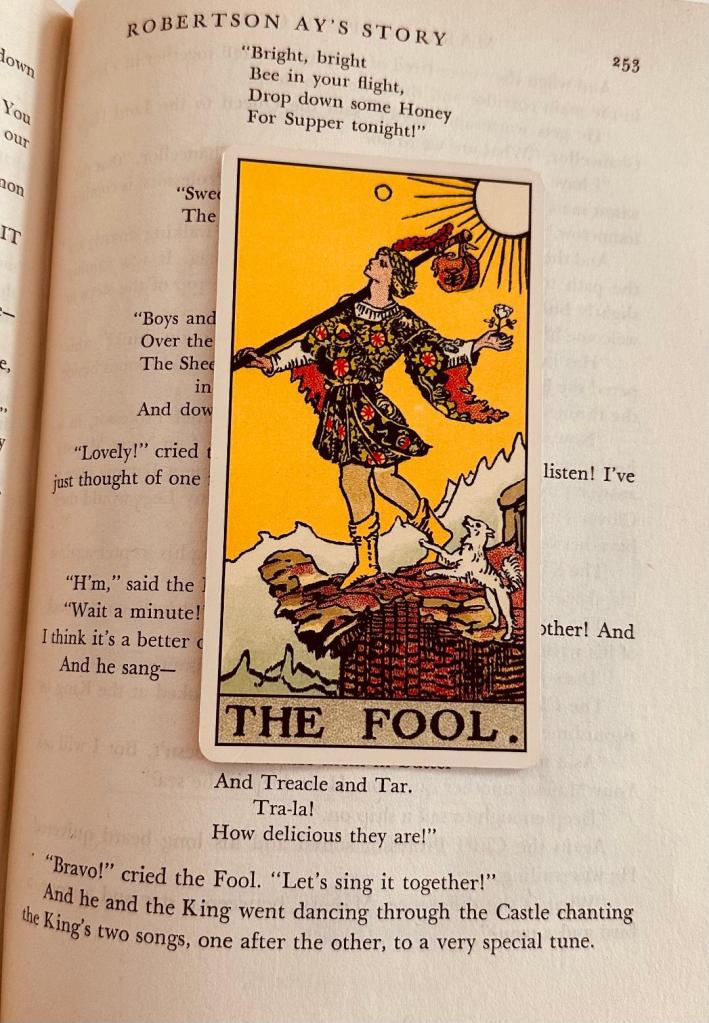
 This blog post is about an esoteric reference in Robertson Ay’s Story, a story from Mary Poppins Comes Back, the second book in the series published in 1935. This esoteric reference is the Tarot card of the Fool. I found a few more Tarot references in the Mary Poppins stories but they will be the subject of other blogposts.  

As a young writer P.L. Travers gravitated towards the renowned Irish poet and occultist W.B. Yeats, and her literary mentor, the mystic writer, poet, and painter George W. Russel (AE) who was also one of Yeats’s closest friends. Both men knew Pamela Coleman Smith, the illustrator of the most popular Tarot deck today, the Waite/ Ryder deck which was first published in London in 1909. It is also said that W.B. Yeats was an advisor to Pamela Coleman Smith on the mystic symbolism to be incorporated into Waite’s new deck. 

Pamela Coleman Smith was a member of the Hermetic Order of the Golden Dawn, the secret magical society to which W.B. Yeats also belonged. Between 1903 and 1904 she published, edited, and illustrated the magazine The Green Sheaf which focused on Irish Celtic folklore and mysticism. Both Yeats and AE, who were leading figures of the Celtic Revival, were literary contributors to her magazine. 

W.B. Yeats and AE also called Pamela Coleman Smith “Pixie”; a name first given to her by the Victorian actress Ellen Terry. Then some twenty years later, AE began to call P.L. Travers “Pixie” probably because he noticed certain similarities in their personalities and interests. Both women were orphaned at an early age, both loved fairy tales and magic and were interested in theatre, and both displayed a mischievous streak. 

The two Pixies were thus connected, although I suspect they never met in person because by the time P.L. Travers entered the artistic/occult scene, Pamela Coleman Smith had abandoned it and converted to Roman Catholicism.  

 Because of her connections to W.B. Yeats and AE, and her regular attendance at their literary salons, P.L. Travers was familiar with the archetypes of the Tarot. This is what she said about the Tarot card of the Fool to Jonathan Cott during an interview at her house in Chelsea, London. 

Who is Robertson Ay? What is he paid for? He does nothing but sleep? He turns out to be the Fool. Yes, he does, but I didn’t know he was going to turn that way when he cropped up in my mind. 

Not unnumbered, but Zero, which is all numbers and no numbers. The Fool is omnipresent, serenely passing through the world – as I said in “The Youngest Brother”- here and there are alike to him.” 

The Wisdom of Mary Poppins: Afternoon Tea with P.L. Travers, in Pipers at the Gate of Dawn, The Wisdom of Children’s Literature, Jonathan Cott, 1981 

The Tarot is composed of seventy-eight cards, twenty-two Major Arcana cards and fifty-six Minor Arcana cards. The Minor Arcana cards are divided into four suits, each associated with one of the four elements: fire, water, air, and earth. The suit of Pentacles is associated with the earth, the suit of Cups with water, the suit of Wands with fire and the Suit of Swords with air. 

The twenty-two Major Arcana cards (meaning Big Secrets) are considered to represent cosmic, energetic patterns that manifest in our human world as opportunities or obstacles to our personal growth, and the Minor Arcana cards (Little Secrets) relate to our individual struggles and challenges in our daily lives. All Major Arcana cards are numbered except for the Fool. The number of the Fool is zero, signifying nothingness, the void from which all things proceed, the field of pure potentiality.  

The archetype of the Fool represents pure potential. He lives in the here and now without placing judgments and looks at the world with a childlike innocence and wonder. The Fool in his positive aspect, is the playful, joyful child within us all. When The Fool appears in a reading, he heralds a clearing of the senses and announces a brand-new beginning. His advice is to go with the flow, just go with what is happening and learn from experience.  

In the Wait/Ryder deck The Fool is depicted standing on the edge of a precipice or a cliff suggesting that the path regenerates itself with each step; he encourages us to take a leap of faith and trust in life and in ourselves. Notice that the Fool carries a small bundle on a stick as he only takes with him what he needs and nothing more. His advice to us is one of release; to release what no longer serves us. He tells us to keep only the habits and lessons that will help us along our journey.  

Mary Poppins tells three fairy tales to the Banks children during her stay with the family. I find it interesting that she does not tell these fairy tales at bedtime as most people do. She only tells a story when the occasion calls for it and as it happens, she tells the story of Robertson Ay in the park during one of their outings.  

It is a sunny day in the park and Mary Poppins is sitting on a bench knitting, Anabel and the twins are in the perambulator and Jane and Michael are busy enacting the nursery rhyme I am the King of the Castle and You Are the Dirty Rascal, when out of nowhere a strange figure appears on the path at the edge of the Lake and catches their attention. 

“Along the path at the edge of the Lake came a tall, slim figure, curiously dressed. He wore stockings of red striped with yellow, a red-and-yellow tunic scalloped at the edges and on his head was a large-brimmed red-and-yellow hat with a high peaked crown.” 

Robertson’s Ay Story, Mary Poppins Comes Back (1935) 

The man stops by the bench to greet Mary Poppins, and the children learn that this is the Dirty Rascal, and Robertson Ay, but that is revealed to them only at the end. The children are mystified by the stranger whose face is hidden underneath the large-brimmed hat. When he leaves their company, and to the greatest delight of Jane and Michael, Mary Poppins offers to tell them the story of the Dirty Rascal.  

The story is in fact the story of a King who is extremely stupid and uncapable of fulfilling his royal duties. It is the Queen, and the Lord High Chancellor who must step in and do the work. However, they spare no amount of effort to impart some wisdom to the King, alas to no avail. As a last resort, the Queen and the Lord High Chancellor offer a generous reward to whomever succeeds in teaching the King some wisdom.  

As is the custom in fairy tales, the reward comes with a steep price for those who fail at the task. The professors who fail to teach the King wisdom are all doomed to have their heads cut off and spiked on the Castle Gates.  

All the teachers who come to test their luck lose their heads. The King is crushed by the events and his inability to learn. Then an unexpected visitor arrives, pushes past the sentry at the gate and walks up to the King. The King presents himself as the King of the Castle and the visitor as the Dirty Rascal. They immediately form a strong bond as the Fool shows the King that he does not have to conform to other people’s expectations nor to their understanding of what it means to be intelligent. 

 In Robertson’s Ay Story, the Fool appears in its positive aspect, a carefree, playful, childlike creature capable of imparting wisdom to the hopelessly stupid King. But he does not teach him in the way all the other teachers tried to. Instead, the Fool incites the King to burn all his books and simply enjoy life. They sing and dance, and laugh to the horror of the Queen and the Lord High Chancellor who see their behavior as being completely foolish and crazy. This highlights another aspect of the Fool archetype. The Fool is the outsider, the one that does not conform to pre-established norms.  

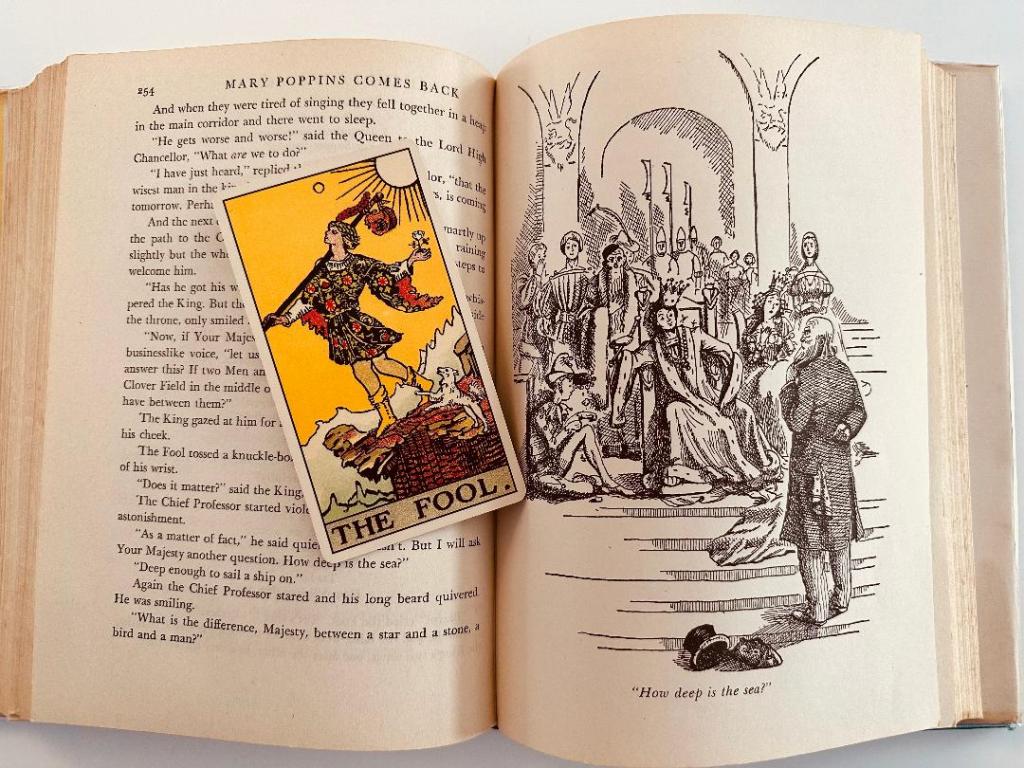
At the end of the story, the King is tested by the Chief of all the Professors, the wisest man in the kingdom. The questions asked by the Chief Professor are met with unexpected, but practical answers and the Chief Professor has no other choice but to declare the King to be wise. Wisdom, as P.L. Travers believed, cannot be taught, it can only be acquired through lived experience; a dance through life. To understand something, she said one must stand under it. Factual knowledge can only get us so far, something else is required of us to live an authentic life.  

When the Fool appears in a Tarot reading, it often signifies a new journey, a new beginning and this is exactly how the story of Robertson’s Ay ends with the beginning of a new journey for the King. Once the King realizes that what others think about him has no importance whatsoever, he realizes that he has no desire to be King. Together with the Dirty Rascal, the King climbs on a rainbow that has suddenly appeared in the sky and throws down his crown and scepter, thus shedding his old identity.  

Interestingly, the rainbow appears on another Tarot Card, the 10 of Cups, and I am thinking that I will have to explore this element of the story in a future blog post. For now, I hope you enjoyed reading this blog post as much as I enjoyed writing it.  

Shadow Play

I used to play with my shadow as a kid. I tried to run away from it, but no matter how fast I ran, I could never outrun it. Every time I looked down there it was, glued to my feet, sometimes in front of me, sometimes behind, sometimes on my left side and sometimes on my right. I was never certain of its position, but I was certain of its presence, even on rainy days. I knew that it was there, only, it was invisible for the time being.  

Occasionally, my shadow games involved other children in the neighbourhood. We chased after each other’s shadows and screeched with delight as we stepped on them, something that Mrs. Corry teaches the Banks children in Hallowe’en, a story from Mary Poppins in the Park (1952), is not a wise thing to do. I did not know that back then. I had read Mary Poppins (1934), the first book in the series in the early 1980’s in Bulgaria and I did not know about the other books until I read P.L. Travers’s biography in 2015.  

 I enjoyed my shadow’s shape-shifting tricks, how it changed its size, and how sometimes it climbed on walls and ceilings. One evening, to my enchantment, shadows of animals and birds appeared on the walls in the living room of my grandparents’ apartment.  Amazed, I kept shifting my eyes from the lively images on the walls to my mother’s and grandfather’s strangely positioned hands. They looked nothing like the shadows on the wall and I marvelled at this mysterious transformation; it was pure magic.  

However, despite my enjoyment of shadow games I doubt that I would have been as courageous as Jane and Michael Banks in Hallowe’en and followed my shadow out in the night should I have seen it run out of the door. Certainly not, if this had happened after I read Andersen’s fairy tale The Shadow and learned that a shadow without a body is the most dangerous thing of all. Suffice it to say that Andersen’s fairy tale put an end to my shadow games.   

The shadows in Hallowe’en are friendly. I wrote about P.L. Travers’s concept of the shadow in a previous blog post. If you are interested, you can read it here. In this blog post I want to spend some time exploring a contradiction in the story.

Yes, this is what happens when you read the same story repeatedly; you see things you did not see the first time, or even the second time around.  

It is the night of Hallowe’en, and everybody is fast asleep when Jane and Michael Banks wake up and find mysterious messages written on leaves left on their pillows. These are the leaves that the wind blew into their hands on their way back home from a stroll in the park. Mary Poppins had taken the leaves away before they could see the words written on them, but now they can read the messages. One leaf reads “Come” and the other “Tonight.” The children accept the invitation and follow their shadows to the park where other shadows are having a party.  

At first, Jane and Michael are a little scared, but the Bird Woman’s shadow reassures them. There is no need to be afraid, a shadow never did any harm to anyone. Then, after Jane and Michael Banks accidentally step on Mrs. Corry’s shadow, she tells them to pay attention, because shadows are extremely sensitive.

Mrs. Corry, an ancient crone and a friend of Mary Poppins, and Mary Poppins herself are the only people at the party with their shadows firmly attached to their feet.  

Mrs. Corry advises the children to take good care of their shadows or else their shadows will not take good care of them. This to me sounds much like a warning and reminds me of the perfect example of what happens to someone who does not take care of his shadow. 

The Shadow by Hans Christian Andersen begins in a hot country where the sun is very strong. A learned man from the cold regions is trying to acclimate to the heat but it is difficult. He loses weight, and his shadow shrivels to nothing. It is only in the evenings that it comes to life on the walls of the learned man’s room and stretches itself to regain its former strength.  

The learned man spends his evenings sitting on his balcony where he can observe the hustle and bustle of the city below, but he is mostly curious about the house across the street. Nobody ever comes out on its balcony, yet it has beautiful flowers that could not survive unless someone waters them regularly. 

One night, the learned man awakes and sees a light coming from the mysterious balcony. A beautiful maiden, all aglow, is standing amidst the flowers. The learned man jumps out of bed and creeps behind the curtain to get a better look, but it is too late, the maiden is already gone. 

One evening, not long after this brief vision, the learned man notices that his shadow is cast on the maiden’s balcony. Jokingly, he suggests to his shadow to slide through the half-opened door and have a look around and come back to tell him who lives there.  The shadow accepts the learned man’s proposal and disappears into the confines of the house but then, it does not return. 

Many years pass, the learned man is back to his cold country where he spends his time writing books about what is true, good and beautiful in life. Only, no one cares about such things and the learned man is deeply grieved. Then one evening his shadow, now with a fleshed-out body and wearing lavish clothes, shows up at his door. From this moment on, the story takes a dark turn. The learned man gradually becomes the shadow of his own shadow and then dies by its hand.  

However, before this tragic end, the shadow reveals all about his solo journey. The learned man discovers that Poetry lived in the house opposite theirs.  It is there that the shadow learns all that there was to be learned, although it had to stay in the twilight of the antechambers, or it would have been consumed by the light. 

Despite its human body, the shadow retains its ability to change its shape and size and that is what allows him to peak into other people’s homes and discover their darkest secrets. The knowledge of people’s dirty deeds allows the shadow to manipulate them to give him all he wants in exchange for his silence.  Andersen’s story is clearly a metaphor for the dark side of the learned man’s psyche and his refusal to acquaint himself with his own darkness.

I do not know if the contradiction between the words of the Bird’s Woman shadow and Mrs. Corry’s advice in Hallowe’en was intentional on P.L. Travers’s part, but it is possible, she liked indirection and Andersen’s fairy tales were part of her childhood readings. The idea of free roaming shadows, I believe, was inspired, consciously or not, by Andersen’s fairy tale.  

I wish I could ask P.L. Travers about all this and more. Are our shadows good or are they bad? 

I will never know what P.L. Travers’s answer would have been, but I found mine most unexpectedly one evening after work, as I was walking in the parking lot towards my car. The light from the lamp posts hit my body at a fortuitous angle, and I saw three shadows stretching at my feet in three different directions. I had never noticed this phenomenon before, and I was awestruck by its revelation.  

We have more than one shadow! We have them all, the good, the bad and the ugly. Both P.L. Travers and Andersen are right, we better pay attention to them or else…  

Happy Halloween! 

Midsummer’s Eve with Mary Poppins

Bulgarian Mary Poppins in Cherry Tree Lane

Cover illustration by Piers Stanford, 1994

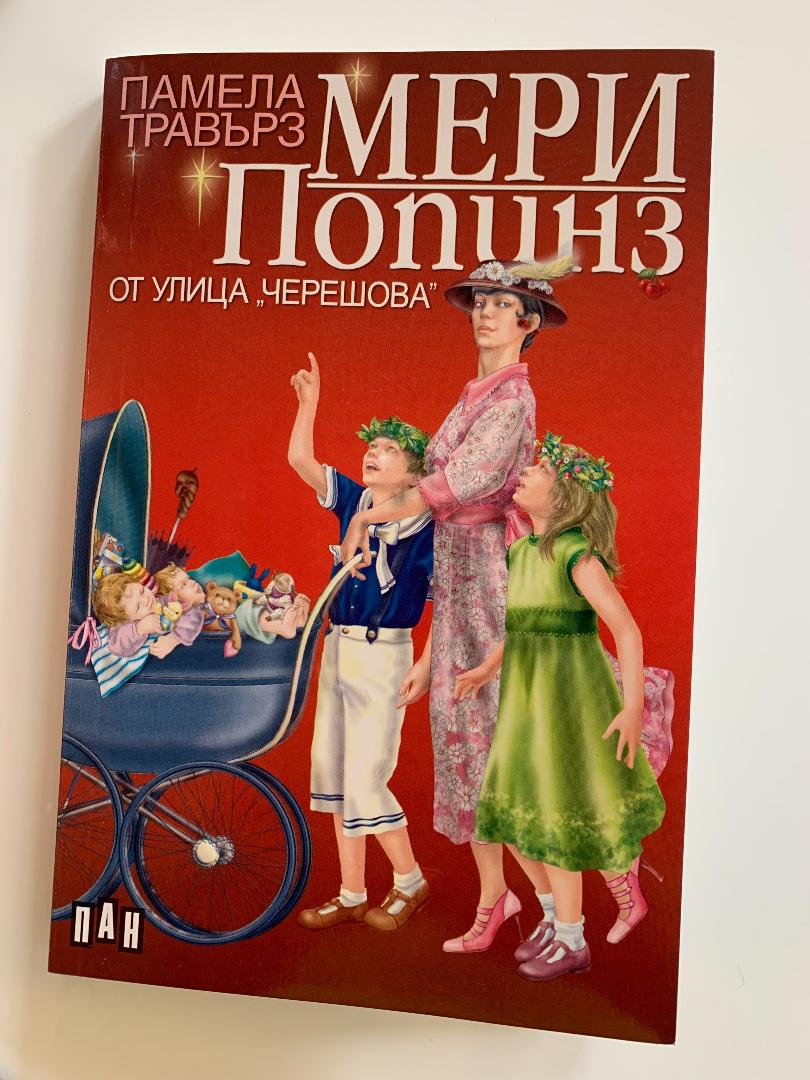
Yesterday, as a celebration of the summer solstice, I read the Bulgarian translation of the fifth Mary Poppins book, Mary Poppins in Cherry Tree Lane. The Bulgarian edition in my possession was published in 2004 and is translated by Anelia Ianeva.

It is Midsummer’s Eve and Mary Poppins takes the Banks children for an evening picnic in the park.

Mary Poppins in Cherry Tree Lane

Illustration by Mary Shepard

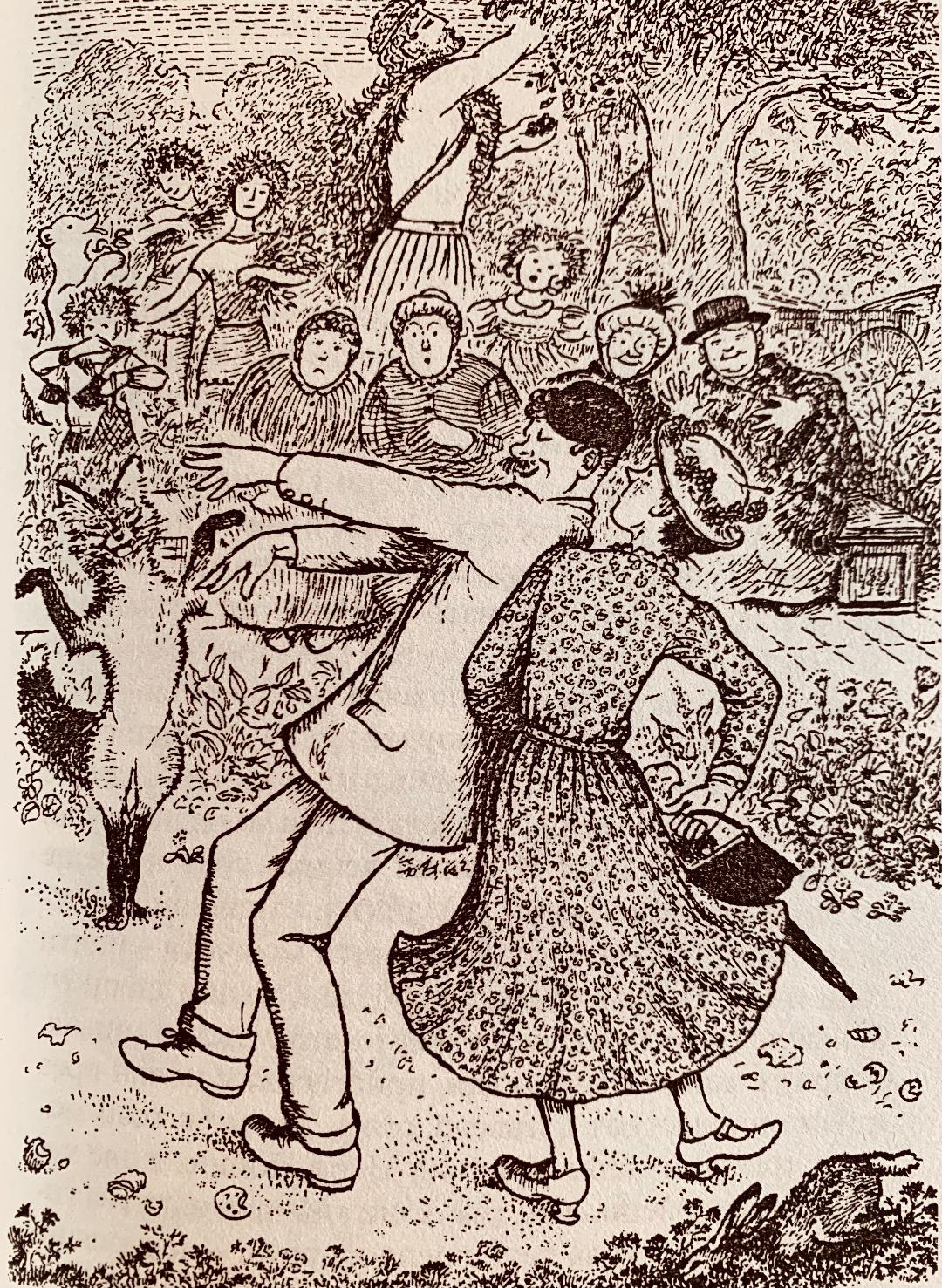
There, in the furthest corner of the park, in the herb garden, they feast and dance with celestial constellations who have taken the shape of their appellations:  Orion, Castor and Pollux, the Bear, the Fox (or Vulpecula in Latin) named in the late 17th century by the astronomer Johannes Hevelius, and the Rabbit (or Lepus in Latin), a constellation that was listed in the 2nd century by Ptolemy. PL Travers was interested in astrology and like a pastry chef fond of sugar, she sprinkled her Mary Poppins books with stars and constellations.

Mary Poppins celebration Midsummers Eve

Illustration by Mary Shepard

Down a lane in the park comes Ellen, the maid, strolling backwards with her eyes closed. She had put herbs under her pillow the night before and now is on her way to meet her true love.

Ellen the maid Mary Poppins

Illustration by Mary Shepard

The lonely Park Keeper decides, rather uncharacteristically, to try his luck. He follows suit only to bump into Mary Poppins. Afterall, opposites attract. What better match for a rigid man overly concerned with rules.

Mary Poppins and the Park Keeper

Illustration by Mary Shepard

The Bulgarian translation of the story, just like the translation of Mary Poppins, is loyal to the original text, but there is one interesting modification. Midsummer’s Eve is translated for the corresponding Bulgarian folk holiday Eniovden.

On Eniovden, according to old Bulgarian beliefs the celestial lights “go crazy”. At midnight, the sky opens and miracles happen. The stars descend on Earth and bathe in the cold waves of the sea. People gather herbs because on this day the herbs’ healing powers are at their peak. Young women perform divination rituals and put herbs under their pillows in the hope that their dreams will reveal their husbands-to-be. On Eniovden there is also a custom of making offerings of fresh cherries to the deceased. 

Surprisingly, these old Bulgarian customs are reflected in Mary Poppins in Cherry Tree Lane, first published in 1982. Aren’t these similarities of beliefs between two different cultures fascinating? I am certain P.L. Travers would have been interested to hear about Eniovden. Then, maybe she did.

I have two editions of Mary Poppins in Cherry Tree Lane but none of them contain any illustrations. The Bulgarian one does! What a nice surprise for a Mary Poppins nerd like myself.

Happy Summer Solstice!