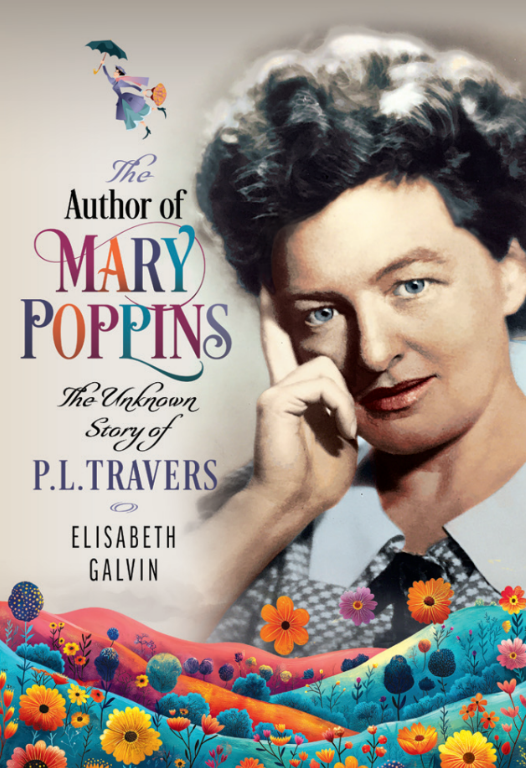
I am very excited to share my conversation with Elisabeth Galvin about her upcoming biography of P. L. Travers, the creator of Mary Poppins. This time, our conversation takes place in video form, a medium I avoided for a long time but have now come to accept as one I need to embrace.
In this interview, which I am sharing below, Elisabeth and I explore what first drew her to Travers, her research process, and the unexpected material she uncovered while tracing the life of a writer who has fascinated readers for generations.
We also talk about the people she met along the way who knew Travers personally, and how their memories and stories brought new texture and meaning to this biography. Travers’s complexity is portrayed in a gentle and respectful way, as Elisabeth is keenly aware of the responsibility that comes with writing a biography and of the difficulty of portraying with care and honesty a person one has never met. Elisabeth’s writing is also deeply atmospheric, carrying the reader through an almost visual experience of time and place. It is a delightful read, and I sincerely hope this book finds its way into the hands of many readers.
There is an additional reason for my excitement. I had the honor of writing the introduction to this biography, as well as an entire chapter on Travers’s spiritual beliefs, a subject very dear to my heart. I have been immersed in the world of Travers and Mary Poppins for over ten years, and I am convinced there is still much left to uncover. Travers lived a long and productive creative life, yet today she is often remembered only for Mary Poppins. I believe she is an author worth rediscovering. I also believe she was truthful when she said she did not write Mary Poppins with children in mind, and that these stories continue to hold important lessons for adult readers.
I hope you enjoy my conversation with Elisabeth Galvin, and that you will consider subscribing to The Mary Poppins Effect for more reflections and stories exploring the world of Mary Poppins and its connections to other literary worlds.
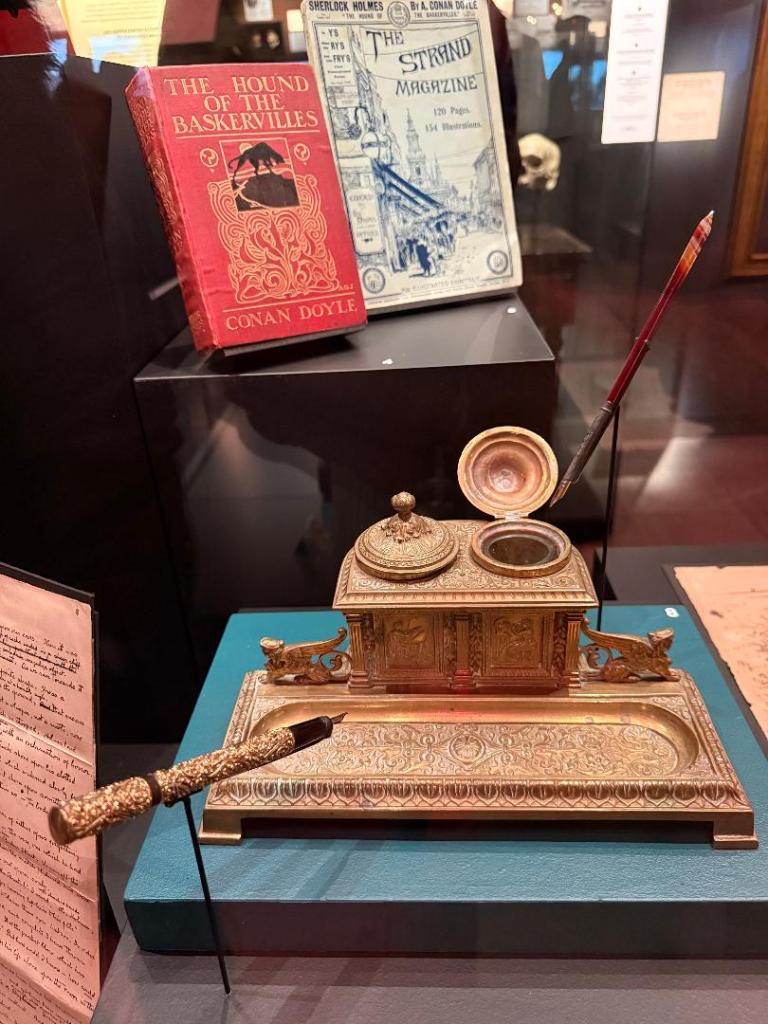
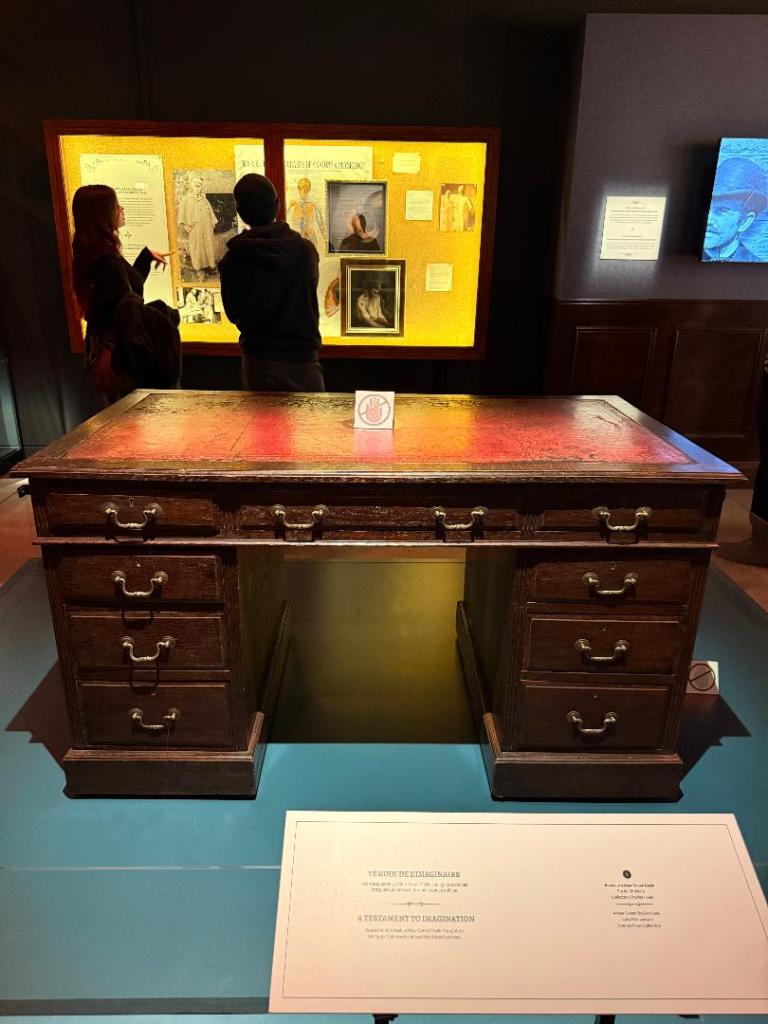
This weekend I visited an immersive exhibition in Montreal devoted to the world of Sherlock Holmes, the legendary detective created by Sir Arthur Conan Doyle. It was both fun and educational, but as any bookworm would probably agree, there is something almost transcendental about seeing in real life the desk at which Conan Doyle wrote the Sherlock Holmes stories. I only wish I could have touched it. There was also his richly ornate inkwell set, along with many other interesting objects.
Beyond the objects themselves, the exhibition led me to reflect on an unexpected connection between Sherlock Holmes and Mary Poppins. One section included a video recording of Conan Doyle speaking about his creation and about the correspondence he received from readers. He explained that he was surprised by the number of people who were convinced that Sherlock Holmes was a real, living human being. He received letters addressed directly to Holmes, letters requesting his autograph, letters written to his friend Dr. Watson, and even letters from women offering to become his housekeepers.
This immediately reminded me of an interview with P. L. Travers in which she said that people wrote to her asking whether Mary Poppins could be sent to their home to help with the raising of their young children. When I first read this, I assumed that people were simply being whimsical and indulging in wishful thinking, but were still aware that Mary Poppins is a fictional character. Surely they could not truly believe that Mary Poppins was a living, breathing being in our world, even though I was convinced of it myself as a child.
Now, hearing that readers reacted in the same way to another fictional character, I have come to a different conclusion. This longing to meet such characters in person may be the strongest proof of a truly successful literary creation, one that feels original and extraordinary. It makes me wonder whether P. L. Travers was aware of this striking similarity between her experience as an author and that of Conan Doyle.
There are other curious parallels as well. Both writers were interested in the occult, though in different forms, and both shared a belief in an invisible dimension beyond ordinary perception. Both authors refused to treat imagination as mere fantasy. They seemed to believe that imagined figures could carry truth, presence, and meaning that felt real to readers. That kind of openness allows characters to feel alive rather than invented, which may explain why readers wrote letters as if Sherlock Holmes and Mary Poppins actually existed.
And lastly, Sherlock Holmes’s creator wanted recognition for his historical novels and did not want to write as many Sherlock stories as he did. Similarly, P. L. Travers wrote other books and essays on myth and fairy tales and complained that people only wanted Mary Poppins stories from her. Both fictional characters became larger than their creators, and the relationship between creator and creation was riddled with ambiguous feelings. Isn’t it funny how what brings outer success does not always equate to inner fulfilment?
I hope you enjoyed reading this post and will consider subscribing to The Mary Poppins Effect for more stories exploring the world of Mary Poppins and its connections to other literary worlds.
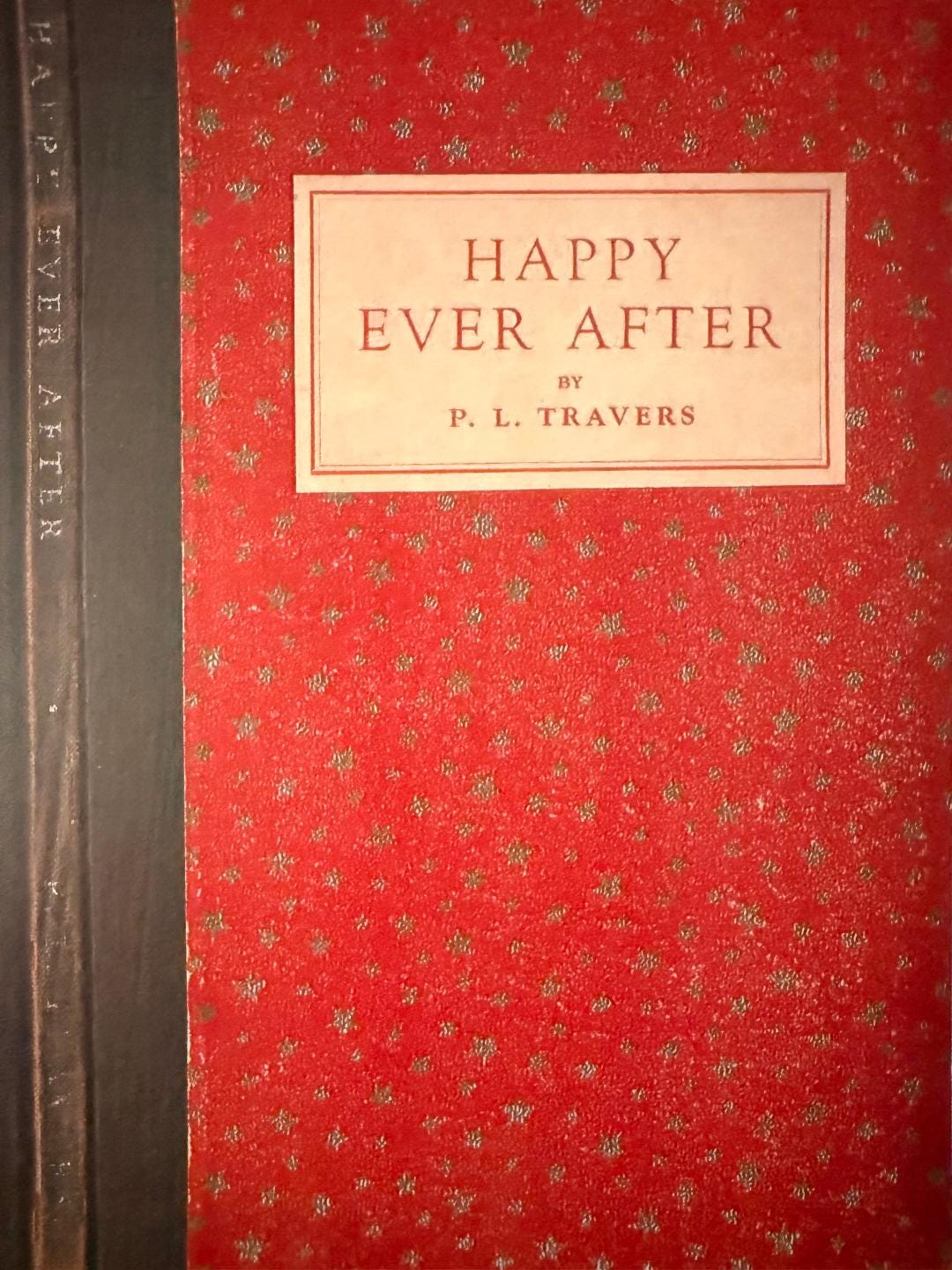
I wish I were as talented a storyteller as P. L. Travers, able to gift you a magical story this holiday season, but my brain is analytical and reflective. So instead of enchantment, what I am offering is a comparative analysis of the first version of “Happy Ever After,” a Mary Poppins story by P. L. Travers first published privately for friends in 1940 and later included in Mary Poppins Opens the Door, the third book in the series, published in 1943.
The first edition of “Happy Ever After” was limited to one thousand copies privately published by the author for her friends and her publishers as a New Year’s greeting. What a lovely idea, and how lucky were those who received it!
When I first sat down to read the original version, I did not know what to expect, though I suspected there would be some differences from the story I had read in Mary Poppins Opens the Door. Naturally, I was curious to see what had changed and perhaps even to investigate the differences and what they might reveal.
It turned out that the original story is very similar, with most of the differences being largely stylistic. That will likely come as no surprise to any writer. Editing, polishing, and improving a text can be a never-ending process, especially when one struggles with perfectionism or insecurity, which may simply be two sides of the same coin. However, I noticed two significant discrepancies between the two versions of the story and these are the ones that I want to tell you about.
Nowhere in the Mary Poppins books is the exact age of the Banks children stated. The reader understands that Jane and Michael are preschoolers, since they spend most of their time with Mary Poppins in the nursery or in the park. John and Barbara grow from babies to toddlers, and the youngest Banks child, Annabel, appears in the second book, Mary Poppins Comes Back (1935).
But in the 1940 edition of “Happy Ever After,” P. L. Travers reveals how she imagines the ages of the children, and interestingly she seems to forget about Annabel. Or perhaps she intended the story to take place between Mary Poppins’s first visit to the Banks family in Mary Poppins (1934) and her second visit in Mary Poppins Comes Back (1935).
“It was the latest day of the Old Year. Upstairs in the nursery of Number Seventeen Cherry Tree Lane, Jane Banks who was seven, Michael Banks who was five and John and Barabra Banks who were twins and two-and-a-half, were being undressed.”
This is certainly the kind of detail only a Mary Poppins enthusiast like me would notice, but I take enormous pleasure in diving deeply into these stories and sharing my findings with you. I hope you enjoy reading about them as much as I enjoy discovering them.
Another interesting difference between the two versions is that in the 1940 edition, P. L. Travers describes at length how the children perceive Mary Poppins. In the later version, which I find more successful, she conveys the same idea more succinctly and in a way that feels more revealing. Here are the two passages in order.
“She moved about the nursery, folding up the scattered clothes and tidying away the toys. To look at her – with her coal-black hair, her china-blue eyes, her bright pink cheeks and her turned-up nose that was like the nose for a Dutch Doll – you would never imagine that she was anything but a perfectly ordinary person. But Jane and Michael and John and Barbara knew better. For had she not, when she first arrived at Number Seventeen, mounted the stairs by sliding up the banisters? And was it not certain that on her second visit she had appeared from Nowhere on the end of a string, looking more like a kite than a human being? How could a perfectly normal ordinary person be capable of such extraordinary behaviour? Impossible. Jane and Michael and John and Barbara knew very well how extraordinary she was but they did not speak of it for there were things about Mary Poppins that could never be explained. And it was no use talking to her about it for Mary Poppins, as everybody knows, never told anybody anything.”
The passage comes across as clunky and overly explained, and P. L. Travers may have added extra detail for friends unfamiliar with Mary Poppins, but she later trimmed it from 182 words to 94 in the second version of the story.
“She moved about the Nursery, folding up the scattered clothes and tidying the toys. The children lay cosily in their beds, watching the crackling wing of her apron as it whisked about the room. Her eyes were blue and her cheeks were pink and her nose turned up with a perky air like the nose of a Dutch Doll. To look at her, they thought to themselves, you would never imagine she was anything but a person. But, as you know and I know, they had every reason to believe that Appearances are Deceptive.”
What a valuable lesson for children and one that resonates deeply, yet is often forgotten as we grow older. The importance of looking beyond outward appearances and not relying solely on what meets the eye is especially relevant in today’s world, where social media shapes so much of our perception. We are constantly exposed to carefully curated images and stories that can distort what is real and influence how we view ourselves and others.
It’s all too easy to fall into the trap of comparing and judging based on these surface impressions. Many of us have likely experienced firsthand how the tendency to compare ourselves with others can disrupt our relationships and undermine genuine connections. Although it is natural to observe and compare, I find that the rise of social media has intensified these impulses, often resulting in feelings of envy, dissatisfaction, and a sense of inadequacy. Ultimately, the gentle reminder from Mary Poppins to look deeper and not be deceived by appearances is a lesson we would all do well to remember, especially in our modern, image-driven world.
I often wonder what would P.L. Travers think of the world we now live in.
Now I would like to share some examples of the stylistic changes made in the story, even though I cannot fully explain the reasons behind these edits:
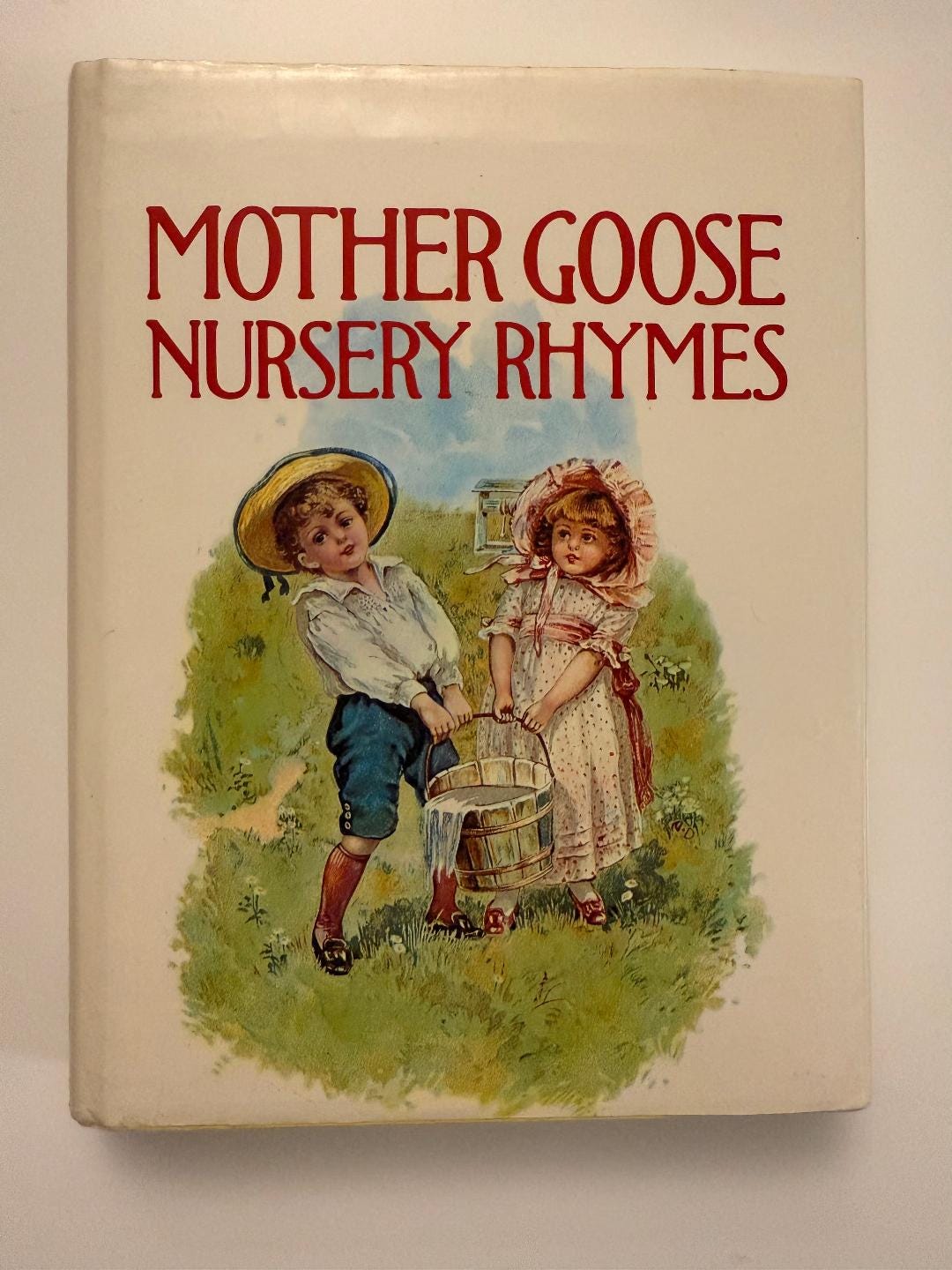
In the 1940 version, the nursery characters that come to life on New Year’s Eve are drawn from Nursery Rhymes Old and New, a Victorian era edition of classic English nursery rhymes. In the 1943 version, however, the characters come from Mother Goose Nursery Rhymes, which refers not to a single book but a long-standing tradition of collections featuring familiar English rhymes and characters.
In the 1940 version Admiral Boom blows a trumpet in the frosty air while in the 1943 story he clangs a ship bell.
In the 1940 version, Barbara’s monkey toy is called Sissie, while in the later version the toy is renamed Pinnie.
In the first version, when the children follow their toys to the park where characters from fairy tales and nursery rhymes have gathered to celebrate a magical moment of happy ever after, the brief crack between the first and last stroke of midnight on New Year’s Eve, they are greeted by the Frog Who Would a-Wooing Go. In the second version, however, they are welcomed instead by the Three Blind Mice and the Farmer’s Wife.
There are several similar small changes in the second version of the story, although the reasons for them are not entirely clear. Even so, the heart of the narrative remains unchanged, reminding us that we each must work to reconcile the opposing forces within our inner and outer lives.
Wishing you all a happy ending of the old year and an even happier start of the new year.
If you’re a devoted fan of Mary Poppins and P.L. Travers—like I am—or if you have a passion for literary travel, this blog post is for you. Through sharing my travel experiences, I hope to offer you some inspiration for visiting locations in London and its surroundings that are deeply connected to the enchanting world of Mary Poppins and her creator.
My Mary Poppins-Themed Trips to London and its Surroundings
In the summer of 2023, I finally fulfilled my long-held dream of visiting London—and the cherry on top was that my daughter decided to join me on the adventure. The trip was inspired by my love for P.L. Travers and Mary Poppins, and my daughter’s enthusiasm for Harry Potter. We also carved out time for some book shopping, exploring iconic historical landmarks, and visiting the Charles Dickens Museum. However, in this blog post, I’ll be focusing specifically on the Mary Poppins side of our journey.
So, let’s begin with a truly special address for any Mary Poppins fan.
50 Smith Street, Chelsea, London
P.L. Travers lived at 50 Smith Street, Chelsea, London with her adopted son, Camillus, from 1946 to 1962. It was here that she wrote Mary Poppins in the Park, the fourth book in the series. Today, the building proudly bears an English Heritage blue plaque in honour of her literary legacy. I used to come across photos of fans on its doorstep shared on social media, and I must admit, I always looked at them with a hint of envy. But now, it was my turn to see the place where she once lived and to experience history in a truly sensory way.
I remember fighting the urge to break into a run as we emerged from the Tube station and began walking down King’s Road. I glanced at the shop windows lining the sidewalks and the red double-decker buses on the street, their colours unusually vivid in the bright daylight, like freshly painted canvases. Even my daughter could sense my heightened emotional state and the spring in my step, and she teased me, ‘You do realise you’re not actually going to meet her in person?’ And I knew she was right—but this was the closest I could ever get to meeting her in the physical world.
In fact, I could hardly believe I was finally just steps away from something I had dreamed about for years—and had often doubted would ever come true. For one reason or another, it was never the right time; something always held me back from booking the trip. This may sound strange to experienced travellers, but I’m not much of a traveller myself—and Canada is a long way from London. So, this first trip to London was a big deal for me on many levels and as it turned out, the experience was truly transformative.
Now you can imagine my disappointment when we reached the corner of Smith Street and I saw a huge construction box blocking the entrance to 50 Smith Street.
The only positive thing, as suggested by a friend who saw the picture afterwards, was that there was a blown-up reproduction of the blue commemorative plaque on display, but that was probably just a friend’s way of trying to lift my spirits.
In a moment of madness (and ignoring my daughter’s rational arguments), I dialed the number displayed on the notice in the window of the construction box. It said that all visitors or anyone seeking access could call the number on the notice. Well, I was definitely a visitor wanting access. The person on the other end of the line clearly didn’t agree—they actually dared to hang up on me. Needless to say, I was offended, but as I gradually came to my senses, I realised not only was I acting a bit unhinged, but I also had a second chance just a few minutes’ walk down King’s Road: Number 29 Shawfield Street, the last residence of P.L. Travers. There really was no need to get so agitated.
29 Shawfield Street, Chelsea, London
P.L. Travers lived at number 29 Shawfield Street for the last thirty years of her life and it is in her the study on the second floor that she wrote Mary Poppins in Cherry Tree Lane and Mary Poppins and the House Next Door, the last two books in the series.
As we turned the corner onto King’s Road and began walking toward Number 29 Shawfield Street, I felt a tinge of sadness that only deepened when I saw the front door, no longer pink as it had been when P.L. Travers lived there. We walked back and forth along the sidewalk, trying—but not quite succeeding—to be circumspect. After all, how circumspect can you really be when snapping selfies in front of someone’s front door?
It was a weekday, and I had convinced myself that the residents of Number 29 were probably at work. But then, a postman happened to walk by and rang the doorbell—and suddenly, the door opened. Feeling a bit embarrassed, we crossed to the other side of the street and sat on the edge of the sidewalk, while I continued to stare intently at the front door.
How I envied all those who had visited her here and, even if only briefly, had been granted a glimpse into her personal world. Below are two personal accounts from people who visited her home and the lasting impression it made on them.
“She lives in a small Georgian house in Chelsea. Her sitting room, where she received me, is light, airy and sparsely furnished. She sits on the corner of a long sofa the rest of which is covered with stacks of books, letters, various publications. On the creamy wall hang a Paul Klee, portraits of great grandmothers and aunts, a drawing of P.L. Travers by AE (George Russell), a Tree of Life by one of her students … The mantle piece is covered with photographs of family and friends, including many children.”
Looking Back, by Shusha Guppy
“P.L. Travers lives in a quiet, small period house in the Chelsea section of London, and everything in her home contributes to a visitor sensing the emptiness of plenitude and the plentitude of emptiness – exemplified in, her upstairs study, by several beautiful Japanese scroll and screen paintings, mostly by Sengai: a willow almost breaking in the wind; six persimmons; a cock crowing to the morning and a little hen bird nearby; the depiction of the syllable mu (literally meaning “not” or “without” and referring to a famous Zen koan and the extraordinary “Ten Oxherding Pictures” (attributed to the twelfth- century Chinese Zen master Kaku-an Shi-en).
Pipers at the Gates of Dawn, by Jonathan Cott
I tried to picture her stepping out of the front door, then slowly descending the three steps. I imagine her gaze fixed on the pavement as she walks down the street, her mind clearly elsewhere. Then she stops. Something has caught her eye. It must be the small star embedded in the sidewalk. She smiles. She loved pointing it out to friends who came to visit, inviting them to find it too—as if it were a secret only she could truly see.
How many people before me had walked that same stretch of pavement, searching for the star? And how many had actually found it? Not being able to see it myself was somewhat of a letdown. Could it be that she made it up? Or had time and countless footsteps worn it away?
Then I remembered reading a blog post by her friend, writer Brian Sibley in which he recounts his first encounter with her and, at the very end of his recollections, mentions the star on the pavement.
“Light was failing, but I found it, at last: just as Pamela had said – a star-shape, faintly but clearly marked in the surface of a paving stone. Doubtless it was some rouge imprint on the surface from the manufacturing of the cement paving-stone, but I was remembering the words of the old snake, the Hamadryad, on that night of the full moon when Mary Poppins took Jane and Michael to the zoo: ‘We are all made of the same stuff… The tree overhead, the stone beneath us, the bird, the beast, the star – we are all one, all moving to the same end…’ ”
Chelsea Physic Garden, London
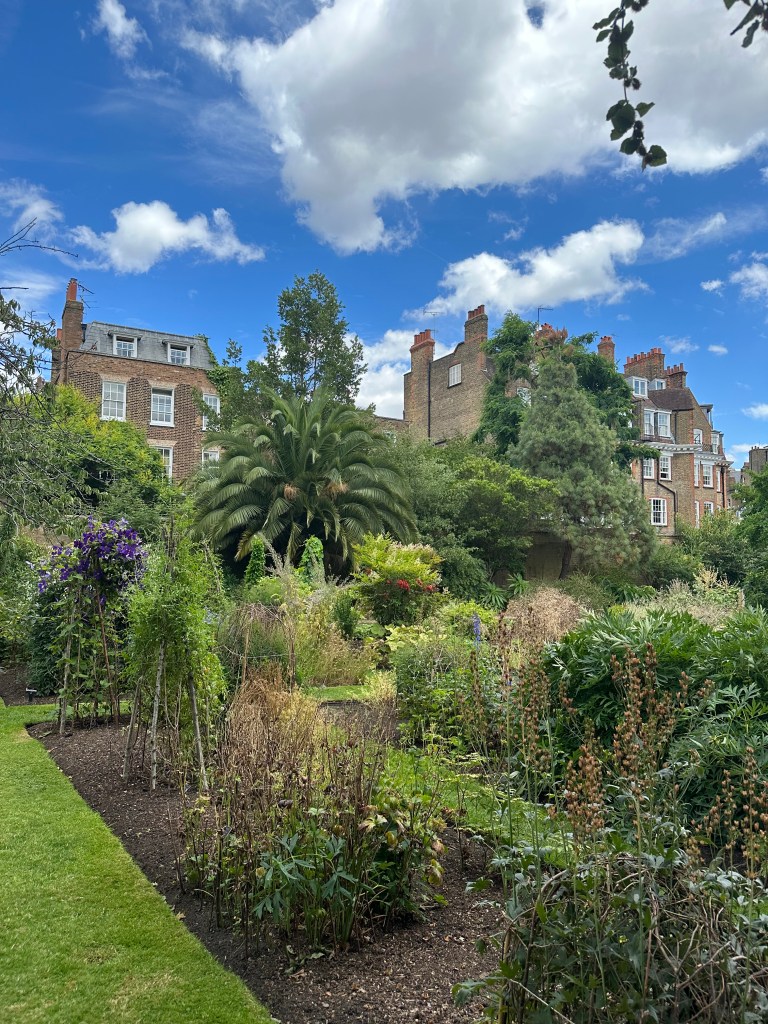
London’s oldest botanical garden, the Chelsea Physic Garden, is just around the corner from 29 Shawfield Street. It was founded in 1673 by the Worshipful Society of Apothecaries with the mission to grow medicinal plants for study and healing. Located in London, the garden played a key role in botanical research, plant exchange, and the advancement of medical science. Chelsea Physic Garden was open to the public in 1987 with the aim to increase public awareness and support for its historical and scientific significance.
I don’t know for sure if P.L. Travers ever visited the garden, she was 88 years old at the time, but it is possible. What I do know is that in her eighties she was very interested in the medicinal and magical properties of plants, probably motivated by a desire to find a cure, or at least some relief from her digestive problems. Her granddaughter Kitty, recalling childhood memories in an interview for the BBC, said her grandmother was always drinking strange teas and concoctions. These were probably the infusions she made from the herbs she cultivated on her balcony at 29 Shawfield Street.
In an interview she gave to South East at Six, a local BBC teatime news bulletin for viewers in London and the South East, promoting her book Mary Poppins in Cherry Tree Lane, we see P.L. Travers at the end of the video standing on her balcony, gathering herbs into a small wicker basket, a wooden birdhouse behind her. The balcony has a quiet, romantic storybook charm befitting of a writer steeped in fairy tales and mythology.
While the herbs aren’t central characters in the plot of Mary Poppins in Cherry Tree Lane, they do take on a magical, symbolic role during the Midsummer’s Eve adventure of the Banks children. The book also includes at its end a list of herbs with both common and Latin names that are mentioned in the story—a tangible nod to P.L. Travers’s knowledge of plants.
Occasionally, she also gave herbs as a gift to friends who came to visit her at her home.
“At the time I visited P.L. Travers in July 1979, I was feeling perplexed and confused about several things in my life, whose murkiness contrasted sharply with the clarity of the pictures in her study. (…) She also took me to her garden in the back, where she was growing more than twenty varieties of herbs, many of which appear in her recent Mary Poppins in Cherry Tree Lane. (“Taste all of them,” she suggested, “they will do you good.”) Then, as a friendly gesture, she cut off some rosemary sprigs and gave them to me (“This will last forever and bring you good luck. It means “To Remember”)
Pipers at the Gates of Dawn, by Jonathan Cott
This is all for now. I hope you enjoyed reading this post and that you’ll return to read more about Mary Poppins, P.L. Travers, and my adventures as I continue to explore their world. In the next blog post, I’ll be continuing the story of my Mary Poppins-themed trips to London and its surroundings, so stay tuned! And do let me know if you go on a Mary Poppins adventure of your own—or if you enjoy literary trips in general.
Recently, I revisited a transcript of a conversation between P.L. Travers and Janet Graham that took place in P.L. Travers’s home on June 23, 1965. I like to do that occasionally. Although I love discovering new information about P.L. Travers and Mary Poppins, and all things related to them, rereading materials I’ve gathered over the years allows me to notice things I did not see the first time. Frequently, and to my enjoyment, the information I glean sends me into another tunnel in the rabbit hole in which I fell nine years ago, and I hope you enjoy being taken along on this exploratory journey.
The title of the interview is “A Conversation About Sorrow,” and it is one of my favorite P.L. Travers interviews. All her interviews are interesting and provide much food for thought, but I notice that their quality depended a lot on the chemistry between her and the interviewer. Luckily for us readers, when she liked the journalist, she was more talkative, and I get the impression from this conversation that she did like Janet Graham.
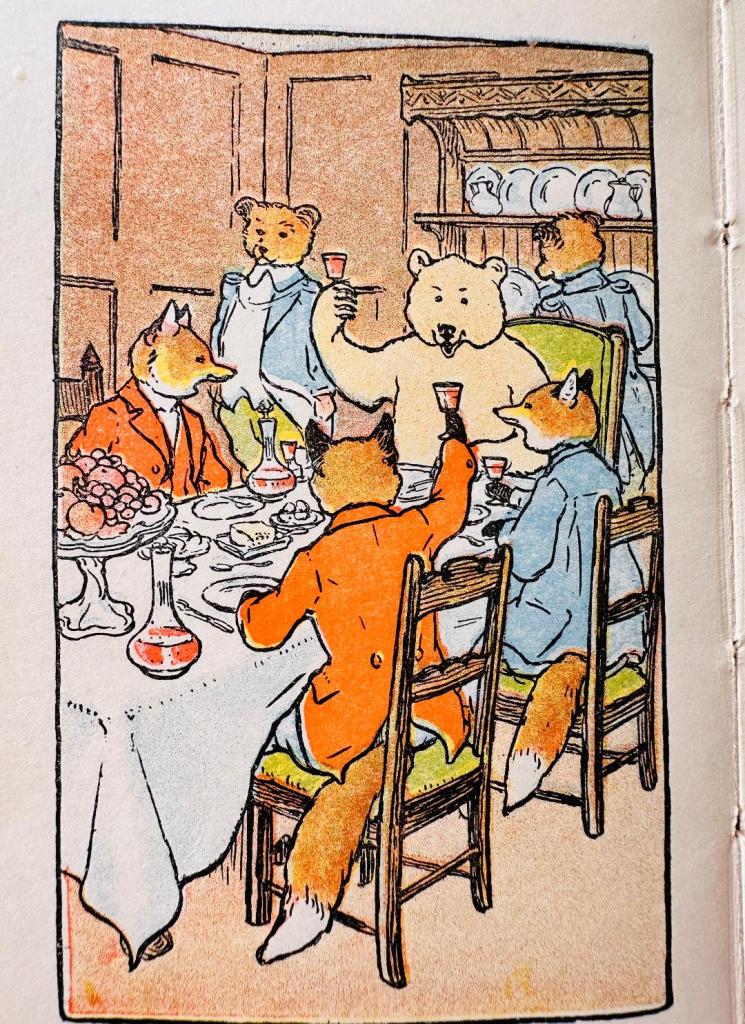
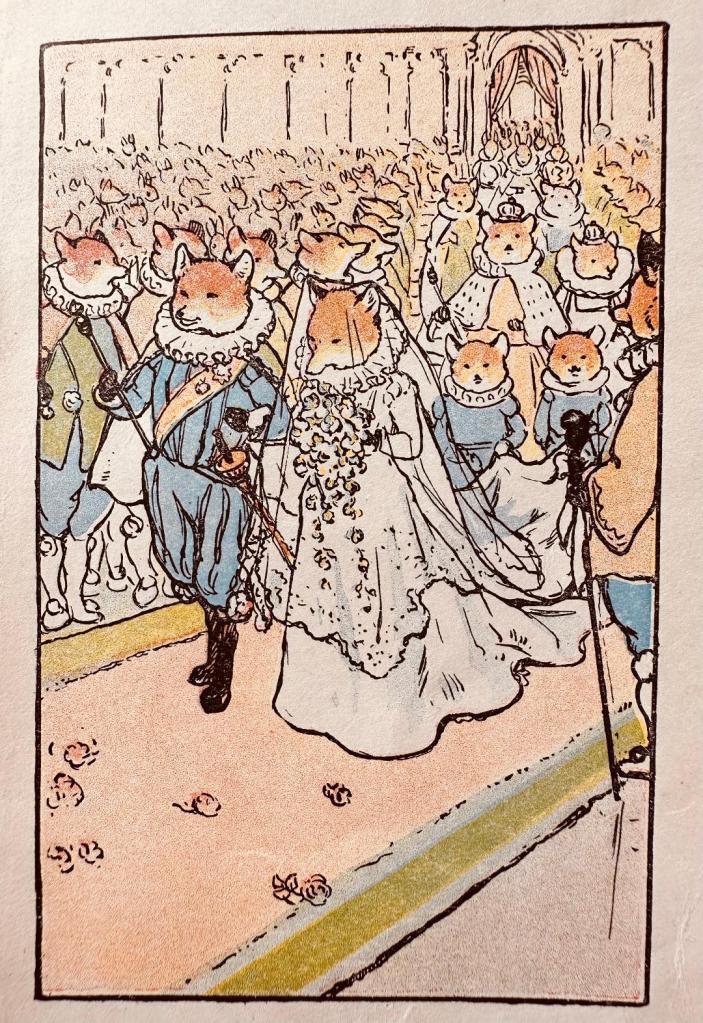
Today, I want to tell you about “The Three Little Foxes” by Mary Tourtel, a book that P.L. Travers kept with her since she was 7 years old. On the flyleaf of her book someone wrote the name of Mary Poppins, but according to P.L. Travers, it was not she who wrote it.
In the transcript “A Conversation About Sorrow” there is a handwritten note in the margin: “start of Mary Poppins”. It is right next to the passage in the interview where P.L. Travers told Janet Graham that her sister had mentioned that, as a child, P.L Travers told her siblings stories about Mary Poppins. However, P.L. Travers didn’t believe her sister to be right. She said, “I think she is having very clever hindsight”.
We will never know who wrote the name of Mary Poppins on the flyleaf. It is possible that her son Camillus wrote it when he was a young boy. He must have seen the book in his mother’s library and, knowing that she wrote the Mary Poppins stories, could have written it himself. I know I used to scribble things in books as a child, but of course, all this is just a speculation on my part.
P.L. Travers loved the story of “The Three Little Foxes”. She said, “It was a lovely story. Three Foxes called Ringo, Bingo and Lubilee – What beautiful names, Ringo Bingo and Lubilee. They were great family names; my mother was always calling us those names. She had the kind of mind quotations stuck in.”
And that is all she said about the story in the interview. What was it about? What did the little foxes do? Why did she like it so much to keep it with her all this time? Was it because of her fond memories of her mother, or was it something else?
I wanted to find out, and luckily, I managed to find an old (and affordable) copy on the Internet. It did not have ‘Mary Poppins’ written on its flyleaf, (I secretly wished it did!), but at least I now know the story and can speculate about why she might have liked it. I wonder who has her copy of the book now?
“The Three Little Foxes” tells the story of three brothers who decide to leave their cozy home and seek adventure in the world. In fact, it is the two oldest brothers, Ringo and Bingo, who are bored and need a change of scenery. Meanwhile Lubilee, the youngest brother, is quite content at home and doesn’t really have time for boredom. He is busy in the kitchen cooking and taking care of his brothers. But when the older brothers decide to leave their home, he must follow them, albeit unwillingly.
The three brothers meet a frog who tells them that if they are in search of adventure, maybe they could rescue the Fox Princess, who is kept hostage by the Old Bear Ogre. The three little foxes must go see the Queen of the Rabbits, who knows of a secret entrance to the grounds of the Bear Ogre’s castle. The Queen agrees to help them and orders one of her guards to lead the brothers through a secret passage leading to the garden where the Fox Princess likes to spend time.
When the three brothers arrive at the entrance of the passage, which turns out to be a long and winding tunnel, it is only Lubilee who musters enough courage to follow the guard. Scared Ringo and Bingo remain behind.
Lubilee succeeds in finding the garden and meets with the Fox Princess who, at that precise moment, happens to be strolling there. He tells the princess that he and his brothers have come to save her, but she warns him that the task is going to be difficult. The Ogre keeps her locked up in a lonely tower.
It was at this point in the narrative that I failed to follow the logic of the story. It is unclear (and frankly does not make much sense) why the Princess does not run off with Lubilee towards the secret tunnel and out of the garden right there and then. Instead, she tells Lubilee where the Ogre hides the key to her tower. It is in a box he uses as a footstool while sitting on his chair.
Lubilee goes back to his brothers, tells them all about the Princess and the key, and they come up with a plan on how to gain entrance into the Ogre Castle. They present themselves as acrobats who want to perform before the Bear Ogre.
During their performance, which consists of the two older brothers standing on their heads while Lubilee spins plates on sticks, the Bear Ogre sits comfortably in his chair with his feet on the footstool. However, their chance comes when Bear Ogre invites them to stay over for dinner and a little dance.
After dinner, the Bear Ogre wants to show his abilities too and he begins to dance the Keel Row. He is so taken by his dancing that he does not notice little Lubilee taking the key from the box in the footstool.
As soon as the little foxes find themselves outside of the castle, Ringo and Bingo start quarrelling over who should marry the Princess. In the meantime, Lubilee runs towards the tower and frees the Princess.
The Fox King was so glad that he called his Queen, gathered his court together and made Lubilee a Prince on the spot. Lubilee and the Princess become husband and wife.
When Ringo and Bingo finally find their way to the Fox King’s City, they begin to tell everyone who wants to hear that they were the ones who saved the Princess, and that Prince Lubilee is an impostor. Their slander lands them in a dungeon, but then good-hearted Lubilee frees them and appoints Ringo his Prime Minister, and Bingo the Commander-in-Chief of his Army. This decision seems very unwise to me…and could potentially propel Lubilee on another hero’s journey. Maybe I will try my hand at writing a sequel…but who will illustrate it?
P.L. Travers wrote an essay titled “The Youngest Brother”, it was first published in ‘Parabola’ on the theme of the Trickster in 1979 and then in “What the Bee Knows” in 1989. She reflects on the character of the youngest brother in fairy tales, who is often depicted as a simpleton, meaning, as she tells us, innocent and blessed. He is not yet burdened with knowledge and pride. He eagerly offers and accepts help from others, no matter how strange they may appear.
She goes on to explain the usual sequence in these types of stories, which “The Three Little Foxes” follows closely.
The stories always begin with a quest, something that only the three brothers can undertake. However, the usual mistake of the two older brothers is that they believe success in their quest depends solely on themselves. Consequently, they often find themselves imprisoned at the beginning of the story, unable to continue their quest.
In these stories, P.L. Travers tells us, there is also an imprisoned princess who is the youngest brother’s complementary figure. Then, the youngest brother is wronged by the older brothers who are envious and greedy, just like Ringo and Bingo in the story, and things can become quite dangerous; all can be lost.
In the end, the youngest brother forgives his brothers’ sins. P.L. Travers links this pattern of forgiveness to Plato’s myth of the Cave: “... where those who have risen to the light go down again to rescue others who still live with the shadows.”
The third and youngest brother in fairy tales is always in service of something else than himself and does not think he knows it all like his older brothers, who consider themselves to be men of the world who know their way about it.
Knowing tells us P.L. Travers is achieved through unknowing. Learning through experience, the man becomes a child – pure at heart.
She also links the progress of the youngest brother through his quest to Gurdjieff’s Law of Seven and the concept of repairing the past in the present. Although original and interesting, this calls for a separate blog post.
I hope you enjoyed this post and will come back again to read some more about P.L. Travers and Mary Poppins.
As a devoted fan of P.L. Travers, you can only imagine my delight in having the opportunity to learn firsthand about a private conversation she had with bestselling fantasy author Gregory Maguire back in 1995, a year before her passing. I hope that reading this blog post will be as much of a treat for you as it was for me to write it.
As a young boy, Gregory Maguire loved the Disney adaptation of Mary Poppins, but he loved the books more. And I believe that this is the case for most of us who first encountered the magical nanny on the page. It was certainly my own experience, but then I never saw Disney’s Mary Poppins as a child growing up behind the Iron Curtain. My acquaintance with the cinematographic version of Mary Poppins came much later and at a time when my mind had acquired its critical abilities.
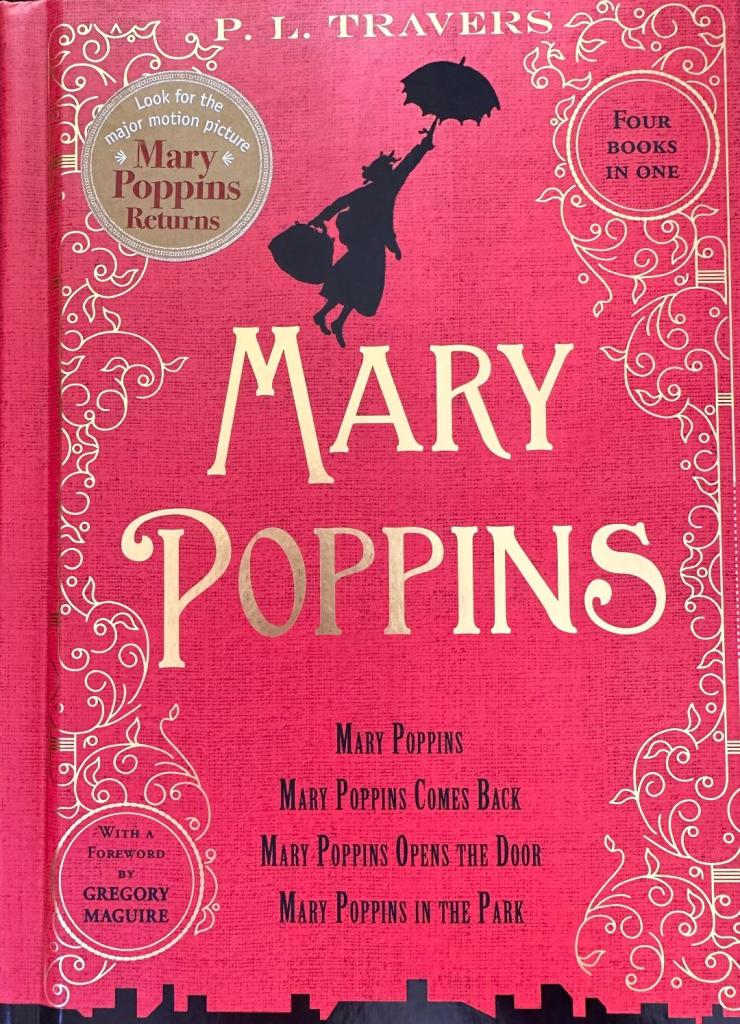
“The movie is sunny and as sweet as a spoonful of sugar. The books, though, show glimmers of a far more mysterious and even dangerous world. For thirty years before the nanny began to sing on the screen, she stalked the pages of these books with ferocity and power.” (Foreword by Gregory Maguire, Mary Poppins Collection published by Houghton Mifflin Harcourt, 2014)
I couldn’t agree more!
At the time of his meeting with P.L. Travers, Gregory Maguire was at a turning point in his writing career as he was just about to publish his bestselling novel “Wicked”. He was living in London, and after discovering that the author of Mary Poppins also lived there, he sent her a note, and in return received an invitation for tea.
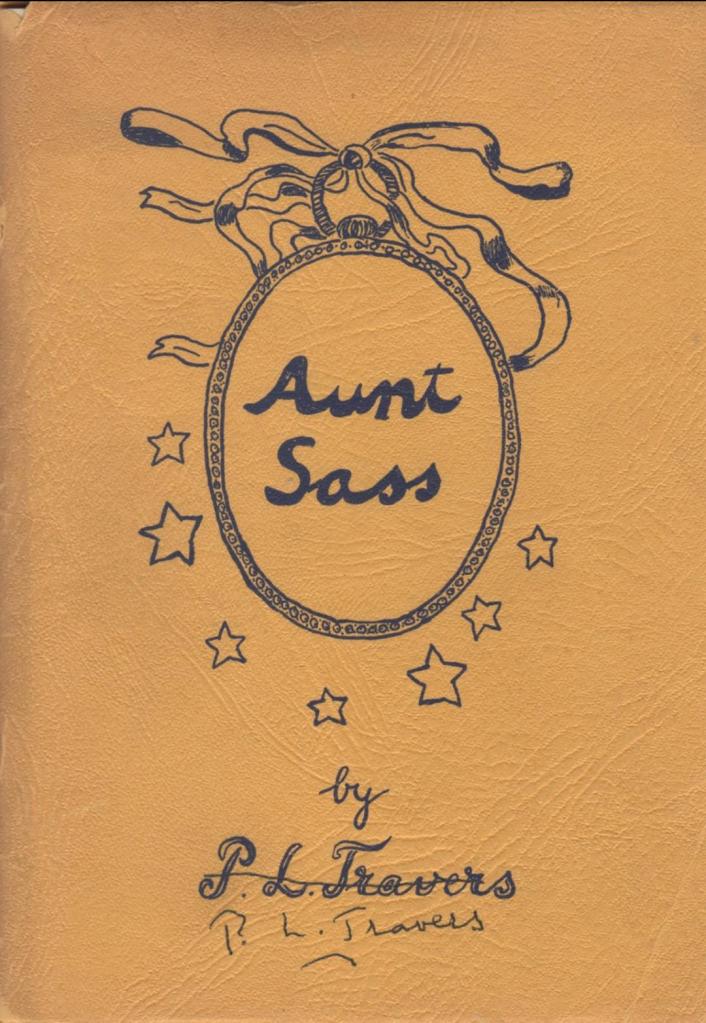
He showed up at Number 29, Shawfield Street, London on the appointed day and time with three of P.L. Travers’s books: one of the Mary Poppins books, “The Fox at the Manger” and “Aunt Sass”.
He found P.L. Travers “an old woman slumped in an upholstered chair set back from the window” in a “shadowy parlor that hadn’t been fluffed up recently”.
The meeting lasted for about an hour, but it was long enough for P.L. Travers to plant a seed for a story in her visitor’s fertile imagination. It was a comment she made about a fairy tale character, the youngest brother in the fairy tale “The Six Swans” by the Brothers Grimm. In this story the wicked stepmother turns her stepchildren into swans, and it is their sister who, in the end, breaks the spell by knitting shirts from aster flowers. Only she does not have enough time to finish the last shirt and the youngest brother is left with one swan wing instead of an arm.
P.L. Travers felt, and rightfully so, that there, at the end of one story, was the beginning of another.
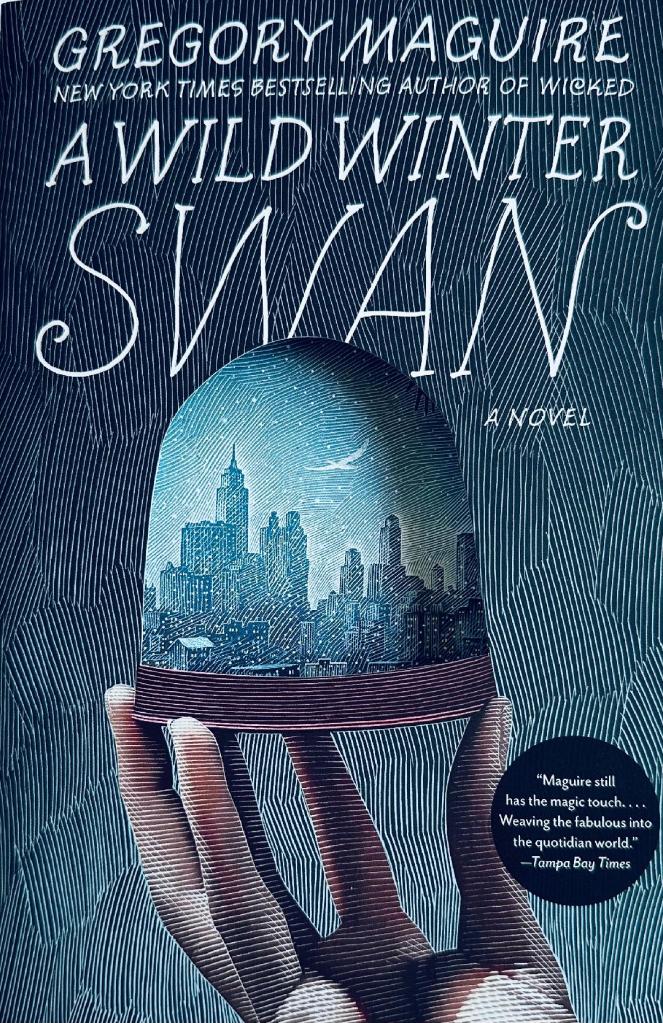
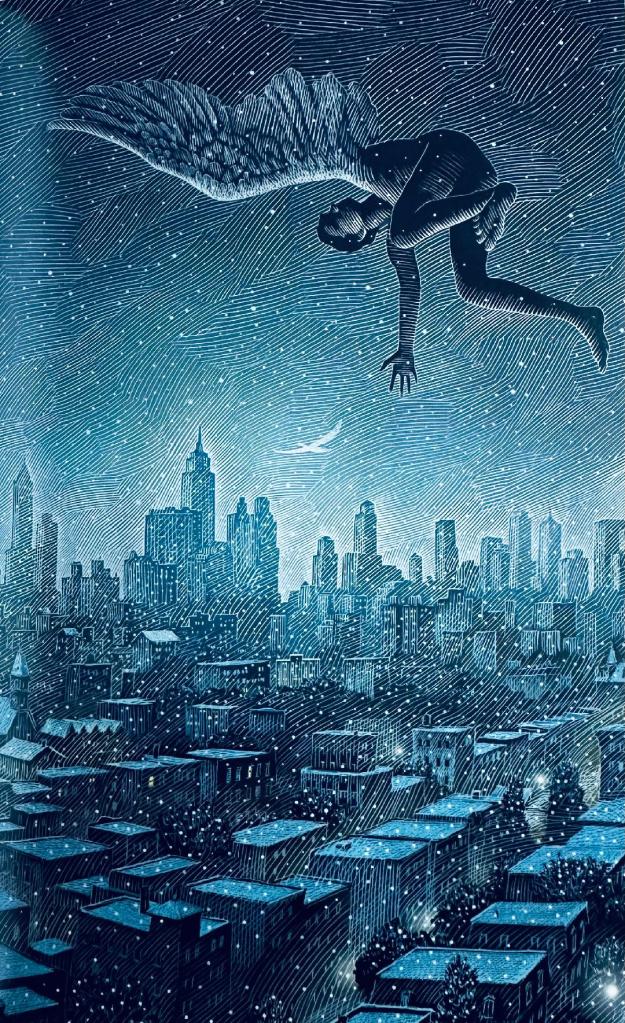
Shortly after Gregory Maguire finished writing his book “A Wild Winter Swan” but before its publication in 2020, he came across in his hand-written journals from 1995 something about P.L. Travers having said to him, “There’ a story – the sixth brother. Give him something to do. The boy with a wing. You know the one I mean?”
As the swan boy had been a beloved figure in his psyche ever since reading Hans Christian Andersen’s beautiful retelling of the Grimms’ fairy tale at the age of ten or twelve, her remark had evidently stuck in his subconscious. But that’s where Gregory Maguire tells us, seeds to stories wait.
This is by far the most exciting interview I have had the opportunity to conduct so far, but before we dive into it, and with Mr. Maguire’s permission, I am reproducing a portion of his lecture “The World at Hand, The World Next Door” presented by the Osborne Collection of Early Children’s Books for the 32nd Annual Helen E. Stubbs Memorial Lecture in November of 2019. Here is his charming recollection of his meeting with P.L. Travers.
I was living in London. Because somehow, I came across her home mailing address—perhaps in the phone book—I’d written to the author of MARY POPPINS, Ms. P. L. Travers, to thank her for her great work. She’d replied in a shaky hand ordering me to come to tea Tuesday week. Perhaps she preferred to receive tribute in person, I thought. (…) It’s nearly time to go—Number 29 Shawfield Street, London. . . .
A Georgian [row] house with a broad single window, behind palings, a small house on the east side of the street, behind a shocking pink door . . . at street level. The doorbell sharp and hard. I thought she might have forgotten, might not be there. A young woman, maybe part Jamaican, came in jeans and answered the door.
P. L. Travers sat in a chair in the corner, angled so she could watch out the window. She looked up when we came in and said to me, “Who are you?” I introduced myself—and she seemed not to hear me, but when I said again, more slowly, “Gregory” she appended “Maguire.” “You invited me to come by, and so I have, for a very short time,” I said. Mostly, in her face, were eyes and smile; she smiled like a small child; she seemed happy at everything, and smiled as a way of conversing. I had heard she was a bitch, a tart and difficult woman, but only at the end of my visit did one small comment erupt.
What follows is a sort of dialogue I devised that day out of notes I scribbled down on the back of a checkbook immediately after I had left Ms. Travers’ home. By this I mean it is more scripted than it may have sounded as it occurred—one can’t help imposing logic on scribbled notes. But the exchanges are verbatim as I could recall them even if they didn’t come out as sequentially as I put them down. Only a few words have been changed, for clarity.
PLT: I’ve been in the hospital and the nursing home for two years. I just got back. I can move very little.
GM: Can you get out at all?
PLT: Up and down the street.
GM: To the end.
PLT: To the second lamp-post. My world has shrunk to the second lamppost. But when I was out the other day, looking down to watch my feet, I found a present—
GM: —?
PLT: A star. A star!—there in the pavement. I’d never seen it there before. There’s a story—the sixth brother. Give him something to do. The boy with a wing. You know the one I mean
GM: Yes (I thought I might but wasn’t certain).
PLT: At the end of the street is a pub called the World’s End.
GM: At the other end, on the King’s Road, is a café called the Picasso Café. I sat there and a storm came up, and a rainbow came over—just ten minutes ago.
PLT: That was for you, to show you that you’re welcome here.
GM: You live between the star and the rainbow.
PLT: Yes! . . . . this is my whole world. There used to be… acres and acres of lavender, and cows mooing.
GM: Where is Cherry Tree Lane?
PLT: What?
GM: Where in London is Cherry Tree Lane supposed to be?
PLT: I don’t know what you mean.
GM: The house that Mary Poppins lived in. Is it in Chelsea? In Kensington?..
PLT: Oh! Well, no. Well, it’s…. it’s…. (she waves her hand)… It’s between here and someplace else.
GM: Do you know, I grew up on Mary Poppins. When I was ten years old, I sat on our front porch and read the books and ate sour-apple hard candy. I never forget it.
PLT: Do you know, when I came home from hospital, I picked up the second Mary Poppins book, and I began to read it. And I didn’t know what was going to happen! I turned the pages—I found it delightful. …. I didn’t know what would come next.
GM: I’m not surprised. She’s a mystery.
PLT: I don’t think we’ve seen the last of her. . . .
GM: Will you sign a few books?
PLT: It is hard to do.
GM: Maybe three? This is MARY POPPINS AND THE HOUSE NEXT DOOR.
PLT: And this is something special for you. (She draws a star). William Butler Yeats told me only to sign my name, but this is for you.
GM: Do you remember this? (A privately printed copy of AUNT SASS, which Travers had once had done up as a Christmas present for close friends.)
PLT: ! (She opens it.) Look! Stars! Nine stars! Who put those there? But where’s myname?
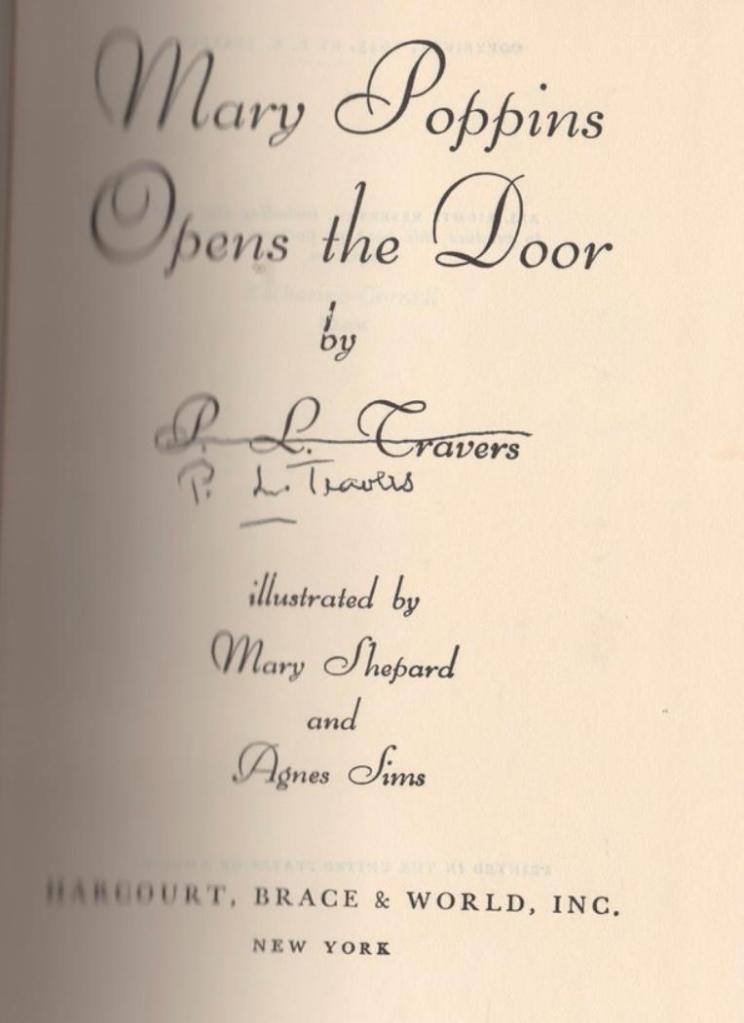
GM: On the front. (She crosses out the printed name and signs her own name.) And this last. MARY POPPINS OPENS THE DOOR. It’s my favorite.
PLT: It’s not for children.
GM: It’s Mystery. Mystery is for children.
PLT: Yes, but also for adults.
GM: Yes. Of course.
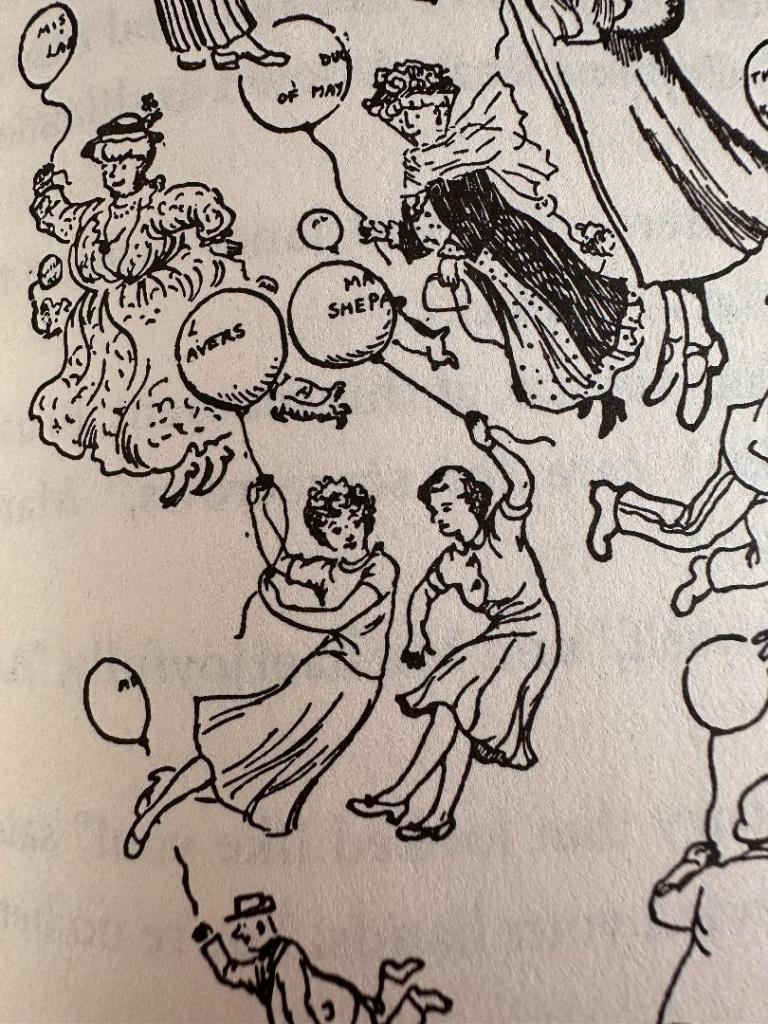
PLT: (She signs it.) I found a picture of myself in the chapter called “Balloons and Balloons.” Me and Mary Poppins and Mary Shepherd.
GM: I’ll look for it when I go home. And I should go soon. I’m flying out tonight.
PLT: Where?
GM: Dublin tonight, and Boston tomorrow.
PLT: I was at Radcliffe once, teaching. And at Smith. I loved Radcliffe. I hated Smith.
GM: Why?
PLT: A man from an American magazine called Life came to every lecture, and all the Smith girls threw themselves at him.
GM: This has been an extraordinary afternoon for me. I will never forget it. Thank you. (I kiss her.) Goodbye.
PLT: Goodbye. Write about this.
GM: Pardon—?
PLT: Write about coming here to tea.
Cheryl shows me to the door. I leave PLT sitting in the corner of the room, all eyes and smile, in a blue cardigan, knees together, hands on her knees. The big square window is now dark with dusk.
Something intriguing about the conversation: “Here I divert from my journals to insert a memory that I didn’t write down at the time. Ms. Travers elected to address me as the man who came to read the meters, and kept telling me they were out back, through that door. She seemed entirely unfazed that the meter man would arrive carrying rare copies of her hardcover books and would be conversant in arcane details of her career and work. I’ve often wondered if she wasn’t having me on.”
Reading about the man who came to read the meters made me smile. She was, most probably “having him on”. Her life quest was all about finding the meaning of life and the questions she asked in her essays were “Who are you?” and “What is man a metaphor for?” It is possible then that she was probing her guest in the manner of her spiritual teacher G.I. Gurdjieff, who used to shock and surprise his pupils with strange statements and behaviours in order to break down their habitual thought patterns and thus strip off their masks.
Now, onto my interview with Mr. Maguire and his delightful book “A Wild Winter Swan”.
LS: Is there is a possibility for a sequel of “A Wild Winter Swan”? In the ending Laura explains the swan boy’s arrival into her world in these words: “No, he has flown away from them once because he could not bear to be other than wholly human. Now he has to try the alternative. He really doesn’t have a choice. Do we.” But what if that alternative does not prove to be the solution either?
GM: I have not contemplated writing a sequel to “A Wild Winter Swan” —but I never say never with conviction. I had not contemplated writing a sequel to “Wicked”, and it was ten years before “Son of a Witch” came out. There have been five more books about my take on Oz after that one—so far.
Still, in regard to “A Wild Winter Swan”, I admit there is something both sad and satisfying in the loss of a character whom one has come to love—even one who is ultimately bewildering. Not unlike, come to think of it, a certain Mary Poppins herself. I tried to leave the reader with a sense of insecurity about how and even why this boy, Hans, had landed in Laura’s life.
LS: Yes, I did wonder about that too. Did Laura somehow summon him because she herself was in a liminal state of being; suspended between the dreamland of childhood and the demands of adolescence, all in the background of the dire circumstances of her personal life? Or was it the other way around. Why did the swan boy happen to Laura?
GM: Why does anything happen to anyone? Why did Peter Pan land on the nursery windowsill of the Darling family instead of the family next door named the Oblenskys, with their fat little cousin visiting from Moscow, the one who dangled the family turtle from a third-floor window and nearly decapitated it? It just happened. Wendy’s mother told stories, after all, and Peter wanted to hear the stories.
Hans might just have landed on Laura’s windowsill by chance. Things happen in stories. On the other hand, Laura had just read the Andersen tale to those first-grade students. Then she’d come home and helped rescue a worker about to fall off Laura’s own roof. The conditions of Hans’s arrival were established in her mind by the events of the day. Maybe they helped her recognize him when it happened—or maybe it was happening largely in her mind, a dream and hope of escape and of rescue from her increasingly dire situation. (Of course, no one else saw the visitor except the cat, and there is the matter of the bloody eels, the most proof that someone else is in the house with the Ciardi family. But maybe the cat did get the eel itself, and Laura was inventing what else must have happened in the terms of the story going on in her head.)
This makes a sequel hard to position in my imagination, for in order for there to be more to Hans, I would have to be more definite about how, and what, he actually is—and that he lives outside of the story Laura is busy telling herself in her own head. And I’m not sure of that myself.
The point is, while I think that Hans is real, and so does Laura, others might not be so sure.
LS: I believe Hans to be real too, but maybe other readers will interpret the story differently. P.L. Travers said that a book is only half the writer, the other half being the reader. I wonder if you intentionally made the parallel between Laura’s inner strength and that of Elise in Andersen’s story.
Elise must knit shirts from stinging-nettle without ever saying a single word and at the risk of perishing because of it. Laura does speak in the story, but she is mute about the existence of the swan boy, and she goes about his rescue in the most secretive way despite all the challenges that his presence creates in her already troublesome situation.
I found Laura to be just as self-contained, determined and resilient as Elise in Andersen’s fairy tale. And just like in Andersen’s fairy tale, by saving the swan boy, Laura saves herself. Did you start writing the story with the end in mind, or did the narrative unfold organically in this way?
GM: When I began to write the story, I wanted Laura to be clever imaginatively but not socially—perhaps a bit backward in school. I never know how stories are going to end when I start them—that means I am uncovering the story in an organic way, as I want readers to do, too. I didn’t realize until about 2/3 of the way through the story that as Laura didn’t have the capacity—as Elise in Andersen’s story didn’t, either—to do surgery upon the swan boy and convert his swan wing to an arm, there really was only one other choice: she had to return to him a second wing, and confer upon him agency to fly away. This is also what she has to do for herself, and so I intended that the act of rescue for Hans should be synonymous, or at any rate practice, for the act of rescuing herself.
LS: Why did Laura’s grandparents choose a boarding school in Montreal as an alternative to her education? I live on the south shore of Montreal and work in the city, so naturally, this caught my interest.
GM: There is one main reason for this. As I loved books like “A Wrinkle in Time”, “Mary Poppins”, “The Wizard of Oz” and the Narnia books—among many others—I noted even then that there is a consistency of literary genre in these beloved titles. I didn’t know the word “fantasy” until I was in high school, I mean not as applied to a type of story. I called them “magic books” —books about magic (though they seemed to do magic, too, in how they made me feel!)
But I had one favorite title from childhood that was not a literary fantasy. It was the novel by Louise Fitzhugh called “Harriet the Spy”. You’ve heard of it, and perhaps you’ve read it. Harriet is a sixth-grade girl who spies on her classmates, writes things down in her journal, and intends to become a writer when she grows up. She is wildly curious and, like all children, quite naive, but she is working at increasing her bank of experiences so she can understand the world better.
In writing “A Wild Winter Swan”, I wanted to pay homage to Harriet a little. I set the story in roughly the same patch of neighborhood where Harriet lives, on the Upper East Side of New York—and in very nearly the same couple of years. (“Harriet the Spy” came out in 1964, I think, and my story takes place in 1962.) I imagined Harriet and Laura passing one another on the pavement. I didn’t want Laura to be a writer per se, as that would be too imitative, and besides Laura’s capacity to “see” and experience Hans is predicated on her simplicity, perhaps her simple-mindedness—so working arduously with words the way Harriet does would contradict Laura’s open and believing nature. Her gullibility, perhaps.
Instead, I had Laura “think” stories—narrate her own experiences in her head as she would write them—if she were a writer. She is not shy of imagination and thoughtfulness, after all—or of imaginative sympathy—but she is not academically robust, either. This method allowed me to have Laura comment on her own experiences but only in her head. It’s another proof that she lives in her mind, and therefore another hint that the incidents with Hans may be self-generated. (You might say she is having a schizoidal break, unable to separate between reality and fantasy. I mean some might say that. I wouldn’t.)
In “Harriet the Spy”, the child’s beloved governess leaves the household about halfway through the novel to get married. She tells Harriet she is going to move with her beau to Montreal. To Harriet, Montreal seems as far away as the moon. “Mon-tre-ALLLL?” she wails when she hears the plan. My threat of sending Laura to Montreal was a quiet tip of the hat to Louise Fitzhugh.
I like Montreal, though. My big sister, who was a little like Laura in 1962, grew up and married a Canadian man and spent all her adult life in Montreal, Quebec, and Toronto, and is now retired as a grandmother in Ontario. So, growing up in Albany NY, Montreal was to me a place of warmth and attraction, and I liked, and like, visiting.
LS: In your interview by Kristen McDermott, you say that “Magic helps the young reader skip over some of this as-yet-imponderable mysteries and supplies instead a set of inchoate influences that organize a mystifying world to the young mind.” What role and significance does magic hold in the world of adult readers?
GM: At this point in my life I think fantasy is largely a gift for the young. I don’t seek it out to read as an adult (though I do love to return to books I loved as a child). There are some exceptions. The Philip Pullman novels come close to matching, in moral seriousness, what Ursula Le Guin managed in her Earthsea books. But I think a sort of disservice has been done to the reading of fantasy by the technical marvels of CGI in the film industry. When virtually anything can be pictured, and pictured convincingly, thanks to the wizardry of computer animation etc., then the thrill of reading of something impossible happening on the page is somewhat demoted.
The strength of fantasy in the lives of children is still potent, though. Fantasy still has power to charm because children have not yet finished pacing off the dimensions of the structure of reality. In fantasy, they are playing with “what might be” without being entirely sure. Of course once they get to the age of five, most children realize that humans don’t fly, and can’t fly, and they won’t—and yet they can fly in their dreams! So what’s that all about? And there are other enchantments (the thrill of romance and sex, when they get there) that will seem to open up the world to them in ways they couldn’t have anticipated a year or two earlier.
While adults, having convinced themselves that they’ve (largely) got the measure of reality, must approach fantasy in literature with a different expectation. Indulging in that literary art is a bit nostalgic, perhaps; it can more easily be read as metaphoric; in any case fantasy is at least diverting and a consolation, allowing one to turn away from the vicissitudes of our increasingly hostile and dangerous life on this planet. But as a rule, fantasy literature for adults can no longer tempt as a possible alternative construction to reality that we might someday find our way into embracing—as Laura does, in my story. That magic casement is closed. Peter Pan knows it, and so even does Mary Poppins.