Discover Mary Poppins’ London: A Literary Travel Guide for Fans of P.L. Travers – Part II 

Dear Reader, 

This post continues the story about my first Mary Poppins–themed trip to London with my daughter in the summer of 2023. In last month’s post, I shared our visit to P. L. Travers’s former homes at 50 Smith Street and 29 Shawfield Street in Chelsea. If you haven’t read it yet, you can find it here

In this blog post, we will visit St Paul’s Cathedral, stroll through Poppin’s Court near Fleet Street, shop for parrot-headed umbrellas at James Smith & Sons and admire the Mary Poppins statue in Leicester Square Gardens.  

St Paul Cathedral, London 

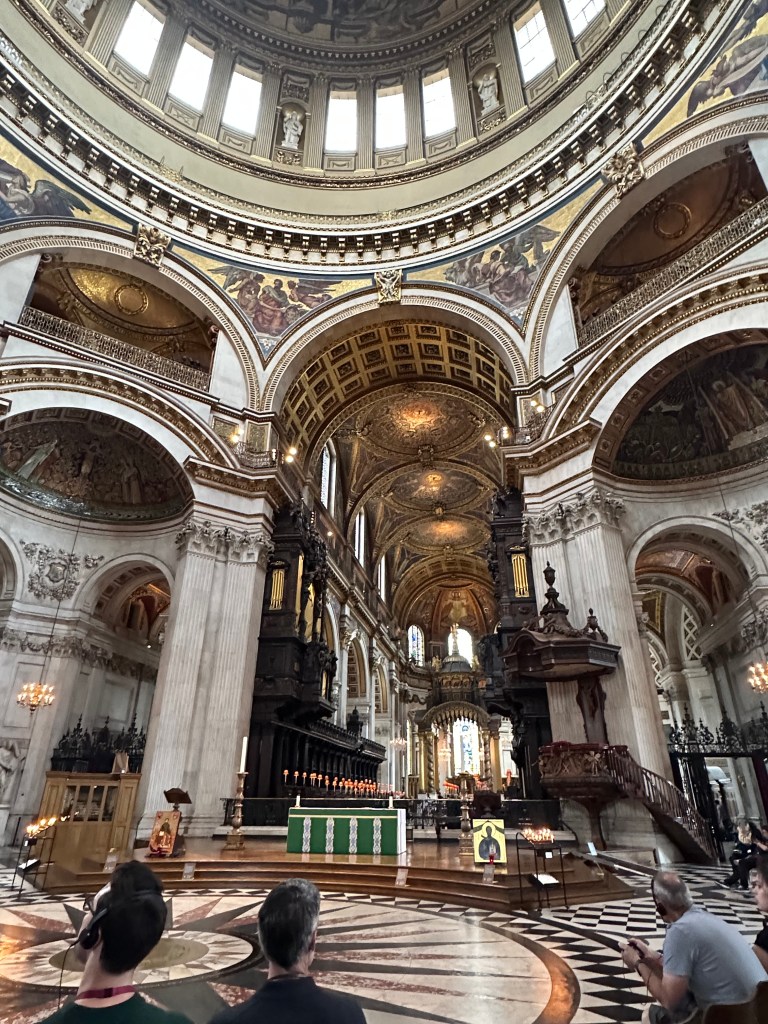
If you find yourself in London, a visit to St Paul’s Cathedral is, in my humble opinion, an absolute must. Its grandeur is astonishing—from the soaring colonnades to the magnificent domed ceiling—and the vast interior, adorned with intricate mosaics, takes your breath away the moment you step inside.

This iconic landmark was especially dear to P.L. Travers, who featured it not only in The Bird Woman chapter of her first Mary Poppins book, but also in her later 1975 Christmas tale The Fox at the Manger. I’ve explored this story in detail on the blog—you can read more in: A Christmas Story by Pamela L. Travers, The Nativity Reimagined by the Author of Mary Poppins, The Fox at the Manger (Part I) and (Part II). 

In The Bird Woman, Mary Poppins takes the Banks children to visit their father who works at the bank, where he, as described in the very first Mary Poppins story, East Wind, “sat on a large chair in front of a large desk and made money. All day long he worked, cutting out pennies and shillings and half-crowns and threepenny-bits.”   

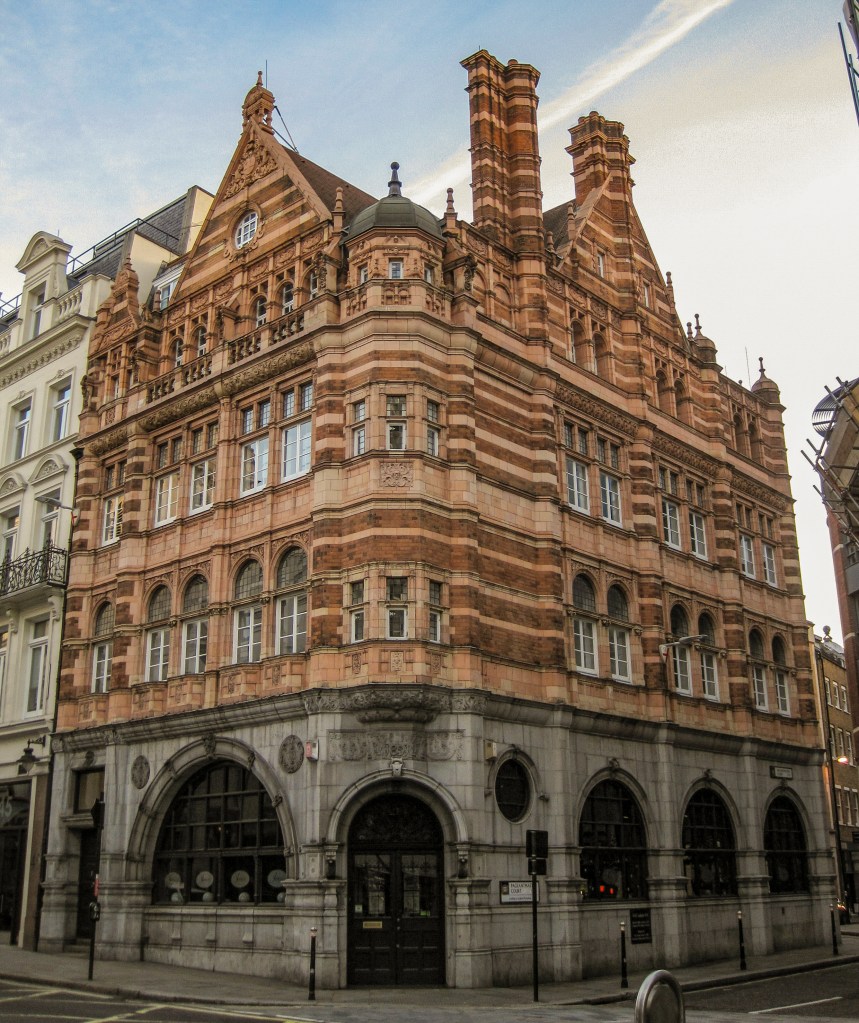
I wish the idea of looking up banks around St Paul’s Cathedral had occurred to me while I was there, but it didn’t—so this will have to go on my list for my next trip to London. I’m talking about the bank where I believe P. L. Travers imagined Mr. Banks working: the Ludgate Hill branch of the City Bank at 45–47 Ludgate Hill, which, according to Memoirs of a Metro Girl, is now a wine bar.

The picture above was taken by Metro Girl and is shared here with her permission 🙂

How do I know this was the bank P. L. Travers had in mind when she wrote “The Bird Woman”? Because she writes: ‘They were walking up Ludgate Hill on the way to pay a visit to Mr. Banks in the City.’  

In The Bird Woman we learn that Mr. Banks is entirely absorbed in material pursuits and has no time for small pleasures. But we can hardly blame him—he is the sole provider for his ever-growing family (by the second book in the series, the Banks family counts five children). Hoping to offer him a rare moment of joy and respite, Mary Poppins and the children plan an outing for tea and Shortbread Fingers. Yet Jane and Michael are far more excited by the possibility of meeting the Bird Woman and her pigeons outside St Paul’s Cathedral than by the promised tea and shortbread.    

Because of the sharp contrast between the Bird Woman’s quiet act of feeding the birds and Mr. Banks’s worldly occupation, The Bird Woman takes on a distinctly spiritual undertone for the adult reader. The doves, traditionally associated with the Holy Spirit in Christianity, serve here as a visual metaphor for the nourishment of the soul. Clearly, P.L. Travers is concerned with our human struggle to balance material responsibilities with the quest for spiritual fulfilment.  

Yet for carefree Jane and Michael, the Bird Woman and her doves are simply companions to delight in and play with. For them, the magic of the day is found in this gentle, enchanting encounter—an experience that carries them beyond the ordinary and into a realm of wonder. 

I love how P. L. Travers conveys Jane and Michael’s understanding of the doves, while at the same time revealing her own gift for remembering how to see the world through the eyes of the child she once was. 

There were fussy and chatty grey doves like Grand-mothers; and brown, rough-voiced pigeons like Uncles; and grey, cackling, no-I’ve-no-money-today  pigeons like Fathers. And the silly, anxious, soft blue doves were like Mothers. That’s what Jane and Michael thought, anyway.” 

Jane and Michael (and probably P.L. Travers) relate to the animal world far more naturally—and kindlier—than most adults. To them, the birds are not pests but companions, each a living being with its own character. We, on the other hand, tend to brush past pigeons and doves as if they were mere annoyances, hardly pausing to see them at all—too busy rushing for the train or speeding down the highway, intent on our own version of cutting pennies and shillings. 

I experienced my own version of feeding the birds—not at St. Paul’s Cathedral, but in St. James’s Park. While we were there, a little girl, slightly older than Jane and Michael Banks, had a bag full of seeds. She was not only feeding the birds but also offering seeds to passersby who, like me, wanted to join in the experience. It was deeply touching, and here is a short clip of me feeding the birds.

Feeding the birds in St. Jame’s Park

Many of the characters in the Mary Poppins stories—if not all—have their roots in the real-life experiences and encounters of P.L. Travers. She rarely revealed these inspirations openly, though hints occasionally surfaced in interviews she gave throughout her long writing career.  

I have never come across an interview in which P. L. Travers spoke about the origin of the Bird Woman. However, I did find an old picture of a man standing outside St Paul’s, his arms and shoulders alive with pigeons as he feeds them. In the late 1920s and early 1930s, while working as a freelance journalist near Fleet Street, P. L. Travers often passed by St Paul’s Cathedral, and I can’t help but wonder whether this man might have been the true inspiration behind the Bird Woman. 

St Paul’s Cathedral, as P.L. Travers writes in The Bird Woman, was built long ago by “A man with a bird’s name. Wren it was, but he was no relation to Jenny.” That man, of course, was Sir Christopher Wren, England’s most celebrated architect of his day. When my daughter and I visited St Paul’s Cathedral in the summer of 2023, we saw a lovely exhibit inside about Sir Christopher Wren and the reconstruction of the building after the Great Fire of London in 1666. 

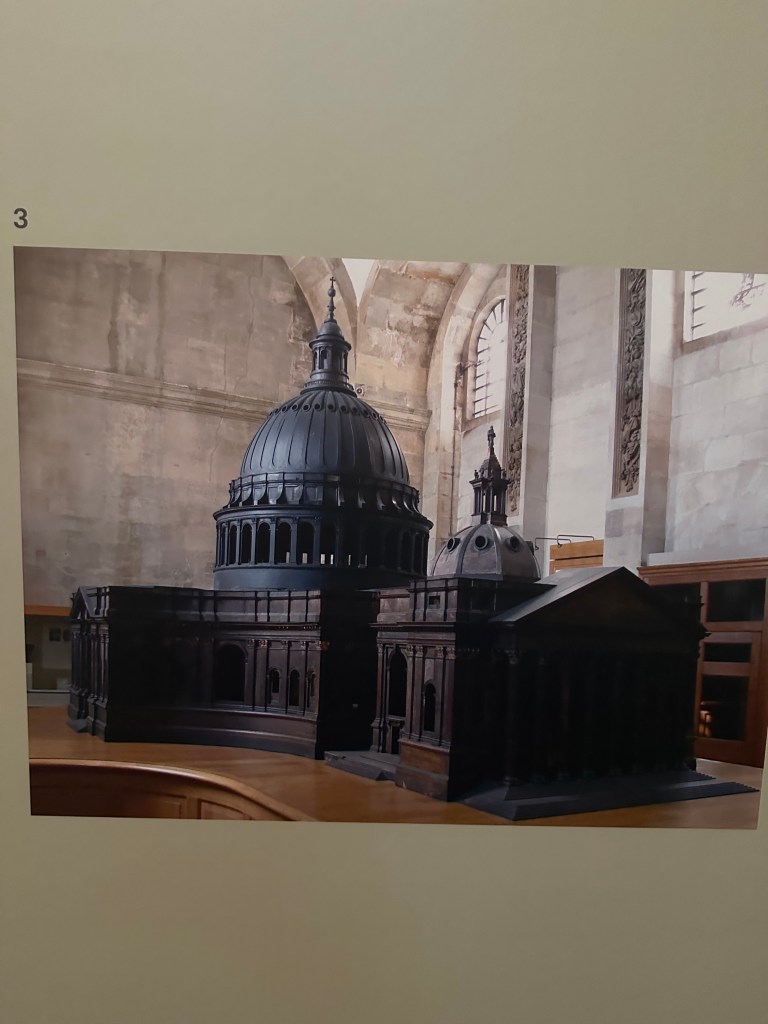
Wren designed the Great Model of the cathedral in 1672–73. The version you see in the picture below was executed by William Cleere and a team of thirteen joiners. This design differed from the original in style, evolving from the “Greek Cross” plan by extending the nave and adding a domed bell tower. 

King Charles II, who awarded the reconstruction contract to Wren, requested a slight modification: the domed bell tower had to be replaced with a traditional spire. But Wren was not a man easily discouraged. Once the plans were approved and the contract signed, and construction was well under way, he discovered a loophole in the fine print: it permitted ornamental rather than essential changes. So, he made his alterations accordingly. 

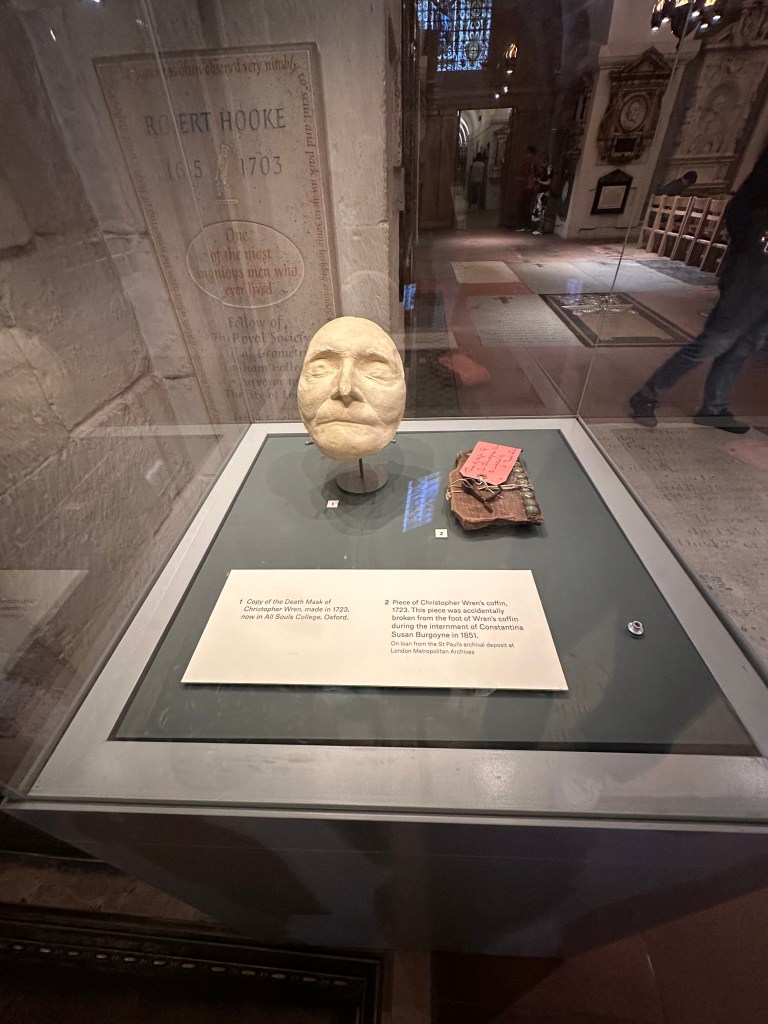
St Paul’s Cathedral is also Wren’s final resting place. Below is a photo of a copy of Wren’s death mask—the original is preserved at All Souls College in Oxford. A little morbid, perhaps, yet also a fascinating human attempt at transcending death.  

Now who is Jenny Wren? What did P.L. Travers meant by saying that Wren was not related to Jenny? The reference is a pun woven by P.L. Travers—one I had completely missed, since English folklore and nursery rhymes were not part of my upbringing. For those who may also be unfamiliar: the wren, a tiny brown bird, was affectionately called “Jenny Wren” in English tradition. She appears in old songs and nursery rhymes, often paired with Robin Redbreast as husband and wife. 

Children in P.L. Travers’s time would have instantly recognized “Jenny Wren” as shorthand for the little wren, and the playful wordplay would have delighted them. It signals to young readers that the world is whimsical, alive with hidden connections. The pun weaves together architecture (Wren), folklore (Jenny Wren), and the story’s imagery of birds and the mystical Bird Woman—perfect for a chapter set at St. Paul’s amid flocks of pigeons. 

And for adult readers, there’s yet another layer: an echo of Dickens. Jenny Wren is also a character in Our Mutual Friend. That reference escaped me as well, but this Dickens novel has now joined my ever-expanding TBR list. 

Poppin’s Court 

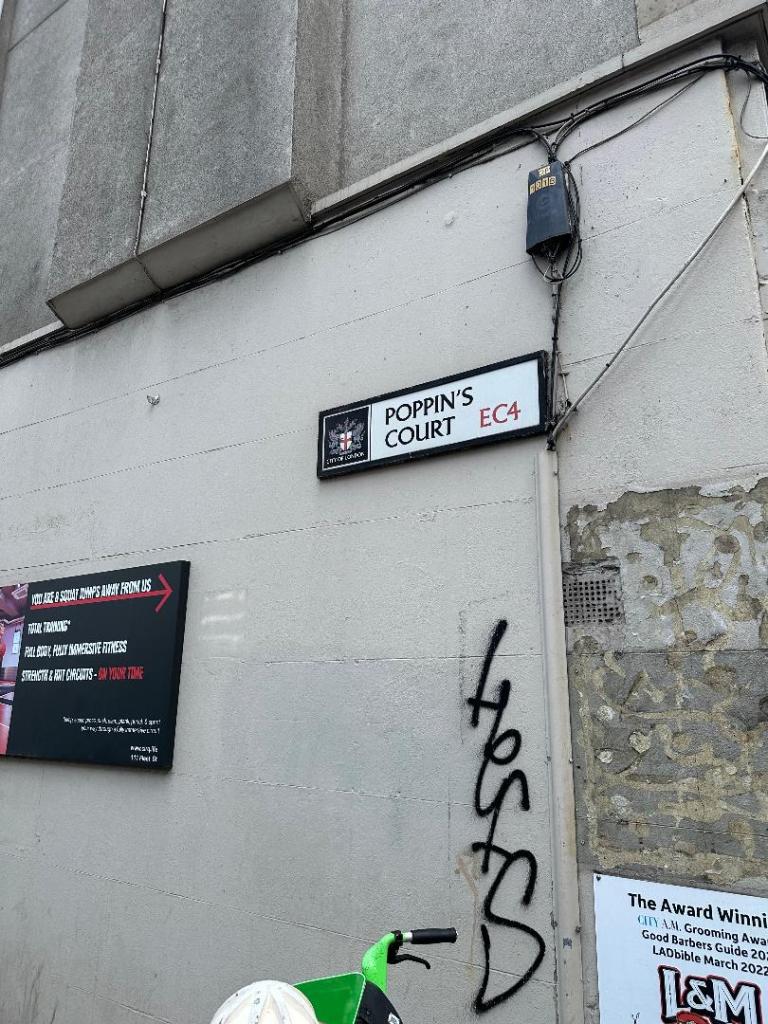
Not far from St Paul’s Cathedral, just off Fleet Street, you will come across a narrow lane called Poppin’s Court. When P.L. Travers first came to London she worked as a free-lance journalist on a street near Fleet Street and she must have passed by Poppin’s Court on her way to St Paul’s Cathedral, and it is, as her friend Brian Sibley wrote, possible that this is how she came up with the idea for the name of her famous nanny.  

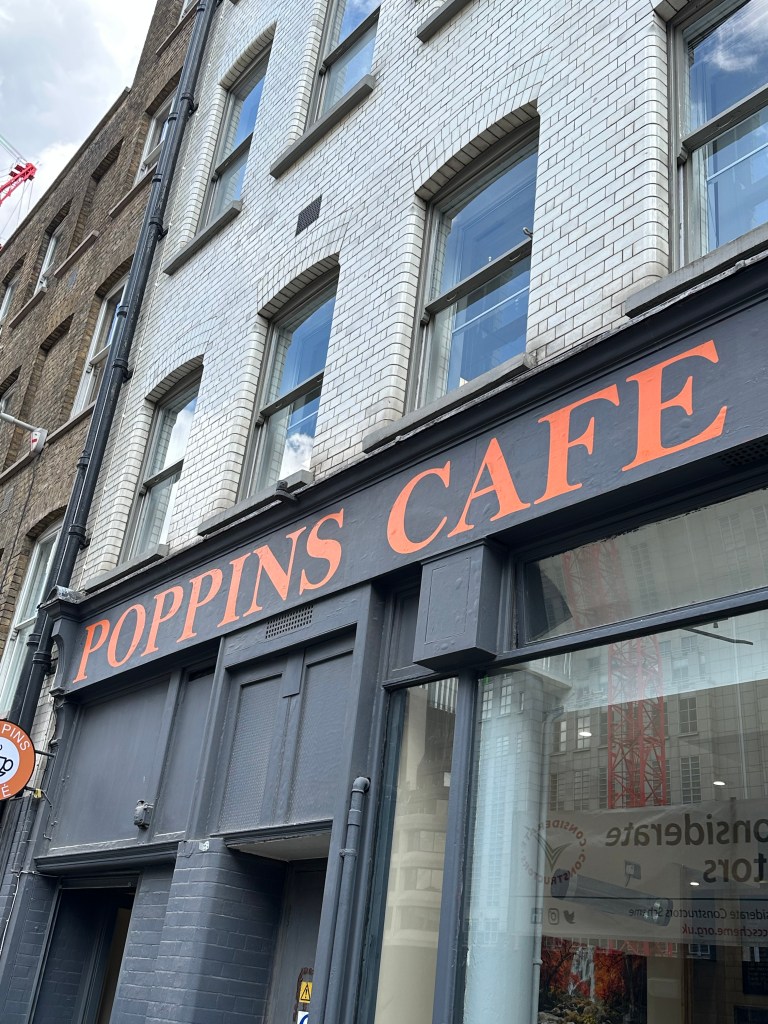
Back in 2023, when my daughter and I visited Poppin’s Court, there was a Poppins Café, which may still be there. Sadly (for me), it had nothing to do with Mary Poppins. I would have loved to visit a Mary Poppins–inspired tea room based on the books.

Leicester Square Gardens 

If you have time, be sure to stop by Leicester Square, where you’ll find several statues capturing iconic movie moments from different decades since the 1920s — and of course, one of them is Mary Poppins. Although the Mary Poppins statue in Leicester Square celebrates the film character rather than the one from the books, I couldn’t resist trying to ‘fly away’ on her umbrella. 

Since this Mary Poppins statue was created many years after P.L. Travers’s death, we can only guess what she might have thought of it. What we do know is that she once wished for a statue of her character in London—though her dream location was Kensington Gardens. I will tell you more about that in a future post on this blog.  

James Smith & Sons Umbrellas  

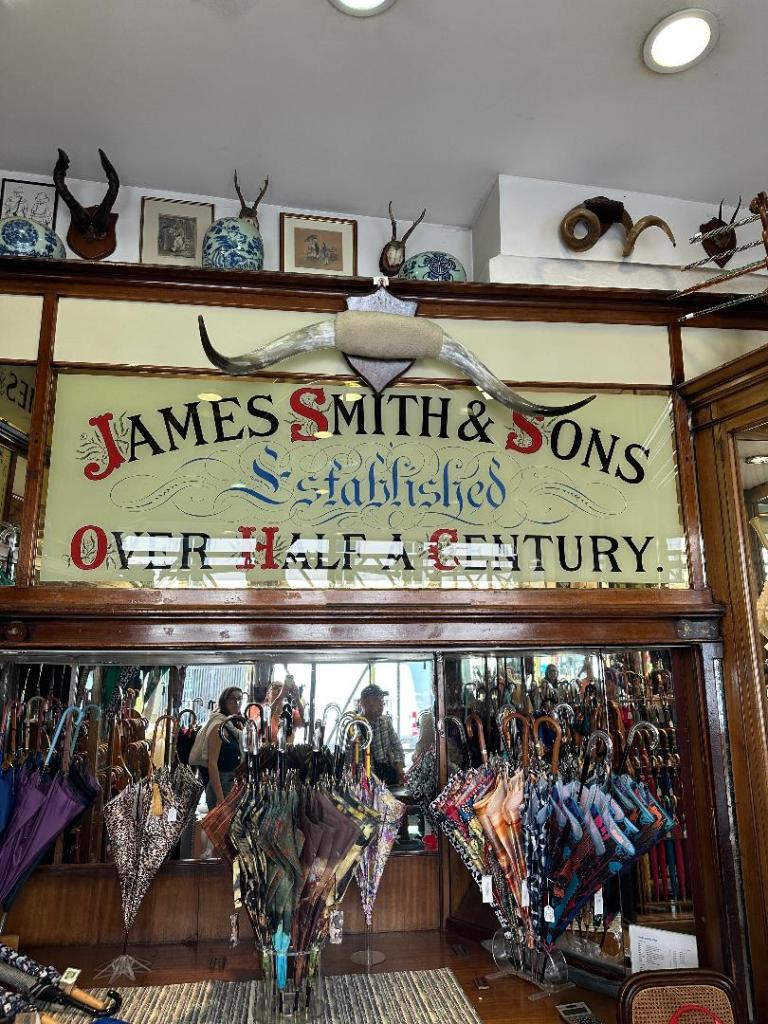
If you want to get a parrot-headed umbrella like Mary Poppins’, you should definitely visit James Smith & Sons Umbrellas, a tiny shop founded back in 1830. I have no idea whether P.L. Travers knew about this shop or if she ever visited it. According to her own account, the inspiration for the parrot-headed umbrella came from a childhood memory of a servant’s umbrella in the Travers household in Australia (and maybe by something else, which I also plan to tell you about in a future post). But whether or not P. L. Travers ever visited this shop, I thoroughly enjoyed our own visit — dampened only by the scaffolding on the facade, which was under renovation.  

Here is a picture of a parrot-headed umbrella standing proudly beside another famous fictional character. I was tempted to purchase both, but the price tag quickly discouraged me. But two years later I am still thinking about this parrot headed umbrella … 

That’s it for now—thank you for reading! If this post brought you a little joy, just click the subscribe button in the bottom-right corner of your screen and join me for the next stop in my Mary Poppins adventures through London and beyond. You can also follow along on Facebook and Instagram for more glimpses into the magical world of Mary Poppins and P.L. Travers. 

Until next time, take care and be well. 

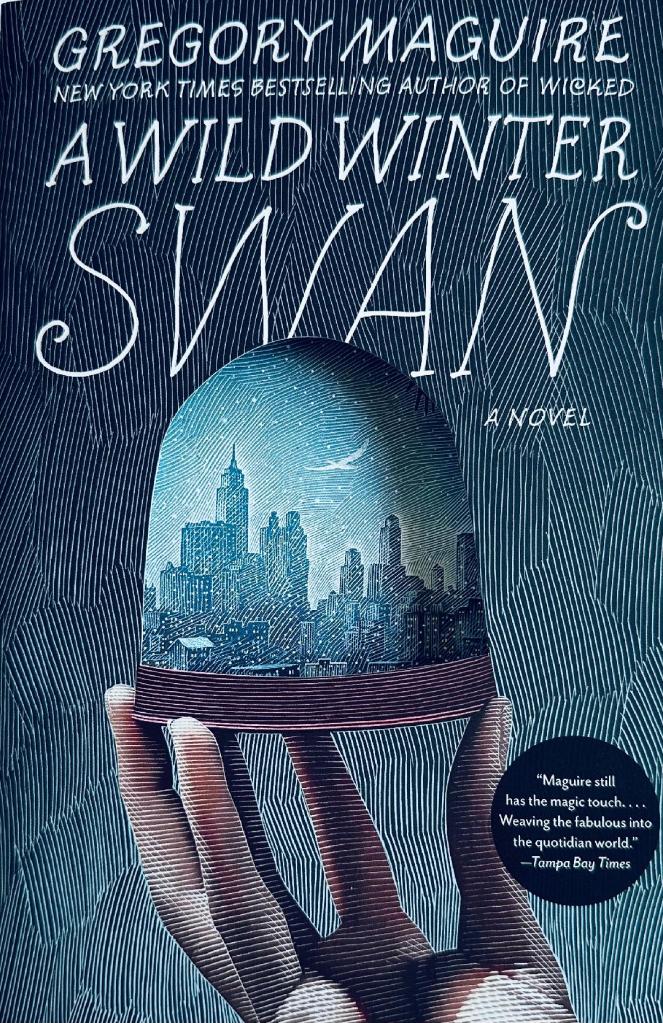
Gregory Maguire Remembers P.L. Travers and Talks About His Book “A Wild Winter Swan”

Dear Reader,

As a devoted fan of P.L. Travers, you can only imagine my delight in having the opportunity to learn firsthand about a private conversation she had with bestselling fantasy author Gregory Maguire back in 1995, a year before her passing. I hope that reading this blog post will be as much of a treat for you as it was for me to write it.

As a young boy, Gregory Maguire loved the Disney adaptation of Mary Poppins, but he loved the books more. And I believe that this is the case for most of us who first encountered the magical nanny on the page. It was certainly my own experience, but then I never saw Disney’s Mary Poppins as a child growing up behind the Iron Curtain. My acquaintance with the cinematographic version of Mary Poppins came much later and at a time when my mind had acquired its critical abilities.

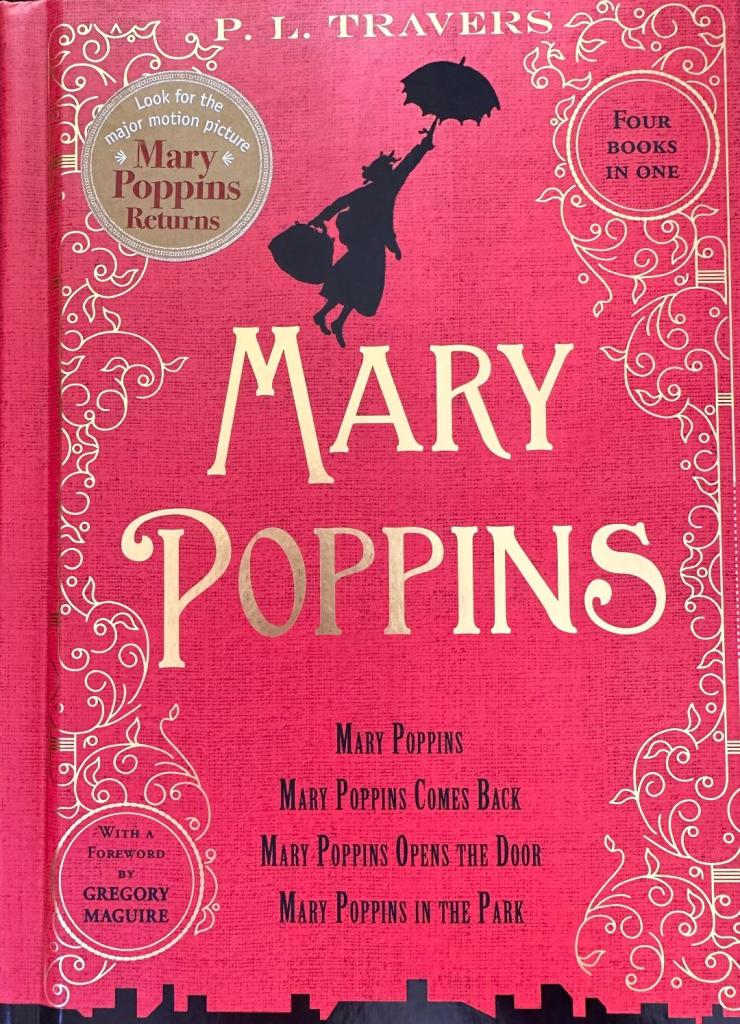
The movie is sunny and as sweet as a spoonful of sugar. The books, though, show glimmers of a far more mysterious and even dangerous world. For thirty years before the nanny began to sing on the screen, she stalked the pages of these books with ferocity and power.” (Foreword by Gregory Maguire, Mary Poppins Collection published by Houghton Mifflin Harcourt, 2014)

I couldn’t agree more!

At the time of his meeting with P.L. Travers, Gregory Maguire was at a turning point in his writing career as he was just about to publish his bestselling novel “Wicked”. He was living in London, and after discovering that the author of Mary Poppins also lived there, he sent her a note, and in return received an invitation for tea.

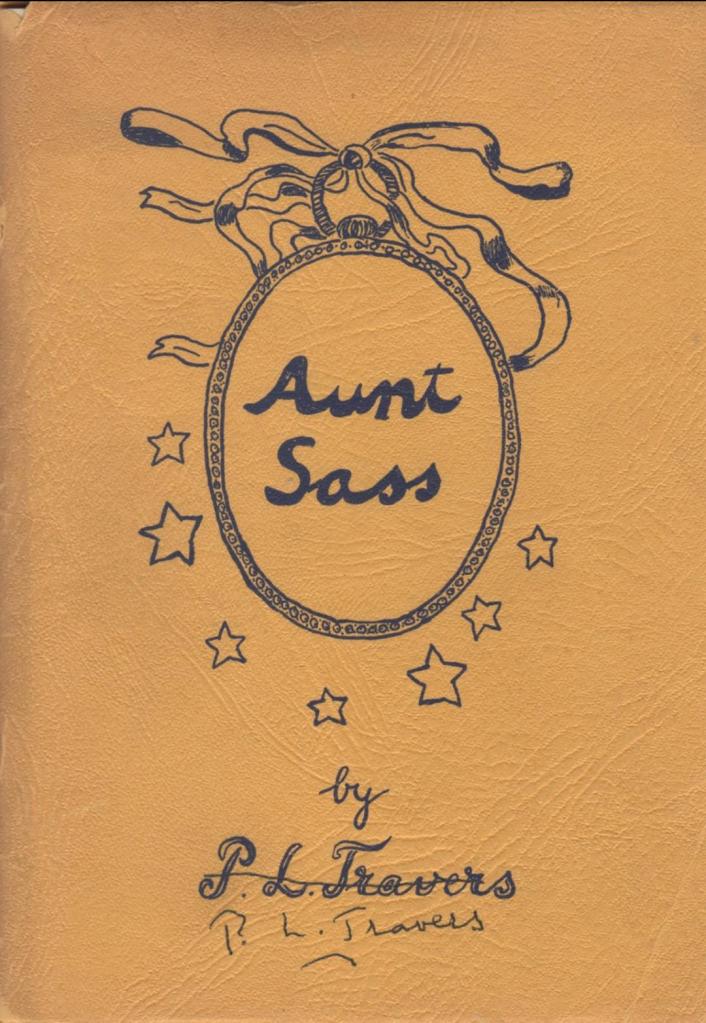
He showed up at Number 29, Shawfield Street, London on the appointed day and time with three of P.L. Travers’s books: one of the Mary Poppins books, “The Fox at the Manger” and “Aunt Sass”.

He found P.L. Travers “an old woman slumped in an upholstered chair set back from the window” in a “shadowy parlor that hadn’t been fluffed up recently”.

The meeting lasted for about an hour, but it was long enough for P.L. Travers to plant a seed for a story in her visitor’s fertile imagination. It was a comment she made about a fairy tale character, the youngest brother in the fairy tale “The Six Swans” by the Brothers Grimm. In this story the wicked stepmother turns her stepchildren into swans, and it is their sister who, in the end, breaks the spell by knitting shirts from aster flowers. Only she does not have enough time to finish the last shirt and the youngest brother is left with one swan wing instead of an arm.

P.L. Travers felt, and rightfully so, that there, at the end of one story, was the beginning of another.

Shortly after Gregory Maguire finished writing his book “A Wild Winter Swan” but before its publication in 2020, he came across in his hand-written journals from 1995 something about P.L. Travers having said to him, “There’ a story – the sixth brother. Give him something to do. The boy with a wing. You know the one I mean?”

As the swan boy had been a beloved figure in his psyche ever since reading Hans Christian Andersen’s beautiful retelling of the Grimms’ fairy tale at the age of ten or twelve, her remark had evidently stuck in his subconscious. But that’s where Gregory Maguire tells us, seeds to stories wait.

This is by far the most exciting interview I have had the opportunity to conduct so far, but before we dive into it, and with Mr. Maguire’s permission, I am reproducing a portion of his lecture “The World at Hand, The World Next Door” presented by the Osborne Collection of Early Children’s Books for the 32nd Annual Helen E. Stubbs Memorial Lecture in November of 2019. Here is his charming recollection of his meeting with P.L. Travers.

I was living in London. Because somehow, I came across her home mailing address—perhaps in the phone book—I’d written to the author of MARY POPPINS, Ms. P. L. Travers, to thank her for her great work. She’d replied in a shaky hand ordering me to come to tea Tuesday week. Perhaps she preferred to receive tribute in person, I thought. (…) It’s nearly time to go—Number 29 Shawfield Street, London. . . .

A Georgian [row] house with a broad single window, behind palings, a small house on the east side of the street, behind a shocking pink door . . . at street level. The doorbell sharp and hard. I thought she might have forgotten, might not be there. A young woman, maybe part Jamaican, came in jeans and answered the door.

P. L. Travers sat in a chair in the corner, angled so she could watch out the window. She looked up when we came in and said to me, “Who are you?” I introduced myself—and she seemed not to hear me, but when I said again, more slowly, “Gregory” she appended “Maguire.” “You invited me to come by, and so I have, for a very short time,” I said. Mostly, in her face, were eyes and smile; she smiled like a small child; she seemed happy at everything, and smiled as a way of conversing. I had heard she was a bitch, a tart and difficult woman, but only at the end of my visit did one small comment erupt.

What follows is a sort of dialogue I devised that day out of notes I scribbled down on the back of a checkbook immediately after I had left Ms. Travers’ home. By this I mean it is more scripted than it may have sounded as it occurred—one can’t help imposing logic on scribbled notes. But the exchanges are verbatim as I could recall them even if they didn’t come out as sequentially as I put them down. Only a few words have been changed, for clarity.

PLT: I’ve been in the hospital and the nursing home for two years. I just got back. I can move very little.

GM: Can you get out at all?

PLT: Up and down the street.

GM: To the end.

PLT: To the second lamp-post. My world has shrunk to the second lamppost. But when I was out the other day, looking down to watch my feet, I found a present—

GM: —?

PLT: A star. A star!—there in the pavement. I’d never seen it there before. There’s a story—the sixth brother. Give him something to do. The boy with a wing. You know the one I mean

GM: Yes (I thought I might but wasn’t certain).

PLT: At the end of the street is a pub called the World’s End.

GM: At the other end, on the King’s Road, is a café called the Picasso Café. I sat there and a storm came up, and a rainbow came over—just ten minutes ago.

PLT: That was for you, to show you that you’re welcome here.

GM: You live between the star and the rainbow.

PLT: Yes! . . . . this is my whole world. There used to be… acres and acres of lavender, and cows mooing.

GM: Where is Cherry Tree Lane?

PLT: What?

GM: Where in London is Cherry Tree Lane supposed to be?

PLT: I don’t know what you mean.

GM: The house that Mary Poppins lived in. Is it in Chelsea? In Kensington?..

PLT: Oh! Well, no. Well, it’s…. it’s…. (she waves her hand)… It’s between here and someplace else.

GM: Do you know, I grew up on Mary Poppins. When I was ten years old, I sat on our front porch and read the books and ate sour-apple hard candy. I never forget it.

PLT: Do you know, when I came home from hospital, I picked up the second Mary Poppins book, and I began to read it. And I didn’t know what was going to happen! I turned the pages—I found it delightful. …. I didn’t know what would come next.

GM: I’m not surprised. She’s a mystery.

PLT: I don’t think we’ve seen the last of her. . . .

GM: Will you sign a few books?

PLT: It is hard to do.

GM: Maybe three? This is MARY POPPINS AND THE HOUSE NEXT DOOR.

PLT: And this is something special for you. (She draws a star). William Butler Yeats told me only to sign my name, but this is for you.

GM: Do you remember this? (A privately printed copy of AUNT SASS, which Travers had once had done up as a Christmas present for close friends.)

PLT: ! (She opens it.) Look! Stars! Nine stars! Who put those there? But where’s my name?

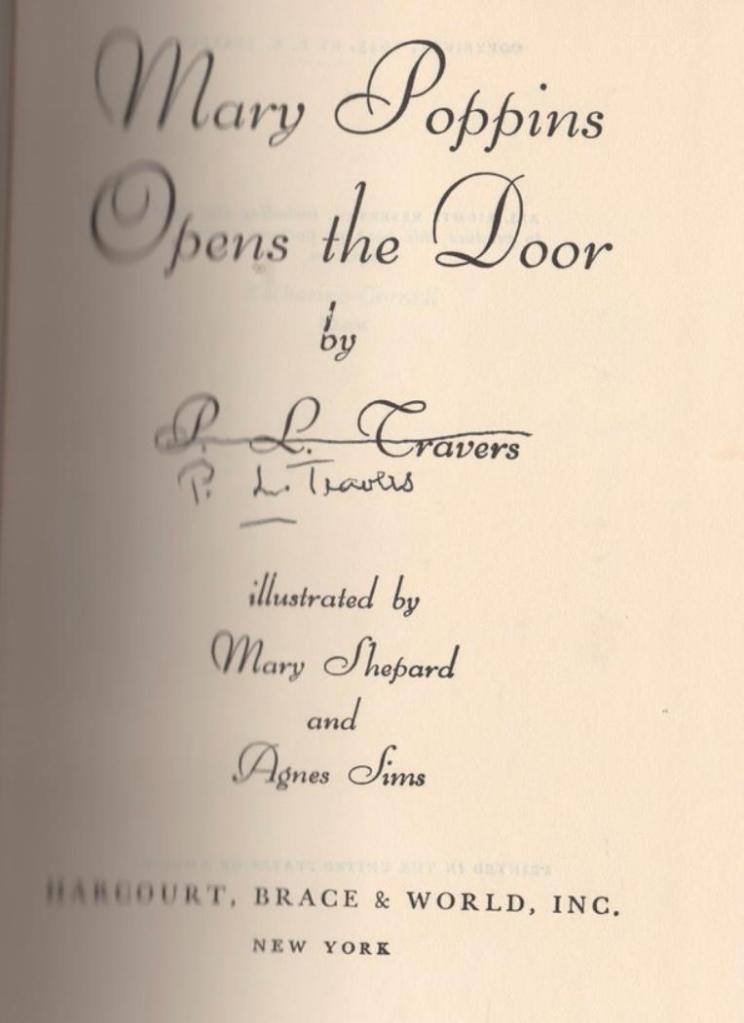
GM: On the front. (She crosses out the printed name and signs her own name.) And this last. MARY POPPINS OPENS THE DOOR. It’s my favorite.

PLT: It’s not for children.

GM: It’s Mystery. Mystery is for children.

PLT: Yes, but also for adults.

GM: Yes. Of course.

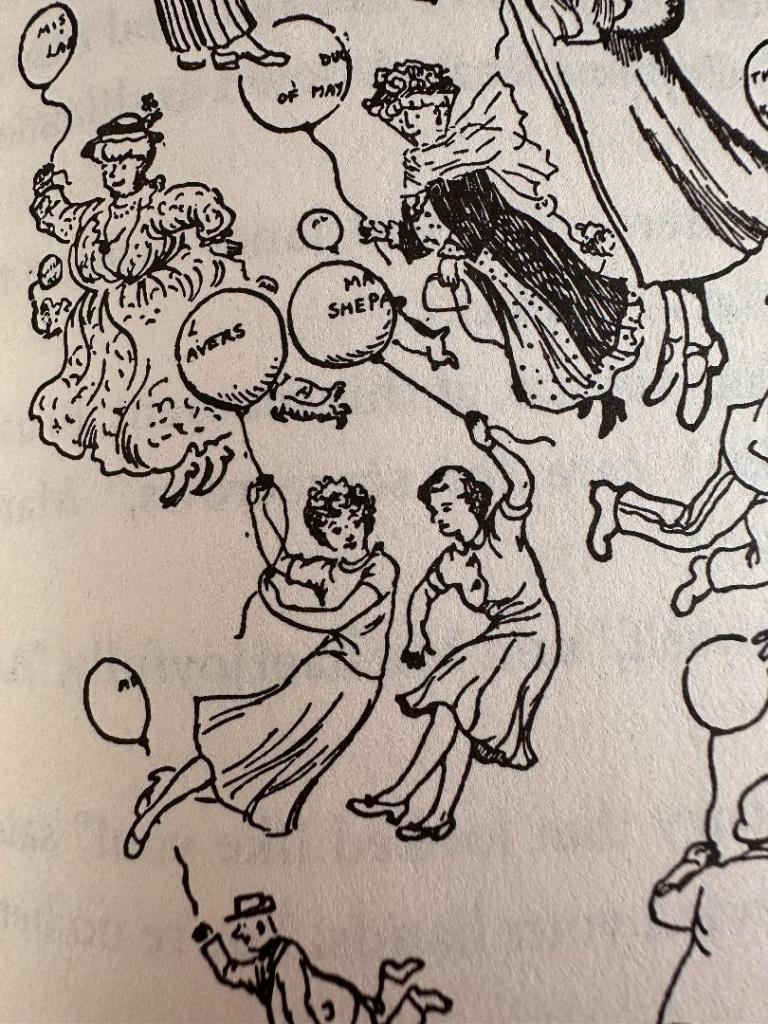
PLT: (She signs it.) I found a picture of myself in the chapter called “Balloons and Balloons.” Me and Mary Poppins and Mary Shepherd.

GM: I’ll look for it when I go home. And I should go soon. I’m flying out tonight.

PLT: Where?

GM: Dublin tonight, and Boston tomorrow.

PLT: I was at Radcliffe once, teaching. And at Smith. I loved Radcliffe. I hated Smith.

GM: Why?

PLT: A man from an American magazine called Life came to every lecture, and all the Smith girls threw themselves at him.

GM: This has been an extraordinary afternoon for me. I will never forget it. Thank you. (I kiss her.) Goodbye.

PLT: Goodbye. Write about this.

GM: Pardon—?

PLT: Write about coming here to tea.

Cheryl shows me to the door. I leave PLT sitting in the corner of the room, all eyes and smile, in a blue cardigan, knees together, hands on her knees. The big square window is now dark with dusk.

Something intriguing about the conversation: “Here I divert from my journals to insert a memory that I didn’t write down at the time. Ms. Travers elected to address me as the man who came to read the meters, and kept telling me they were out back, through that door. She seemed entirely unfazed that the meter man would arrive carrying rare copies of her hardcover books and would be conversant in arcane details of her career and work. I’ve often wondered if she wasn’t having me on.”

Reading about the man who came to read the meters made me smile. She was, most probably “having him on”. Her life quest was all about finding the meaning of life and the questions she asked in her essays were “Who are you?” and “What is man a metaphor for?” It is possible then that she was probing her guest in the manner of her spiritual teacher G.I. Gurdjieff, who used to shock and surprise his pupils with strange statements and behaviours in order to break down their habitual thought patterns and thus strip off their masks.

Now, onto my interview with Mr. Maguire and his delightful book “A Wild Winter Swan”.

LS: Is there is a possibility for a sequel of “A Wild Winter Swan”? In the ending Laura explains the swan boy’s arrival into her world in these words: “No, he has flown away from them once because he could not bear to be other than wholly human. Now he has to try the alternative. He really doesn’t have a choice. Do we.” But what if that alternative does not prove to be the solution either?

GM: I have not contemplated writing a sequel to “A Wild Winter Swan” —but I never say never with conviction. I had not contemplated writing a sequel to “Wicked”, and it was ten years before “Son of a Witch” came out. There have been five more books about my take on Oz after that one—so far.

Still, in regard to “A Wild Winter Swan”, I admit there is something both sad and satisfying in the loss of a character whom one has come to love—even one who is ultimately bewildering. Not unlike, come to think of it, a certain Mary Poppins herself. I tried to leave the reader with a sense of insecurity about how and even why this boy, Hans, had landed in Laura’s life.

LS: Yes, I did wonder about that too. Did Laura somehow summon him because she herself was in a liminal state of being; suspended between the dreamland of childhood and the demands of adolescence, all in the background of the dire circumstances of her personal life? Or was it the other way around. Why did the swan boy happen to Laura?

GM: Why does anything happen to anyone? Why did Peter Pan land on the nursery windowsill of the Darling family instead of the family next door named the Oblenskys, with their fat little cousin visiting from Moscow, the one who dangled the family turtle from a third-floor window and nearly decapitated it? It just happened. Wendy’s mother told stories, after all, and Peter wanted to hear the stories.

Hans might just have landed on Laura’s windowsill by chance. Things happen in stories. On the other hand, Laura had just read the Andersen tale to those first-grade students. Then she’d come home and helped rescue a worker about to fall off Laura’s own roof. The conditions of Hans’s arrival were established in her mind by the events of the day. Maybe they helped her recognize him when it happened—or maybe it was happening largely in her mind, a dream and hope of escape and of rescue from her increasingly dire situation. (Of course, no one else saw the visitor except the cat, and there is the matter of the bloody eels, the most proof that someone else is in the house with the Ciardi family. But maybe the cat did get the eel itself, and Laura was inventing what else must have happened in the terms of the story going on in her head.)

This makes a sequel hard to position in my imagination, for in order for there to be more to Hans, I would have to be more definite about how, and what, he actually is—and that he lives outside of the story Laura is busy telling herself in her own head. And I’m not sure of that myself.

The point is, while I think that Hans is real, and so does Laura, others might not be so sure.

LS: I believe Hans to be real too, but maybe other readers will interpret the story differently. P.L. Travers said that a book is only half the writer, the other half being the reader. I wonder if you intentionally made the parallel between Laura’s inner strength and that of Elise in Andersen’s story.

Elise must knit shirts from stinging-nettle without ever saying a single word and at the risk of perishing because of it. Laura does speak in the story, but she is mute about the existence of the swan boy, and she goes about his rescue in the most secretive way despite all the challenges that his presence creates in her already troublesome situation.

I found Laura to be just as self-contained, determined and resilient as Elise in Andersen’s fairy tale. And just like in Andersen’s fairy tale, by saving the swan boy, Laura saves herself. Did you start writing the story with the end in mind, or did the narrative unfold organically in this way?

GM: When I began to write the story, I wanted Laura to be clever imaginatively but not socially—perhaps a bit backward in school. I never know how stories are going to end when I start them—that means I am uncovering the story in an organic way, as I want readers to do, too. I didn’t realize until about 2/3 of the way through the story that as Laura didn’t have the capacity—as Elise in Andersen’s story didn’t, either—to do surgery upon the swan boy and convert his swan wing to an arm, there really was only one other choice: she had to return to him a second wing, and confer upon him agency to fly away. This is also what she has to do for herself, and so I intended that the act of rescue for Hans should be synonymous, or at any rate practice, for the act of rescuing herself.

LS: Why did Laura’s grandparents choose a boarding school in Montreal as an alternative to her education? I live on the south shore of Montreal and work in the city, so naturally, this caught my interest.

GM: There is one main reason for this. As I loved books like “A Wrinkle in Time”, “Mary Poppins”, “The Wizard of Oz” and the Narnia books—among many others—I noted even then that there is a consistency of literary genre in these beloved titles. I didn’t know the word “fantasy” until I was in high school, I mean not as applied to a type of story. I called them “magic books” —books about magic (though they seemed to do magic, too, in how they made me feel!)

But I had one favorite title from childhood that was not a literary fantasy. It was the novel by Louise Fitzhugh called “Harriet the Spy”. You’ve heard of it, and perhaps you’ve read it. Harriet is a sixth-grade girl who spies on her classmates, writes things down in her journal, and intends to become a writer when she grows up. She is wildly curious and, like all children, quite naive, but she is working at increasing her bank of experiences so she can understand the world better.

In writing “A Wild Winter Swan”, I wanted to pay homage to Harriet a little. I set the story in roughly the same patch of neighborhood where Harriet lives, on the Upper East Side of New York—and in very nearly the same couple of years. (“Harriet the Spy” came out in 1964, I think, and my story takes place in 1962.) I imagined Harriet and Laura passing one another on the pavement. I didn’t want Laura to be a writer per se, as that would be too imitative, and besides Laura’s capacity to “see” and experience Hans is predicated on her simplicity, perhaps her simple-mindedness—so working arduously with words the way Harriet does would contradict Laura’s open and believing nature. Her gullibility, perhaps.

Instead, I had Laura “think” stories—narrate her own experiences in her head as she would write them—if she were a writer. She is not shy of imagination and thoughtfulness, after all—or of imaginative sympathy—but she is not academically robust, either. This method allowed me to have Laura comment on her own experiences but only in her head. It’s another proof that she lives in her mind, and therefore another hint that the incidents with Hans may be self-generated. (You might say she is having a schizoidal break, unable to separate between reality and fantasy. I mean some might say that. I wouldn’t.)

In “Harriet the Spy”, the child’s beloved governess leaves the household about halfway through the novel to get married. She tells Harriet she is going to move with her beau to Montreal. To Harriet, Montreal seems as far away as the moon. “Mon-tre-ALLLL?” she wails when she hears the plan. My threat of sending Laura to Montreal was a quiet tip of the hat to Louise Fitzhugh.

I like Montreal, though. My big sister, who was a little like Laura in 1962, grew up and married a Canadian man and spent all her adult life in Montreal, Quebec, and Toronto, and is now retired as a grandmother in Ontario. So, growing up in Albany NY, Montreal was to me a place of warmth and attraction, and I liked, and like, visiting.

LS: In your interview by Kristen McDermott, you say that “Magic helps the young reader skip over some of this as-yet-imponderable mysteries and supplies instead a set of inchoate influences that organize a mystifying world to the young mind.” What role and significance does magic hold in the world of adult readers?

GM: At this point in my life I think fantasy is largely a gift for the young. I don’t seek it out to read as an adult (though I do love to return to books I loved as a child). There are some exceptions. The Philip Pullman novels come close to matching, in moral seriousness, what Ursula Le Guin managed in her Earthsea books. But I think a sort of disservice has been done to the reading of fantasy by the technical marvels of CGI in the film industry. When virtually anything can be pictured, and pictured convincingly, thanks to the wizardry of computer animation etc., then the thrill of reading of something impossible happening on the page is somewhat demoted.

The strength of fantasy in the lives of children is still potent, though. Fantasy still has power to charm because children have not yet finished pacing off the dimensions of the structure of reality. In fantasy, they are playing with “what might be” without being entirely sure. Of course once they get to the age of five, most children realize that humans don’t fly, and can’t fly, and they won’t—and yet they can fly in their dreams! So what’s that all about? And there are other enchantments (the thrill of romance and sex, when they get there) that will seem to open up the world to them in ways they couldn’t have anticipated a year or two earlier.

While adults, having convinced themselves that they’ve (largely) got the measure of reality, must approach fantasy in literature with a different expectation. Indulging in that literary art is a bit nostalgic, perhaps; it can more easily be read as metaphoric; in any case fantasy is at least diverting and a consolation, allowing one to turn away from the vicissitudes of our increasingly hostile and dangerous life on this planet. But as a rule, fantasy literature for adults can no longer tempt as a possible alternative construction to reality that we might someday find our way into embracing—as Laura does, in my story. That magic casement is closed. Peter Pan knows it, and so even does Mary Poppins.


About a Forthcoming Biography of P.L. Travers 

Dear Reader, 

A new biography of P.L. Travers is scheduled for release in 2025 by Pen & Swords, a British publisher specializing in history and true crime. The author of this biography is Elisabeth Galvin, a British journalist and author who currently resides with her family in Brisbane, Australia.   

Last year after discovering this blog, Elisabeth reached out to me, sparking a correspondence that eventually, to my delight, culminated in my contribution of a chapter about P.L. Travers’s spiritual beliefs. 

Elisabeth Galvin has written two other biographies of famous children’s writers. The first one, “The Extraordinary Life of E. Nesbit”, which will be the subject of this blog post, was published in 2018.   The second, “The Real Kenneth Graham”, was published in 2021.  

P.L. Travers was in her own words “a tremendous Nesbit fan” and read her books again and again even as an adult.  

I think so highly of her, and I’m absolutely sure that such writers as C.S. Lewis, for instance, good though his books are, could never have existed without Nesbit.” 

Transcripts of A Talk About Sorrow, July 1965 

P.L. Travers and Janet Rance 

Elisabeth Galvin drew some interesting similarities between the two writers during a recent conversation we had, and I’ve decided to share some snippets of it here for the benefit of the readers of this blog. But just before, let me provide a brief note about the life of E. Nesbit for those of you who are not familiar with her work.  

E. (Edith) Nesbit was an English author and poet. She was born in 1858 and died in 1924, the year when P. Travers first came to London, so the two women never met.  Edith lost her father when she was only four years old and had to change homes and schools often as her mother traveled frequently to France and Spain seeking a cure to the ailments of Edith’s older sister Mary.  

Edith married Hubert Bland who later became an influential socialist journalist and with whom she co-founded the Fabian Society, a socialist organization in the late 19th and early 20th centuries.  

She wrote numerous short stories, poems and novels both for children and adults. Her most well-known works for children include “The Railway Children”, “Five Children and It”, “The Story of the Treasure Seekers”, “The Phoenix and the Carpet”, and “The Enchanted Castle”. 

Her ability to blend fantasy with everyday experiences resonated with readers and contributed to the evolution of children’s literature and as such had a significant influence on later writers, including C.S. Lewis, J.K. Rowling, and Jacqueline Wilson. 

Now to my conversation with Elisabeth Galvin.  

LS: Why did you choose to write a biography about E. Nesbit? 

EG: Well, I always wanted to be an author, and I became a magazine journalist, and I absolutely loved my job. Then, when the opportunity came to submit some ideas for biographies about children’s authors to a publisher, I knew I had to take that chance. I thought about all the stories that I loved when I was younger, and Railway Children was one of my favorite stories.  I still have the book that my parents gave me, a red leather-bound book with a gold spine – it’s such a lovely story, and E. Nesbit led such an interesting life as well, and I believe that is why I chose to write about her.   

LS: Yes, she did have a tumultuous life, and I really enjoyed reading your book because you recreate the atmosphere of that period so vividly. I imagine you had to visit some of the places you write about in your book.   Could you share some insights into your research process for the book?  

EG: Yes, of course. It was an exciting process because as a journalist, I love meeting and talking with people and exploring different places. A notable experience was visiting Well Hall, where E. Nesbit lived with her family for some twenty years. I had the privilege of exploring it in the company of a member of the E. Nesbit Society, which truly brought the whole experience to life. We walked around Well Hall; while the original house was demolished in 1930, parts of the original gardens still remain and I saw the wooden statues portraying characters from E. Nesbit’s books, so yes, her spirit was definitely there. 

(Picture taken from “The Extraordinary Life of E. Nesbit” by Elisabeth Galvin. Dame Jacqueline Wilson at Well Hall unveiling the wooden sculpture of the Psammead, commissioned by the E. Nesbit Society in 2013.)

I visited another one of E. Nesbit’s residences, Halstead Hall in Kent (click on the link to see the pictures). It was one of her childhood’s homes. It was lovely, it had the quintessential English garden and that is where she loved to spend time reading during her teenage years. I think she was 13 when she was there.  The vicar who lived in the village at that time lent her his books and that is when she first came across Shakespeare.  I could imagine this impressionable young girl lying in her garden looking at the apple trees and the roses and get a picture of her character, so it was very helpful going to those places. 

Surprisingly, after E. Nesbit’s death, her personal papers were sold to The University of Tulsa in Oklahoma. She never went to America but was published there too, so I had to go there. I spent five intense days reading letters and other materials from the late eighteen hundreds and early nineteen hundreds and then suddenly came outside to see a Taco Bell and fire engines. It was a funny experience.   

LS: Yes, I can imagine, it sounds like a real time travelling experience. Now, what proved to be the most difficult part in writing the book? 

EG: The most difficult was knowing that I would never meet her, or talk to her or hear her voice, or ask her questions. A lot of biographies really are speculation, even if it is unintentional, your natural biases do come out. As a journalist you always want to tell the truth and be as fair as you can, and there is a sense of responsibility when delving into someone else’s life. 

LS: Definitely, and this also applies to P.L. Travers, especially considering she did not want people to inquire about her private affairs. You mentioned previously that during your research on both women you noticed certain similarities between them. Could you tell us more? 

EG: Well, it is amazing, actually.  The more you think about it, the more similarities there are – both physically and in terms of their personalities. The way they approach life, the events that unfolded in their early childhood as well as their literary works exhibit striking similarities.  

Firstly, both were very tall women with short curly hair. They possessed a somewhat androgynous appearance, attracting men and women. They were both, in a sense, single parents.  E. Nesbit was married, but her husband was not particularly supportive. 

They both had a “get up and go” attitude toward life. They experienced significant hardships, losing their fathers at a young age, and both had a nomadic childhood—P.L. Travers throughout Australia, and E. Nesbit across Europe, attending school in France and Spain.  

Despite the disarray of their early years, they shared a deep love for reading, voraciously consuming any available books. Their affection for Shakespeare and a natural flair for writing emerged early in their lives. Both harbored aspirations to become poets, and perhaps even experienced a tinge of disappointment for not receiving the recognition they desired. 

And they both wrote about ordinary children and everyday magic. Their skill was to remember what it was to be a child and to transpose the essence of childhood into their writings. And I don’t know if it is because they had such unusual childhoods, losing a parent at a very young age, but they always had an idealized version of family life.  

LS: Do you think they would have gotten along if they had met? 

EG: I am sure they would have had a lot in common to talk about. E. Nesbit loved bohemian parties and thrived on that kind of energy. Similarly, P.L. Travers loved to meet new people and make new friends. They were not solo writers, they loved sharing their knowledge and taking part in artistic gatherings.  

And I believe they would have connected on the fairy tale aspect as well. P.L. Travers wrote about Sleeping Beauty in the 1970s, and E. Nesbit was also deeply interested in fairy tales, writing her own collection of fairy stories. 

LS: I agree, they would have had a lot to talk about. They even shared common acquaintances, George Bernard Shaw for example. Their lives and literary contributions provide an endless well of discussion and we can go on for hours.

I want to thank you for taking the time to share your thoughts with the readers of the Mary Poppins Effect blog, and I hope to share more about our collaboration and your forthcoming biography of P.L. Travers in the coming months. 

Halloween with P.L. Travers

During her stay as a writer-in-residence at Smith College in Northampton, Massachusetts in the autumn of 1966, P.L. Travers was invited to give a lecture about myths, fairy tales and their connection to everyday life. The following year the lecture was published in ‘The Quarterly Journal (Library of Congress, USA) and later in 1989 included in P.L. Travers’s compilation of essays published under the title ‘What the Bee Knows’.    

Because the lecture happened on Halloween, P.L. Travers concluded with a brief comment on its history, which she told the audience began as a pagan celebration of the dead and later on was integrated into a Christian celebration by one of the Popes, ‘Boniface IV, perhaps, in the seventh century, who decided to do away with all the pagan saturnalia and turn it from what it so significantly was, into a commemoration of the saints and martyrs’. 

Normally I should have taken her word on the matter, she knew so much and I so little in comparison, yet for some unknown reason I felt compelled to do a quick factual check. To my surprise I discovered that it was not Pope Boniface IV in the seventh century, but Pope Gregory III, in the eighth who decided to morph the old beliefs into the new Christian religion. 

Obviously, her historical reference was wrong but getting the dates right was beside the point she wanted to make, and in all fairness, she did use the word ‘perhaps’, meaning she was not sure of the factual accuracy of her statement. Yet, its truthfulness remains, the old beliefs were indeed transmuted into the new system of beliefs but were unfortunately, in her opinion, deprived of their essential purpose. Luckily, people knew better than Pope Gregory III and a version of this pagan celebration remained to our days.  

In ‘Only Connect’ P.L. Travers acknowledged our human need to remember the dead and to come to grips with our own grieving and fears of death and the unknown. These needs, old as humanity, need an outlet, a ritual to allow us to turn our faces back to life.  

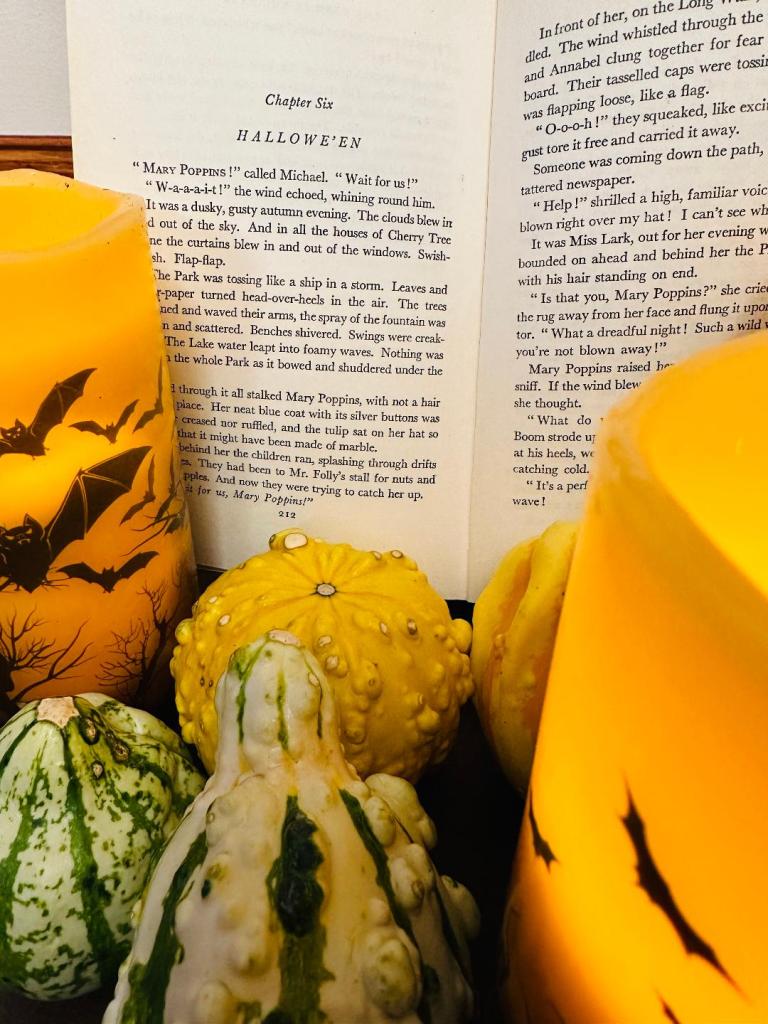
From time immemorial, stories are what allows us to create meaning out of our human experiences, and fairy tales were for P.L. Travers the guideposts in our personal lives. Then, it is only normal that she had written her own version of this pagan celebration in Hallowe’en a story in Mary Poppins in the Park, where not ghosts but the shadows of characters from fairy tales come to party in the Park under a Blue Full Moon. I have written about this story before, and you can read the blogposts here and here.

Now rereading ‘Only Connect’ leads me to believe that the idea for the story may well have been inspired by her own observations of the modern ritual of trick-or-treating; a night when children in the guise of fairy tales characters, heroes and villains, hand in hand, roam the streets at night in search of treats.

Happy Halloween!  

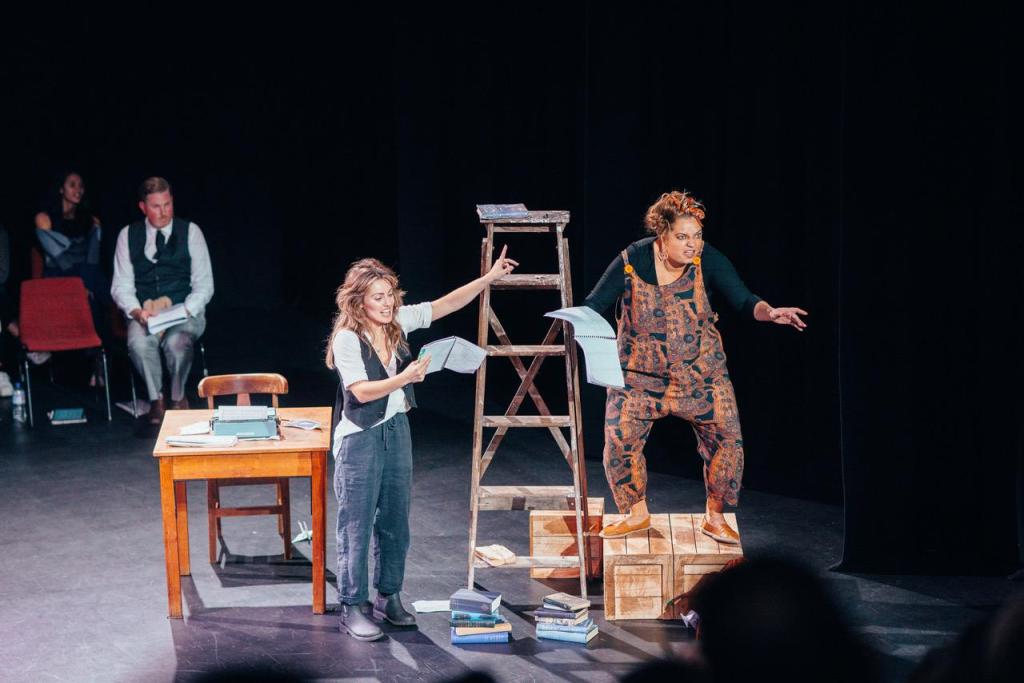
‘Paper Stars’ a Musical About P.L. Travers, the Creator of Mary Poppins 

Photo: Cameron Jones

Three years ago, Miranda Middleton, a young writer and theatre director from Australia had the brilliant idea of a theatrical production centered around P.L. Travers and the writing of the Mary Poppins books.  

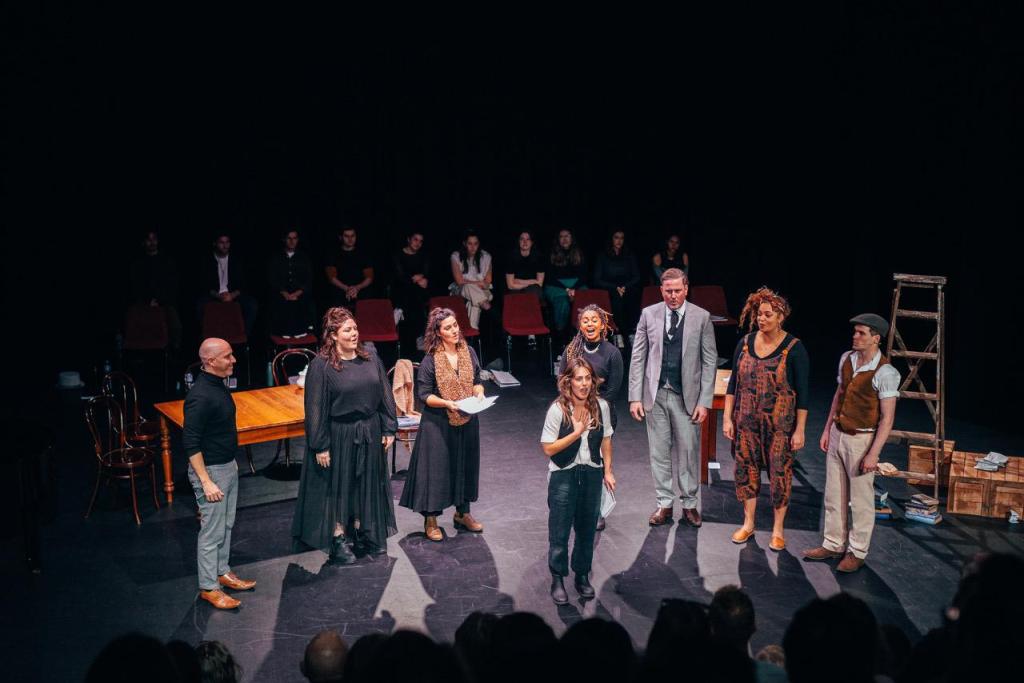
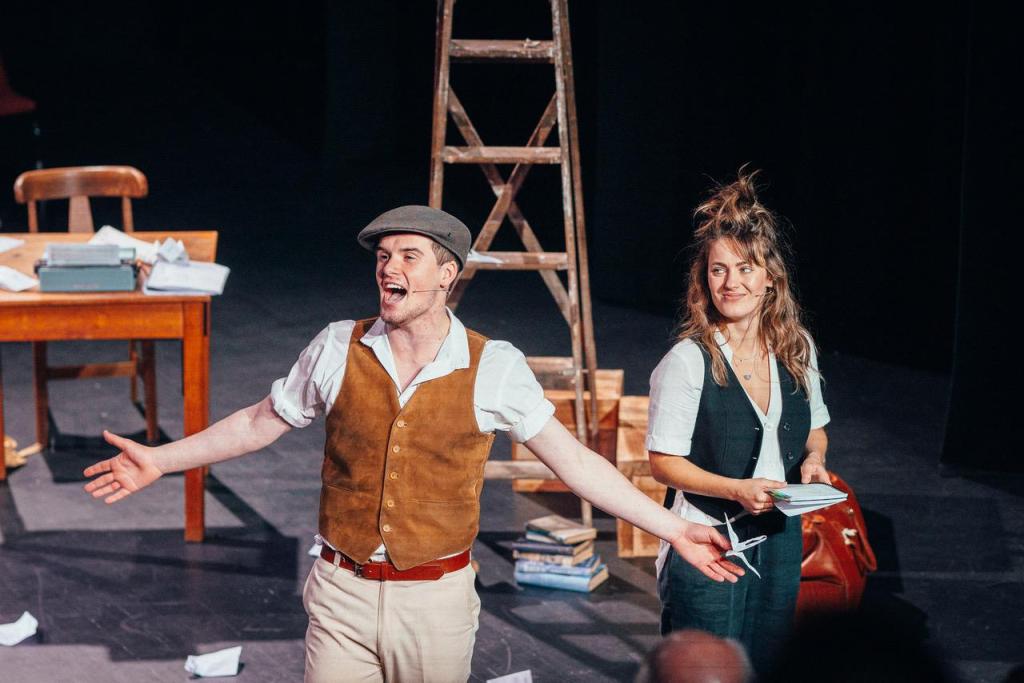
The initial idea has now crystalized into ‘Paper Stars’, a musical first developed by The Hatch Lab Musical Theatre Residency Program at Salty Theatre in 2021. From there ‘Paper Stars’ was further workshopped at the Victorian College of the Arts, and last May a stage reading was presented at the Australian Musical Theatre Festival in Tasmania. 

By a fluke of circumstances, I got the chance to meet with Miranda Middleton via Zoom and talk about ‘Paper Stars’ and all things P.L. Travers and Mary Poppins. I am sharing here some snippets from our conversation which begins with a predictable question, and one that was despised by P.L. Travers, but one that honestly, we cannot help but ask creators. 

LS: How did you come up with the idea of ‘Paper Stars’? 

MM: I was quite a theatrical child with a big imagination, so naturally I adored the ‘Mary Poppins’ film, even though it made me sob at the end! I was totally devastated by the fact that Mary Poppins had to leave, and I think I carried that grief for the character into my adulthood, as I too lost people in my life that I loved. Then I saw the film ‘Saving Mr. Banks’ and I discovered that in fact P.L. Travers – the author of ‘Mary Poppins’- was Australian.  I couldn’t believe that I didn’t know she was Australian! And this is basically how the idea for ‘Paper Stars’ was born. From there I recruited my playwright friend Grace Chapple to develop the story with me, and she said, “I think it needs to be a musical.” So, then we asked Luke Byrne to write the music and it has just kind of gone from there. 

LS: ‘Paper Stars’ is not a biographical piece, is it? 

MM: I guess we set out to write ‘Paper Stars’ to add to the canon of biographical material about P.L. Travers. We wanted to cover the period of her life when she was creating this magical character so that gave us the period between 1925 and 1935, during which there really isn’t much written about what was going on for her internally. But that was also interesting for us as writers because it meant that we could bring out our own imaginations to the table. I think the way that we describe ‘Paper Stars’ is that there is a HUGE spoon full of creative license in there So…  it is the somewhat true story of how Mary Poppins came to be, but we are not calling it biographical –it is probably more fictional than biographical.  

LS: ‘Paper Stars’ explores the difficult relationship between P.L. Travers and her mother, their painful separation back in Australia, and then also P.L. Travers’s relationship with Madge Burnand. 

MM: Yes, we were very interested in this idea that Pamela was living with a woman in the 1920’s which was controversial and unconventional – it is those qualities about her that we loved. We were also interested in her relationship with her mother because ‘Mary Poppins’ (the first book in the series) is dedicated to her, not to her father, who she purportedly adored. We were just so fascinated by that fact. So, I guess we dreamt into that backstory. 

LS: Another insight that I gained from ‘Paper Stars’ is that P.L. Travers wanted to be taken seriously as a writer and this is the reason why she kept her Australian origins secret. 

MM: Yes – the cultural cringe! It is a big thing for us Australians, we are very cautious and aware of being kind of looked down upon by the mother land or people overseas. 

LS: Back then or now? 

MM: Even now, I think Australians are kind of still conscious of it. 

LS: The songs are quite touching and emotional. I enjoyed all of them, but my favorites are “Great Story” and “Everyday Magic.” 

MM: Luke who wrote all the music is so clever! The emotional impact of the songs and the story on the audience (at the staged presentation in Tasmania) was really touching to me. Lots of people were crying and wanted to stay around afterwards to talk about the show. I’ve received a number of messages since  saying: “I think this is a really important story to tell.” “It really touched me.” Yes, so I was surprised by how emotionally impactful the story was and so, I am excited to take it to the next stage. 

LS: And what happens now, what are the next steps? 

MM: We are in an interesting phase now where we are talking to various venues about its eventual premiere. It is not official yet, but we are hoping that something will happen next year, because 2024 is the centenary of P.L. Travers leaving Australia. We’ll see what the stars have in store! 

LS: Well, I hope the musical goes into production soon and maybe one day I will get to go to Australia too and see it! 

A Little-Known Friendship 

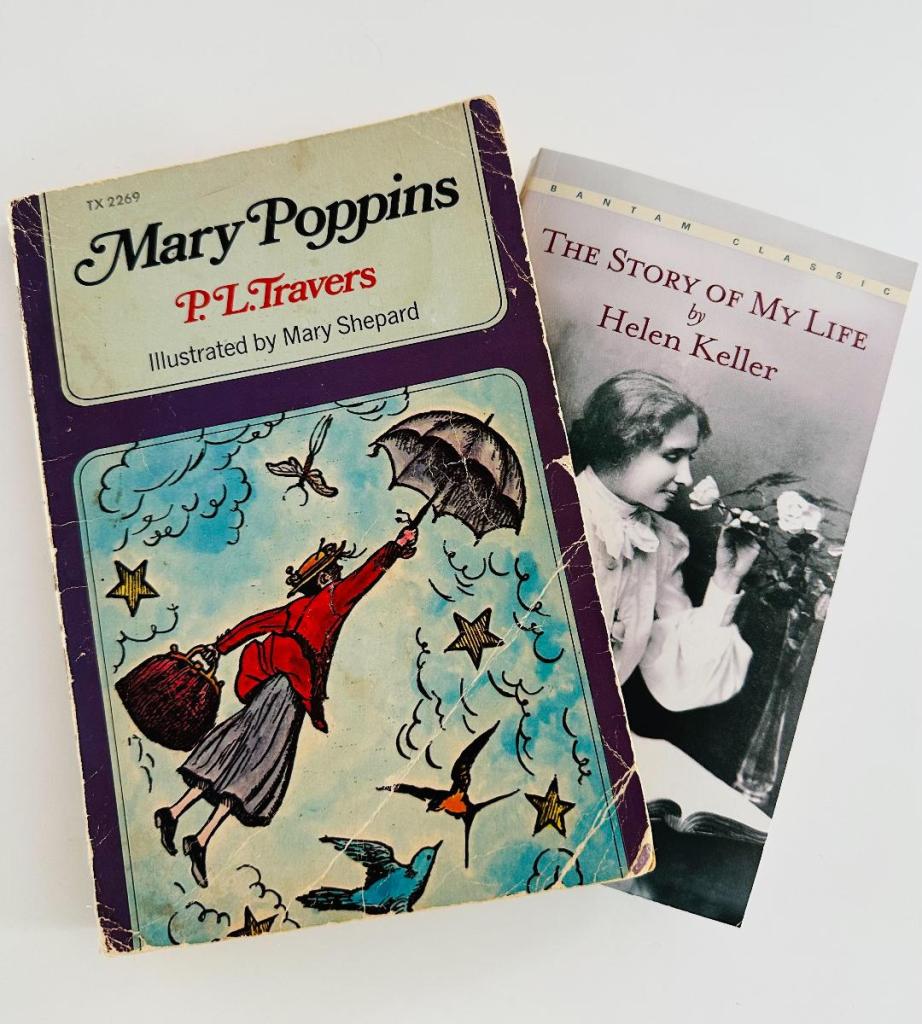
The friendship between P.L. Travers and Helen Keller is a little-known fact and one that was brought to my attention by a generous reader of this blog. I am forever grateful to my readers who share my interest in the world of P.L. Travers and Mary Poppins and freely share their knowledge with me.

A few letters kept in the archives of Helen Keller reveal that she and Polly Thomson stayed at P.L. Travers’s home during their visit to the UK in 1946. Helen Keller recollects the visit in these words: 

How often Polly and I recall the cozy evenings we spent with you, Camillus, and Moya by the fire in that dear, war-tried little house, surrounded by objects upon which your artistry has bestowed a fairy grace! “

And in another letter: 

I prefer to tell you how two pilgrims in search of ways to succor the war-blinded of Europe were rested and cheered by their visits with you, Moya and darling Camillius. Besides taking you to our hearts we loved your house, bomb-wounded yet warm and sweet to the core, your fire crackling with a cheery message of peace that shall someday inundate all homes, the simple hospitality making us feel natural and free instead of feeling “guests,” and the talk on whose wings the hours flew unnoticed.

The connections I make from reading P.L. Travers’s interviews and writings usually require time and effort, and although I enjoy the process, I must admit that it is immensely satisfying, albeit I feel a little mischievous, to read P.L. Travers’s private thoughts on matters she never discussed in interviews. 

Her correspondence with Helen Keller contains candid details about her relationship with her son, Camillus, and her feelings about single motherhood. In her interviews P.L. Travers rarely talked about Camillus and when she did, it was indirectly, by making references to a boy she knew well or a boy dear to her heart. This may appear strange, but I believe that she was trying to avoid questions about his adoption.  

The adoption of Camillus is discussed in P.L. Travers’s biography Mary Poppins She Wrote by Valerie Lawson, as well as in the documentaries about her life, and so I am not going to delve into the details of the adoption here, but just mention briefly, for those of you who are not familiar with the story, that P.L. Travers never told Camillus that he was adopted and that he had a twin brother, and other siblings. At the age of seventeen he discovered the truth when his twin brother came knocking on P.L. Traver’s door.  

As you can imagine Camillus was hurt and felt betrayed by the person he trusted most in life. His anger was mighty, and he never completely forgave her. This was a terribly sad and tragic event for both and P.L. Travers’s biggest regret in life was that she had not been a good enough mother for Camillus.  

And maybe from the outside one can say that she should have made better choices when it came to her son, the truth is she could not have done differently because she did what she could, what she thought was best, based on the level of awareness she had at the time.  

In her letters to Helen Keller, P.L. Travers writes about teaching Camillus how to swim and row during their summer vacation in Ireland and in the Wales, and how she is teaching him to handle a canoe on the Regent Park Lake. She mentions that he is taking violin lessons and “being very musical and with a good ear.”  

But what I find most interesting in this correspondence is that P.L. Travers appears to have been nostalgic of Camillus’s earliest childhood years. It is almost as if she was grieving the loss of their deepest connection, feeling the bond between them beginning to weaken as he was growing up and losing touch with the dreamland of fairytales. In a way they no longer shared a common way of perceiving the world. Camillus, like most of us when growing up, was interested in the external affairs of life and of becoming, whereas P.L. Travers always kept one foot in the land of myth and fairy tales, and looked for a deeper meaning of life, beyond the illusion of the ordinary. She wrote to Helen Keller: 

He, when he first heard poetry, was enchanted by it, but now at the age of eight only wants it now and then. He is so busy being a gangster one moment, supervisor another, a policeman the next. Everything now is acting and there is very little dreaming. The house shakes with his thundering feet, he is always coming from or going somewhere and only at night remembers that he has a mother and is still small enough to sit in her lap and be rocked in the rocking chair.”  

This sentiment of hers was so strong that it made its way in Every Goose a Swan in Mary Poppins in the Park. Camillus is the Boy in the story. The Boy is engrossed in pretend play, he is a fearsome one- eyed pirate, but then when the Tramp dares him to go to Dead Man’s Drop he suddenly remembers that he has a mother, that if he leaves she would be anxious and that after all she was making pancakes and it was better for him to stop acting and be his other self. 

Another interesting aspect of this correspondence with Helen Keller is P.L. Travers’s frankness about her difficulties as a single parent, the frustrations of domestic life, and her difficulty at reconciling it all with her deep need to write.  

Helen, you will understand how sad I have been at having to face the possibility of sending Camillus to boarding school. I aways wanted to keep him at home with me and let him go to a day school. But daily living becomes ever more difficult in England and the almost impossibility of finding anybody to help in the house will probably make it imperative. (…) I have broached the subject with him and his cheerful reply was “I will hit you if you do send me away!” However, as he grows I think he will quite like the idea and I hope to find a simple loving school which will not try and mould his abundant nature into too conventional a pattern. Then perhaps I shall have time to write.”

The boarding school she chose for Camillus was Dane Court Preparatory School for boys in Surrey. Joy Davidson, the wife of C.S. Lewis, sent her own two sons there after consulting P.L. Travers over tea. P.L. Travers’s high praise confirmed Joy Davidson’s impression of the school.  

The one she liked best was Dane Court, in Surrey, about twenty miles southeast of London. It was the most expensive, “gracious, well-established, comfortable without being luxurious and modern without being faddist,” having adopted a progressive policy of not “whack(ing) the children.” 

Poet, Seeker, and the Woman Who Captivated C.S. Lewis, by Abigail Santamaria. 

In conlusions, P.L. Travers did what she could to give Camillus a good education and a good start in life.

There are other things in the letters that will probably prompt me to write other blogposts, but this is it for this one, and I sincerely hope you enjoyed reading it.  

Tarot and Mary Poppins   

I read Mary Poppins and Mary Poppins Comes Back by P.L. Travers as a child in the early 1980’s in Bulgaria, but when I reread the stories in their original versions a few years ago, and discovered the other books in the series, I was amazed by P.L.Travers’s imagination. As a child I enjoyed the magic in the stories, but I did not give much thought to the author, although the name was on the cover of my book.  

As an adult, however, I wondered where P.L. Travers got her whimsical ideas from. When asked about the origin of her magical nanny, she never gave a straight answer. This may be partially explained by her desire to keep people away from her private life. Afterall, she did say in one interview that Mary Poppins was the story of her life, and that she had taken every precaution to cover her tracks. But then in other interviews she said that no one really knows where ideas come from. Her statement about the mystery of the creative writing process is echoed by other contemporary writers such as Philip Pullman and Elizabeth Guilbert. 

In Creativity, the Psychology of Discovery and Invention, psychologist Mihaly Csikszentmihalyi brings light to some interesting facts about our human creativity, such as the existence of certain commonalities in the personality traits of creatives.  

Csikszentmihalyi explains in his book that the creative process does not occur in a vacuum. Most of the time we build on old ideas by combining and reorganizing them in new ways, or by applying ideas from one domain to another. However, the mystery of creation remains. How exactly we combine ideas and morph them into new ones in our minds and why they take the forms they take is still a conundrum. 

All P.L. Travers’s writings are sprinkled with esoteric, mythological and fairy tales’ references, as these were her literary and spiritual pursuits. I love dwelling in the world of Mary Poppins and P.L. Travers, and I find the process of uncovering these references in the stories most enjoyable. Yet, I am fully aware that I can only uncover some of the components of the stories and link them to her personal beliefs and interests, without ever being able to explain how she incorporated and organized them into the whimsical Mary Poppins adventures.  

I believe that she herself was not entirely conscious of the creative process. Her writing was, at its core, unconscious writing. Her ideas sprang from deep within and then she polished the form. This is at least how I understand her statement about writing Mary Poppins because she was there to be written about. Besides, the adventures in the books all have a dreamlike quality to them, and I doubt this can be achieved to such an extraordinary level of artistry only by rational thinking. 

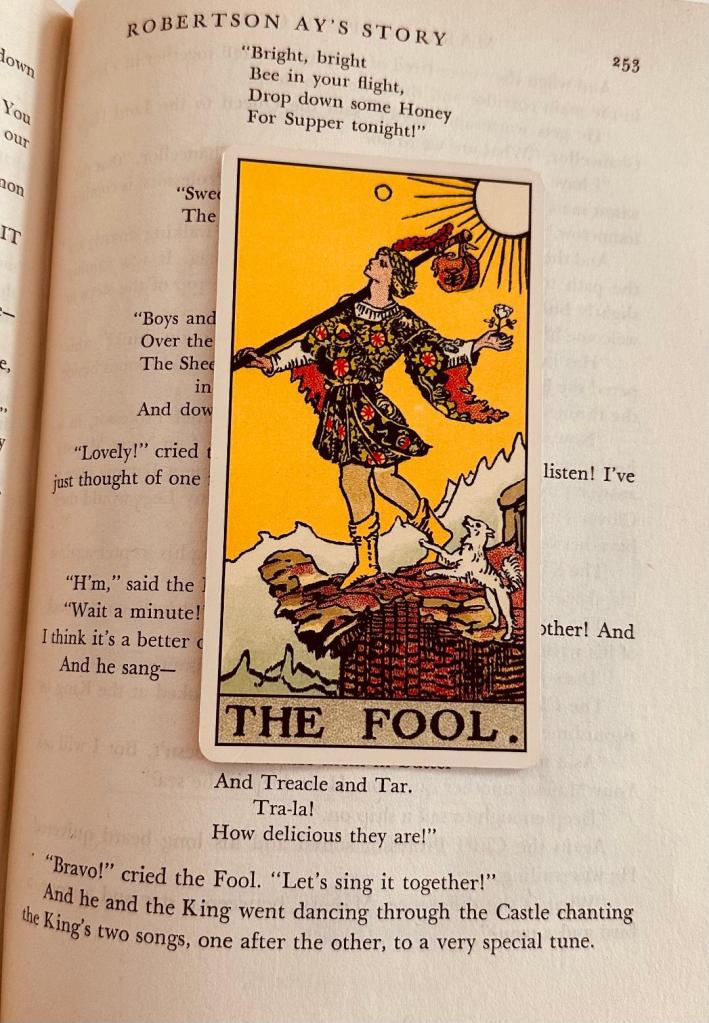
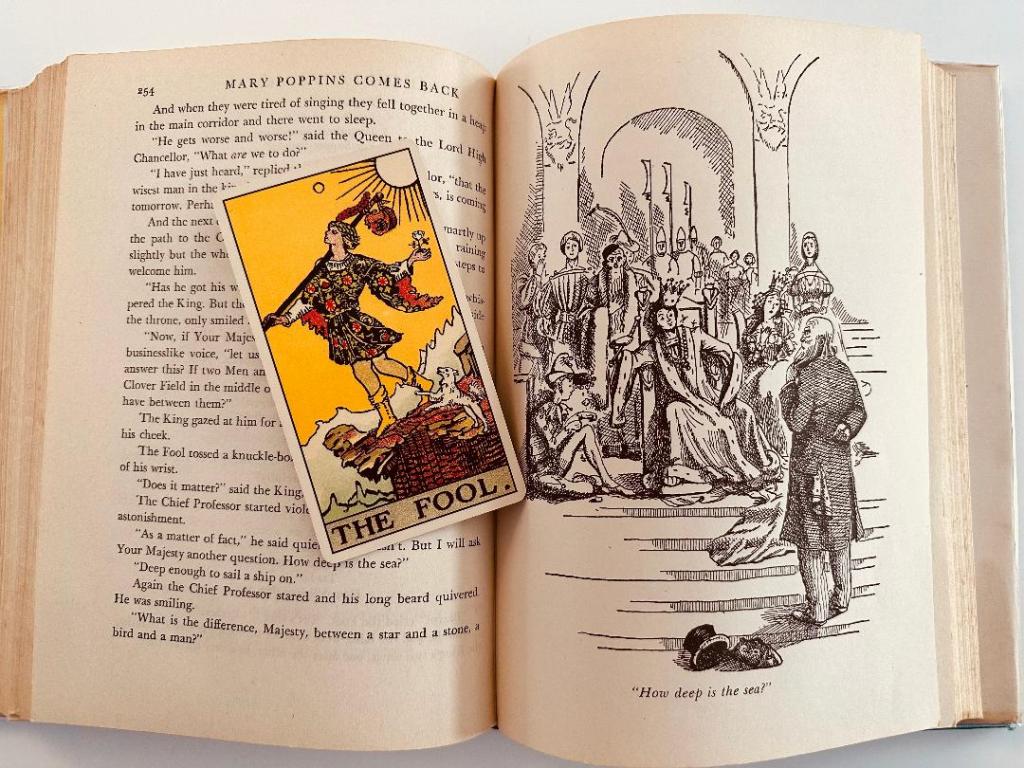
 This blog post is about an esoteric reference in Robertson Ay’s Story, a story from Mary Poppins Comes Back, the second book in the series published in 1935. This esoteric reference is the Tarot card of the Fool. I found a few more Tarot references in the Mary Poppins stories but they will be the subject of other blogposts.  

As a young writer P.L. Travers gravitated towards the renowned Irish poet and occultist W.B. Yeats, and her literary mentor, the mystic writer, poet, and painter George W. Russel (AE) who was also one of Yeats’s closest friends. Both men knew Pamela Coleman Smith, the illustrator of the most popular Tarot deck today, the Waite/ Ryder deck which was first published in London in 1909. It is also said that W.B. Yeats was an advisor to Pamela Coleman Smith on the mystic symbolism to be incorporated into Waite’s new deck. 

Pamela Coleman Smith was a member of the Hermetic Order of the Golden Dawn, the secret magical society to which W.B. Yeats also belonged. Between 1903 and 1904 she published, edited, and illustrated the magazine The Green Sheaf which focused on Irish Celtic folklore and mysticism. Both Yeats and AE, who were leading figures of the Celtic Revival, were literary contributors to her magazine. 

W.B. Yeats and AE also called Pamela Coleman Smith “Pixie”; a name first given to her by the Victorian actress Ellen Terry. Then some twenty years later, AE began to call P.L. Travers “Pixie” probably because he noticed certain similarities in their personalities and interests. Both women were orphaned at an early age, both loved fairy tales and magic and were interested in theatre, and both displayed a mischievous streak. 

The two Pixies were thus connected, although I suspect they never met in person because by the time P.L. Travers entered the artistic/occult scene, Pamela Coleman Smith had abandoned it and converted to Roman Catholicism.  

 Because of her connections to W.B. Yeats and AE, and her regular attendance at their literary salons, P.L. Travers was familiar with the archetypes of the Tarot. This is what she said about the Tarot card of the Fool to Jonathan Cott during an interview at her house in Chelsea, London. 

Who is Robertson Ay? What is he paid for? He does nothing but sleep? He turns out to be the Fool. Yes, he does, but I didn’t know he was going to turn that way when he cropped up in my mind. 

Not unnumbered, but Zero, which is all numbers and no numbers. The Fool is omnipresent, serenely passing through the world – as I said in “The Youngest Brother”- here and there are alike to him.” 

The Wisdom of Mary Poppins: Afternoon Tea with P.L. Travers, in Pipers at the Gate of Dawn, The Wisdom of Children’s Literature, Jonathan Cott, 1981 

The Tarot is composed of seventy-eight cards, twenty-two Major Arcana cards and fifty-six Minor Arcana cards. The Minor Arcana cards are divided into four suits, each associated with one of the four elements: fire, water, air, and earth. The suit of Pentacles is associated with the earth, the suit of Cups with water, the suit of Wands with fire and the Suit of Swords with air. 

The twenty-two Major Arcana cards (meaning Big Secrets) are considered to represent cosmic, energetic patterns that manifest in our human world as opportunities or obstacles to our personal growth, and the Minor Arcana cards (Little Secrets) relate to our individual struggles and challenges in our daily lives. All Major Arcana cards are numbered except for the Fool. The number of the Fool is zero, signifying nothingness, the void from which all things proceed, the field of pure potentiality.  

The archetype of the Fool represents pure potential. He lives in the here and now without placing judgments and looks at the world with a childlike innocence and wonder. The Fool in his positive aspect, is the playful, joyful child within us all. When The Fool appears in a reading, he heralds a clearing of the senses and announces a brand-new beginning. His advice is to go with the flow, just go with what is happening and learn from experience.  

In the Wait/Ryder deck The Fool is depicted standing on the edge of a precipice or a cliff suggesting that the path regenerates itself with each step; he encourages us to take a leap of faith and trust in life and in ourselves. Notice that the Fool carries a small bundle on a stick as he only takes with him what he needs and nothing more. His advice to us is one of release; to release what no longer serves us. He tells us to keep only the habits and lessons that will help us along our journey.  

Mary Poppins tells three fairy tales to the Banks children during her stay with the family. I find it interesting that she does not tell these fairy tales at bedtime as most people do. She only tells a story when the occasion calls for it and as it happens, she tells the story of Robertson Ay in the park during one of their outings.  

It is a sunny day in the park and Mary Poppins is sitting on a bench knitting, Anabel and the twins are in the perambulator and Jane and Michael are busy enacting the nursery rhyme I am the King of the Castle and You Are the Dirty Rascal, when out of nowhere a strange figure appears on the path at the edge of the Lake and catches their attention. 

“Along the path at the edge of the Lake came a tall, slim figure, curiously dressed. He wore stockings of red striped with yellow, a red-and-yellow tunic scalloped at the edges and on his head was a large-brimmed red-and-yellow hat with a high peaked crown.” 

Robertson’s Ay Story, Mary Poppins Comes Back (1935) 

The man stops by the bench to greet Mary Poppins, and the children learn that this is the Dirty Rascal, and Robertson Ay, but that is revealed to them only at the end. The children are mystified by the stranger whose face is hidden underneath the large-brimmed hat. When he leaves their company, and to the greatest delight of Jane and Michael, Mary Poppins offers to tell them the story of the Dirty Rascal.  

The story is in fact the story of a King who is extremely stupid and uncapable of fulfilling his royal duties. It is the Queen, and the Lord High Chancellor who must step in and do the work. However, they spare no amount of effort to impart some wisdom to the King, alas to no avail. As a last resort, the Queen and the Lord High Chancellor offer a generous reward to whomever succeeds in teaching the King some wisdom.  

As is the custom in fairy tales, the reward comes with a steep price for those who fail at the task. The professors who fail to teach the King wisdom are all doomed to have their heads cut off and spiked on the Castle Gates.  

All the teachers who come to test their luck lose their heads. The King is crushed by the events and his inability to learn. Then an unexpected visitor arrives, pushes past the sentry at the gate and walks up to the King. The King presents himself as the King of the Castle and the visitor as the Dirty Rascal. They immediately form a strong bond as the Fool shows the King that he does not have to conform to other people’s expectations nor to their understanding of what it means to be intelligent. 

 In Robertson’s Ay Story, the Fool appears in its positive aspect, a carefree, playful, childlike creature capable of imparting wisdom to the hopelessly stupid King. But he does not teach him in the way all the other teachers tried to. Instead, the Fool incites the King to burn all his books and simply enjoy life. They sing and dance, and laugh to the horror of the Queen and the Lord High Chancellor who see their behavior as being completely foolish and crazy. This highlights another aspect of the Fool archetype. The Fool is the outsider, the one that does not conform to pre-established norms.  

At the end of the story, the King is tested by the Chief of all the Professors, the wisest man in the kingdom. The questions asked by the Chief Professor are met with unexpected, but practical answers and the Chief Professor has no other choice but to declare the King to be wise. Wisdom, as P.L. Travers believed, cannot be taught, it can only be acquired through lived experience; a dance through life. To understand something, she said one must stand under it. Factual knowledge can only get us so far, something else is required of us to live an authentic life.  

When the Fool appears in a Tarot reading, it often signifies a new journey, a new beginning and this is exactly how the story of Robertson’s Ay ends with the beginning of a new journey for the King. Once the King realizes that what others think about him has no importance whatsoever, he realizes that he has no desire to be King. Together with the Dirty Rascal, the King climbs on a rainbow that has suddenly appeared in the sky and throws down his crown and scepter, thus shedding his old identity.  

Interestingly, the rainbow appears on another Tarot Card, the 10 of Cups, and I am thinking that I will have to explore this element of the story in a future blog post. For now, I hope you enjoyed reading this blog post as much as I enjoyed writing it.  

Mary Poppins Translated

Mary Poppins Translated

Mary Poppins is translated in twenty languages and Bulgarian, my mother tongue, is one of these languages. I was seven or eight years old when I first read Mary Poppins, and it was still some time before my parents decided to leave the country and start a new life here in Canada. It was before I learned English and before I discovered Walt Disney’s adaptations of the fairy tales of my childhood.

One would expect that I would be curious and eager to compare my childhood reading of Mary Poppins with the original text at the very beginning of this blog project. Strangely enough, the idea never crossed my mind until recently, and only after I read an academic paper about the Polish translation of Mary Poppins*.

I was amazed to learn that the changes in the Polish translation exceeded the understandable modifications caused by the difficulty of translating certain idioms, proverbs, and other fixed expressions. Professional translators, I learned, must make a choice of either remaining loyal to the original text (adopt the method of foreignization) or adapt the text to the cultural context of the target audience (adopt the method of domestication.)

Mary Poppins was first translated in Polish in 1938 by Irena Tuwim and then, published in 1957 under the title Agnieszka. Other characters in the stories shared the same fate, the translator choosing to rename them with popular Polish names. Even some of the dialogues between Mary Poppins and the Banks children were modified to make Mary Poppins less frightening to the young readers. Names of streets and locations also changed, and in some instances for completely unconnected Polish words. The newest Polish translation of Mary Poppins was published in 2008. Although it is still Irena Tuwim’s translation, it contains few modifications made by Julian Tuwim and Irena Tuwim’s Foundation. The good news is that in the 2008 version Mary Poppins recovered her real name.

Reading about the Polish translation, I realised that Mary Poppins was altered not only for the movie screen and the stage, but in all probabilities in all its translated versions. Of course, it is more than obvious that any text translated in another language would undergo certain inevitable modifications. I just never thought about it before. However, once I became aware of this reality, I was left with no choice but to order Mary Poppins from a Bulgarian bookstore and begin my comparative reading.

I am currently halfway through the first Mary Poppins book, comparing the Bulgarian translation with the original text is a time-consuming exercise, considering I am comparing both versions sentence by sentence. Anyhow, I am happy to report that overall, the Bulgarian version as translated by Svetlana Stefanova is loyal to P.L. Travers’s original text. 

The names of the characters remain unchanged, save for the Match Man and the Bird Woman whose names are translated in their Bulgarian equivalent, and for Willoughby, Andrew’s friend in the story Miss Lark’s Andrew. Willoughby, for some mysterious reason, is given a new name which can be translated in English by “wished-for” or “treasured”.  It is interesting to note that in the Bulgarian translation the forms of address are translated phonetically. The words Mr. and Mrs. not being translated in their Bulgarian equivalent. Another interesting example where the original name of a character remains unchanged can be found in The Laughing Gas.  In this instance the translator communicates the humour around Mr. Wig’s name, by indicating its translated meaning in a footnote. Children certainly appreciate the humour in the situation of a bald man with a name such as Mr. Wig.

Most importantly, in the Bulgarian translation the essence of Mary Poppins remains intact.  Her exchanges with the Banks children keep all their harshness and coldness.

As for the idioms and fixed expressions in the original text, most of the time these are successfully translated by expressions having similar meanings.

The most notable changes I have noticed so far, deal with the translation of terminology connected with food. However, and despite the cultural differences, the translator tried to stay as close to the original food as possible. Here are some examples.

  • Lime-juice cordial becomes Lemon juice with sugar.
  • Crumpets become croissants.
  • Raspberry jam cakes become pastries with raspberry jelly.
  • Coconut cakes become cakes made out of coconut flour.
  • Plum cake with pink icing becomes plum tart.
  • Whelks are translated for mussels and pins for needles.

The dialogues in the Bulgarian version also contain some modifications, although they are subtle and do not change the meaning of the stories. When P.L. Travers wrote the dialogues she simply finished with “said Mary Poppins”, “said Michael”, “said Jane”.  In the Bulgarian version however, the translator chose to describe the tone in which the words are spoken. For example, in the very first story East Wind, when Mary Poppins looks at the children and evaluates if she wants to accept the position of nanny or not, Michael asks her boldly, “Will we do?” prompting his mother to say, “Michael don’t be naughty” after which P.L. Travers wrote, “said his Mother.” In the Bulgarian version it reads “his Mother scolded him.

The translator occasionally altered some descriptions of characters and places. Again, these changes do not affect the structure of the stories. Here is one example from the story The Laughing Gaz.

At that moment the door flew open, and a thin watery-looking lady appeared.”  “Watery-looking lady” became “a thin lady with watery bleu eyes”. I believe the reason for this modification to be the difficulty in translating “watery-looking lady” in Bulgarian. Using “watery-looking” in a description of a person does not make any sense in Bulgarian. Yet, in my opinion, using the word “pale” would have been a better choice.

In conclusion, the Bulgarian readers have a better chance than their Polish counterparts of getting to know Mary Poppins as she was imagined by P.L. Travers.

*Cultural Adaptation in Translation of English Children’s Literature into Polish: The Case of Mary Poppins, by Paulina Bialy, University of Silesia.


Bad Tuesdays with Mary Poppins

Mary Poppins Bad Tuesday compass.jpg

Original illustration by Mary Shepard

“Bad Tuesday” is a story in the first Mary Poppins book published in 1934 in which Mary Poppins, with the help of a compass, takes the Banks children on a trip around the world. In a flash, Jane and Michael experience the vastness and variety of our human world. With a shake of the compass, they are transported to the North Pole where they meet with an Eskimo family. Then, to the South where they encounter a family with a skin much darker than their own. In the East the children are greeted by a Chinese Mandarin, and by a tribe of Indians on their last destination in the West. All the characters in this adventure are friends of Mary Poppins. The different attires, manner of speech and greeting customs are not experienced by the children as something threatening, but on the contrary, as something extremely exciting and enjoyable.  

Yet, many years after its first publication the story underwent two alterations for socio-political reasons. The first revision, which left the plot of the story untouched, occurred in 1971. Then, in 1980 the San Francisco Public Library removed Mary Poppins from its shelves because of alleged racist references and derogatory treatment of minorities. Lawson, P.L. Travers’s biographer, reports that P.L. Travers was angry with her publisher at that time for not defending her loudly enough. In fact, P.L. Travers learned about the unfortunate event from her friends.  

After pondering whether she should stick to her artistic expression or risk to see her book banished from more shelves, P.L. Travers  decided to rewrite the story. With a stroke of her pen, she changed the colorful trip around the world into a wildlife nature expedition. In this last version of the story, which is now in print, the Banks children meet a Polar Bear, a Hyacinth Macaw, a Panda and a Dolphin.  

Mary Poppins Bad Tuesday Revised.jpg

Original illustration by Mary Shepard

Now, was the original story racist? This is the question that will be explored in this blogpost.  

The major issue with “Bad Tuesday” was brought to P.L. Travers’s attention in 1971 by her friend Dr. Francelia Butler. She told P.L. Travers how embarrassed she felt when reading the story to the black students in her class. Her embarrassment being caused by the words “Negro lady” and “a picaninny baby” as well as the picaninny language used by the characters.    

Beneath the palm trees sat a man and a woman, both quite black all over and with a  very few clothes on. But to make up for this they wore a great many beads – some hung  round their heads just below great crowns of feathers (….). On the knee of the negro lady  sat a tiny black picaninny with nothing on at all. It smiled at the children as its Mother  spoke.  

“Bad Tuesday”, Mary Poppins, P.L. Travers 1934 

P.L. Travers decided to alter the descriptions and dialogues in this section of the story because “if even one Black child were troubled, or she (Dr. Francelia Butler) were troubled, I would have to alter it.” 

 So, the description was redrafted and read: 

Under the palm-trees sat a man and a woman as black and shiny and plum as a ripe  plum, and wearing very few clothes. But to make up for this they wore a great many  beads. (…) And on the knee of the dark lady sat a tiny plum-black baby with nothing on at all. It smiled at the children as its Mother  spoke.  

“Bad Tuesday”, Mary Poppins, P.L. Travers, redraft published in 1972 

This time around the characters expressed themselves in formal English. 

P.L Travers accepted to be interviewed about this first revision of “Bad Tuesday”. The interview was published in Interracial Books for Children in Vol.3, 1974. She said:  

I have no racism in me. I wasn’t born with it. And it’s never happened inside of me. And therefore, I feel perfectly at ease and at home no matter what color anybody’s skin is. I was brought up in a family and in a world where there was no hint of racism of any kind (…) I was brought up by large minded people who never had any sense of racism at all. 

P.L. Travers, Mary Poppins Revised: An Interview with P.L. Travers, Interracial Books for Children, Vol. 3, 1974 

P.L. Travers was just like her Mary Poppins, apolitical, a rebel and a freethinker.  She was completely engulphed in her imagination and her spiritual explorations which had to do with the much larger universal laws of creation. She was not interested in socio-cultural conventions. Hers was the world of myths and fairy tales, and the human experience of life on a larger scale. Not surprisingly, she said so herself. 

Literature and imagination are my world. I don’t like being pulled out from that world and being forced to live in a sociological world of which I am not a native habitant. Imagination is a pure thing. It is envisaging. Imagination does not depend upon the sociology of the time. More functional books do; imagination does not.(…) Mary Poppins is not a contemporary book. It is a timeless book, and probably it goes back a great deal to my own childhood.  

P.L. Travers, Mary Poppins Revised: An Interview with P.L. Travers, Interracial Books for Children, Vol. 3, 1974 

This is P.L. Travers in a nutshell. This was not a statement made for the occasion. I have spent years reading her writings and interviews and listening to testimonials from people who knew her. This was truly her stance in life. It does not matter if you agree or not with her assertion about imagination not depending on the sociology of the time. What matters here is her subjective truth. What matters is the fact that she had no intention of being disrespectful towards other ethnic groups.  Her willingness to alter the story not once, but twice, proves just that.  

It is important here to note that the accusations of racism were raised in the socio-cultural context of North America many years after the story was first written. People in North America assumed that the characters in the story were from Africa. However, it is possible that their assumption was wrong. It is possible that these characters were inspired by P.L. Travers’s memories of or ideas about the Australian aboriginal tribes. Maybe this is what she meant when she told the interviewer that the story goes back to her childhood. P.L. Travers was born and raised in the Southern Hemisphere of the Earth. So, when Mary Poppins tells the compass to take her and the children to the South, that probably meant Australia. What’s more, in the early 1900’s, the newspapers in Australia contained Picaninny Pages and “negro” was not considered to be a socially unacceptable word. It was all just part of the reality of her life back then and it was absorbed into her imagination without any negative connotation.  

“Bad Tuesday” reflected P.L. Travers’s childhood fascination with people and stories. Encounters with people who were not part of her family, mostly the help, stimulated her imagination. These outsiders made her realize that she was living in a world much vaster than her household. And, let’s not forget another important aspect of her childhood. She was an avid reader. She loved to read fairy tales, fantasy and adventure novels. Her childhood readings included Alice in Wonderland, Peter Pan and the adventures of Buffalo Bill. 

The descriptions of the characters in “Bad Tuesday” may not have been accurate, but factual preciseness is beside the point here. Obvisouly, P.L. Travers did not use researched information for the portrayal of her characters. She simply pulled them out of the mixture of her childhood memories, readings and musings. Facts were never of a great concern for P.L. Travers. She was interested in big ideas. And, the original “Bad Tuesday” was a big idea kind of story. It was a story about the variety of human life on this planet and the possibility for all human beings, despite their socio-cultural differences, to be friends. It was a lesson in openness and willingness to take part in other people’s customs.  

Isn’t it a sad paradox that a story about diversity and inclusion was relegated to oblivion by misguided reading and interpretation? The story was not promoting racist ideas or making children believe that other ethnic groups were somehow inferior. It was just a story, an imaginative story, and a humorous one at that.   

Halloween With Mary Poppins

Mary Poppins Halloween

At this time of the year, here in the Northern Hemisphere, autumn is in full swing. Winds are rising, trees are gradually shedding their colorful leaves and nights are getting longer. Symbolically, we are beginning our descent into darkness, and holidays like the approaching Halloween invite us to honour this shadowy season. So, this is an appropriate moment to write a blogpost about Hallowe’en, a story from Mary Poppins in the Park, the fourth Mary Poppins book published in 1952.  

It is Halloween night and Jane and Michael see their shadows outside in the garden “floating down the front path and through the garden railings”. Encouraged by the sounds of music coming from the Park and the messages left on their pillows – two maple leaves on which are inscribed the words “Come” and “Tonight”- Jane and Michael leave the warmth and safety of their nursery and follow their shadows into the night.

In the Park, under the light of the Full Moon, they attend a strange party crowded with shadows of people they know, and fictional characters from nursery rhymes and fairy tales.  Of course, the children are amazed to see  something unreal, that just goes through things and has no substance, to suddenly have an existence of its own.

But then, The Bird Woman’s shadow explains to Jane and Michael that shadows are more than real. In truth, she tells them, they are the outside of our inside, and they know important things.

And that’s what they are made for – to go through things. Through and out on the other side – it’s the way they get to be wise. You – take my words for it, my loves, when you know what your shadow knows – then you know a lot.  

Mrs. Corry, a close friend of Mary Poppins is also at the party, but just like Mary Poppins her shadow is firmly attached to her feet. She warns the children that shadows have feelings.

They feel twice as much as you do. I warn you, children, take care of your or shadows or your shadows won’t take care of you.

Then Mary Poppins arrives, and Jane and Michael learn that it is not only Halloween, but also the eve of Mary Poppins’s birthday. The celebration begins. However, soon after the dancing starts, the owners of the merry shadows show up in the Park looking for them. Things get even more interesting for Jane and Michael.

The Park Keeper.jpg

The Park Keeper is a character that appears in many of the Mary Poppins adventures. He is always fretting and admonishing people to follow the rules, while living in constant fear of punishment for the irregularities that inevitably occur each time Mary Poppins comes to the park.  On this Halloween night the Park Keeper is particularly frightened. Spooky things come out in the night, and he decides to abandon the Park for just this one time.

Understandably, when Jane and Michael see his shadow at the party, they are quite surprised, but the shadow explains:

Oh. I am not frightened, Miss – it’s ‘im. My body, so to speak. A very nervous chap’e is – afraid of ‘is own shadow.

The Park Keeper, who ignores that he has lost his shadow, but can not bring himself to ignore his duty, returns to the Park. When he sees his shadow dancing, which by the way is against the rules, he orders it to behave like a human being. His shadow replies with a giggle: “But shadows are so much nicer!” Then, the Park Keeper is forced by some mysterious powers to dance with his shadow, but even this shocking experience does not succeed in changing the Park Keeper’s rigid mind. At the end, he gets a firm hold of his shadow, and it is clear that the Park Keeper will remain just as he was before this uncanny incident. Apparently being forced to face one’s shadow is not enough. One has to willingly enter the dance for change to occur.   

Mrs. Boom

Admiral Boom, another frequently encountered character in the Mary Poppins adventures, is aware that his shadow is missing, but he is unwilling to face it. Instead, when he realises that his shadow has gone missing, he sends his wife out in the dark to look for it. Now, this is a rather cowardly act, and one that contradicts his usual authoritative behavior during the day. But Admiral Boom’s shadow knows better. It knows that behind the Admiral Boom’s imposing façade hides an entitled, spoiled child who wants everything on a plate. When things get tough, Admiral Boom gets tough on people. Someone else needs to fixit the situation for him.

I leave him for one night in the year – and he threatens to sink the ship! Now, that’s a thing I’d never do. He is nothing but a spoiled child – no sense of responsibility.

Obviously, the Admiral will remain locked in his anger and his experience of life will remain unchanged.

Mrs. Lark

What about snobbish Mrs. Lark?  She too braves the darkness and shows up in the Park looking for her shadow.  When confronted with it, she is horrified by its behaviour. In her opinion, it is totally unacceptable for the shadow of a woman of her social standing to be dancing around the Park with total strangers. But this is not how her shadow sees the situation:

I’m gayer than you think, Lucinda. And so are you, if you knew it. Why are you always fussing and fretting instead of enjoying yourself? If you stood on your head occasionally, I’d never run away.

Surprisingly, Mrs. Lark does not need a lot of convincing, although she does not quite know how to go about this standing on your head business. Anyhow, she is going to practice on the hearthrug in her drawing-room.

The Professor, Mrs. Lark’s companion, follows in her footsteps. He walks in the Park knowing that he is looking for something, only he does not remember what that something is.  This is much in line with the Professor’s usual absentmindedness. Funny enough, his shadow is just as forgetful as he is.

‘Lost and found!’ He (The Professor) embraced his shadow. ‘How beautiful are those two words when one hears them both together! Oh, never let us part again! You will remember what I forget – ‘

‘And vice versa!’ his shadow cried.

This happy reunion suggests that the Professor is not at odds with his shadow like the rest of the characters in the story. The Professor’s wholeness and alignment with his true nature is illustrated by the affectionate hug he shares with his shadow.

Mr. Banks Sleepwalking.jpg

Mr. Banks, Jane and Michael’s father, comes sleepwalking across the Park with his arms stretched out before him. He talks in his sleep about feeling that there is something missing, although he cannot figure it out. In his dream, he has his bag and morning paper, so what could possibly be missing? His shadow gently comes forward and takes him back to his bed.

                                                ‘There, old chap! I’ll do the counting. Come along back to bed.

Obviously, Mr. Banks is unconscious of his soul searching. Sadly, he is hopelessly trapped in the rat race of his existence, and his role as the provider of his large family. There is no revelation for him on this Halloween night. 

Knowing about P.L. Travers’s spiritual allegiance to Gurdjieff and his teachings, it is easy to make the link between Mr. Banks’s sleepwalking and the functioning, according to Gurdjieff, of the average person. Gurdjieff believed that, for the most part, we are asleep and unconscious of the forces that control our lives. He compared the human being to a machine with three commanding, so to speak, centers: the physical center, the emotional center, and the intellectual center, which act independently from one another. Meaning that Gurdjieff viewed human beings as fractured beings who need to integrate their split off parts.

In interpreting this story, it is tempting to make a parallel between P.L. Travers’s metaphor of the shadow and Jung’s concept of the shadow. In Jungian terms the shadow is the dark part of the human psyche. It contains our unconscious motivations, unfulfilled desires, needs and complexes. Simply put, if completely split off from our consciousness, our shadow gathers up destructive powers which can be harmful both to us and to others.  According to Jung, the only way of becoming mentally and emotionally healthy is by integrating our shadow, by acknowledging its existence and examining its needs.  In this sense, stories about adventures in the underworld can be understood as reminders that we can go into darkness in our lives and emerge on the other side better for it.

However, P.L. Travers’s metaphor of the shadow in this story is one paradoxically full of light. In this story the shadows are aware of the problems and complexes of their owners. However, they are not the embodiment of these forces. The shadows appear to be the repressed inner essence of the characters, their soul, the inner voice of truth. Or why would the Bird Woman’s shadow tell the Banks children that shadows never hurt anybody? “A “shadder” never did anyone harm-at least, not as I know of.”

P.L. Travers’s allegorical tale teaches an important lesson.  Blindly following social rules and norms will never make us happy. Assuming roles imposed from the world outside of us will never allow us to live a life of fulfillment. To experience life fully, we must focus on our inner world, and recognise our true nature, or else, we are setting ourselves up for an unhappy, unfulfilling, small lives. And, now is as good a time as any to bring a little light into the dark corners of our inner worlds.  Will you take on P.L. Travers’s invitation and party with your shadow?  

Happy Halloween to all!