Christmas Shopping with Mary Poppins

Christmas Shopping Mary Poppins

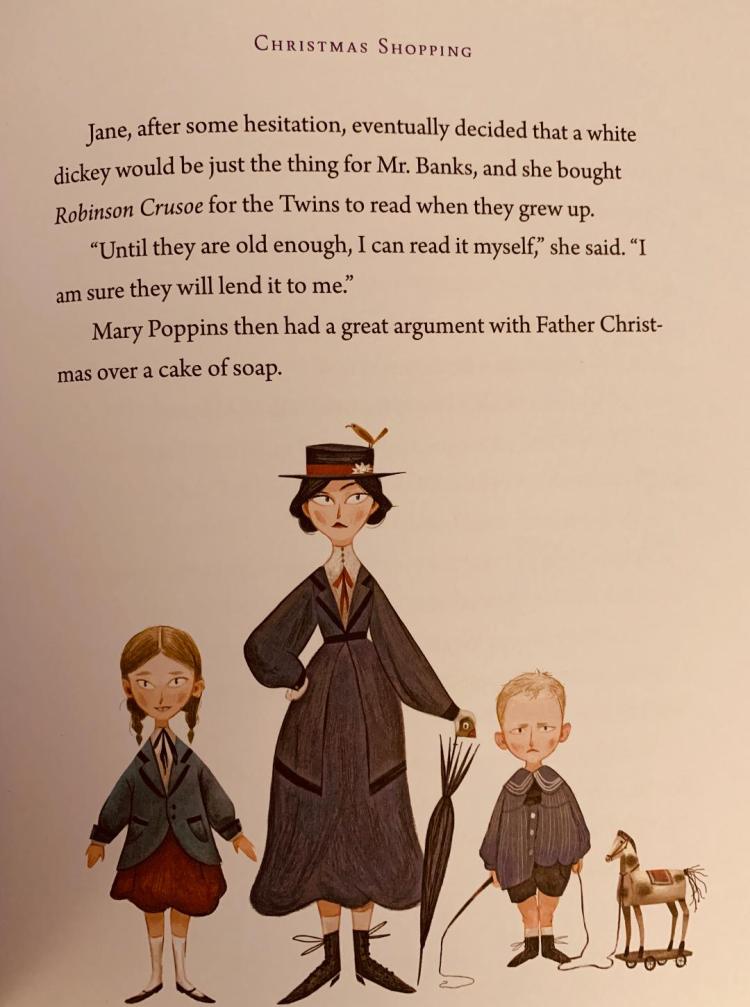
(illustration by Júlia Sardà)

Would you like to go Christmas shopping with Mary Poppins? I know I would, for the obvious reason, the outing would most certainly entail some kind of unexpected magical experience. And who wouldn’t enjoy a little magic? Although, Mary Poppins’s magic is never meant to entertain.

No, despite all appearances, Mary Poppins’s magic has a much more serious purpose. And, it is not the one conveyed by Disney’s movie “Mary Poppins” (and even less so by the sequel “Mary Poppins Returns” ). Mary Poppins does not visit the Banks family to save them or Mr. Banks, as another Disney movie “Saving Mr. Banks” suggests.

Mary Poppins comes to teach the Banks children, and all those who read the original stories, about life and its mysteries. The essence of these stories is mystical and with each subsequent book* (as the spiritual journey of P.L. Travers evolved) they become more and more spiritually infused.

I thought that a blog post about the story Christmas Shopping from the first Mary Poppins book published in 1934 would be an appropriate theme for this time of the year.  

Christmas Shopping Mary Poppins 2

(illustration by Júlia Sardà)

It is almost Christmas, and Mary Poppins, Jane and Michael Banks are riding the bus on the way to the Largest Shop in the World. Jane and Michael are excited:

                                    ‘I smell snow’, said Jane, as they got out of the Bus.

                                    ‘I smell Christmas trees’, said Michael.

And what does Mary Poppins reply?

                                    ‘I smell fried fish?’ said Mary Poppins.
Now, this is Mary Poppins! She never gets overly excited and she never gives away any sign that something magical is about to happen. And why would she? There would be no magic without an element of surprise!

Of course, Mary Poppins’s attitude does not stop Jane and Michael from being excited about Christmas and from marveling at the toys displayed in the windows of the Largest Shop in the World. The children take their time because, by now, they know Mary Poppins, and they know that there is nothing she likes more than to look at her own reflection in shop windows.

Christmas Shopping Mary Poppins 4

(original illustration by Mary Shepard)

Jane and Michael are looking for presents for their family. The Toy Department is definitely the designated place for such a purpose; a clockwork train with special signals for Daddy, a small doll’s perambulator for Mommy, a mechanical beetle for Robertson Ay, a pair of spectacles for Ellen who, by the way, doesn’t have any eyesight problems, and Robinson Cruose for the twins to read when they grow up. You get the gist. The children are choosing for themselves. And what does Mary Poppins do? Nothing. She lets them do as they wish, for she does not interfere with their choices, at least not in an obvious way. And anyhow, she it too busy having an argument with Father Christmas over a cake of soap. Now, it is time for tea, and they have to leave the store. Understandably, Jane and Michael are not ready to tear themselves away from the toys.

But Mary Poppins hurried on and they had to go with her. Behind them Father Christmas was waving his hand, and the Fairy Queen on the Christmas Tree and all the other dolls were smiling sadly and saying. “Take me home, somebody!” and the aeroplanes were all beating their wings and saying in bird-like voices “Let me fly! Ah, do let me fly!” Jane and Michael hurried away, closing their ears to those enchanting voices, and feeling that the time in the Toy Department had been unreasonably short.

Just at that very moment, when the children are about to walk out of the shop, a flickering figure of a child pops out of the spinning door at the shop entrance. The adventure begins.

… the child had practically no clothes on, only a light wispy strip of blue stuff that looked as though she had torn it from the sky to wrap round her naked body.

This is Maia, she is the second star of the seven Pleiades; those are the stars that Mr. Banks showed one night to Jane and Michael.

Christmas Shopping Mary Poppins 3

(illustration by Júlia Sardà)

Maia has come down to earth to do a little Christmas shopping and buy toys for her sisters who can’t get away very often because they are “so busy making and storing up the Spring Rains.”

So, Michael and Jane are now following Maia in the store as she choses the gifts she wants to bring back home. Maia selects a little stove with silver saucepans and a stripped broom for her eldest sister because she is domestic, and because, of course, up there where they live there is a lot of star dust.

Then Maia choses a skipping rope for another one of her sisters because she likes to dance and a book for another who is quiet and never wants anything. As for the youngest one of Maia’s sisters, Maia asks advice from Jane and Michael. A humming-top and rubber ducks will do the job.

Now it is time for Maia to go back home. Jane remarks that Maia has no Christmas gift for herself and she starts searching through her parcels to see what she could spare for Maia.  It is then that Mary Poppins whips off her new gloves with the fur tops; the first gloves she ever had and the ones she thought she would never grow tired of looking at in the shop windows, and she gives them to Maia, because it is cold outside. Maia kisses Mary Poppins and steps on an invisible ladder carved into the sky and begins to climb up in the air.

Christmas Shopping Mary Poppins 5

(original illustration by Mary Shepard)

Clearly, Mary Poppins teaches Jane and Michael about generosity and the nature of gift giving. A lesson taught without preaching, in the most effective way, by example. She shows them that a gift is an act of love and that one must choose a gift to match the desires and needs of the receiver and not the giver.  And, if we push the interpretation further, we can say that there is an element of sacrifice in the ritual of gift giving, at least in P.L. Travers’s mind. The lesson here is similar to another Christmas story written by P. L. Travers The Fox at the Manger.

Another interesting theme in the story is the question of money. After Maia has chosen all her gifts, a practical question is raised by Michael:

                                    “But she has no purse. Who will pay for the toys?”

And Maia answers:

What did you say?” demanded Maia with round, surprised eyes. “Pay? Nobody will pay. There is nothing to pay – is there?” She turned her shining gaze to the Assistant.

“Nothing at all, madam,” he assured her as he put the parcels into her arms and bowed again.

“I thought no. You see,” she said, turning to Michael “the whole point of Christmas is that things should be given away, isn’t it? Besides what could I pay with? We have no money up there.” And she laughed at the mere suggestion of such a thing.

After all, the spirit of Christmas is about love, generosity and compassion and not so much about shopping. Mary Poppins might have been written in 1934 long before the invention of the internet and smart phones, but she is just as relevant today as she was back then. If we could only remember her!

Maia’s comment about money hints at something we lose out of sight in our everyday life. Money outside of our human social structures has no importance whatsoever. The Universe in which we spin couldn’t care less about money.

We might be living in a material world of our own creation, but we must remember that we are a part of a much vaster macrocosm that obeys different laws. How are we to strike a balance between our material and spiritual needs? And, does one exclude the other? Don’t we need both perspectives even if they appear to be at odds with each other?

And did P.L. Travers succeed in finding that balance? I am not certain, but spirituality was a major part of her life experience, and the spiritual teacher who influenced her outlook on life was G. I. Gurdjieff.

I have written a few posts on this blog about Gurdjieff and I believe that it is relevant here in this Christmas post to talk about Gurdjieff’s inverted Christmas tree and P.L. Travers’s own thoughts about the meaning of this symbol.

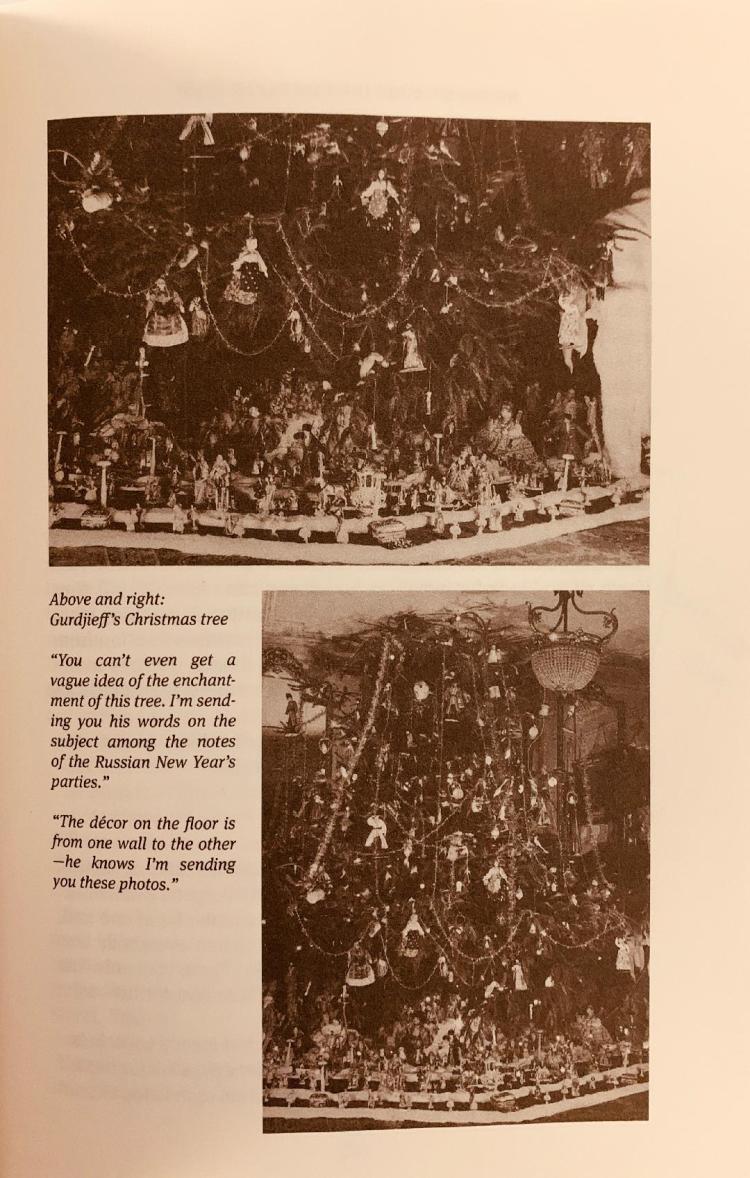
There is an ancient tradition originating in Eastern Europe of suspending Christmas trees by their roots and it appears that this tradition was also adopted by G.I. Gurdjieff.

Gurdjieff inverted Christams tree

(picture from Gurdjieff and the Women of the Rope)

Rene Zuber a pupil of Gurdjieff experienced Gurdjieff’s inverted Christmas tree firsthand and wrote about it in his book Who Are You Monsieur Gurdjieff?:

(…) I will describe what happened to me on Christmas Eve (the Russian Christmas which is thirteen days later that ours). I had been asked to go to his flat where I found another of his pupils. The master of the house showed us into the empty drawing-room, and there in the middle of the floor lay piles of toys, sweetmeats and oranges. We had to divide them up and put them into little paper bags, so that each child could have his share.

A lovely pine tree, fresh from the flower market, confirmed that everything would be done to custom. I took upon myself to transform it into a Christmas tree with the necessary tinsel, candles and stars. For someone from Alsace, like myself, this was a deeply satisfying task.

I had almost finished when Mr. Gurdjieff came in, glanced at our work, and going up to the tree signalled to me to hang it from the ceiling. I could not believe my eyes. ‘But….Monsieur….from that hook up there? Upside down, with the roots in the air?’ That was exactly what he wanted. So I was left to strip the tree, climb on a stool and attach the roots to the ceiling as best as I could. (…) The story is perplexing. (…)

Maybe Gurdjieff wanted to encourage Zuber to change his perspective on life, to look at things from different angles, to question customs and habits. Zuber writes of Gurdjieff’s teaching as being “invigorating” with “provoking quality” that is “inexhaustible”. These are some of the traits of Gurdjieff’s teaching that must have appealed to his pupils. Or, maybe Gurdjieff was pointing in the direction of P.L. Travers’s interpretation.

P.L. Travers examined the symbol of the tree in a talk she gave for The Far West Institute in the summer of 1973. In that talk she informed her listeners that the tree appears as a major mythological symbol throughout different cultures at different times in the history of humanity, and almost always in the same vein: as a cosmic pillar connecting the underworld, the earth and the Heaven.

She gave examples from the Bible, the Kabbalah, the Norse and Teutonic myths, the Avestan tradition, the ancient writings of the Parsees. And then she introduced her audience to a lesser known mythology, that of the inverted tree:

But it is in the earliest writings of Hinduism that one finds it most vividly portrayed, the mysterious Asvattha Tree of the Rig Veda, with its roots in Heaven and its branches spreading downward. Clearly this tree has a solar aspect, not so much of a physical as of a supernal sun whose rays strike downward bringing life.

 And thus, she links the symbol of the inverted tree to G.I. Gurdjieff’s cosmogony:

And all this can be assimilated to Gurdjieff’s system, whose great symbol, the Ray of Creation, is also an inverted tree, rooted above in the Absolute and descending as an octave through ever denser stages of being from one Do to another. Clearly the message of this many faceted symbol is that the roots of man are not on earth but in the Heaven….

In that talk she alos mentiones, although rather briefly, the Tarot card of the Hanged Man. This gives me an idea for another blog post. And on and on it goes… I hope you enjoyed reading this post and that you will come back to read more about Mary Poppins and P.L. Travers.

____________________________________________

* There are eight Mary Poppins books.

In the Kitchen with Mary Poppins

Mary Poppins in the Kitchen colour cover

This blogpost is about P.L. Travers’s book “Mary Poppins in the Kitchen” first published in 1975.

Mary Poppins in the Kitchen” is composed of two parts: the story of Mary Poppins in the Kitchen

MAry Poppins in the Kitchen bright

and the recipes from Mary Poppins’s Cookery Book from A to Z.

MAry Poppins Cookery Book 2

Mr. and Mrs. Banks are on their way to a weeklong planned trip to Brighton. But then Mrs. Brill, the cook, announces that she needs to leave the household to give a helping hand to her niece, whose four children have measles. And, of course, that happens just when Ellen, the maid, is nursing a cold. The question then arises: Can Mary Poppins cook and is she willing to?

‘I have only one pair of hands,’ she said, ‘And those are occupied’. She had lifted Annabel from the floor, and John and Barbara, one on either side of her, were each hugging a leg.

Mary Poppins in the Kitchen, P.L. Travers

Jane and Michael rise to the occasion and offer to help Mary Poppins in the kitchen. The matter is settled, and the parents leave for the week.

Each day during that week a special visitor from the gallery of mythical characters from the Mary Poppins books shows up in the Banks’s kitchen to help Mary Poppins and her charges to prepare the meal of the day.

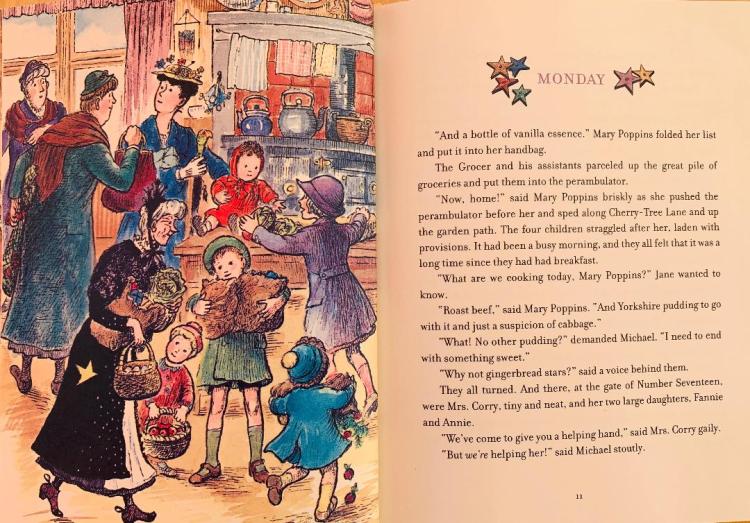
On Monday, Mrs. Corry comes to help with the cooking of a roast beef, a suspicion of cabbage and a Yorkshire pudding. On Tuesday, it is Admiral Boom’s turn to come and cook a shepherd’s pie, carrots and apple charlotte. On Wednesday, Mr. and Mrs. Turvey come to mix the ingredients for an Irish stew and a honey and bananas dessert. Then on Thursday, Mary Poppins’s cousin, Mr. Twigley, shows up to play music with the kitchen utensils while Mary Poppins and the children prepare the beef patties, the green peas and the bread-and-butter pudding. Comes Friday, the Bird Woman appears in the garden outside of the kitchen, carrying herbs for the planned roasted chicken with bread sauce and green beans. And on Saturday, Andrew and Willoughby, Miss Lark’s dogs bring the Park Keeper and Mrs. Lark into the Banks’s kitchen. The dogs are of course intrigued by the smell of the Lancashire hot pot and the cherry pie, but the Park Keeper and Mrs. Lark are of no use in the kitchen. On Sunday, the day on which Mr. and Mrs. Banks come back home, the children are so busy cooking for their parents that even the sound of the bell on the Ice Cream Man’s tricycle outside in the lane can’t distract them from their occupation. No, they are cooking chicken with potatoes and making a salad, and a lemon soufflé for dessert.

Each of these weekday stories has its own illustration depicting the cooking adventures of Mary Poppins and the children. The original Mary Shepard’s illustrations in the first edition of “Mary Poppins in the Kitchen” were not colored.

Mrs. Corry Origianl cooking illustration.jpg

(Picture taken from The Left Chapter Blog)

I have the 2006 redesigned edition of “Mary Poppins in the Kitchen” published by Houghton Mifflin Harcourt, which reproduces the original vintage illustrations but in colour, certainly making the book more appealing to today’s young readers.

Mary Poppins Monday colour story

Mary Poppins in the Kitchen” is the least magical of all the Mary Poppins books and it also, in my opinion, lacks the whimsical feel of “Mary Poppins From A to Z. The episodes with Mr. Twigley and Mr. and Mrs. Turvy are probably the most playful stories in the book.

I can easily imagine young children laughing at the desperate attempts of the Turvies to participate in the cooking activities taking place in the kitchen on Wednesday.

So everybody set to work. And though the guests behaved in a topsy-turvy manner – Mrs. Turvey repeatedly stood on her head and Mr. Turvy insisted on looking for the lamb chops in the broom cupboard – the cooking went under way.

Mary Poppins in the Kitchen, P.L. Travers

Topsy Turvey cooking adventure.jpg

It is worth noting here that P.L. Travers chose the Bird Woman as the helper for the seasoning of the chicken on Friday. I would’ve definitely asked P.L. Travers what motivated her choice. Did she want to hint to the young readers that everything that lives eats, and is eaten in its own turn? There is definitely something sacrificial in the Friday cooking story. I never gave any thought about the Bird Woman’s diet until I read “Mary Poppins in the Kitchen”. But now that I have, I kind of doubt that the Bird Woman would eat birds or participate in their cooking. This is really not how I feel the character. Anyway, that would have been an interesting discussion to have with P.L. Travers.

There are other discrepancies of similar nature in “Mary Poppins in the Kitchen” that make this book stand apart form the other books in the series, starting with the first scene where Mr. and Mrs. Banks are having tea with the children.

 Mr. Banks, down on all fours, pretending to be an elephant with John and  Barbara on his back, rose, panting, to his feet.

                                                              Mary Poppins in the Kitchen, P.L. Travers

Mr. Banks on all four.jpg

Now, this is uncharacteristic. Mr. Banks is usually rather busy and has no time for frivolities.

Another strange detail in this book is the apparent emotional connection between Mary Poppins, Jane and Michael in the final scene. “Mary Poppins and Jane and Michael exchanged a glance full of meaning.” This is not something a reader encounters in the other Mary Poppins stories. Mary Poppins, always and in all circumstances, keeps her position of authority and of superiority. There is never ever an emotional connection between her and her charges; they are always kept at a distance. Again, this would have been an interesting subject to discuss with P.L. Travers.  

And now about Mary Poppins’s Cookery Book. All the recipes are British Edwardian recipes from P.L. Travers’s own childhood stomach memories*. And, inferring from her testimony that she never used recipes and cooked out of her head, she apparently needed the help of a culinary consultant to give the recipes precision and structure. That consultant was Maurice Moore-Betty, an Irish cook living in Manhattan.  

However, I must say I do have some doubts about P.L. Travers in the kitchen. Somehow, I can’t picture her in front of a stove… But then, she must have fried an occasional egg.

Why did P.L. Travers write a cookery book? This is the official answer she gave:

I think it’s desirable that children should have every opportunity to express their imagination. A child that can help to make a soufflé may be able to make a poem the next day.

Mary Poppins Has Her Own Way Even in the Kitchen, by Lisa Hammel, November 12, 1975, The New York Times

The answer that I believe is closer to the truth is that she wanted to sell more books before the effect from the Dinsey Mary Poppins movie wore off completely.

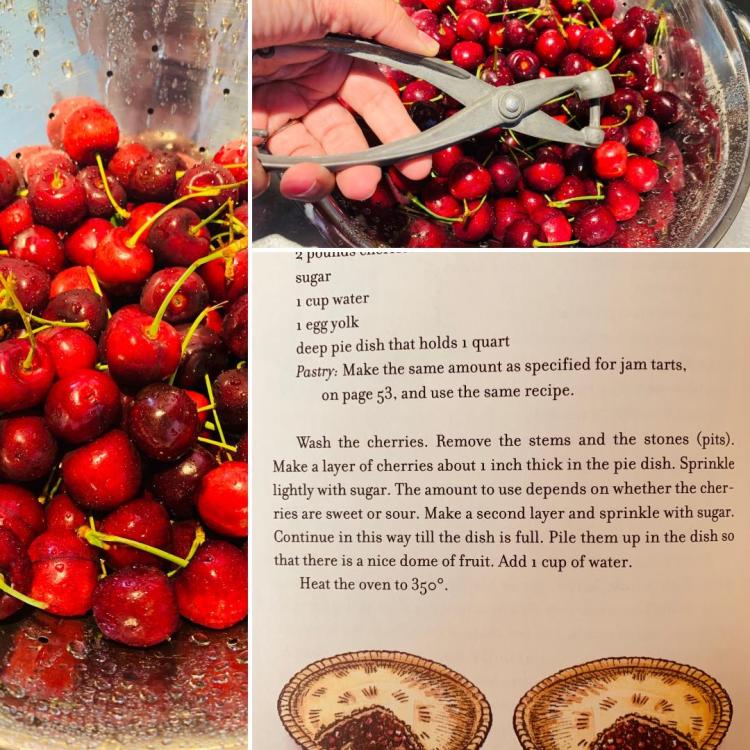
I decided to try a few recipes from the Mary Poppins’s cookery book, but since I am not an experienced pastry baker (and I got no help from magical friends) even easy child appropriate recipes proved somewhat difficult. 

I can’t really say if the gingerbread stars were a little dry because something is missing in the recipe or because I overbaked them.

My version of the cherry pie was good but not fantastic.  I didn’t have enough dough to cover it nicely.  Again, not sure if the problem was in the recipe or in the cook. I guess I could have played it safe with a store-bought dough but then I wanted to have the full Mary Poppins in the kitchen experience.

Mary Poppins Cherry Pie Montage.jpg

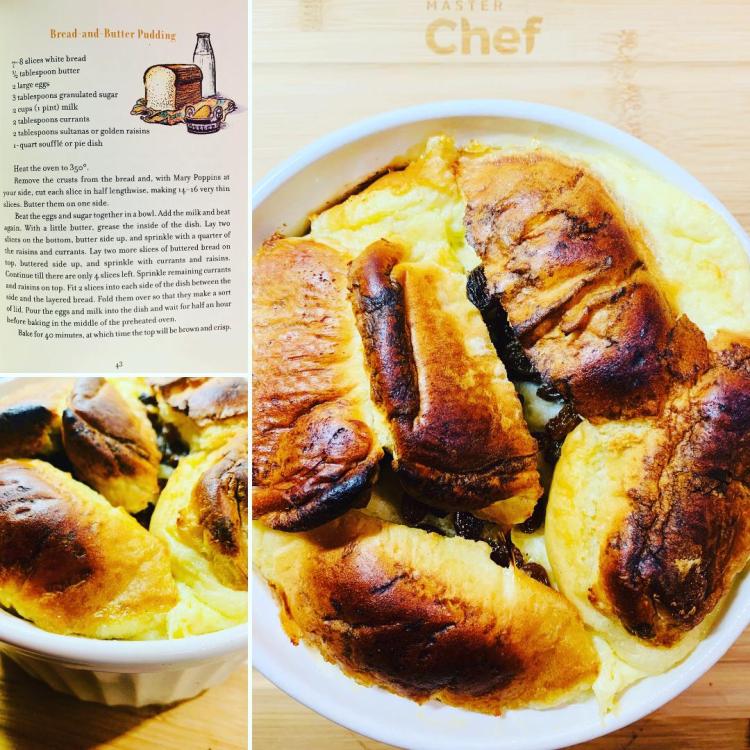
I enjoyed making and eating the bread and butter pudding, even if I only had raisins to put in and no currants. And, I didn’t remove the crusts from the bread either. I just love bread crusts.

Mary Poppins Bread and Butter Pudding

Finally, I can report with confidence that the honey and bananas recipe works without fail (and is the easiest one along with the fruit salad), but I would suggest cutting the bananas in round slices so you can serve them with ice cream. At least this is what I will do next time.

In total in this new redesigned edition there are 30 recipes and wisely, twenty-one of them are for desserts! However, some of the recipes from the original edition are missing. I will have to get a copy of the original first edition.

I hope that you enjoyed this post and that you will come back to read more about P.L. Travers and her Mary Poppins.

Mary Poppins in the Kitchen back cover.jpg

__________________

* Mary Poppins Has Her Own Way Even in the Kitchen, by Lisa Hammel, November 12, 1975, The New York Times

Mary Poppins From A to Z

Mary Poppins From A to Z Second edition

The Mary Poppins magnum opus is composed of eight books written over a period of fifty years. The first four adventure books, Mary Poppins (1934), Mary Poppins Comes Back (1935), Mary Poppins Opens the Door (1943) and Mary Poppins in the Park (1952) are the most popular.

The next two books, Mary Poppins From A to Z, (1962) and Mary Poppins in the Kitchen (1975) are companions to the adventure books and are the least known by the public. Nevertheless, they still deserve attention.

As for the last two Mary Poppins adventure books, Mary Poppins in Cherry Tree Lane (1982) and Mary Poppins in the House Next Door (1988), P. L. Travers wrote them when she was well into her eighties. Their lack of popularity could easily be explained by the eerie mood of the themes explored in the stories and the evermore shadowy character of Mary Poppins. Understandably, mending broken things and finding lost possessions are not exactly themes appealing to young readers at the beginning stages of life.  However, a fact, even when forgotten or disregarded, still remains a fact; none of the Mary Poppins adventures books were written especially for children, strange as this may sound.
In this post I want to explore one of the lesser known Mary Poppins books, Mary Poppins From A to Z and its new adaptation for the very small, the board book Mary Poppins ABC (2018).

Mary Poppins From A to Z, as the title suggests, is an alphabet book and was first published in the early 1960’s. It was illustrated by Mary Shepard, the illustrator of all the Mary Poppins books.  It contains twenty-six illustrated short tales, one for each letter of the alphabet. Each story is a snapshot of the daily life of the Banks family, outlined in black ink on a colored background.

Vintage Illustration Mary Poppins From A to Z

(I found this picture on the Internet but I couldn’t identify its origin, so I am not able to give the owner any credits.)

After its first publication the book remained out of print in North America until 2006, when Houghton Mifflin Harcourt released a new edition. In this second edition, colors light up the original vintage illustrations and energize the activities depicted on its pages, undoubtedly making the book more appealing to today’s young readers.

Mary Poppins From A to Z Letter A colors.jpg

The tales although rather short keep pace with the eccentric aspects of the adventure books, the magic is palpable. However, the beginning reader will require some assistance from a more experienced one because P.L. Travers generously sprinkles her stories with unusual words.  

In Mary Poppins From A to Z, P.L. Travers definitely displays her love for words and her talent for weaving them into whimsical patterns of her choosing. And anyhow, how is a child to develop a rich vocabulary if not through reading?

My favourite vignette is the one for the letter G. Jane and Michael, chaperoned by Mary Poppins, are feeding the geese on the green by a lake. Mr. Banks happens to pass by and observing the children’s activity remarks that he is glad not to be a goose. To which Jane replies that the geese are not really geese but gallant swans in disguise, that she herself is Goldilocks and Michael a killer of giants. Then Mr. Banks jokingly tells the children he is a grand Duke and that he never needs to pay the grocer.  

Mary Shepard’s illustration of this vignette strikingly reveals the meaning of the story. Behind each character there is a second, astral depiction of the imagined self. Only Mary Poppins’s reflection into the field of potentialities is simply Mary Poppins.

Mary Poppins From A to Z Letter G colors

The children are in a state of becoming, with imaginations still unburdened by everyday responsibilities and limitations. There is nothing surprising about them imagining their future selves. The story’s message is lodged in the contrasting projections of the grown-up characters, Mr. Banks and Mary Poppins.

Mr. Banks, appears to use his imagination for a fleeting escape from his unsatisfying state of being, while Mary Poppins appears to be genuinely happy with herself. And that is a nice ideal for children to live up to, to grow up into themselves and be happy with who they become.

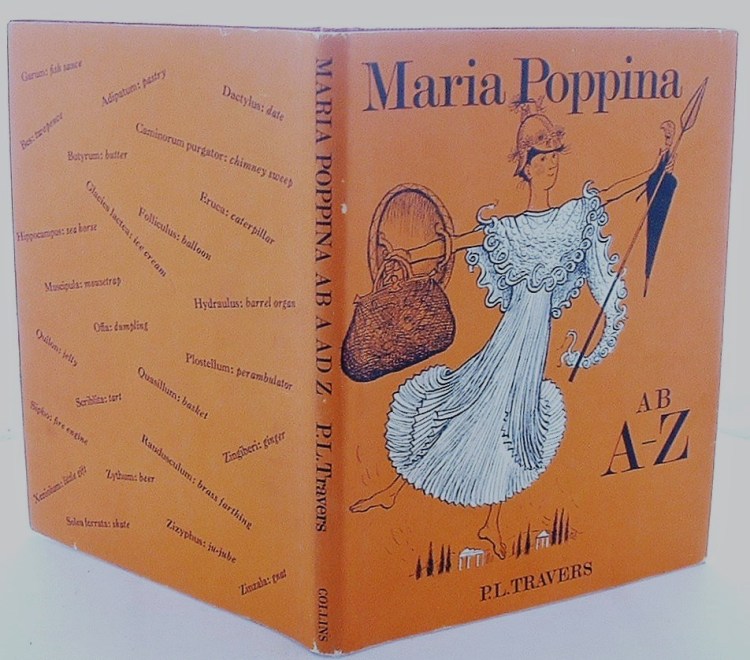
Since we are on the subject of Mary Poppins From A to Z, it must be mentioned here that P.L. Travers made special efforts to get the book translated in Latin. Unusual as this may appear at first, there is logic to it. In the 1960’s Mary Poppins was already a children’s classic of the stature of Alice in Wonderland and Winnie-the-Pooh and these two were at that time published in Latin. Not only that, the Latin translation of Winnie-the-Pooh became a favourite with students of Latin and thus an instant bestseller, remaining on Times list for 20 weeks selling 125,000 copies in 21 printings.  No wonder P.L. Travers went out of her way to find a translator during her writers’ residency at Smith College in 1966. Finally, it was Peter Marshal, Professor of Latin and Clas­sics at Amherst College who agreed to work on the Latin translation. 

Maria Poppina

(I found this picture on the Internet but I couldn’t identify its origin, so I am not able to give the owner any credits.)

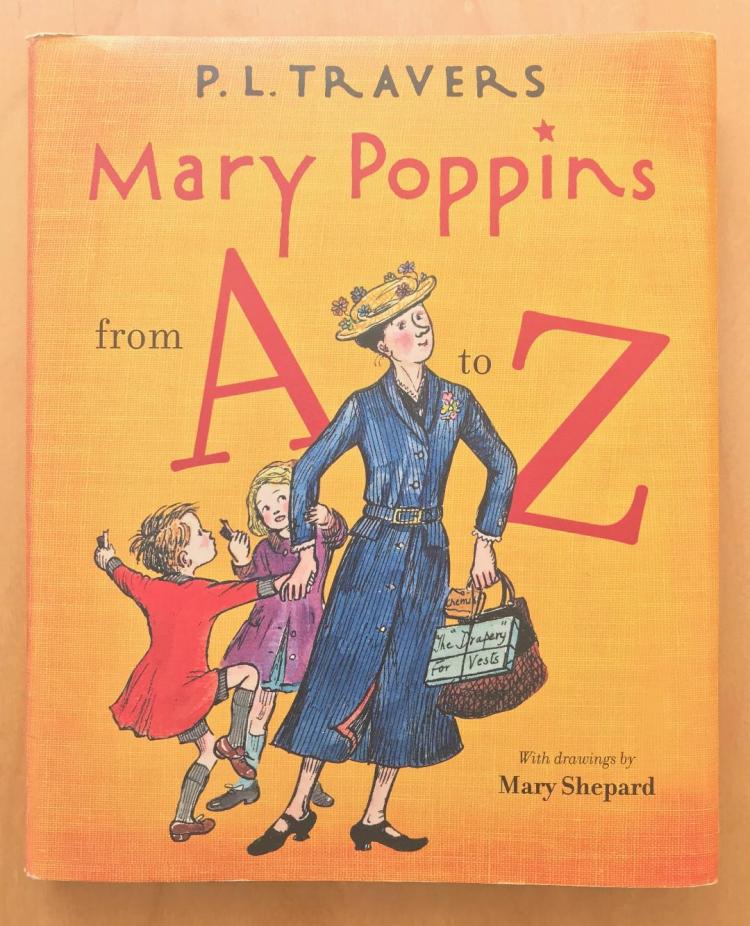
Now, a word about the new adaptation of Mary Poppins Form A to Z into a board book. In 2018 in anticipation of the new movie, Mary Poppins Returns, Houghton Mifflin Harcourt released the board book Mary Poppins ABC in which each tale of the original book is shortened to one sentence.  Again, the original Mary Shepard drawings are animated with bright colors and the overall impression of the book is one of vibrant joy. There is just one small glitch in this new adaptation.

Mary Poppins ABC cover

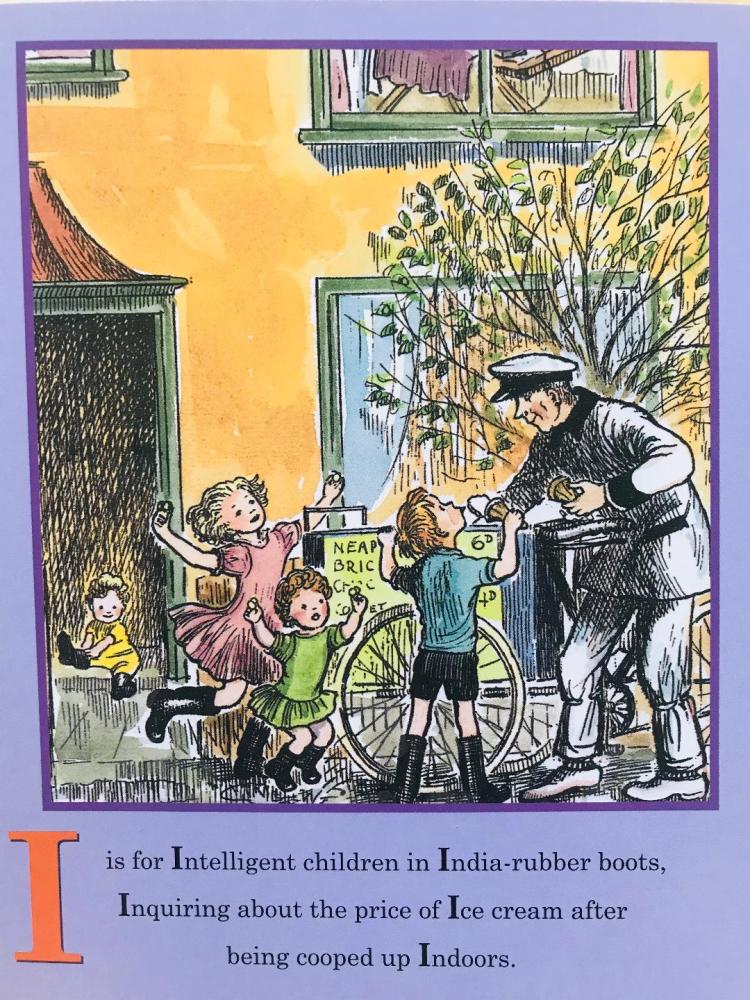
Some of the original illustrations were altered, in my view quite unsuccessfully, in order to fit the brevity of their corresponding tales. For example, in the illustration for the letter M the bodies of the  Park Keeper and the Lord Mayor are cut in half, and on the illustration for the letter I, one can see the bottom of a window on the second floor of the house but Mary Poppins, who is in the room on the second floor happily ironing her apron, is completely removed from the picture.

Of course, when the original vignette is reduced to a sentence the remaining images contain more elements than the written story, but that allows for animate discussions with the young reader.

Mary Poppins Letter I.jpg

Mary Poppins Letter M

Regardless of this imperfection the book is a nice way of introducing young children to the Mary Poppins books.

P.L. Travers’s note at the end of Mary Poppins Form A to Z is one of the loveliest descriptions of the Banks’s nursery and the perfect conclusion to this blog post. I simply can’t resist the temptation to share it here with the readers:

Mary Poppins From A to Z nursery description

I believe that this is the only book in which Mary Poppins is said to fall asleep. I would have loved to discuss this particularity with P.L. Travers. So many questions remain unanswered.

The Miraculous According to Mary Poppins

Mary Poppins Miraculous

As children, we readily believe in magic without any need for explanations. Then, as we grow older, we begin to question the world around us, and no matter how vast and mysterious this world may be, most of us fall into the trap of labeling, categorising, defining, and shrinking the infinite to our human and limited capacity of understanding. In a way, we can’t help it. The fact is that the day comes, for all of us, when we realize that wishful thinking does not solve our problems. Some of us lose the connection to the miraculous gradually, walking down the stairs of life’s small disappointments. For others, the loss is sudden and traumatic. 

Then, there are the few, who even after losing their childish understanding of magic, and despite all the surrounding madness, remain connected by some invisible thread to an inner belief; a particular combination of knowing and feeling all at once, that despite all the chaos of our outer world there still remains the possibility of encountering  the “miraculous.” Somehow, they can embrace the elusive, unpredictable and unexplainable phenomena that links us to a larger reality, to an expansive consciousness, which if we could connect to it, has the capacity to enhance our experience of life and maybe give it meaning. The question then becomes, what is this unknown reality and how can one find the miraculous in everyday life?  In which direction should one go? What path should one take? Or perhaps any road can lead to the miraculous? P.D. Ouspensky offered a beautiful definition of the miraculous:

The ‘miraculous’ is very difficult to define. But for me this word had a quite definite meaning. I had come to the conclusion a long time ago that there was no escape from the labyrinth of contradictions in which we live except by an entirely new road, unlike anything hitherto known or used by us. But where this new or forgotten road began I was unable to say. I already knew then as an undoubted fact that beyond the thin film of false reality there existed another reality from which, for some reason, something separated us. The ‘miraculous’ was a penetration into this unknown reality. (1)

However, beautiful as this definition may be, it remains a subjective attempt to define the indefinable. How can one define the unknown and inexplicable? Yet, if experienced, it needs to be shared with the rest of humanity.

Our ancestors realized the imperfections and the limitations of our ordinary language to convey inner insights. So, they demised a way in which to use language for the purposes of transmitting experientially acquired inner knowledge. Essentially, they found the language of the heart. They began to tell stories. They gave us myths and fairy tales.

Pamela L. Travers, the creator of Mary Poppins, although she did not like being called her creator nor assuming that role, (she felt, very much as C. S. Lewis, that she was merely mixing the elements she was given by the one true creator from which we all emanate (2) )  walked on the road of myths and fairy tales. She lived and breathed myth. As Staffan Bergsten, who knew her personally and studied her work said, she experienced reality as a mixture of everyday realism and a form of mythical stylisation where the everyday occurrences blend with mythical allusions (3).   And this is probably why Pamela L. Travers succeeded in conjuring for us Mary Poppins, a fictional character who embodies the essence of the “miraculous,” and of its manifestation in our ordinary life. At the same time, the Mary Poppins stories illustrate our innate capacity as children to both rejoice in and accept the miraculous without the need for any logical explanations. 

Mary Poppins arrives unexpectedly into the Banks family at the exact moment when she is most needed. No one knows where she comes from although it is clear that she existed before the beginning of the adventures in the books. Her ways of being in the world defy all known natural laws: she slides up banisters, speaks with animals, dances with the Sun, glues stars with a brush on the night sky, is able to shrink her size at will and go into plasticine parks and pictures drawn with chalk, just to name a few of her magical abilities.

The strength of her magic resides precisely in the mysteriousness of these faculties. Truth is, if Mary Poppins explained, all magic would have disappeared. Once explained, the miraculous becomes mundane and mechanical. Its power to expand our consciousness consists in its mysterious nature and in its hints of infinite possibilities. Let’s hope that there is no other way, no end to expansion, no end to growth, no end to the mystery. One uncovered secret shows us the infinite vastness of what remains to be explored; it gives us breath and spaciousness.

When Walt Disney decided to make the Mary Poppins books into a movie, he entrusted the project into the hands of the Sherman Brothers (Richard M. Sherman and Robert B. Sherman) who were confronted with the contemplative, dreamlike states of the adventures in the Mary Poppins stories. They saw the books as “an incredible treasure trove of delightful characters and wonderful incidents” (4) that somehow needed to be weaved into a story line, which of course from a movie making perspective makes sense, but by doing so the power and meaning of these stories were reduced to mere entertainment. Mary Poppins was scaled down to fit the American pop-culture understanding of magic: entertainment and a temporary escape from mundane realities.

The movie industry is dabbling now more than ever in the making of modern myths, exploring a mixture of science and magic, and using today’s technologies for visual feasts.  Sadly, our modern myths are one dimensional. Maybe that is because few of us today are interested in symbols, paradoxes, and multiple layers of meaning. Who has time for contemplation? Serious matters need to be attended to, but what are these matters that we chose to label as “serious?”

Endnotes:

  1. P.D. Ouspensky. In Search of the Miraculous. Harcourt Inc., 2001, p.3
  2. Brian Sibley, P.L. Travers: The Woman behind Mary Poppins, a recoding of P.L. Travers in conversation with Brian Sibley.
  3. Staffan Bergsten. Mary Poppins and Myth. Almqvist & Wiksell International Stockholm – Sweden, 1978, p.32.
  4. Brian Sibley and Michael Lassell, Mary Poppins: Anything Can Happen If You Let It. Disney Editions, New York, 2007, First Edition, p.33