Halloween with P.L. Travers

During her stay as a writer-in-residence at Smith College in Northampton, Massachusetts in the autumn of 1966, P.L. Travers was invited to give a lecture about myths, fairy tales and their connection to everyday life. The following year the lecture was published in ‘The Quarterly Journal (Library of Congress, USA) and later in 1989 included in P.L. Travers’s compilation of essays published under the title ‘What the Bee Knows’.    

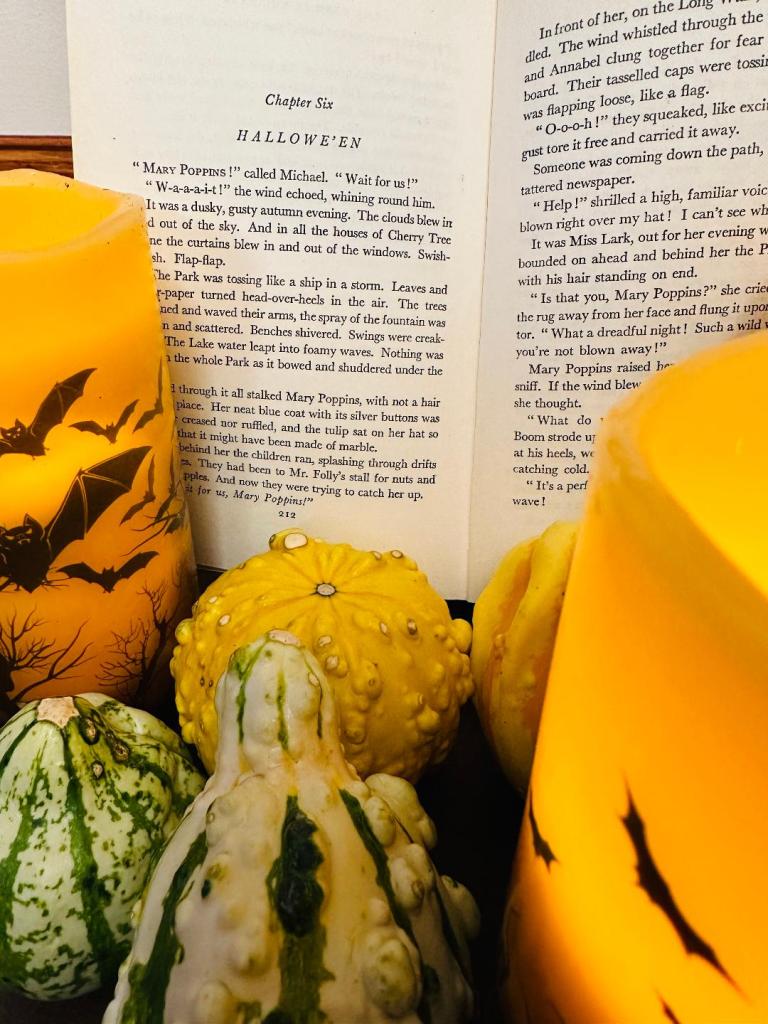
Because the lecture happened on Halloween, P.L. Travers concluded with a brief comment on its history, which she told the audience began as a pagan celebration of the dead and later on was integrated into a Christian celebration by one of the Popes, ‘Boniface IV, perhaps, in the seventh century, who decided to do away with all the pagan saturnalia and turn it from what it so significantly was, into a commemoration of the saints and martyrs’. 

Normally I should have taken her word on the matter, she knew so much and I so little in comparison, yet for some unknown reason I felt compelled to do a quick factual check. To my surprise I discovered that it was not Pope Boniface IV in the seventh century, but Pope Gregory III, in the eighth who decided to morph the old beliefs into the new Christian religion. 

Obviously, her historical reference was wrong but getting the dates right was beside the point she wanted to make, and in all fairness, she did use the word ‘perhaps’, meaning she was not sure of the factual accuracy of her statement. Yet, its truthfulness remains, the old beliefs were indeed transmuted into the new system of beliefs but were unfortunately, in her opinion, deprived of their essential purpose. Luckily, people knew better than Pope Gregory III and a version of this pagan celebration remained to our days.  

In ‘Only Connect’ P.L. Travers acknowledged our human need to remember the dead and to come to grips with our own grieving and fears of death and the unknown. These needs, old as humanity, need an outlet, a ritual to allow us to turn our faces back to life.  

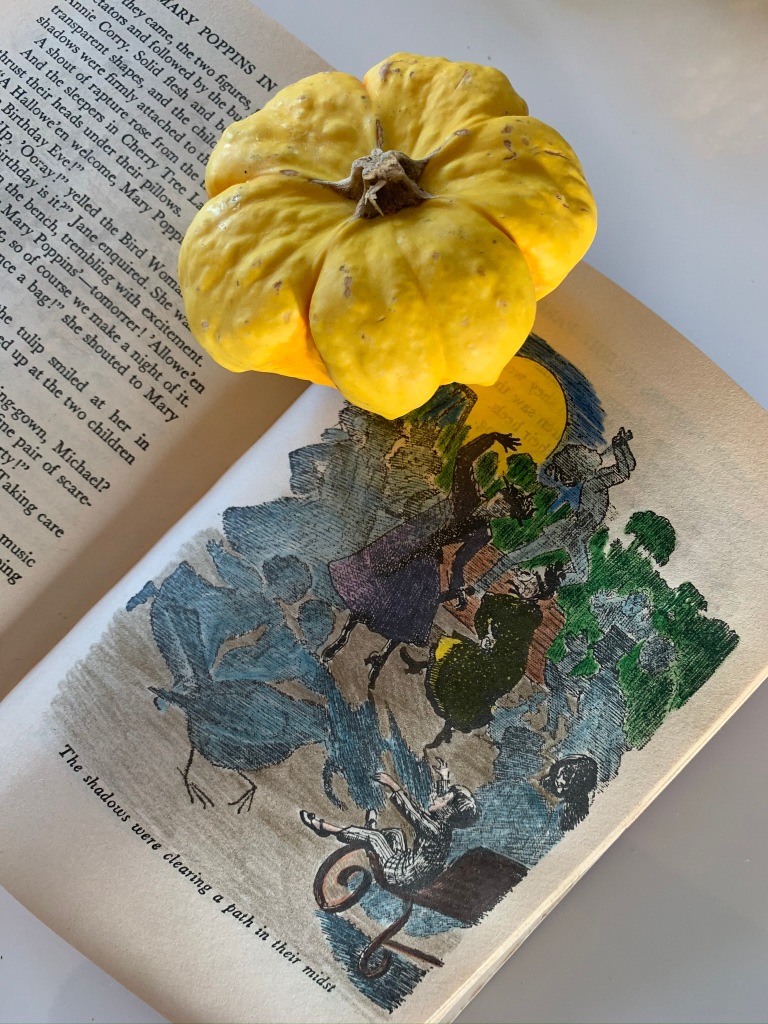
From time immemorial, stories are what allows us to create meaning out of our human experiences, and fairy tales were for P.L. Travers the guideposts in our personal lives. Then, it is only normal that she had written her own version of this pagan celebration in Hallowe’en a story in Mary Poppins in the Park, where not ghosts but the shadows of characters from fairy tales come to party in the Park under a Blue Full Moon. I have written about this story before, and you can read the blogposts here and here.

Now rereading ‘Only Connect’ leads me to believe that the idea for the story may well have been inspired by her own observations of the modern ritual of trick-or-treating; a night when children in the guise of fairy tales characters, heroes and villains, hand in hand, roam the streets at night in search of treats.

Happy Halloween!  

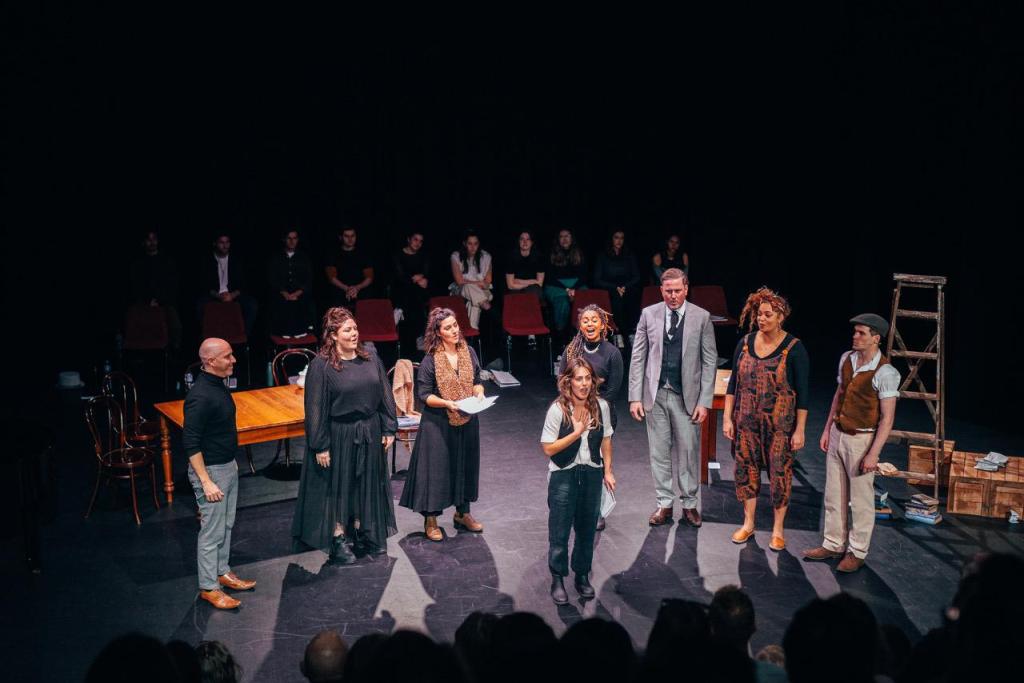
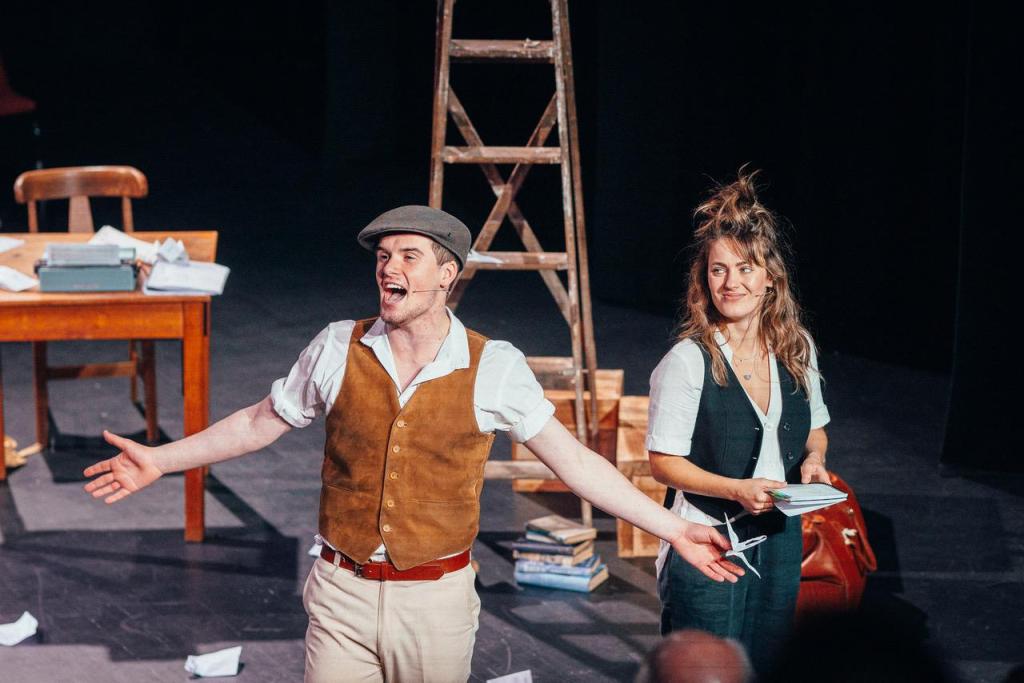
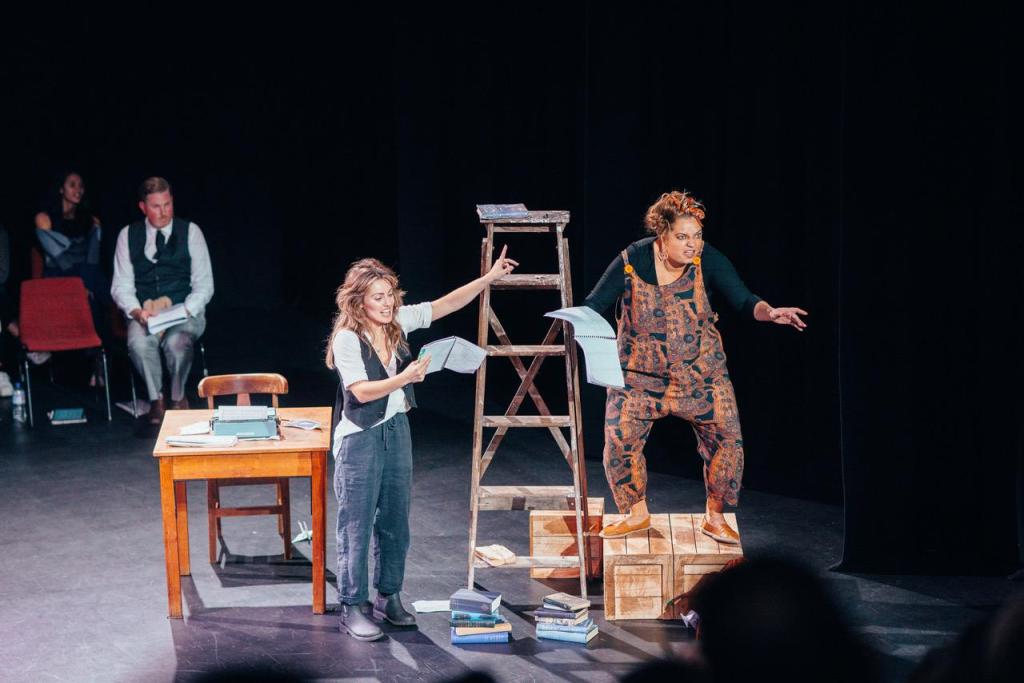
‘Paper Stars’ a Musical About P.L. Travers, the Creator of Mary Poppins 

Photo: Cameron Jones

Three years ago, Miranda Middleton, a young writer and theatre director from Australia had the brilliant idea of a theatrical production centered around P.L. Travers and the writing of the Mary Poppins books.  

The initial idea has now crystalized into ‘Paper Stars’, a musical first developed by The Hatch Lab Musical Theatre Residency Program at Salty Theatre in 2021. From there ‘Paper Stars’ was further workshopped at the Victorian College of the Arts, and last May a stage reading was presented at the Australian Musical Theatre Festival in Tasmania. 

By a fluke of circumstances, I got the chance to meet with Miranda Middleton via Zoom and talk about ‘Paper Stars’ and all things P.L. Travers and Mary Poppins. I am sharing here some snippets from our conversation which begins with a predictable question, and one that was despised by P.L. Travers, but one that honestly, we cannot help but ask creators. 

LS: How did you come up with the idea of ‘Paper Stars’? 

MM: I was quite a theatrical child with a big imagination, so naturally I adored the ‘Mary Poppins’ film, even though it made me sob at the end! I was totally devastated by the fact that Mary Poppins had to leave, and I think I carried that grief for the character into my adulthood, as I too lost people in my life that I loved. Then I saw the film ‘Saving Mr. Banks’ and I discovered that in fact P.L. Travers – the author of ‘Mary Poppins’- was Australian.  I couldn’t believe that I didn’t know she was Australian! And this is basically how the idea for ‘Paper Stars’ was born. From there I recruited my playwright friend Grace Chapple to develop the story with me, and she said, “I think it needs to be a musical.” So, then we asked Luke Byrne to write the music and it has just kind of gone from there. 

LS: ‘Paper Stars’ is not a biographical piece, is it? 

MM: I guess we set out to write ‘Paper Stars’ to add to the canon of biographical material about P.L. Travers. We wanted to cover the period of her life when she was creating this magical character so that gave us the period between 1925 and 1935, during which there really isn’t much written about what was going on for her internally. But that was also interesting for us as writers because it meant that we could bring out our own imaginations to the table. I think the way that we describe ‘Paper Stars’ is that there is a HUGE spoon full of creative license in there So…  it is the somewhat true story of how Mary Poppins came to be, but we are not calling it biographical –it is probably more fictional than biographical.  

LS: ‘Paper Stars’ explores the difficult relationship between P.L. Travers and her mother, their painful separation back in Australia, and then also P.L. Travers’s relationship with Madge Burnand. 

MM: Yes, we were very interested in this idea that Pamela was living with a woman in the 1920’s which was controversial and unconventional – it is those qualities about her that we loved. We were also interested in her relationship with her mother because ‘Mary Poppins’ (the first book in the series) is dedicated to her, not to her father, who she purportedly adored. We were just so fascinated by that fact. So, I guess we dreamt into that backstory. 

LS: Another insight that I gained from ‘Paper Stars’ is that P.L. Travers wanted to be taken seriously as a writer and this is the reason why she kept her Australian origins secret. 

MM: Yes – the cultural cringe! It is a big thing for us Australians, we are very cautious and aware of being kind of looked down upon by the mother land or people overseas. 

LS: Back then or now? 

MM: Even now, I think Australians are kind of still conscious of it. 

LS: The songs are quite touching and emotional. I enjoyed all of them, but my favorites are “Great Story” and “Everyday Magic.” 

MM: Luke who wrote all the music is so clever! The emotional impact of the songs and the story on the audience (at the staged presentation in Tasmania) was really touching to me. Lots of people were crying and wanted to stay around afterwards to talk about the show. I’ve received a number of messages since  saying: “I think this is a really important story to tell.” “It really touched me.” Yes, so I was surprised by how emotionally impactful the story was and so, I am excited to take it to the next stage. 

LS: And what happens now, what are the next steps? 

MM: We are in an interesting phase now where we are talking to various venues about its eventual premiere. It is not official yet, but we are hoping that something will happen next year, because 2024 is the centenary of P.L. Travers leaving Australia. We’ll see what the stars have in store! 

LS: Well, I hope the musical goes into production soon and maybe one day I will get to go to Australia too and see it! 

A Little-Known Friendship 

The friendship between P.L. Travers and Helen Keller is a little-known fact and one that was brought to my attention by a generous reader of this blog. I am forever grateful to my readers who share my interest in the world of P.L. Travers and Mary Poppins and freely share their knowledge with me.

A few letters kept in the archives of Helen Keller reveal that she and Polly Thomson stayed at P.L. Travers’s home during their visit to the UK in 1946. Helen Keller recollects the visit in these words: 

How often Polly and I recall the cozy evenings we spent with you, Camillus, and Moya by the fire in that dear, war-tried little house, surrounded by objects upon which your artistry has bestowed a fairy grace! “

And in another letter: 

I prefer to tell you how two pilgrims in search of ways to succor the war-blinded of Europe were rested and cheered by their visits with you, Moya and darling Camillius. Besides taking you to our hearts we loved your house, bomb-wounded yet warm and sweet to the core, your fire crackling with a cheery message of peace that shall someday inundate all homes, the simple hospitality making us feel natural and free instead of feeling “guests,” and the talk on whose wings the hours flew unnoticed.

The connections I make from reading P.L. Travers’s interviews and writings usually require time and effort, and although I enjoy the process, I must admit that it is immensely satisfying, albeit I feel a little mischievous, to read P.L. Travers’s private thoughts on matters she never discussed in interviews. 

Her correspondence with Helen Keller contains candid details about her relationship with her son, Camillus, and her feelings about single motherhood. In her interviews P.L. Travers rarely talked about Camillus and when she did, it was indirectly, by making references to a boy she knew well or a boy dear to her heart. This may appear strange, but I believe that she was trying to avoid questions about his adoption.  

The adoption of Camillus is discussed in P.L. Travers’s biography Mary Poppins She Wrote by Valerie Lawson, as well as in the documentaries about her life, and so I am not going to delve into the details of the adoption here, but just mention briefly, for those of you who are not familiar with the story, that P.L. Travers never told Camillus that he was adopted and that he had a twin brother, and other siblings. At the age of seventeen he discovered the truth when his twin brother came knocking on P.L. Traver’s door.  

As you can imagine Camillus was hurt and felt betrayed by the person he trusted most in life. His anger was mighty, and he never completely forgave her. This was a terribly sad and tragic event for both and P.L. Travers’s biggest regret in life was that she had not been a good enough mother for Camillus.  

And maybe from the outside one can say that she should have made better choices when it came to her son, the truth is she could not have done differently because she did what she could, what she thought was best, based on the level of awareness she had at the time.  

In her letters to Helen Keller, P.L. Travers writes about teaching Camillus how to swim and row during their summer vacation in Ireland and in the Wales, and how she is teaching him to handle a canoe on the Regent Park Lake. She mentions that he is taking violin lessons and “being very musical and with a good ear.”  

But what I find most interesting in this correspondence is that P.L. Travers appears to have been nostalgic of Camillus’s earliest childhood years. It is almost as if she was grieving the loss of their deepest connection, feeling the bond between them beginning to weaken as he was growing up and losing touch with the dreamland of fairytales. In a way they no longer shared a common way of perceiving the world. Camillus, like most of us when growing up, was interested in the external affairs of life and of becoming, whereas P.L. Travers always kept one foot in the land of myth and fairy tales, and looked for a deeper meaning of life, beyond the illusion of the ordinary. She wrote to Helen Keller: 

He, when he first heard poetry, was enchanted by it, but now at the age of eight only wants it now and then. He is so busy being a gangster one moment, supervisor another, a policeman the next. Everything now is acting and there is very little dreaming. The house shakes with his thundering feet, he is always coming from or going somewhere and only at night remembers that he has a mother and is still small enough to sit in her lap and be rocked in the rocking chair.”  

This sentiment of hers was so strong that it made its way in Every Goose a Swan in Mary Poppins in the Park. Camillus is the Boy in the story. The Boy is engrossed in pretend play, he is a fearsome one- eyed pirate, but then when the Tramp dares him to go to Dead Man’s Drop he suddenly remembers that he has a mother, that if he leaves she would be anxious and that after all she was making pancakes and it was better for him to stop acting and be his other self. 

Another interesting aspect of this correspondence with Helen Keller is P.L. Travers’s frankness about her difficulties as a single parent, the frustrations of domestic life, and her difficulty at reconciling it all with her deep need to write.  

Helen, you will understand how sad I have been at having to face the possibility of sending Camillus to boarding school. I aways wanted to keep him at home with me and let him go to a day school. But daily living becomes ever more difficult in England and the almost impossibility of finding anybody to help in the house will probably make it imperative. (…) I have broached the subject with him and his cheerful reply was “I will hit you if you do send me away!” However, as he grows I think he will quite like the idea and I hope to find a simple loving school which will not try and mould his abundant nature into too conventional a pattern. Then perhaps I shall have time to write.”

The boarding school she chose for Camillus was Dane Court Preparatory School for boys in Surrey. Joy Davidson, the wife of C.S. Lewis, sent her own two sons there after consulting P.L. Travers over tea. P.L. Travers’s high praise confirmed Joy Davidson’s impression of the school.  

The one she liked best was Dane Court, in Surrey, about twenty miles southeast of London. It was the most expensive, “gracious, well-established, comfortable without being luxurious and modern without being faddist,” having adopted a progressive policy of not “whack(ing) the children.” 

Poet, Seeker, and the Woman Who Captivated C.S. Lewis, by Abigail Santamaria. 

In conlusions, P.L. Travers did what she could to give Camillus a good education and a good start in life.

There are other things in the letters that will probably prompt me to write other blogposts, but this is it for this one, and I sincerely hope you enjoyed reading it.  

Tarot and Mary Poppins   

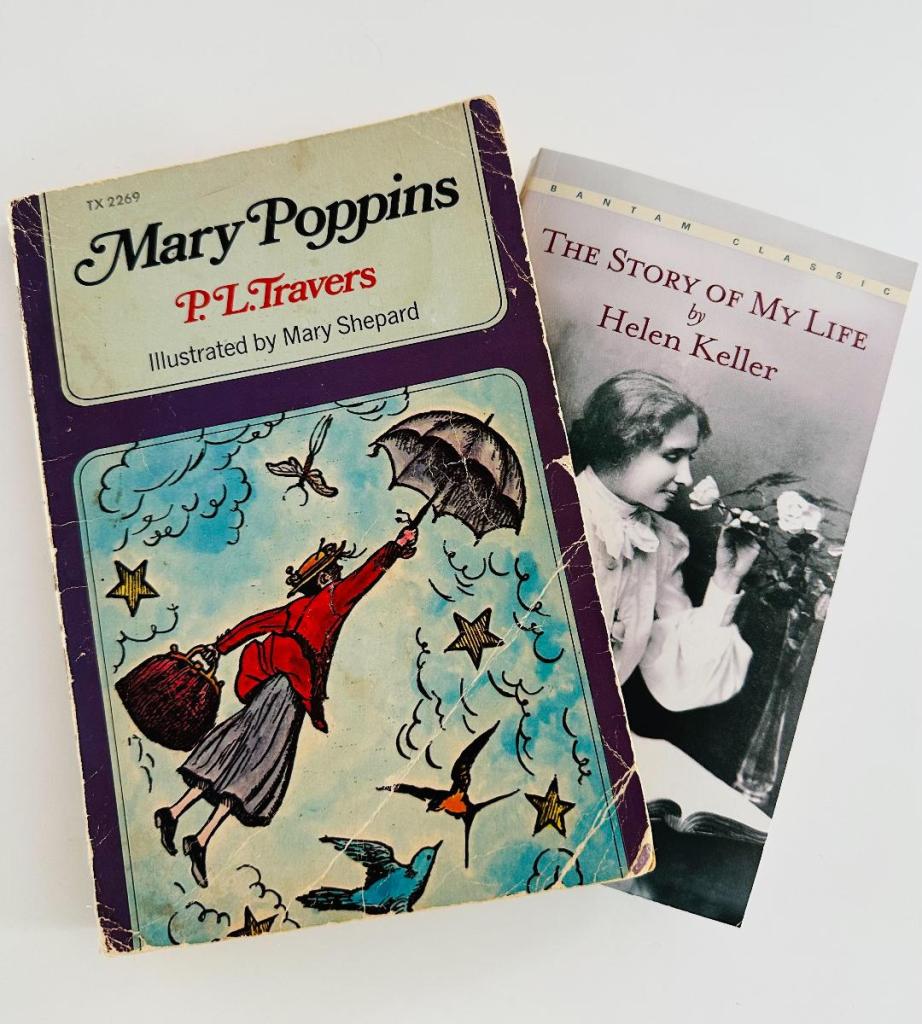
I read Mary Poppins and Mary Poppins Comes Back by P.L. Travers as a child in the early 1980’s in Bulgaria, but when I reread the stories in their original versions a few years ago, and discovered the other books in the series, I was amazed by P.L.Travers’s imagination. As a child I enjoyed the magic in the stories, but I did not give much thought to the author, although the name was on the cover of my book.  

As an adult, however, I wondered where P.L. Travers got her whimsical ideas from. When asked about the origin of her magical nanny, she never gave a straight answer. This may be partially explained by her desire to keep people away from her private life. Afterall, she did say in one interview that Mary Poppins was the story of her life, and that she had taken every precaution to cover her tracks. But then in other interviews she said that no one really knows where ideas come from. Her statement about the mystery of the creative writing process is echoed by other contemporary writers such as Philip Pullman and Elizabeth Guilbert. 

In Creativity, the Psychology of Discovery and Invention, psychologist Mihaly Csikszentmihalyi brings light to some interesting facts about our human creativity, such as the existence of certain commonalities in the personality traits of creatives.  

Csikszentmihalyi explains in his book that the creative process does not occur in a vacuum. Most of the time we build on old ideas by combining and reorganizing them in new ways, or by applying ideas from one domain to another. However, the mystery of creation remains. How exactly we combine ideas and morph them into new ones in our minds and why they take the forms they take is still a conundrum. 

All P.L. Travers’s writings are sprinkled with esoteric, mythological and fairy tales’ references, as these were her literary and spiritual pursuits. I love dwelling in the world of Mary Poppins and P.L. Travers, and I find the process of uncovering these references in the stories most enjoyable. Yet, I am fully aware that I can only uncover some of the components of the stories and link them to her personal beliefs and interests, without ever being able to explain how she incorporated and organized them into the whimsical Mary Poppins adventures.  

I believe that she herself was not entirely conscious of the creative process. Her writing was, at its core, unconscious writing. Her ideas sprang from deep within and then she polished the form. This is at least how I understand her statement about writing Mary Poppins because she was there to be written about. Besides, the adventures in the books all have a dreamlike quality to them, and I doubt this can be achieved to such an extraordinary level of artistry only by rational thinking. 

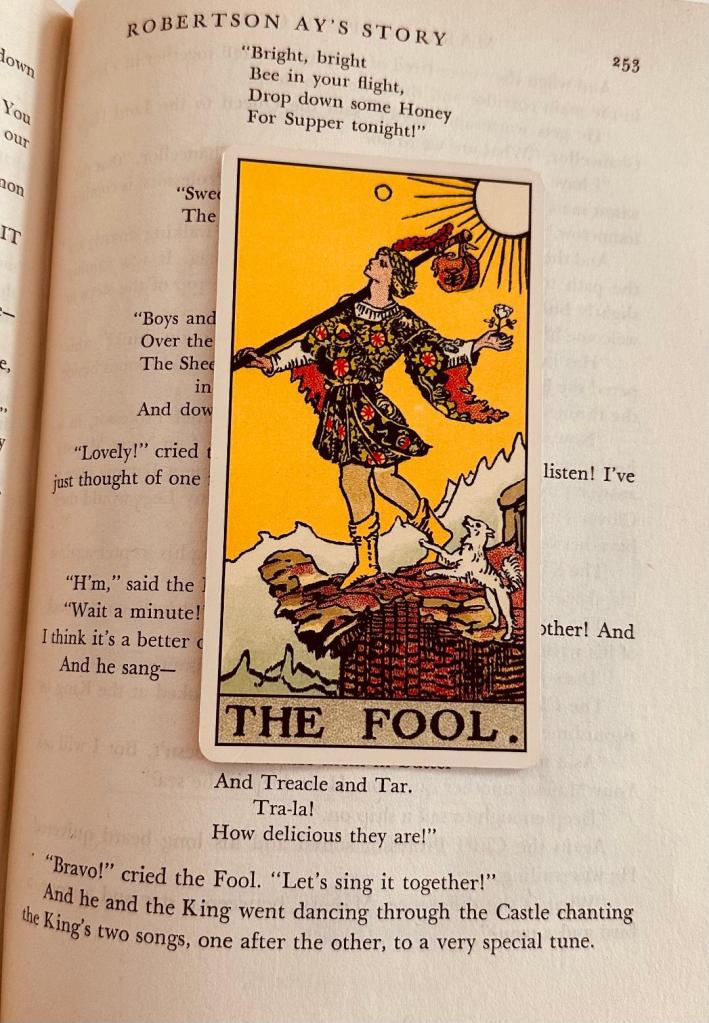
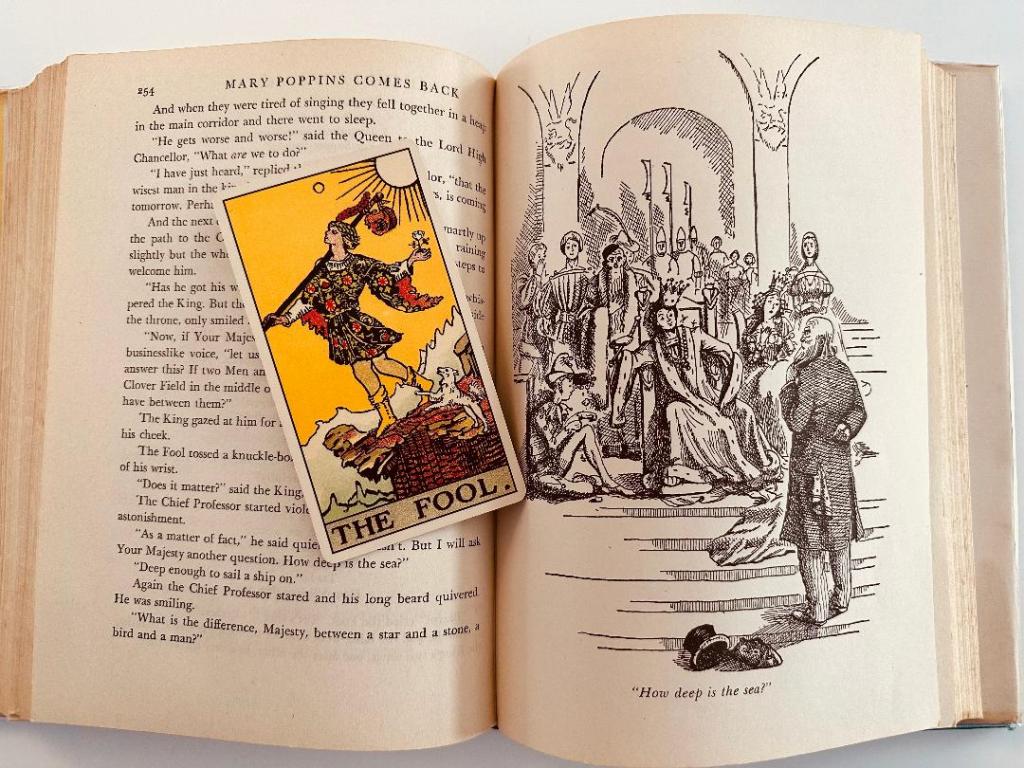
 This blog post is about an esoteric reference in Robertson Ay’s Story, a story from Mary Poppins Comes Back, the second book in the series published in 1935. This esoteric reference is the Tarot card of the Fool. I found a few more Tarot references in the Mary Poppins stories but they will be the subject of other blogposts.  

As a young writer P.L. Travers gravitated towards the renowned Irish poet and occultist W.B. Yeats, and her literary mentor, the mystic writer, poet, and painter George W. Russel (AE) who was also one of Yeats’s closest friends. Both men knew Pamela Coleman Smith, the illustrator of the most popular Tarot deck today, the Waite/ Ryder deck which was first published in London in 1909. It is also said that W.B. Yeats was an advisor to Pamela Coleman Smith on the mystic symbolism to be incorporated into Waite’s new deck. 

Pamela Coleman Smith was a member of the Hermetic Order of the Golden Dawn, the secret magical society to which W.B. Yeats also belonged. Between 1903 and 1904 she published, edited, and illustrated the magazine The Green Sheaf which focused on Irish Celtic folklore and mysticism. Both Yeats and AE, who were leading figures of the Celtic Revival, were literary contributors to her magazine. 

W.B. Yeats and AE also called Pamela Coleman Smith “Pixie”; a name first given to her by the Victorian actress Ellen Terry. Then some twenty years later, AE began to call P.L. Travers “Pixie” probably because he noticed certain similarities in their personalities and interests. Both women were orphaned at an early age, both loved fairy tales and magic and were interested in theatre, and both displayed a mischievous streak. 

The two Pixies were thus connected, although I suspect they never met in person because by the time P.L. Travers entered the artistic/occult scene, Pamela Coleman Smith had abandoned it and converted to Roman Catholicism.  

 Because of her connections to W.B. Yeats and AE, and her regular attendance at their literary salons, P.L. Travers was familiar with the archetypes of the Tarot. This is what she said about the Tarot card of the Fool to Jonathan Cott during an interview at her house in Chelsea, London. 

Who is Robertson Ay? What is he paid for? He does nothing but sleep? He turns out to be the Fool. Yes, he does, but I didn’t know he was going to turn that way when he cropped up in my mind. 

Not unnumbered, but Zero, which is all numbers and no numbers. The Fool is omnipresent, serenely passing through the world – as I said in “The Youngest Brother”- here and there are alike to him.” 

The Wisdom of Mary Poppins: Afternoon Tea with P.L. Travers, in Pipers at the Gate of Dawn, The Wisdom of Children’s Literature, Jonathan Cott, 1981 

The Tarot is composed of seventy-eight cards, twenty-two Major Arcana cards and fifty-six Minor Arcana cards. The Minor Arcana cards are divided into four suits, each associated with one of the four elements: fire, water, air, and earth. The suit of Pentacles is associated with the earth, the suit of Cups with water, the suit of Wands with fire and the Suit of Swords with air. 

The twenty-two Major Arcana cards (meaning Big Secrets) are considered to represent cosmic, energetic patterns that manifest in our human world as opportunities or obstacles to our personal growth, and the Minor Arcana cards (Little Secrets) relate to our individual struggles and challenges in our daily lives. All Major Arcana cards are numbered except for the Fool. The number of the Fool is zero, signifying nothingness, the void from which all things proceed, the field of pure potentiality.  

The archetype of the Fool represents pure potential. He lives in the here and now without placing judgments and looks at the world with a childlike innocence and wonder. The Fool in his positive aspect, is the playful, joyful child within us all. When The Fool appears in a reading, he heralds a clearing of the senses and announces a brand-new beginning. His advice is to go with the flow, just go with what is happening and learn from experience.  

In the Wait/Ryder deck The Fool is depicted standing on the edge of a precipice or a cliff suggesting that the path regenerates itself with each step; he encourages us to take a leap of faith and trust in life and in ourselves. Notice that the Fool carries a small bundle on a stick as he only takes with him what he needs and nothing more. His advice to us is one of release; to release what no longer serves us. He tells us to keep only the habits and lessons that will help us along our journey.  

Mary Poppins tells three fairy tales to the Banks children during her stay with the family. I find it interesting that she does not tell these fairy tales at bedtime as most people do. She only tells a story when the occasion calls for it and as it happens, she tells the story of Robertson Ay in the park during one of their outings.  

It is a sunny day in the park and Mary Poppins is sitting on a bench knitting, Anabel and the twins are in the perambulator and Jane and Michael are busy enacting the nursery rhyme I am the King of the Castle and You Are the Dirty Rascal, when out of nowhere a strange figure appears on the path at the edge of the Lake and catches their attention. 

“Along the path at the edge of the Lake came a tall, slim figure, curiously dressed. He wore stockings of red striped with yellow, a red-and-yellow tunic scalloped at the edges and on his head was a large-brimmed red-and-yellow hat with a high peaked crown.” 

Robertson’s Ay Story, Mary Poppins Comes Back (1935) 

The man stops by the bench to greet Mary Poppins, and the children learn that this is the Dirty Rascal, and Robertson Ay, but that is revealed to them only at the end. The children are mystified by the stranger whose face is hidden underneath the large-brimmed hat. When he leaves their company, and to the greatest delight of Jane and Michael, Mary Poppins offers to tell them the story of the Dirty Rascal.  

The story is in fact the story of a King who is extremely stupid and uncapable of fulfilling his royal duties. It is the Queen, and the Lord High Chancellor who must step in and do the work. However, they spare no amount of effort to impart some wisdom to the King, alas to no avail. As a last resort, the Queen and the Lord High Chancellor offer a generous reward to whomever succeeds in teaching the King some wisdom.  

As is the custom in fairy tales, the reward comes with a steep price for those who fail at the task. The professors who fail to teach the King wisdom are all doomed to have their heads cut off and spiked on the Castle Gates.  

All the teachers who come to test their luck lose their heads. The King is crushed by the events and his inability to learn. Then an unexpected visitor arrives, pushes past the sentry at the gate and walks up to the King. The King presents himself as the King of the Castle and the visitor as the Dirty Rascal. They immediately form a strong bond as the Fool shows the King that he does not have to conform to other people’s expectations nor to their understanding of what it means to be intelligent. 

 In Robertson’s Ay Story, the Fool appears in its positive aspect, a carefree, playful, childlike creature capable of imparting wisdom to the hopelessly stupid King. But he does not teach him in the way all the other teachers tried to. Instead, the Fool incites the King to burn all his books and simply enjoy life. They sing and dance, and laugh to the horror of the Queen and the Lord High Chancellor who see their behavior as being completely foolish and crazy. This highlights another aspect of the Fool archetype. The Fool is the outsider, the one that does not conform to pre-established norms.  

At the end of the story, the King is tested by the Chief of all the Professors, the wisest man in the kingdom. The questions asked by the Chief Professor are met with unexpected, but practical answers and the Chief Professor has no other choice but to declare the King to be wise. Wisdom, as P.L. Travers believed, cannot be taught, it can only be acquired through lived experience; a dance through life. To understand something, she said one must stand under it. Factual knowledge can only get us so far, something else is required of us to live an authentic life.  

When the Fool appears in a Tarot reading, it often signifies a new journey, a new beginning and this is exactly how the story of Robertson’s Ay ends with the beginning of a new journey for the King. Once the King realizes that what others think about him has no importance whatsoever, he realizes that he has no desire to be King. Together with the Dirty Rascal, the King climbs on a rainbow that has suddenly appeared in the sky and throws down his crown and scepter, thus shedding his old identity.  

Interestingly, the rainbow appears on another Tarot Card, the 10 of Cups, and I am thinking that I will have to explore this element of the story in a future blog post. For now, I hope you enjoyed reading this blog post as much as I enjoyed writing it.  

Shadow Play

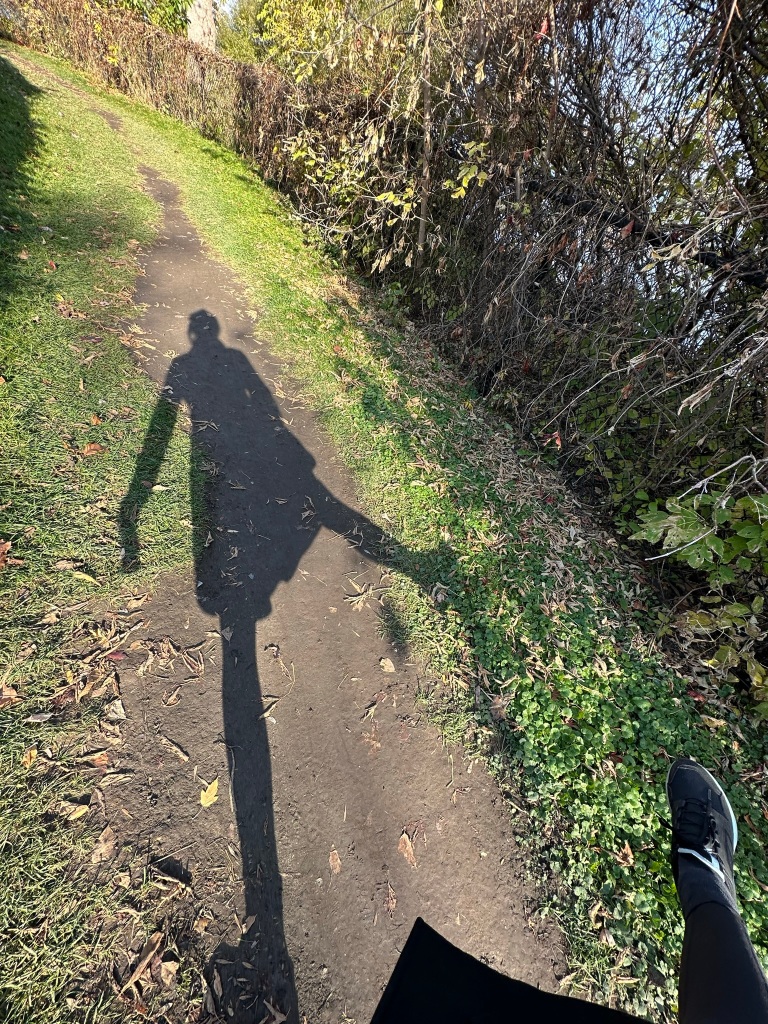
I used to play with my shadow as a kid. I tried to run away from it, but no matter how fast I ran, I could never outrun it. Every time I looked down there it was, glued to my feet, sometimes in front of me, sometimes behind, sometimes on my left side and sometimes on my right. I was never certain of its position, but I was certain of its presence, even on rainy days. I knew that it was there, only, it was invisible for the time being.  

Occasionally, my shadow games involved other children in the neighbourhood. We chased after each other’s shadows and screeched with delight as we stepped on them, something that Mrs. Corry teaches the Banks children in Hallowe’en, a story from Mary Poppins in the Park (1952), is not a wise thing to do. I did not know that back then. I had read Mary Poppins (1934), the first book in the series in the early 1980’s in Bulgaria and I did not know about the other books until I read P.L. Travers’s biography in 2015.  

 I enjoyed my shadow’s shape-shifting tricks, how it changed its size, and how sometimes it climbed on walls and ceilings. One evening, to my enchantment, shadows of animals and birds appeared on the walls in the living room of my grandparents’ apartment.  Amazed, I kept shifting my eyes from the lively images on the walls to my mother’s and grandfather’s strangely positioned hands. They looked nothing like the shadows on the wall and I marvelled at this mysterious transformation; it was pure magic.  

However, despite my enjoyment of shadow games I doubt that I would have been as courageous as Jane and Michael Banks in Hallowe’en and followed my shadow out in the night should I have seen it run out of the door. Certainly not, if this had happened after I read Andersen’s fairy tale The Shadow and learned that a shadow without a body is the most dangerous thing of all. Suffice it to say that Andersen’s fairy tale put an end to my shadow games.   

The shadows in Hallowe’en are friendly. I wrote about P.L. Travers’s concept of the shadow in a previous blog post. If you are interested, you can read it here. In this blog post I want to spend some time exploring a contradiction in the story.

Yes, this is what happens when you read the same story repeatedly; you see things you did not see the first time, or even the second time around.  

It is the night of Hallowe’en, and everybody is fast asleep when Jane and Michael Banks wake up and find mysterious messages written on leaves left on their pillows. These are the leaves that the wind blew into their hands on their way back home from a stroll in the park. Mary Poppins had taken the leaves away before they could see the words written on them, but now they can read the messages. One leaf reads “Come” and the other “Tonight.” The children accept the invitation and follow their shadows to the park where other shadows are having a party.  

At first, Jane and Michael are a little scared, but the Bird Woman’s shadow reassures them. There is no need to be afraid, a shadow never did any harm to anyone. Then, after Jane and Michael Banks accidentally step on Mrs. Corry’s shadow, she tells them to pay attention, because shadows are extremely sensitive.

Mrs. Corry, an ancient crone and a friend of Mary Poppins, and Mary Poppins herself are the only people at the party with their shadows firmly attached to their feet.  

Mrs. Corry advises the children to take good care of their shadows or else their shadows will not take good care of them. This to me sounds much like a warning and reminds me of the perfect example of what happens to someone who does not take care of his shadow. 

The Shadow by Hans Christian Andersen begins in a hot country where the sun is very strong. A learned man from the cold regions is trying to acclimate to the heat but it is difficult. He loses weight, and his shadow shrivels to nothing. It is only in the evenings that it comes to life on the walls of the learned man’s room and stretches itself to regain its former strength.  

The learned man spends his evenings sitting on his balcony where he can observe the hustle and bustle of the city below, but he is mostly curious about the house across the street. Nobody ever comes out on its balcony, yet it has beautiful flowers that could not survive unless someone waters them regularly. 

One night, the learned man awakes and sees a light coming from the mysterious balcony. A beautiful maiden, all aglow, is standing amidst the flowers. The learned man jumps out of bed and creeps behind the curtain to get a better look, but it is too late, the maiden is already gone. 

One evening, not long after this brief vision, the learned man notices that his shadow is cast on the maiden’s balcony. Jokingly, he suggests to his shadow to slide through the half-opened door and have a look around and come back to tell him who lives there.  The shadow accepts the learned man’s proposal and disappears into the confines of the house but then, it does not return. 

Many years pass, the learned man is back to his cold country where he spends his time writing books about what is true, good and beautiful in life. Only, no one cares about such things and the learned man is deeply grieved. Then one evening his shadow, now with a fleshed-out body and wearing lavish clothes, shows up at his door. From this moment on, the story takes a dark turn. The learned man gradually becomes the shadow of his own shadow and then dies by its hand.  

However, before this tragic end, the shadow reveals all about his solo journey. The learned man discovers that Poetry lived in the house opposite theirs.  It is there that the shadow learns all that there was to be learned, although it had to stay in the twilight of the antechambers, or it would have been consumed by the light. 

Despite its human body, the shadow retains its ability to change its shape and size and that is what allows him to peak into other people’s homes and discover their darkest secrets. The knowledge of people’s dirty deeds allows the shadow to manipulate them to give him all he wants in exchange for his silence.  Andersen’s story is clearly a metaphor for the dark side of the learned man’s psyche and his refusal to acquaint himself with his own darkness.

I do not know if the contradiction between the words of the Bird’s Woman shadow and Mrs. Corry’s advice in Hallowe’en was intentional on P.L. Travers’s part, but it is possible, she liked indirection and Andersen’s fairy tales were part of her childhood readings. The idea of free roaming shadows, I believe, was inspired, consciously or not, by Andersen’s fairy tale.  

I wish I could ask P.L. Travers about all this and more. Are our shadows good or are they bad? 

I will never know what P.L. Travers’s answer would have been, but I found mine most unexpectedly one evening after work, as I was walking in the parking lot towards my car. The light from the lamp posts hit my body at a fortuitous angle, and I saw three shadows stretching at my feet in three different directions. I had never noticed this phenomenon before, and I was awestruck by its revelation.  

We have more than one shadow! We have them all, the good, the bad and the ugly. Both P.L. Travers and Andersen are right, we better pay attention to them or else…  

Happy Halloween! 

The Adventures of a Witch

AE Exhibition 4

This month’s blogpost is a guest post by Brian McKernan who has a specialist knowledge of George (AE) Russell – the literary mentor of P.L. Travers.

Brian says that although he had heard of AE since the days of his undergraduate Irish history tutorials, no-one seemed to be properly aware AE’s significance during the ‘birth of modern Ireland’ period. Within thirty years of AE’s passing, and across the following half century, AE became largely overlooked and regarded as a minor peripheral figure. Over the last four years Brian has played a central role in creating and developing an AE Group and the ‘AE Festival’ in Lurgan (Northern Ireland) where AE was born. Following the work of McKernan and his associates, the truth of this forgotten genius is once again beginning to be heard.

The group, known as The Lurgan & North Armagh George Russell Festival Society hold their festival in Lurgan each April to mark AE’s birth. The festival, which includes talks, walks, tours, creative workshops, exhibitions, school events and live music, has been developing at pace and aims to place AE back alongside some of the more readily recalled names in Irish history. The AE group have published articles and books on AE, created an active Facebook presence (AE Russell Appreciation Society – Lurgan), and have various local authorities now interested in supporting AE heritage. Plans for the creation of a large ‘AE Centre’ are currently at an early stage.

Brian McKernan’s post:

AE was a great believer in reincarnation and held that the ultimate purpose in life is perfection of the soul. Accordingly, he devoted himself to others, to society, to making the world a better place for everyone. He sought no fame, wealth or recognition for his brilliant talents and constant outpouring of good deeds.

My interest in Pamela Travers resulted from my research on AE. She made barely an appearance in my early studies – the chief AE biographer only giving her a passing mention at the end of his book, as a ‘young poetess who appointed herself his devoted nurse‘ when AE was dying. In hindsight, it is a wonder that I ever discovered the truth that Pamela and AE were immense friends from the time they met, up to his death, and for Pamela – across the following sixty years of her life. I have no doubt that both benefitted greatly from their mutual companionship, and now I sense that their bond is eternal.  As Pamela, a girl from so far away, became AE’s close friend in life, Lina (author of ‘The Mary Poppins Effect’) and I have reunited them in memory through our cross-Atlantic connection.

George William Russell, known simply as AE, was a benevolent genius who dedicated his life and energies to advancing a number of causes, in the main, related to the well-being of the people of Ireland. He did this through the Arts, Politics/Economics, the Co-operative movement, Social Reform, journalism, and his deep beliefs in the connectivity between the inner and outer worlds. And into this mix, in 1925, came a bright and lively young woman, who had more questions than answers, in her search for purpose, identity, love, home and success. AE loved unearthing, promoting and supporting new energetic and vibrant talent. Pamela was right up his street!

She was soon embraced by the Dublin literary scene,  where AE opened doors of opportunity for her both in London and America.  In the words of Pamela, “AE fished up friends for me from his inexhaustible cauldron.” AE understood that Pamela had an interest in mysticism and fairy tales long before she left Australia, so he helped her along the spirtual path and introduced her to the study of the spirit world, theosophy, mythology and Eastern Religions – all of which fascinated Pamela for the rest of her life.

AE liked her poetry and her Irish connection which was not just some romantic childhood fantasy. Her father’s parents were Irish, and he had been schooled in Ireland before eventually going to Australia. Pamela had relatives in Ireland, and she became acquainted with them when she visited AE in Dublin. After AE’s death, Pamela’s associations with Gurdjieff  and his followers can be seen as the continuum of the mystic elements she first explored with AE. 

Pamela was an exceptional person, determined and forthright, creative and intelligent, yet also delicate, unable to heal her childhood wounds, and searching for meaning in her life. AE was greatly impressed by her imagination and her fiercely rebellious nature. She was by no means an empty vessel into which he poured his ideas, but he had answers and directions which from the start helped her to explore and crystallise her core.

She was never his trainee or follower. He helped her. He connected with her. He raised her spirits and she raised his. Pamela admired AE, loved his company, and valued being educated by him. Such a warm and loyal mutuality grew between them that she became AE’s closest companion and comfort during his final days, taking charge of his personal affairs and final letters. She later wrote a beautiful piece about his passing, in ‘The Death of AE: Irish Hero and Mystic’

Pamela  accompanied AE’s remains from England back to Ireland, and was at his side as the mile long procession of mourners walked from AE’s famous office in the heart of Dublin, to his burial place close to 17 Rathgar Avenue where he had lived for thirty years. A little later, grieving deeply, she went back to Ireland and spent six weeks in Donegal, staying where she and AE had holidayed, to absorb what lingered of his spirit there. This was a special coastal place, complete with a fairytale cottage, hidden in a deep wood which overlooked the scenic Marble Hill Strand, where AE loved to paint and write poetry, and where they had been able to be alone together. In ‘The Death of AE: Irish Hero and Mystic’ Pamela offers glimpses of this holiday:

I stayed with him often in his beloved Donegal, at Janie’s-on-the-Hill above Dunfanaghy – a white washed cottage where at night one would hear the cows moving about in their stalls below the attic bedroom and in the daytime Janie churning butter or clanging the lid of the iron cauldron that swung on a chain above the peat fire and in which everything was cooked: bread, meat, cake, soup. … From Janie’s, he would take me with him on his excursions to friends in the neighbourhood or to those parts of woodland or strand that set up in him the strongest vibrations. Was he intentionally educating me, I wondered! No matter: it was being done, with or without intent.

Ninety years later, I went in search of these places, no doubt drawn there by AE’s spiritual gravitation. I found Janie’s farmhouse, fully matching Pamela’s description. I walked through the bog looking for the boots  she had left behind after getting stuck in the mud on a walk with AE, and I climbed up the trees overlooking the strand. I asked at Janie’s for directions to the fairy house but was told that it had been removed after it had fallen into disrepair, and the stone reused elsewhere. Despite this setback, I wanted at least to stand at the site of this sacred oasis where Pamela had soaked up AE’s strongest vibrations following his death. I made my way into the woods to the general area and walked in every direction, stopping and stirring – searching for any clue to its original location. I was drawn to a clearing in the woods with fairytale trees – magically shaped, like no trees I had ever seen before.
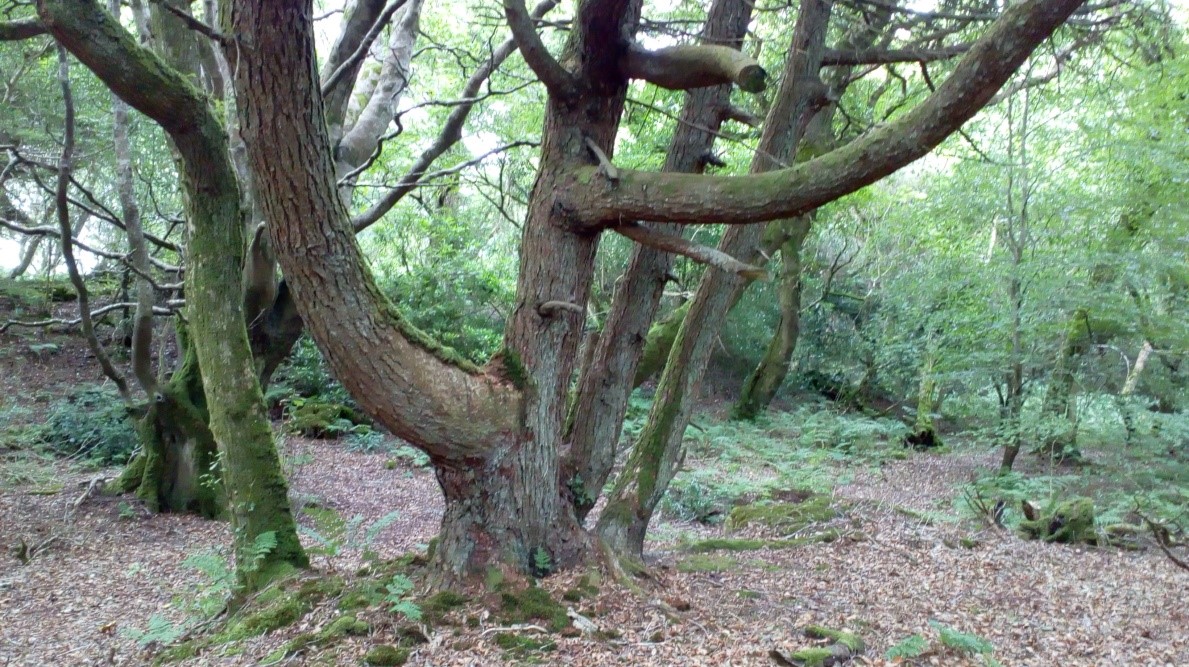
Tree near the Fairy House

However far I went, in any direction, I kept returning to this spot, as a fixed point to guide me safely back out of the woods. After a most unsuccessful and tiring hour, I decided to take one last look from where I now stood. I would turn round, one full circle on this spot, and then give up my quest. Halfway round, and looking as carefully and intently as possible, I saw something that seemed to be out of place. It was something ‘blue’. AE’s favourite colour was blue, and this looked like his favourite shade of blue.

As I tried to focus on this through the wiry tangled thicket, what I saw began to resemble a post, perhaps an old direction sign. I pressed slowly forward trying to get closer to the sign, one difficult step after another, trying not to get too badly scraped by thorns. My eyes scanned the tangled mass of branches and briars to the left of the post, and as I neared, things suddenly began to appear which I had not seen from further back. Right in front of me was a metre high wall. I clambered around the post and recognised (from my memory of an old photograph) that the post and the wall were parts of the porch of the Fairy House. I had found  it, on my very last attempt, and as I forced my way closer so much more became clear. The roof had collapsed in on the building and some parts of the walls were missing. Although the forest had worked hard to gobble up this magical abode, I was able to clamber into the large room, examine the crumbling fireplace and peer out through a side window. I was completely alone, but bursting to share my discovery. I thought of AE and Pamela being here and wondered if they had somehow played a part in my finding – could this have been spiritual gravitation at play?

Fairy House

I took photographs of these places and sent some to Lina along with a brief account of my Donegal adventure. We exchanged a series of emails, back and forth between Canada and Ireland, in which we shared our knowledge of Pamela, the Mary Poppins books and AE . I found myself seeing more and more of AE and his connection with Pamela in the Mary Poppins books.

Although AE spent much of his time writing thousands of serious journalistic articles about society, political turmoil and economic issues, it is practically impossible to find one complete piece which is not warmly wrapped in a blanket of spiritual wonder and mystical magic. He was tremendously imaginative and creative, and whimsical beyond compare, and exceptionally witty.

Myriad hidden spiritual thoughts, talking objects, life within pictures and a oneness with nature, flowed effortlessly and constantly from his mind. AE helped Pamela to explore unknown possibilities and imaginations primarily in conversation across the ten years friendship which saw her become a highly respected writer. They also wrote numerous letters back and forth across the Irish Sea when they were not together.

In early 1932 AE suggested in a letter that she should write a fantastic tale about a young witch.

When you go to your Cottage drop me a postcard with the address of that abode of the vulture witch with her broomstick. It would be rather a nice subject for a fantastic tale of a young witch who found that by white magic the broomstick would fly as well as by the black art & she went here and there doing good deeds or looking at loveliness & wonders. So think over a tale which would use all your powers of fantasy ‘The Adventures of a Witch’ and it may be the idea for letting you say all you want to say.

I see so much of AE and Pamela in the characters of Bert and Mary Poppins. From their first outing in a short 1926 story, in which Mary is a young and inexperienced nanny and where the magic emanates from Bert the Matchman, to the end of the second Mary Poppins book, when Mary has transformed into an older, wiser, and self-assured magical figure, I see how Pamela herself had grown aided by her great friend AE. At the close of Mary Poppins Comes Back, completed shortly after AE’s death, Pamela creates a personal element of closure between herself and AE. In 1926, in the story Mary Poppins and the Match-Man and then in 1934 in the story The Day Out, they rode the Merry-go round together, she on a black horse and AE on a white one, but then in 1935, with him gone, Pamela (Mary Poppins)  rides alone on a dappled horse, possibly symbolising a shared spiritual unity. The text includes utterances denoting finality – ‘Never again! Never again!’ .. ‘If only we could have gone on forever!‘ .. Mary gazes down at the children – ‘Her eyes were strangely soft and gentle in the gathering dusk‘ (AE’s favourite time of day) and says for the second time that day ‘All good things come to an end.

Mary Poppins chooses a return ticket (which is a strange option for such a ride, but may well relate to AE’s deep belief in reincarnation) thoughtfully saying ‘You never know’. The Merry-go-round spins and rises up beyond the trees and soon a new star appears in the night sky. Could this new star be her AE? On the final page Pamela writes –‘And high above them the great shape circled and wheeled through the darkening sky, shining and keeping its secret for ever and ever and ever…

On one occasion, Lina asked me if I had any thoughts on who Pamela could have been referring to when she dedicated Mary Poppins Comes Back ‘To PIP This Keepsake’. I immediately swung into action, thinking this would be a nice puzzle to try solving. I noticed that Pamela had also written ‘P-p! P-p!‘ to describe the sound  made by  Mr Bank’s pipe and I was drawn to the similarity between ‘PIP’, pipe, and P-p. As AE was very much on Pamela’s mind during the writing and completion of the book I wondered if this could all relate to AE. I factored in my belief that Pamela used to refer to AE as ‘the matchman’ due to him constantly leaving a trail or puddle of spent matchsticks wherever he went or sat. This messy habit was common knowledge to all who knew him, and he even had to have a special supply of matches arranged in advance of going on holiday to an isolated location. AE was never without his pipe, and I suppose his two most noticeable features were always his marvellous beard and the pipe. Then I remembered how Pamela had been the one who had sorted through AE’s belongings after he died, and thought that the best keepsake she could possibly have would be his pipe, as I believe he had taken his beard with him to the grave. I think the answer lies within these thoughts and would love to ask Pamela if that is correct. Of course, I could not ask her, so instead I asked Lina, who appreciated my imaginative proposition.

Perhaps a light sprinkle of AE  and Pamela’s magical stardust helped me to discover the connection between them, and find my way to Lina’s blog. But if so, it may not be the first time this magic has come my way. Considering how I only really came across Pamela Travers through my uncommonly rigorous approach to studying AE’s life, I have recently discovered my own personal connection with her, which also links to AE. Remembering how  says, ‘Your own will come to you‘, I must tell you – the first poem AE published by Pamela was titled Christopher, and my son, named Christopher, was born on the very day  Pamela died – 23rd April 1996.

A Rose for Mary Poppins and P.L.Travers (Part II)

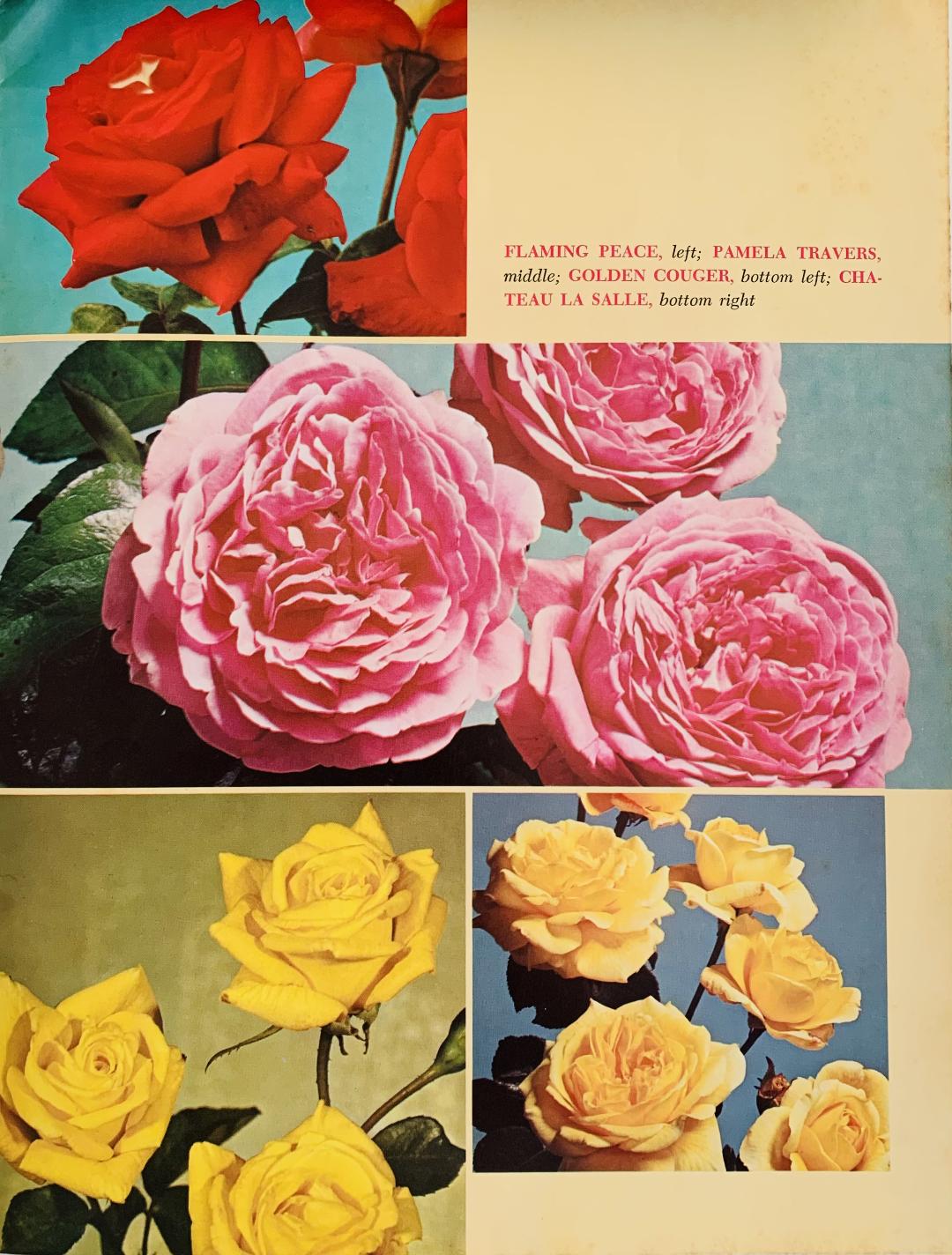
Mary Poppins rose 3

In my previous blog post I told the story of how P.L. Travers wished into physical reality three new varieties of roses. As it happened, she shared one of her personal wishes during an interview, and that interview set into motion a series of serendipitous events, which coalesced into three hybrid tea roses: one named after Pamela Travers, one after Mary Poppins, and a third one after Sleeping Beauty (P.L. Travers’s favourite fairy tale).

I have been poking around the Internet for years trying to find pictures of these roses only to find some technical notes describing their appearance. Until my own serendipitous experience last month. Just as I was about to post A Rose for Mary Poppins and P.L.Travers (on Valentine’s Day, wink, wink), I decided to double check the spelling of Dr. Dennison Morey’s name. I got it right, but my extra precaution paid off. The first reference that appeared in my Google search was Dr. Dennison Morey’s Country Garden Roses pamphlet for 1969 on eBay!

Cover Pamphlet

Picture of the cover of Dr. Dennison Morey’s Country Garden Roses pamphlet for 1969

I got goosebumps and then I hurriedly pulled out my credit card. What if some other Mary Poppins and P.L Travers fan found this and beat me to checkout?  Then, the frequent trips to the mailbox began and that was not because I did not know about the system of notifications of the status of my order. Only people with nerdy obsessions can understand this anxious anticipation.  I mean, there was no certainty that the pictures of the roses would be in the pamphlet. All I knew was that Pamela Travers was created in 1966, Mary Poppins and Sleeping Beauty in 1967. I had to wait.

A couple of weeks later, like fireworks, my heart burst with joy as I flipped through the pages of the pamphlet.

Dr. Dennison Morey

Not only did I get to see the pictures of Pamela Travers and Mary Poppins*, but I also read fragments from P.L. Travers’s correspondence with Dr. Morey.  Now I want to share it all with you, my mysterious readers.  

Pamela Travers rose

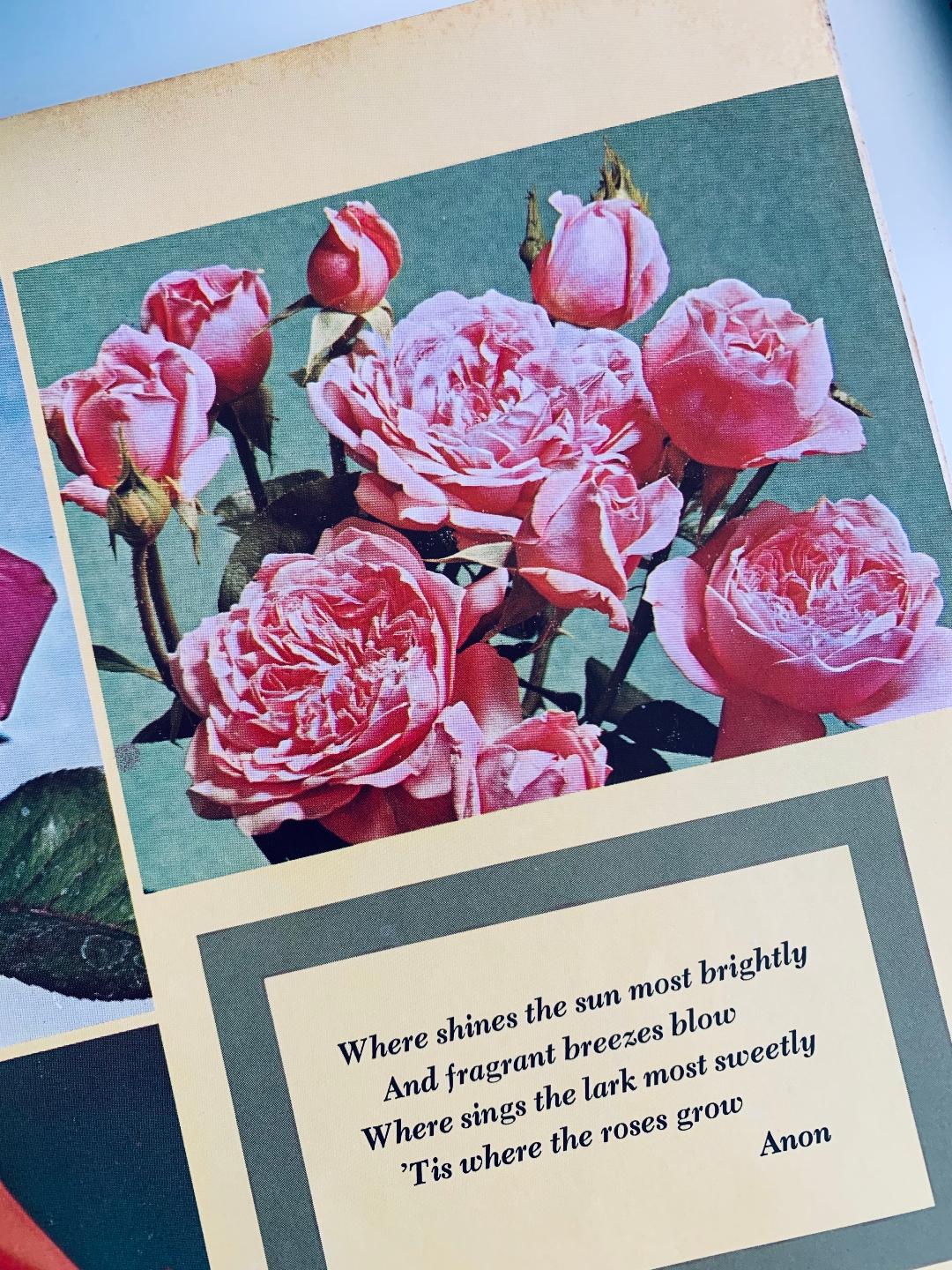
PAMELA TRAVERS PRR P HT (Morey 1966) 36’’-42’’. 30-35 petals. The gracious author of the treasured “Mary Poppins” stories and other lessons for young and old certainly deserves the honor of a rose. Pamela Travers asked only that her rose be pink, fragrant, healthy, vigorous, enthusiastic, happy, pleasant, easy to live with, adaptable, always in bloom, readily and willingly cut for the home, long lasting in the vase, prolific, long seasoned, bright, cheerful, and if possible, gentle, wise, and completely honest.

Undoubtedly this description echoes snippets from P.L. Travers and Dr. Morey’s correspondence, and it definitely feels like P.L Travers played the role of the Fairy Godmother bestowing praiseworthy virtues upon her rose. Could it be that she wished to embody these qualities herself (save of course from being “readily and willingly cut for the home” and “long lasting in the vase”). Possible, but not certain.

What is unequivocal though is that P.L. Travers gave a tall order to Dr. Morey. The words “Pamela Travers asked only that her rose be …”  followed by an extensive list of attributes suggests that Dr. Morey had a good sense of humour, and that P.L Travers was just maybe a little too demanding. She surely knew what she wanted. Regardless, Dr. Morey filled the order.

P.L. Travers’s request for her rose to be honest and cheerful took me by surprise. She associated these qualities with the daisy, which by the way she judged to be a child’s flower, precisely because of its openness and honesty.  Thinking about this apparent contradiction between her request and what she said about the allure and mystery of the rose in her interview with Frankel, I remembered another occasion on which she wrote about an open rose. It was in The Children in the Story in Mary Poppins in the Park, the fourth of the Mary Poppins books published in 1952. I will tell you more about this other rose in a future post.

How did Dr. Morey translate the attribute of honesty in rose language? I believe the answer is in the number of petals. Honest Pamela Travers has only 35 petals compared to mysterious Mary Poppins who has 157 petals.

Mary Poppins rose 1

PRR R HT (Morey 1967) 40’’ – 48’’, 150-157 petals. This remarkable new rose is a shell pink sport of the fabulous “Hallmark”, the first modern mildew resistant, fragrant red hybrid tea. Mary Poppins has all the robust stamina so characteristic of the “Hallmark” combined with a rich but delicate color.

The plant is strong vigorous and of upright habit. The stems are strong and straight, proudly holding the radiant blooms on high for all to admire. New growth starts before the flowers are finished, rapidly pushing a new crown of green and pink glory above the earlier growth.

The foliage is leathery, essentially immune to mildew and highly resistant to rust and blackspots, large and a rich apple green.

The flowers are double, full, high centered, long lasting and, considering the delicacy of the color, notably weather resistant.

The fragrance is of cedar and quite pronounced under favorable conditions. This is an unusually fine garden plant as well as an outstanding rose.

Mary Poppins (the fictional character) conceals a great deal about herself. She never tells where she comes from, nor what she thinks and who she truly is. It is logical then that her rose would conceal its essence in the depths of its petals.

The description is definitely reminiscent of Mary Poppins herself, and I am certain it was P.L. Travers who suggested the attributes of “robust stamina”, “strong vigorous and of upright habit”, “proudly holding the radian blooms for all to admire”. Even Mary Poppins herself could not disagree with this description. Afterall she was, or appeared at least to be, somewhat vain.

On page 4 of Dr. Dennison Morey’s Country Garden Roses pamphlet there is a section titled The Country Garden Gift Calendar. For 1969 the “Mary Poppins” hybrid tea  rose is suggested as the perfect gift for the young gardener.

All floribundaces are good choices for children’s gifts… with a minimum of care the young the junior gardener will receive bountiful blooms for many months each year from his own rosebush. And a rose such as the new pink “Mary Poppins” hybrid tea could bring special joy to a youngster, encouraging the love of growing things.

We can safely assume that the choice to offer this particular rose to budding gardeners had little to do with the actual attributes of the flower. The choice was obviously motivated by the popularity at that time of Disney’s Mary Poppins.

Both roses are pink and although I do not have proof for what I am about to assert, I have the feeling that pink was P.L. Travers’s favourite colour. Or why did she paint her front door at 29 Shawfield Street, London lolly pink?

Now a few words about the nature of P.L. Travers’s wish for a namesake rose. It is a charming wish and one that does not appear to have any useful purpose.  Most of our wishes are materialistic. We wish to obtain or to achieve something that has some functionality, and there is nothing wrong with that. But there is also much joy to be found in whimsical wishes. They can bring new tonalities in our lives, a new tune to dance to. These kinds of wishes have deep symbolic meanings, they speak the language of our souls. So, do you know what is your heart’s whimsical wish?

One of mine is to find the living and breathing roses named after Pamela Travers and Mary Poppins!

* Sleeping Beauty remains to be found.

Halloween With Mary Poppins

Mary Poppins Halloween

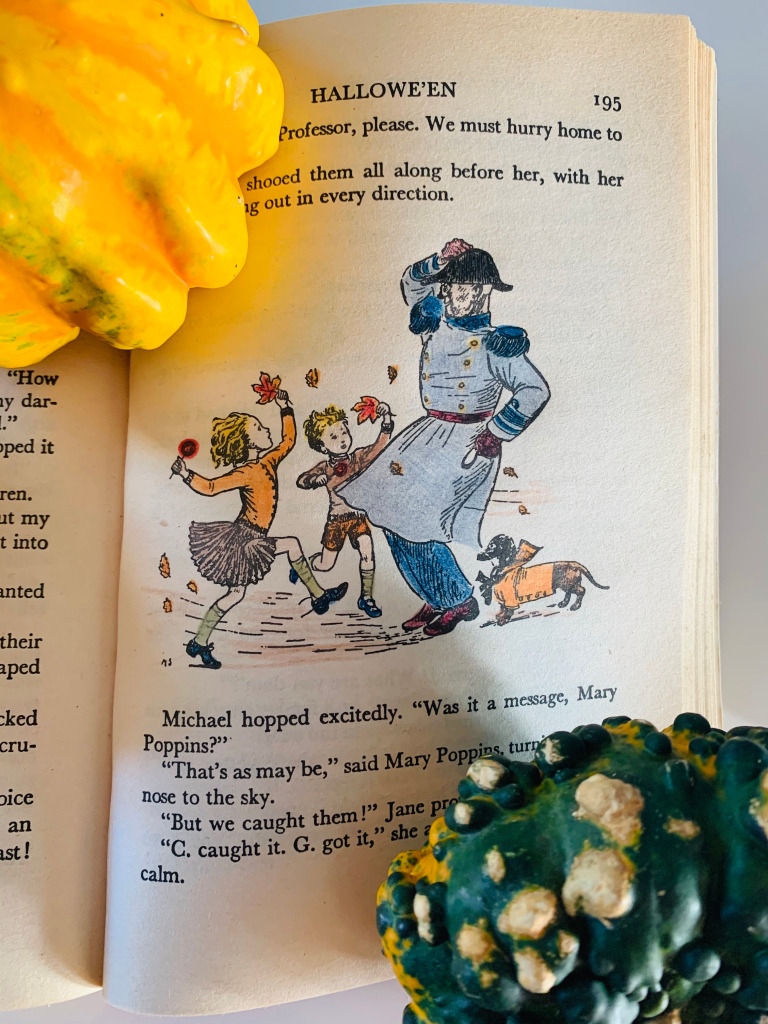
At this time of the year, here in the Northern Hemisphere, autumn is in full swing. Winds are rising, trees are gradually shedding their colorful leaves and nights are getting longer. Symbolically, we are beginning our descent into darkness, and holidays like the approaching Halloween invite us to honour this shadowy season. So, this is an appropriate moment to write a blogpost about Hallowe’en, a story from Mary Poppins in the Park, the fourth Mary Poppins book published in 1952.  

It is Halloween night and Jane and Michael see their shadows outside in the garden “floating down the front path and through the garden railings”. Encouraged by the sounds of music coming from the Park and the messages left on their pillows – two maple leaves on which are inscribed the words “Come” and “Tonight”- Jane and Michael leave the warmth and safety of their nursery and follow their shadows into the night.

In the Park, under the light of the Full Moon, they attend a strange party crowded with shadows of people they know, and fictional characters from nursery rhymes and fairy tales.  Of course, the children are amazed to see  something unreal, that just goes through things and has no substance, to suddenly have an existence of its own.

But then, The Bird Woman’s shadow explains to Jane and Michael that shadows are more than real. In truth, she tells them, they are the outside of our inside, and they know important things.

And that’s what they are made for – to go through things. Through and out on the other side – it’s the way they get to be wise. You – take my words for it, my loves, when you know what your shadow knows – then you know a lot.  

Mrs. Corry, a close friend of Mary Poppins is also at the party, but just like Mary Poppins her shadow is firmly attached to her feet. She warns the children that shadows have feelings.

They feel twice as much as you do. I warn you, children, take care of your or shadows or your shadows won’t take care of you.

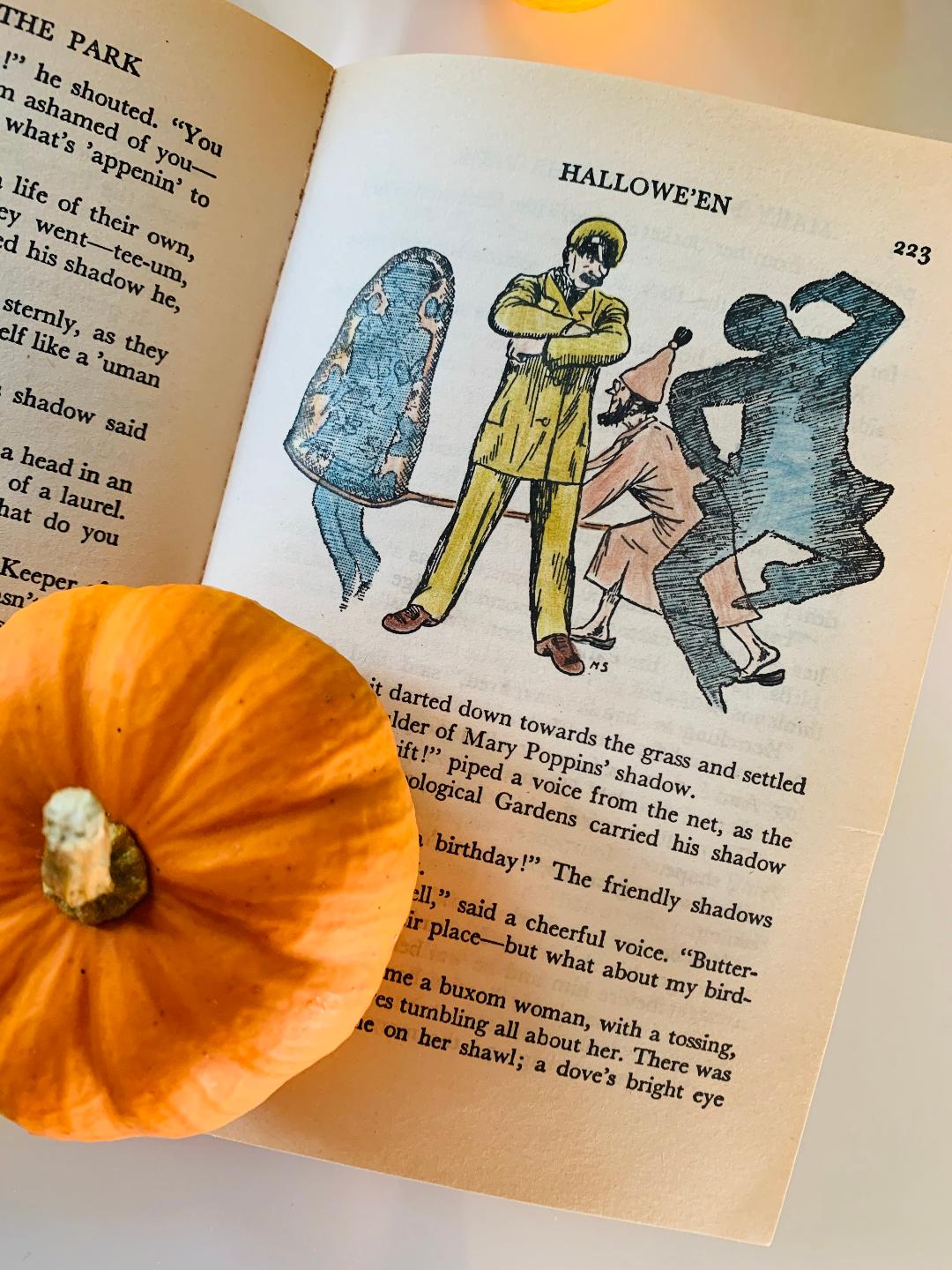
Then Mary Poppins arrives, and Jane and Michael learn that it is not only Halloween, but also the eve of Mary Poppins’s birthday. The celebration begins. However, soon after the dancing starts, the owners of the merry shadows show up in the Park looking for them. Things get even more interesting for Jane and Michael.

The Park Keeper.jpg

The Park Keeper is a character that appears in many of the Mary Poppins adventures. He is always fretting and admonishing people to follow the rules, while living in constant fear of punishment for the irregularities that inevitably occur each time Mary Poppins comes to the park.  On this Halloween night the Park Keeper is particularly frightened. Spooky things come out in the night, and he decides to abandon the Park for just this one time.

Understandably, when Jane and Michael see his shadow at the party, they are quite surprised, but the shadow explains:

Oh. I am not frightened, Miss – it’s ‘im. My body, so to speak. A very nervous chap’e is – afraid of ‘is own shadow.

The Park Keeper, who ignores that he has lost his shadow, but can not bring himself to ignore his duty, returns to the Park. When he sees his shadow dancing, which by the way is against the rules, he orders it to behave like a human being. His shadow replies with a giggle: “But shadows are so much nicer!” Then, the Park Keeper is forced by some mysterious powers to dance with his shadow, but even this shocking experience does not succeed in changing the Park Keeper’s rigid mind. At the end, he gets a firm hold of his shadow, and it is clear that the Park Keeper will remain just as he was before this uncanny incident. Apparently being forced to face one’s shadow is not enough. One has to willingly enter the dance for change to occur.   

Mrs. Boom

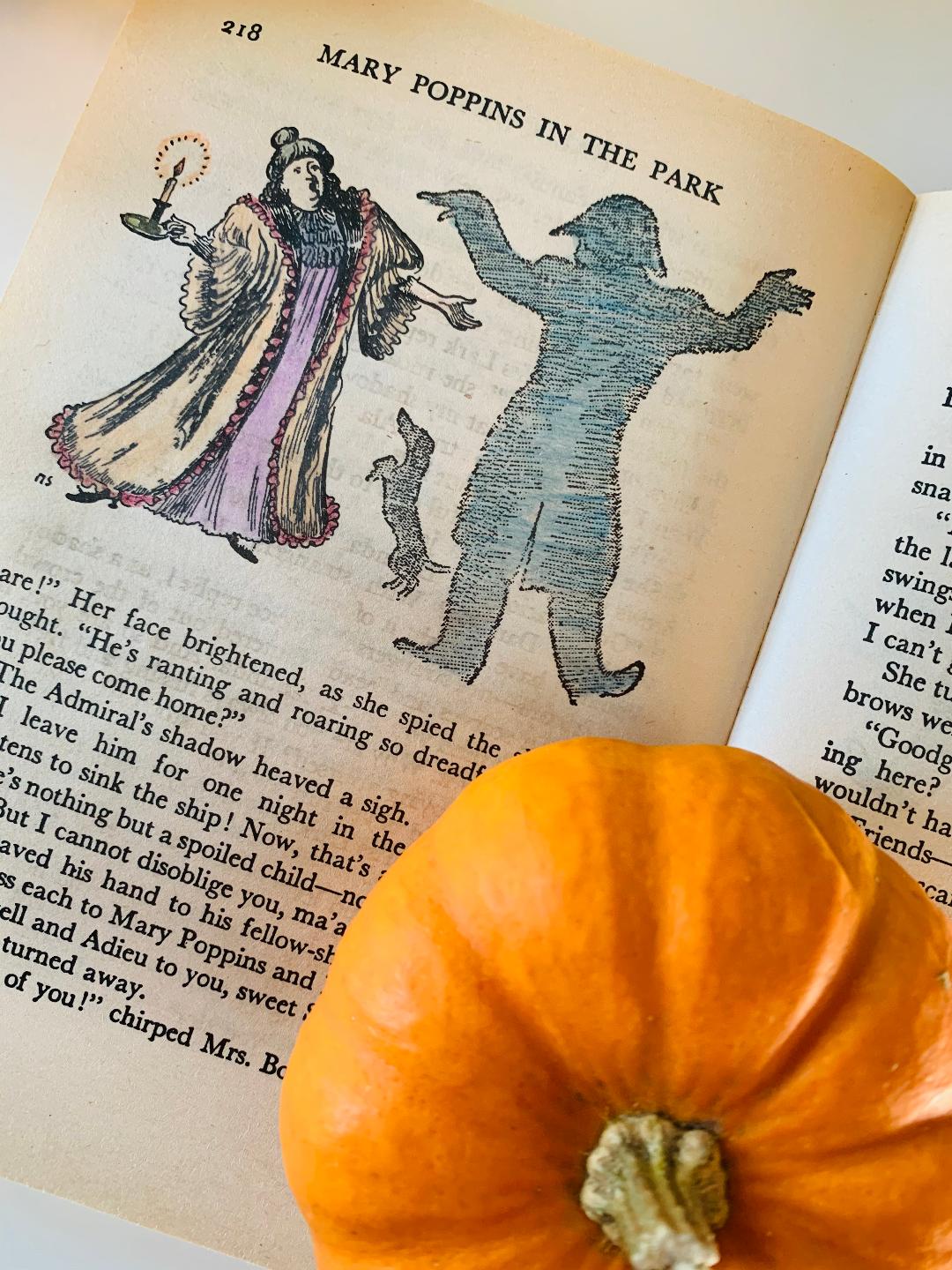
Admiral Boom, another frequently encountered character in the Mary Poppins adventures, is aware that his shadow is missing, but he is unwilling to face it. Instead, when he realises that his shadow has gone missing, he sends his wife out in the dark to look for it. Now, this is a rather cowardly act, and one that contradicts his usual authoritative behavior during the day. But Admiral Boom’s shadow knows better. It knows that behind the Admiral Boom’s imposing façade hides an entitled, spoiled child who wants everything on a plate. When things get tough, Admiral Boom gets tough on people. Someone else needs to fixit the situation for him.

I leave him for one night in the year – and he threatens to sink the ship! Now, that’s a thing I’d never do. He is nothing but a spoiled child – no sense of responsibility.

Obviously, the Admiral will remain locked in his anger and his experience of life will remain unchanged.

Mrs. Lark

What about snobbish Mrs. Lark?  She too braves the darkness and shows up in the Park looking for her shadow.  When confronted with it, she is horrified by its behaviour. In her opinion, it is totally unacceptable for the shadow of a woman of her social standing to be dancing around the Park with total strangers. But this is not how her shadow sees the situation:

I’m gayer than you think, Lucinda. And so are you, if you knew it. Why are you always fussing and fretting instead of enjoying yourself? If you stood on your head occasionally, I’d never run away.

Surprisingly, Mrs. Lark does not need a lot of convincing, although she does not quite know how to go about this standing on your head business. Anyhow, she is going to practice on the hearthrug in her drawing-room.

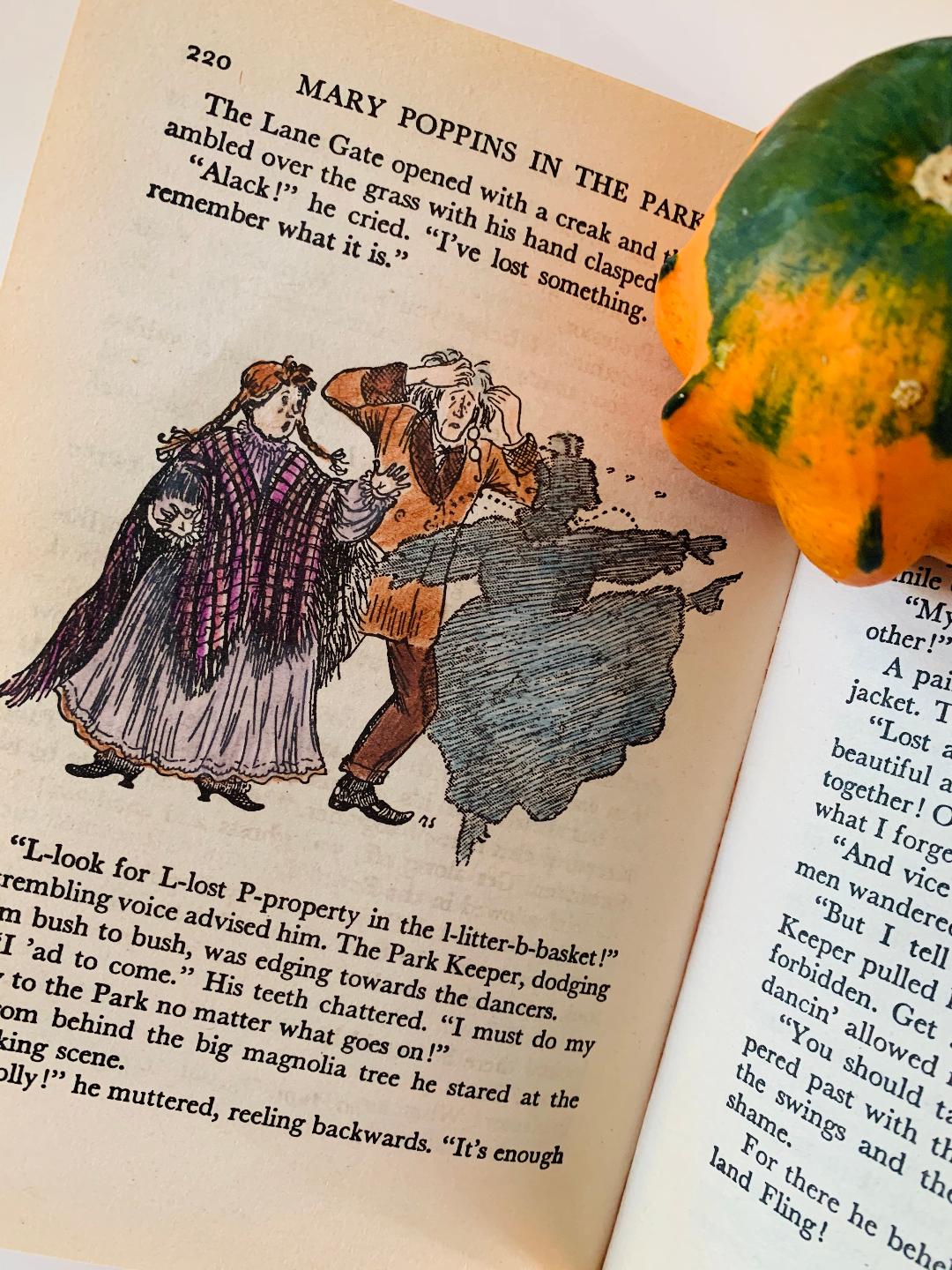
The Professor, Mrs. Lark’s companion, follows in her footsteps. He walks in the Park knowing that he is looking for something, only he does not remember what that something is.  This is much in line with the Professor’s usual absentmindedness. Funny enough, his shadow is just as forgetful as he is.

‘Lost and found!’ He (The Professor) embraced his shadow. ‘How beautiful are those two words when one hears them both together! Oh, never let us part again! You will remember what I forget – ‘

‘And vice versa!’ his shadow cried.

This happy reunion suggests that the Professor is not at odds with his shadow like the rest of the characters in the story. The Professor’s wholeness and alignment with his true nature is illustrated by the affectionate hug he shares with his shadow.

Mr. Banks Sleepwalking.jpg

Mr. Banks, Jane and Michael’s father, comes sleepwalking across the Park with his arms stretched out before him. He talks in his sleep about feeling that there is something missing, although he cannot figure it out. In his dream, he has his bag and morning paper, so what could possibly be missing? His shadow gently comes forward and takes him back to his bed.

                                                ‘There, old chap! I’ll do the counting. Come along back to bed.

Obviously, Mr. Banks is unconscious of his soul searching. Sadly, he is hopelessly trapped in the rat race of his existence, and his role as the provider of his large family. There is no revelation for him on this Halloween night. 

Knowing about P.L. Travers’s spiritual allegiance to Gurdjieff and his teachings, it is easy to make the link between Mr. Banks’s sleepwalking and the functioning, according to Gurdjieff, of the average person. Gurdjieff believed that, for the most part, we are asleep and unconscious of the forces that control our lives. He compared the human being to a machine with three commanding, so to speak, centers: the physical center, the emotional center, and the intellectual center, which act independently from one another. Meaning that Gurdjieff viewed human beings as fractured beings who need to integrate their split off parts.

In interpreting this story, it is tempting to make a parallel between P.L. Travers’s metaphor of the shadow and Jung’s concept of the shadow. In Jungian terms the shadow is the dark part of the human psyche. It contains our unconscious motivations, unfulfilled desires, needs and complexes. Simply put, if completely split off from our consciousness, our shadow gathers up destructive powers which can be harmful both to us and to others.  According to Jung, the only way of becoming mentally and emotionally healthy is by integrating our shadow, by acknowledging its existence and examining its needs.  In this sense, stories about adventures in the underworld can be understood as reminders that we can go into darkness in our lives and emerge on the other side better for it.

However, P.L. Travers’s metaphor of the shadow in this story is one paradoxically full of light. In this story the shadows are aware of the problems and complexes of their owners. However, they are not the embodiment of these forces. The shadows appear to be the repressed inner essence of the characters, their soul, the inner voice of truth. Or why would the Bird Woman’s shadow tell the Banks children that shadows never hurt anybody? “A “shadder” never did anyone harm-at least, not as I know of.”

P.L. Travers’s allegorical tale teaches an important lesson.  Blindly following social rules and norms will never make us happy. Assuming roles imposed from the world outside of us will never allow us to live a life of fulfillment. To experience life fully, we must focus on our inner world, and recognise our true nature, or else, we are setting ourselves up for an unhappy, unfulfilling, small lives. And, now is as good a time as any to bring a little light into the dark corners of our inner worlds.  Will you take on P.L. Travers’s invitation and party with your shadow?  

Happy Halloween to all!

Re-examining the Relationship between Irish Poet and Mystic AE and Young Pamela L. Travers

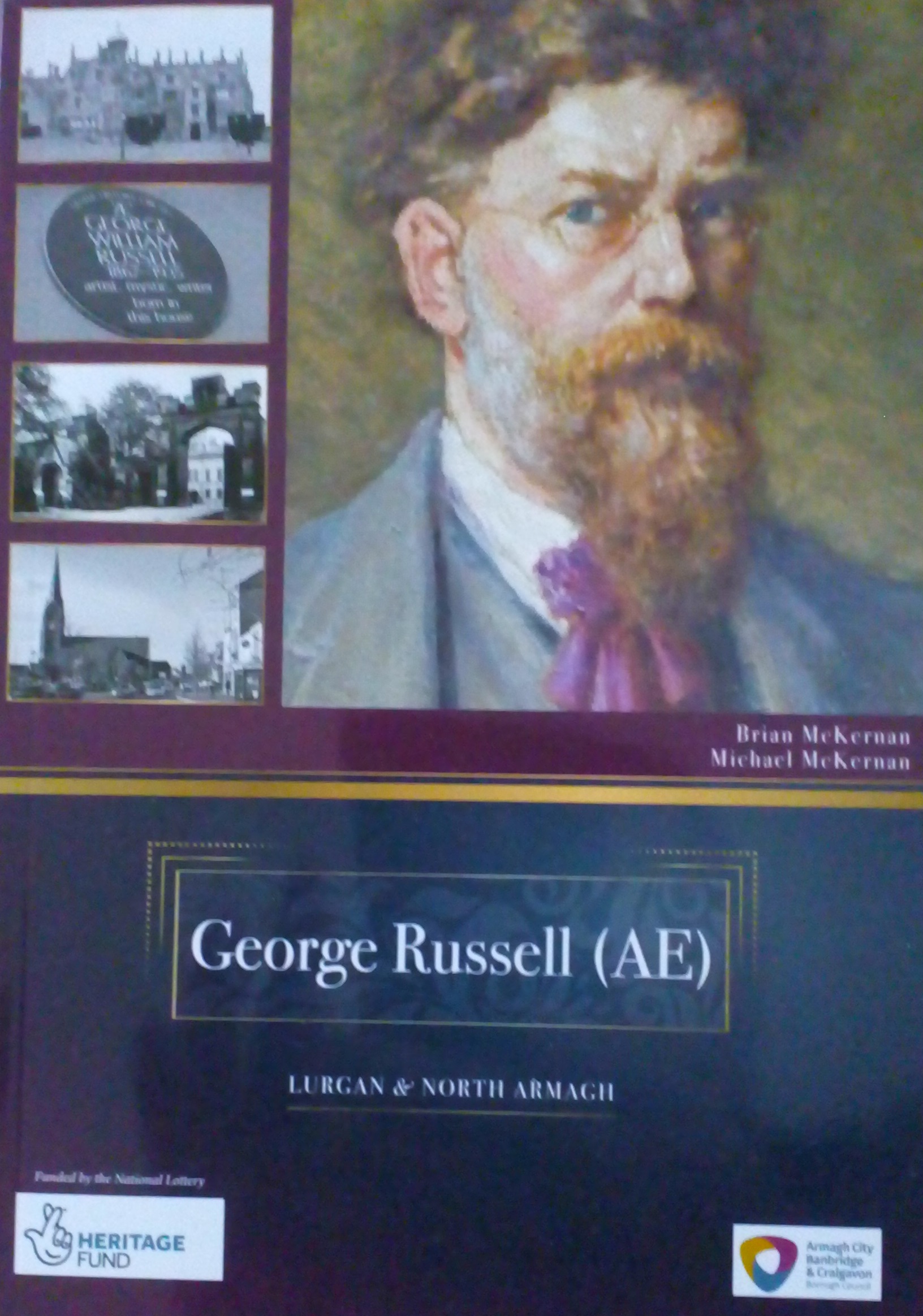
2019 Lurgan Book cover

By some serendipitous coincidence Irish historian Brian McKernan found my blog and read one of my very first blogposts: The Lover Archetype and Friend Monkey (I).

I wrote back then that George W. Russell’s (AE) did not reciprocate the romantic feelings of young Pamela and that he failed to make her feel special as a woman, a statement I based on the fact that he wrote to her about his other interests and flings. From that assertion I extrapolated that his attitude reaffirmed Pamela’s childhood experience of not being lovable enough, and then, I concluded that the relationship remained platonic because AE was emotionally unavailable.

My assumption about AE’s emotional unavailability as the primary reason for the platonic nature of the relationship between him and young Pamela prompted McKernan, who has spent the last couple of years researching AE’s life, to reach out and offer a different perspective. The ensuing correspondence gave nuance to my understanding of their relationship. But, before I offer you some snippets from our correspondence, a word about McKernan’s work. 

McKernan’s initial goal was to read about AE “to build up a basic story about him so that his birthplace-Lurgan, could hear his story.”  It appears that AE despite his numerous contributions to the Irish society has been largely forgotten by the public.

AE Exhibition 1


AE EXIBITION, Rushmere Shopping Centre, Septembre 2019, Curated by Brian and Michael McKernan

McKernan hopes that the memory of AE’s life and achievements will inspire the younger generations and maybe even reverse the sad reality of Lurgan. Today, says McKernan, Lurgan is “socially divided (Catholic/Protestant, Nationalist/Unionist) and the suicide rate locally among young people is so high, the place needs a role model, a hero they can all celebrate together, and which tells them their town has some greatness in its DNA.” An honorable mission.

AE Exhibition 2

After spending considerable amount of time immersed in the world of AE, McKernan developed a true appreciation of his genius. His admiration grew as he realised that AE “acted differently from most men” because of his spiritual beliefs and visions which made him experience life on a different level than most men.

McKernan explains that AE considered ordinary human love to be of an ephemeral nature. He aspired to a higher, more lasting spiritual connection:

AE understood, as we all generally do, about romance, lust and temptation, but he believed so much in a higher love, where two people’s spirits meet, that he forced himself to hold back from the lower base human lust. He wrote a poem ‘The Spell’ in which he directly addresses the opportunities coming his way (sex, lust, romance) and how feeling that he is too old for this is pretty annoying. He regretted letting Pam (P.L. Travers) down. He regretted letting others down. Sometimes he wished he could just let himself succumb to temptation.

THE SPELL   

Now as I lean to whisper

To earth the last farewells,

The sly witch lays upon me

The subtlest of her spells:

Beauty that was not for me,

The love that was denied,

Their high disdainful sweetness

Now melted from their pride:

They run to me in vision,

All promise in their gaze,

All earth’s heart-choking magic,

Madness of nights and days.

These gifts are in my treasure,

Though fleeting be the breath;

Here only to wild giving

Is love made fire by death.

This spell I put upon thee

Must, in thy being burn,

Till from the Heavenly City

To me thou shalt return.

About AE writing to Pamela about his other crushes, McKernarn writes:

As for his ‘other flings’ and writing about them, that was not something he did a lot, but with Leah Bernstein, Simone Tery and Pamela he enjoyed their attention, like forbidden fruit, and they enjoyed this little bit of nonsense and fun too.

There was nothing false about the relationship says McKernan. “AE was simply reluctant to romance the outer Pamela and preferred the more lasting spiritual bond to Pamela’s inner self. And Pamela was reluctant to “jump all over him for a brief breaking down of a slightly awkward and hindering barrier”. The bond between Pamela and AE was strengthen by their shared similarities. “Pamela shared so many similarities with AE – like her sharp wit, innate intelligence, deep and sincere spiritual outlook.”

Anyhow, one thing is certain, AE’s influence was transformative and tributary for setting the course of Pamela L. Travers’s life as a writer and for the creation of Mary Poppins. McKernan writes:

He (AE) completely welcomed her into his world and circle of friends – something she needed. Before this transformative friendship began, she was floating quite aimlessly, with no sense of place. He gave her full acceptance and status.

In her essay The Death of AE: Irish Hero and Mystic, Pamela writes about her relationship with AE. “I do not know in which role he saw me, as a daughter, acolyte, apprentice, or as all three…” “Was he intentionally educating me, I wondered! No matter: it was being done, with or without intent.

Despite the initial infatuation, the relationship evolved into one between a teacher and his student and lasted until AE’s death ten years later. Their bond extended to AE’s son Diarmuid Russell who became Pamela’s literary agent and then to Diarmuid Russell’s daughter Pamela, who was named after her.

All this indicates that AE appreciated young Pamela enough to resist the initial temptation. He was wise enough and aware enough of his personal situation, age, his marriage to his ailing wife and, of course the fact that Pamela wanted a life he couldn’t give her. It is possible then that he wrote to her about his ‘other flings’ precisely because he wanted to maintain a certain distance in order to preserve a lasting relationship. He played the role he knew he could fulfill, that of the guiding mentor.

Pamela wanted to be a poet and it was through poetry that she met AE. However, McKernan notes, it was AE who finally moved her from poetry to prose, “just like he moved his friend William Butler Yeats from Art (painting) to poetry”. If it was not for AE, McKernan believes, there would be no Mary Poppins for us.

He helped her to develop the characters, plots and stories which became the Mary Poppins’ books. Although he had never accepted any financial gain for helping his protégés, he did accept a share of her first Mary Poppins’ royalties in 1934 as he had been so involved in the process.  

In my next blogpost I will tell you more about the connections between AE and Mary Poppins as revealed by McKernan.

Hope you’ll come back to read more about Pamela L. Travers and her Mary Poppins.