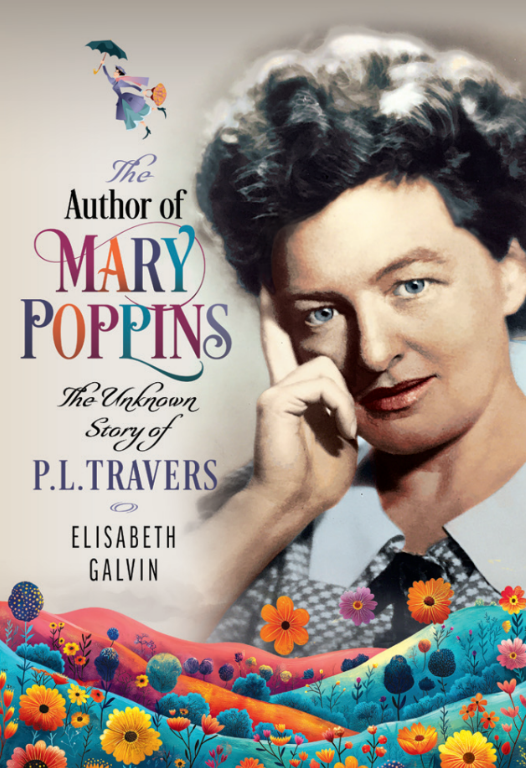
I am very excited to share my conversation with Elisabeth Galvin about her upcoming biography of P. L. Travers, the creator of Mary Poppins. This time, our conversation takes place in video form, a medium I avoided for a long time but have now come to accept as one I need to embrace.
In this interview, which I am sharing below, Elisabeth and I explore what first drew her to Travers, her research process, and the unexpected material she uncovered while tracing the life of a writer who has fascinated readers for generations.
We also talk about the people she met along the way who knew Travers personally, and how their memories and stories brought new texture and meaning to this biography. Travers’s complexity is portrayed in a gentle and respectful way, as Elisabeth is keenly aware of the responsibility that comes with writing a biography and of the difficulty of portraying with care and honesty a person one has never met. Elisabeth’s writing is also deeply atmospheric, carrying the reader through an almost visual experience of time and place. It is a delightful read, and I sincerely hope this book finds its way into the hands of many readers.
There is an additional reason for my excitement. I had the honor of writing the introduction to this biography, as well as an entire chapter on Travers’s spiritual beliefs, a subject very dear to my heart. I have been immersed in the world of Travers and Mary Poppins for over ten years, and I am convinced there is still much left to uncover. Travers lived a long and productive creative life, yet today she is often remembered only for Mary Poppins. I believe she is an author worth rediscovering. I also believe she was truthful when she said she did not write Mary Poppins with children in mind, and that these stories continue to hold important lessons for adult readers.
I hope you enjoy my conversation with Elisabeth Galvin, and that you will consider subscribing to The Mary Poppins Effect for more reflections and stories exploring the world of Mary Poppins and its connections to other literary worlds.
This post continues the story about my first Mary Poppins–themed trip to London with my daughter in the summer of 2023. In last month’s post, I shared our visit to P. L. Travers’s former homes at 50 Smith Street and 29 Shawfield Street in Chelsea. If you haven’t read it yet, you can find it here.
In this blog post, we will visit St Paul’s Cathedral, stroll through Poppin’s Court near Fleet Street, shop for parrot-headed umbrellas at James Smith & Sons and admire the Mary Poppins statue in Leicester Square Gardens.
St Paul Cathedral, London
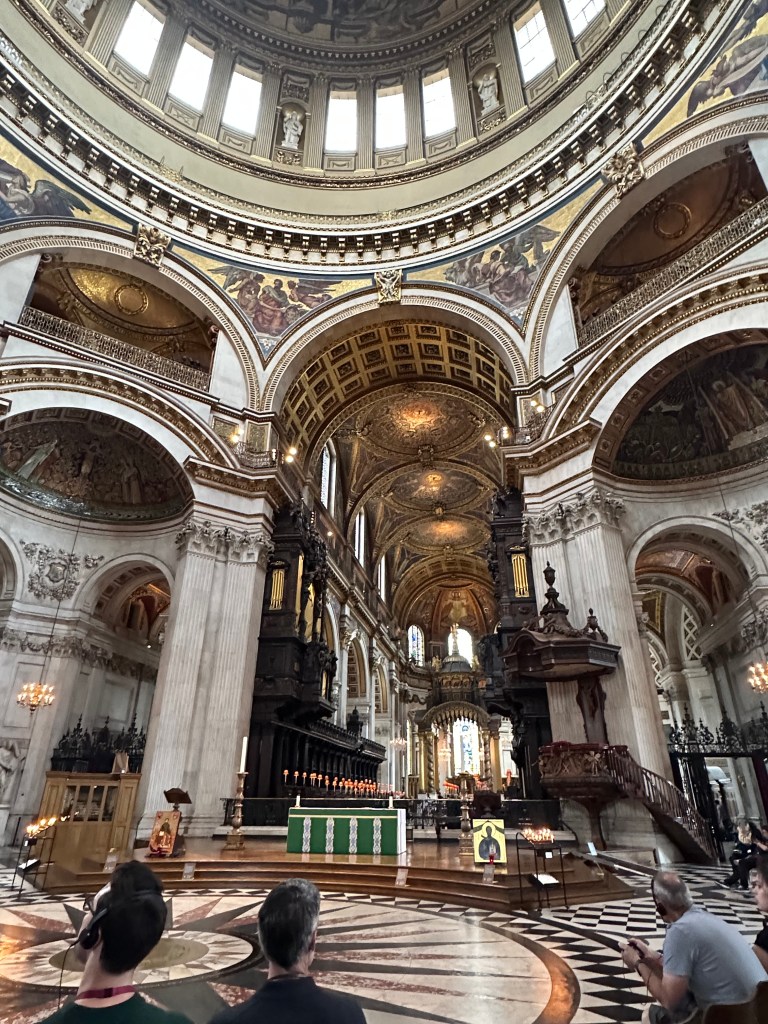
If you find yourself in London, a visit to St Paul’s Cathedral is, in my humble opinion, an absolute must. Its grandeur is astonishing—from the soaring colonnades to the magnificent domed ceiling—and the vast interior, adorned with intricate mosaics, takes your breath away the moment you step inside.
In The Bird Woman, Mary Poppins takes the Banks children to visit their father who works at the bank, where he, as described in the very first Mary Poppins story, East Wind, “sat on a large chair in front of a large desk and made money. All day long he worked, cutting out pennies and shillings and half-crowns and threepenny-bits.”
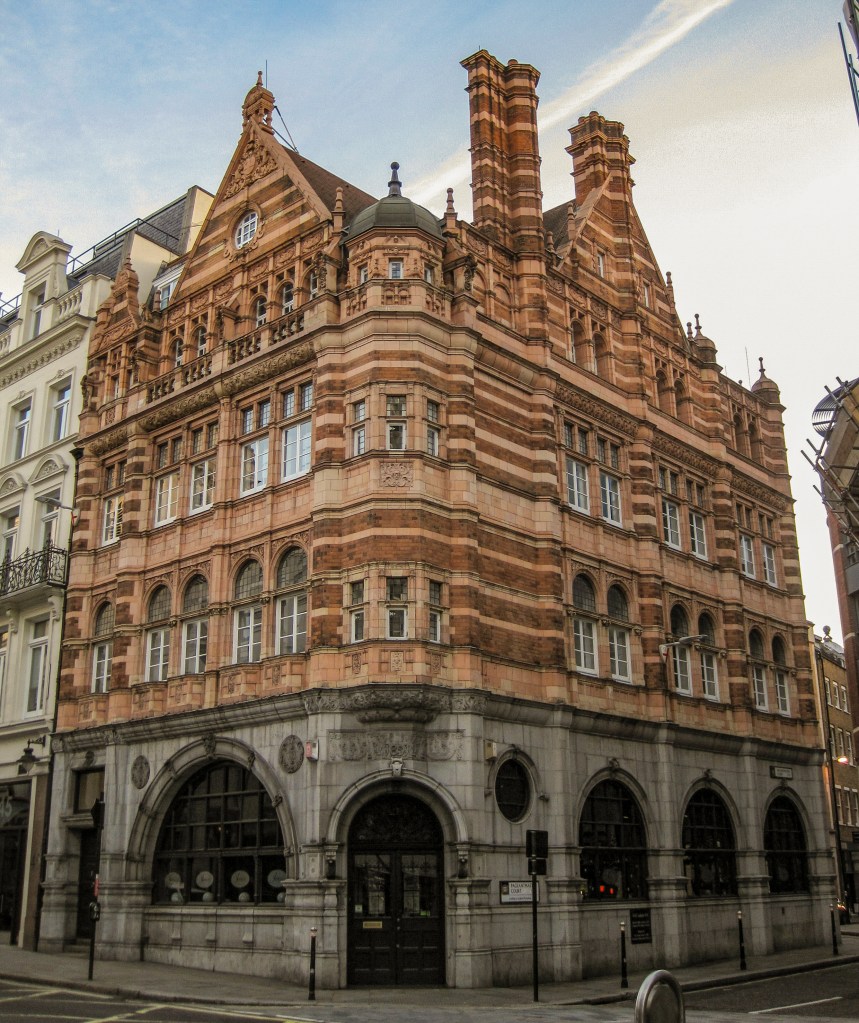
I wish the idea of looking up banks around St Paul’s Cathedral had occurred to me while I was there, but it didn’t—so this will have to go on my list for my next trip to London. I’m talking about the bank where I believe P. L. Travers imagined Mr. Banks working: the Ludgate Hill branch of the City Bank at 45–47 Ludgate Hill, which, according to Memoirs of a Metro Girl, is now a wine bar.
The picture above was taken by Metro Girl and is shared here with her permission 🙂
How do I know this was the bank P. L. Travers had in mind when she wrote “The Bird Woman”? Because she writes: ‘They were walking up Ludgate Hill on the way to pay a visit to Mr. Banks in the City.’
In The Bird Woman we learn that Mr. Banks is entirely absorbed in material pursuits and has no time for small pleasures. But we can hardly blame him—he is the sole provider for his ever-growing family (by the second book in the series, the Banks family counts five children). Hoping to offer him a rare moment of joy and respite, Mary Poppins and the children plan an outing for tea and Shortbread Fingers. Yet Jane and Michael are far more excited by the possibility of meeting the Bird Woman and her pigeons outside St Paul’s Cathedral than by the promised tea and shortbread.
Because of the sharp contrast between the Bird Woman’s quiet act of feeding the birds and Mr. Banks’s worldly occupation, The Bird Woman takes on a distinctly spiritual undertone for the adult reader. The doves, traditionally associated with the Holy Spirit in Christianity, serve here as a visual metaphor for the nourishment of the soul. Clearly, P.L. Travers is concerned with our human struggle to balance material responsibilities with the quest for spiritual fulfilment.
Yet for carefree Jane and Michael, the Bird Woman and her doves are simply companions to delight in and play with. For them, the magic of the day is found in this gentle, enchanting encounter—an experience that carries them beyond the ordinary and into a realm of wonder.
I love how P. L. Travers conveys Jane and Michael’s understanding of the doves, while at the same time revealing her own gift for remembering how to see the world through the eyes of the child she once was.
“There were fussy and chatty grey doves like Grand-mothers; and brown, rough-voiced pigeons like Uncles; and grey, cackling, no-I’ve-no-money-today pigeons like Fathers. And the silly, anxious, soft blue doves were like Mothers. That’s what Jane and Michael thought, anyway.”
Jane and Michael (and probably P.L. Travers) relate to the animal world far more naturally—and kindlier—than most adults. To them, the birds are not pests but companions, each a living being with its own character. We, on the other hand, tend to brush past pigeons and doves as if they were mere annoyances, hardly pausing to see them at all—too busy rushing for the train or speeding down the highway, intent on our own version of cutting pennies and shillings.
I experienced my own version of feeding the birds—not at St. Paul’s Cathedral, but in St. James’s Park. While we were there, a little girl, slightly older than Jane and Michael Banks, had a bag full of seeds. She was not only feeding the birds but also offering seeds to passersby who, like me, wanted to join in the experience. It was deeply touching, and here is a short clip of me feeding the birds.
Feeding the birds in St. Jame’s Park
Many of the characters in the Mary Poppins stories—if not all—have their roots in the real-life experiences and encounters of P.L. Travers. She rarely revealed these inspirations openly, though hints occasionally surfaced in interviews she gave throughout her long writing career.
I have never come across an interview in which P. L. Travers spoke about the origin of the Bird Woman. However, I did find an old picture of a man standing outside St Paul’s, his arms and shoulders alive with pigeons as he feeds them. In the late 1920s and early 1930s, while working as a freelance journalist near Fleet Street, P. L. Travers often passed by St Paul’s Cathedral, and I can’t help but wonder whether this man might have been the true inspiration behind the Bird Woman.
St Paul’s Cathedral, as P.L. Travers writes in The Bird Woman, was built long ago by “A man with a bird’s name. Wren it was, but he was no relation to Jenny.” That man, of course, was Sir Christopher Wren, England’s most celebrated architect of his day. When my daughter and I visited St Paul’s Cathedral in the summer of 2023, we saw a lovely exhibit inside about Sir Christopher Wren and the reconstruction of the building after the Great Fire of London in 1666.
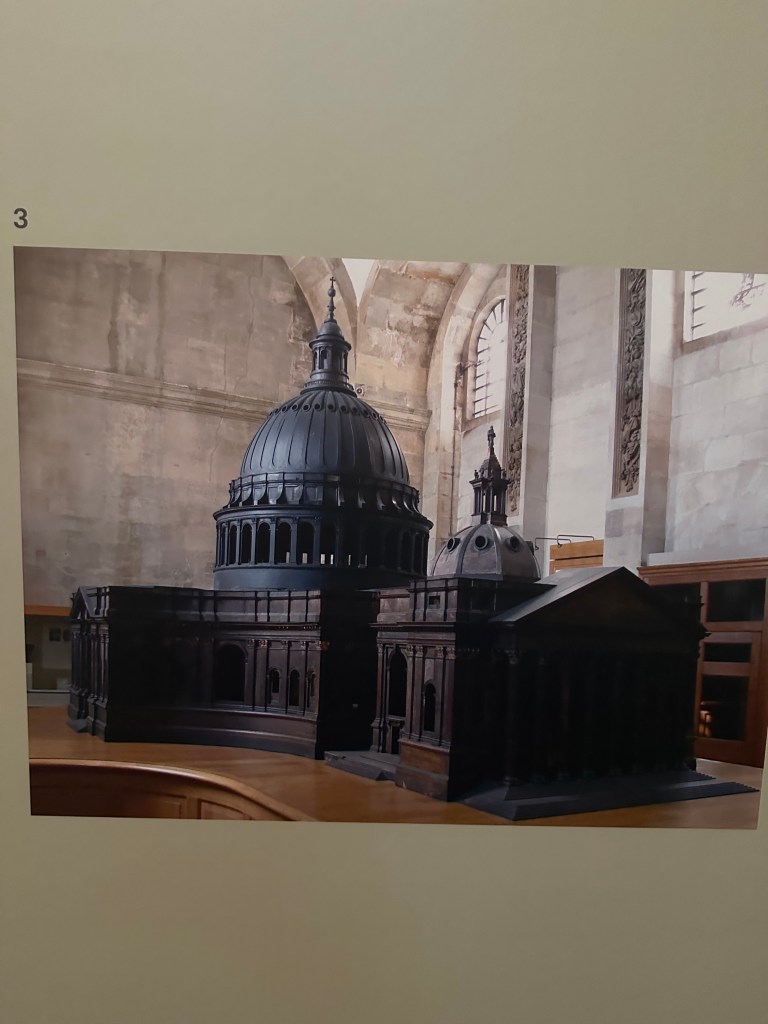
Wren designed the Great Model of the cathedral in 1672–73. The version you see in the picture below was executed by William Cleere and a team of thirteen joiners. This design differed from the original in style, evolving from the “Greek Cross” plan by extending the nave and adding a domed bell tower.
King Charles II, who awarded the reconstruction contract to Wren, requested a slight modification: the domed bell tower had to be replaced with a traditional spire. But Wren was not a man easily discouraged. Once the plans were approved and the contract signed, and construction was well under way, he discovered a loophole in the fine print: it permitted ornamental rather than essential changes. So, he made his alterations accordingly.
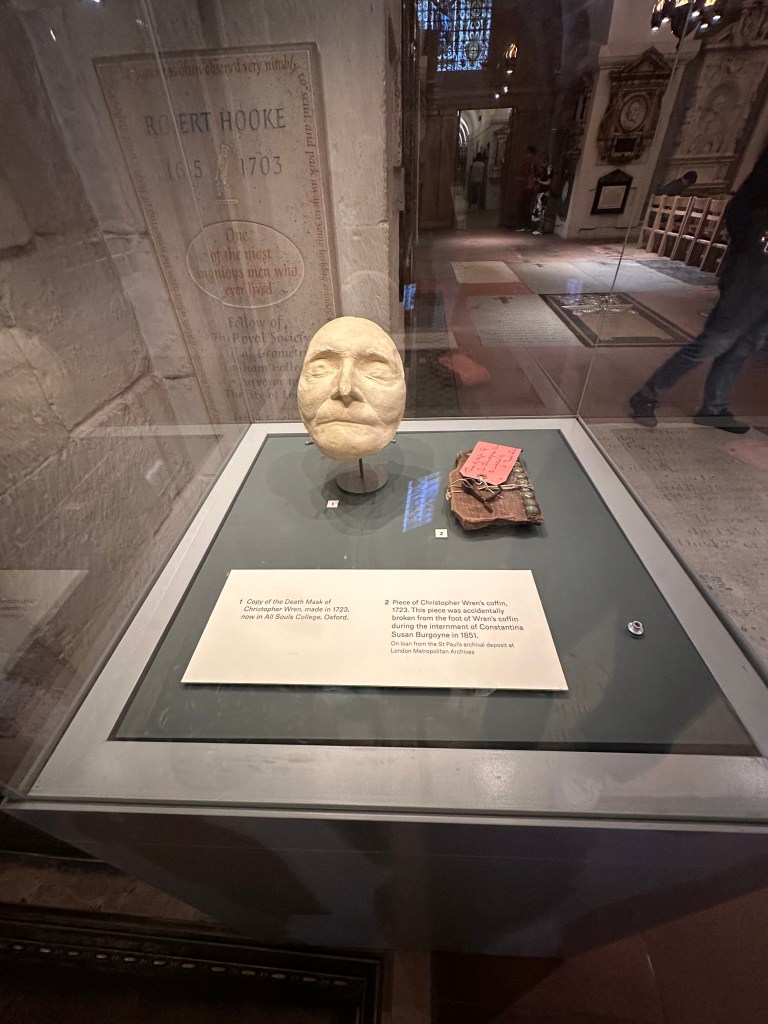
St Paul’s Cathedral is also Wren’s final resting place. Below is a photo of a copy of Wren’s death mask—the original is preserved at All Souls College in Oxford. A little morbid, perhaps, yet also a fascinating human attempt at transcending death.
Now who is Jenny Wren? What did P.L. Travers meant by saying that Wren was not related to Jenny? The reference is a pun woven by P.L. Travers—one I had completely missed, since English folklore and nursery rhymes were not part of my upbringing. For those who may also be unfamiliar: the wren, a tiny brown bird, was affectionately called “Jenny Wren” in English tradition. She appears in old songs and nursery rhymes, often paired with Robin Redbreast as husband and wife.
Children in P.L. Travers’s time would have instantly recognized “Jenny Wren” as shorthand for the little wren, and the playful wordplay would have delighted them. It signals to young readers that the world is whimsical, alive with hidden connections. The pun weaves together architecture (Wren), folklore (Jenny Wren), and the story’s imagery of birds and the mystical Bird Woman—perfect for a chapter set at St. Paul’s amid flocks of pigeons.
And for adult readers, there’s yet another layer: an echo of Dickens. Jenny Wren is also a character in Our Mutual Friend. That reference escaped me as well, but this Dickens novel has now joined my ever-expanding TBR list.
Poppin’s Court
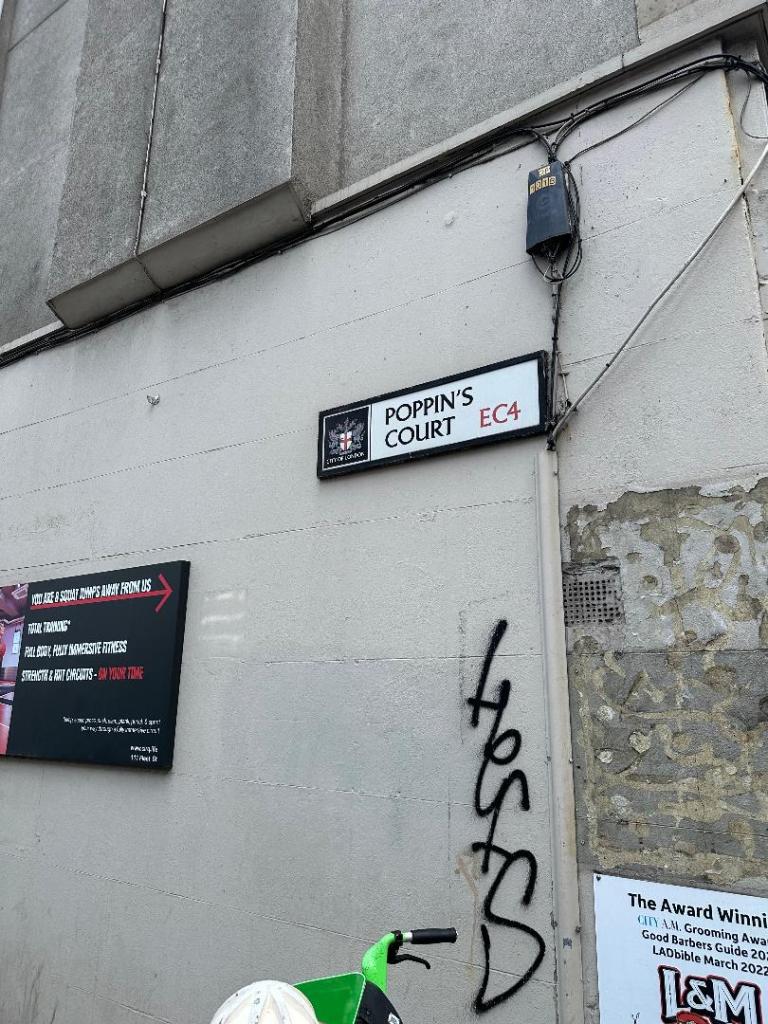
Not far from St Paul’s Cathedral, just off Fleet Street, you will come across a narrow lane called Poppin’s Court. When P.L. Travers first came to London she worked as a free-lance journalist on a street near Fleet Street and she must have passed by Poppin’s Court on her way to St Paul’s Cathedral, and it is, as her friend Brian Sibley wrote, possible that this is how she came up with the idea for the name of her famous nanny.
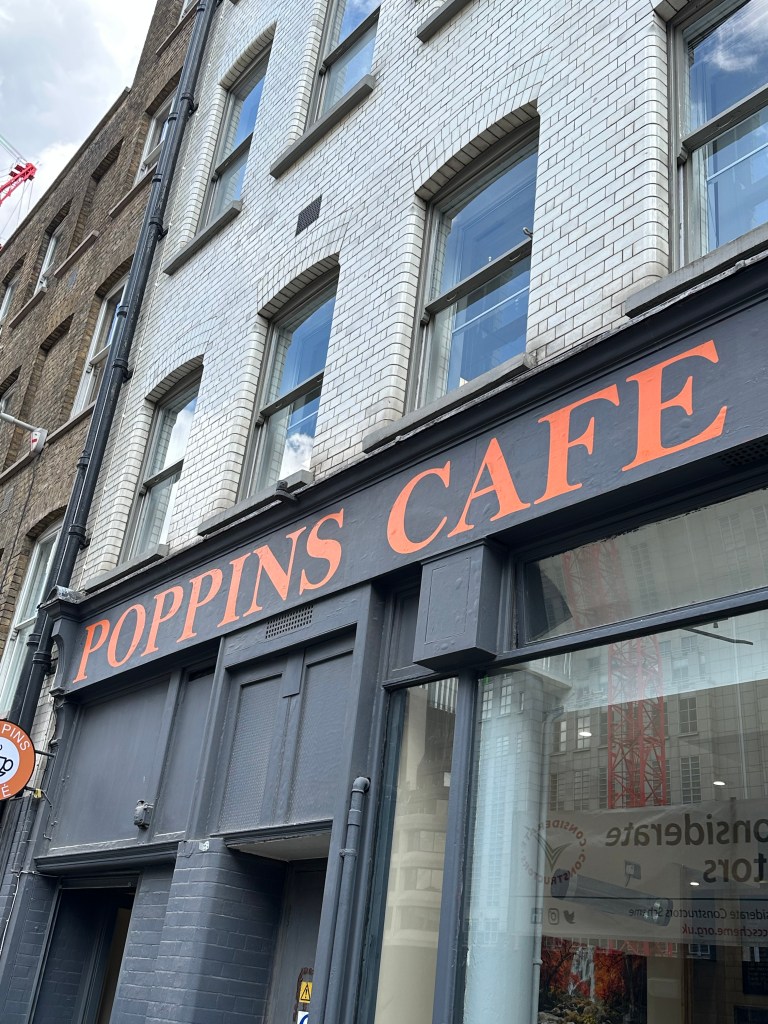
Back in 2023, when my daughter and I visited Poppin’s Court, there was a Poppins Café, which may still be there. Sadly (for me), it had nothing to do with Mary Poppins. I would have loved to visit a Mary Poppins–inspired tea room based on the books.
Leicester Square Gardens
If you have time, be sure to stop by Leicester Square, where you’ll find several statues capturing iconic movie moments from different decades since the 1920s — and of course, one of them is Mary Poppins. Although the Mary Poppins statue in Leicester Square celebrates the film character rather than the one from the books, I couldn’t resist trying to ‘fly away’ on her umbrella.
Since this Mary Poppins statue was created many years after P.L. Travers’s death, we can only guess what she might have thought of it. What we do know is that she once wished for a statue of her character in London—though her dream location was Kensington Gardens. I will tell you more about that in a future post on this blog.
James Smith & Sons Umbrellas
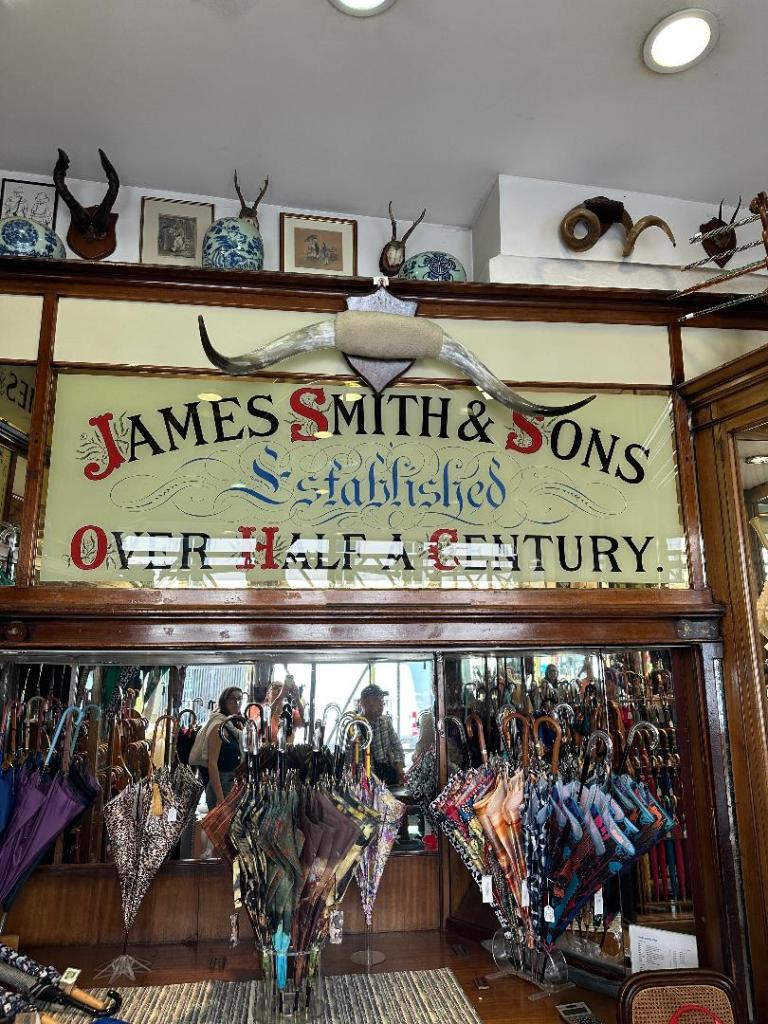
If you want to get a parrot-headed umbrella like Mary Poppins’, you should definitely visit James Smith & Sons Umbrellas, a tiny shop founded back in 1830. I have no idea whether P.L. Travers knew about this shop or if she ever visited it. According to her own account, the inspiration for the parrot-headed umbrella came from a childhood memory of a servant’s umbrella in the Travers household in Australia (and maybe by something else, which I also plan to tell you about in a future post). But whether or not P. L. Travers ever visited this shop, I thoroughly enjoyed our own visit — dampened only by the scaffolding on the facade, which was under renovation.
Here is a picture of a parrot-headed umbrella standing proudly beside another famous fictional character. I was tempted to purchase both, but the price tag quickly discouraged me. But two years later I am still thinking about this parrot headed umbrella …
That’s it for now—thank you for reading! If this post brought you a little joy, just click the subscribe button in the bottom-right corner of your screen and join me for the next stop in my Mary Poppins adventures through London and beyond. You can also follow along on Facebook and Instagram for more glimpses into the magical world of Mary Poppins and P.L. Travers.
When I first read Mary Poppins and Mary Poppins Comes Back (which were printed in one volume) as a child, I was not able to enjoy the original illustrations by Mary Shepard, as they were not included in the Bulgarian translation published in 1980. Instead, they were replaced by illustrations by Lyuben Dimanov.
I don’t think I liked Dimanov’s illustrations as a child because I have no memory of them, and I do remember a lot of the illustrations from my childhood books. All I remember is that the book was very thick, and it felt like proof that I was really good at reading. It was only a couple of years ago when I retrieved an old copy of my childhood edition of Mary Poppins that I realized the original illustrations were not in it.
Now that I am acquainted with the original illustrations, I find it difficult to enjoy Dimanov’s interpretations of the characters. For one, I find the figures a bit too angular, and their proportions too exaggerated. Moreover, in my opinion, he took his artistic liberties to the extreme. In fact, one has to wonder if he even read the stories, or how he could portray Mary Poppins with long, curly, flowing hair like a lion’s mane.
I’m certain P.L. Travers would have been upset if she had seen these illustrations—or maybe she did. I wish I could show them to her and ask her opinion. What we do know is that she was very particular about how Mary Poppins was depicted and insisted on her being represented exactly as she had imagined her.
In fact, P.L. Travers was so particular about the character, and Mary Shepard was such an inexperienced artist at the start of the project, that the emergence of Mary Poppins in visual form was not without its growing pains.
P.L. Travers wanted Mary Poppins to be plain, yet graceful, and to help the young visual artist grasp her vision of the character, they took many walks in the park to observe nannies pushing prams. Yet despite Shepard’s heartfelt efforts, P.L. Travers was not satisfied with the sketches and it wasn’t until she found a wooden doll with bright black hair, bright blue eyes, and a turned-up nose, and showed it to Shepard, that Mary Poppins finally took shape.
The working relationship between P.L. Travers and Mary Shepard spanned over 50 years, during which Shepard illustrated all the Mary Poppins books, including the Latin translation of Mary Poppins, a children’s cookbook, an alphabet book, and a coloring book published in 1969. I had been searching online for this coloring book for a long time, and then, one day, I was fortunate enough to find an unused copy on Facebook Marketplace of all places.
Oh, the joy of finding it and coloring the illustrations! Of course, I kept the original coloring book pristine and worked on photocopied pages, in case anyone is curious. I want to keep it as a collectible, but I also love the idea of having the chance to color the illustrations again whenever the mood strikes. The time I spent coloring reminded me of how much I loved it as a child. It also reminded me of my struggles of not crossing over the lines—though, as it turns out, I still struggle with that! But perfection isn’t the point. The point is enjoyment and playfulness at any age!
While coloring the pictures, I suddenly noticed something interesting in one of the illustrations that struck me as quite indicative of the nature of the relationship between Mary Shepard and P.L. Travers. Reportedly their relationship was a difficult one, P.L. Travers being portrayed as domineering and Mary Shepard as an underestimated, self-effacing artist. I believe that a glimpse of their relationship dynamic is reflected in one of the illustrations in the story “Balloons and Balloons”. This story first appears in the second book Mary Poppins Comes Back first published in 1935. Below is a picture of the illustration from the book.
The picture shows several of the Mary Poppins characters holding balloons with their names on them, floating through the air, with Mary Poppins as the central figure holding the largest balloon. But if you look up closely you will notice the two intruders in this picture. In the bottom left corner, you can see P.L. Travers and Mary Shepard joining the party. According to P.L. Travers, as she once told an interviewer, it was Mary Shepard’s idea to include them both in the illustration. (Personally, I think this was a genius idea.)
Notice how, in this picture, the two women are facing each other. Mary Shepard’s figure is slightly smaller, and her body curves in a way that seems to mold to the shape of P.L. Travers’ figure. Now, look at the picture below from the 1969 coloring book, keeping in mind that at the time, Shepard was bitter about not receiving any money from Disney for the movie adaptation of the character.
The figures are notably different in size and body language. P.L. Travers is larger and holds a bigger balloon. Her body flows gracefully through the air, with the string of her balloon twirling as she holds it effortlessly, without any strain. On the other hand, Mary Shepard, much smaller, is holding onto a short, tight string and appears tense, as if hanging on for dear life. Not only that, but she has her back turned to P.L. Travers.
I wonder if P.L. Travers noticed these changes in their positioning in the illustration, or if this detail completely escaped her, or if she would have even cared about it. I haven’t had the chance to delve deeper into their relationship, so I’m relying on what others have written about the subject and while I’m aware that I’m speculating on the comparative interpretation of these two illustrations, it was, nevertheless, a fun insight to gain from my interaction with A Mary Poppins Story for Coloring.
As for P.L. Travers’s view that ‘what counts most is the text, not the picture,’ I both agree and disagree with her. It all depends on the angle from which you look at the question. Of course, there would be no picture of Mary Poppins without the story, but for children, the illustrations are almost as important as the text.
Perhaps it’s because P.L. Travers never intended the books to be read solely by children that she prioritized the text. Or, maybe it was because she was human and fallible, and possessive of Mary Poppins. After all, she once told an interviewer that a fictional character is like a child to an author. One thing is certain: despite their differences, both P.L. Travers and Mary Shepard must have both gained something positive from their collaboration. Otherwise, why continue for fifty years?
I hope you enjoyed reading this blog post and that you’ll subscribe to my blog, so you don’t miss the next installment. While I can’t commit to a regular posting schedule, one thing I can promise is that I’ll continue writing about all things Mary Poppins and P.L. Travers.
I am thrilled to tell you all about my recent conversation with renowned author Jane Yolen who had the opportunity to meet with P.L. Travers on two occasions, the first of which happened back in 1966. But first, let me share a bit about Yolen’s literary work.
Yolen has written over 400 books for children and adults and is the recipient of many literary awards among which are the Caldecott Medal, two Nebula Awards, three World Fantasy Awards, the World Fantasy Association’s Lifetime Achievement Award and the Science Fiction Writers of America’s Grand Master Award.
She, like P.L. Travers, is a poet with a deep love for fairy tales and has penned several unique retellings and re-imaginings of these timeless stories, infusing them with her own creative touch. I’ll delve deeper into her retelling of Sleeping Beauty and her novel Curse of the Thirteenth Fey in a future blog post. As you may know, Sleeping Beauty was P.L. Travers’s favorite fairy tale, which she explored and analysed (pondered) in her 1975 book, About Sleeping Beauty.
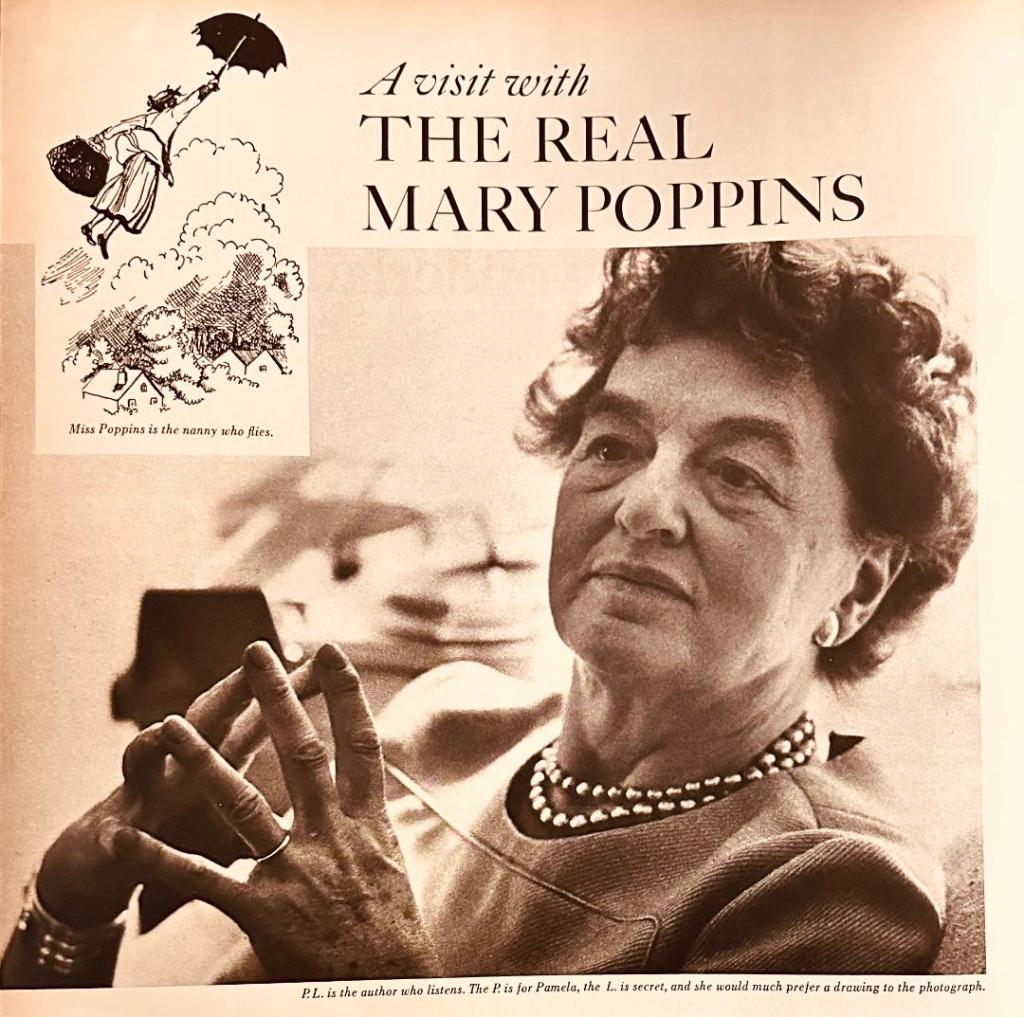
Yolen first met P.L. Travers in 1966 on the famous night when Look Magazine was covering an open house evening with her and a few students from Smith College. At the time P.L. Travers was a writer-in-residence at Smith College and, according to Valerie Lawson, she was not having a good time there.
An article titled “A Visit with the Real Mary Poppins” by Joseph Roddy, was published in Look Magazine on December 13, 1966. A hint of P.L. Travers’s difficulty to connect with the students echoes in the lines of Roddy’s article: ‘P.L. – she would prefer being Anon but will endure the initials – gets the ones who memorized Blake, pondered Camus, are awash in The Hobbit and know every move Mary Poppins made.’ He goes on to write: ‘The talk leaps across centuries every night P.L. has open house in a dormitory suite brightened only by handsome girls and snappy lines.’
According to Yolen’s recollections, there were about fifteen women present, along with the journalist and the photographer from Look Magazine. Yolen was a sort of VIP guest that evening. She, her husband, and their four-month-old baby were accompanying P.L. Travers’s goddaughter, who had a personal invitation to the event.
Yolen’s first impression of P.L. Travers was that she behaved much like the Mary Poppins from the books—whom Yolen had read and loved as a child.
Today, people who have not read the books think of Mary Poppins as the pleasant and charming character from the movies. Then, if they read the books, they are taken aback by the harsher version of the original character. I notice this contrast frequently on social media and I think that it is unfortunate because the expectations set by the movies prevent the readers from appreciating the depths and complexities of the original character.
Mary Poppins is more than just a caregiver in the stories; she acts as a mediator between worlds, initiating the Banks children to the mysteries of life. This dual role creates a fascinating split-personality dynamic that captivates children and adds to the mystery of Mary Poppins’s magic. As a child I never questioned why Mary Poppins could be strict and abrupt with the Banks children; I instinctively understood that it was all part of a playful facade. Beneath it all, she was a good fairy, and I knew that the Banks children felt the same way.
As an adult rereading the Mary Poppins stories and learning about P.L. Travers’s life and spiritual beliefs, I realize that Mary Poppins could be no other way in our world. While others may have different interpretations of the character, the true magic of Mary Poppins lies precisely in her paradoxical nature. The same is true for P.L. Travers herself.
According to Yolen’s recollections of that memorable night, both aspects of P.L. Travers’s character came to the forefront. The anecdotes that follow are not reported in Roddy’s article.
A young student, who had the audacity to begin a question by admitting she hadn’t read the books but had only seen the film, was administered a spoon full of vinegar by P.L. Travers: ‘Then Dear, you KNOW NOTHING, and I suggest you do not say another word.’ ‘It felt almost like she had cursed the poor girl,’ said Yolen, ‘she was reduced to stunned silence’.
Admittedly, there might have been a gentler way to handle the situation, but the fact is that, two years earlier, the Disney film had left a deep wound in P.L. Travers’ psyche—one that had not yet begun to heal (no matter how much money she got out of it, people keep bringing up this argument all the time…) The young student was likely unaware of all this, but who attends a writer’s event without having read their work and then feels entitled to express opinions? Isn’t that rather rude as well?
As for the movie, Yolen recalls watching it with her husband in London and enjoying the music. She did however find Dick Van Dyke’s Cockney accent rather strange, and she thought that the Mary Poppins of her childhood would never sing, “A spoonful of sugar makes the medicine go down.” She was right.
Mary Poppins never explains or sugarcoats anything. If medicine is required, it is administered with a stern demeanor that accepts no opposition, as the Banks children discover in the very first story “East Wind”. It is only after they swallow the medicine that they realize that it has magically transformed into their favorite flavor. For Jane it is lime-juice cordial, for Mickael it is strawberry ice and for the twins John and Barbara it is milk. This is the way of the real Mary Poppins.
Another amusing incident during the screening of the film by Yolen and her husband – and one that I’m sure P.L. Travers would have enjoyed hearing about – occurred when Yolen’s husband, a passionate bird watcher, suddenly stood up and exclaimed loudly during the scene where Julie Andrews is singing with the chirping audio-animatronic bird on her finger, ‘But this isn’t a British robin; it’s an American robin!’ The audience responded with laughter and approval.
Now let’s go back to the open house evening of 1966. After casting her chilling spell on the poor girl who knew nothing about Mary Poppins, P.L. Travers shape-shifted into a protective, motherly figure toward Yolen and her 4-month-old baby. When the baby began to cry, Yolen, not wanting to disturb the event, considered leaving, but P.L. Travers wouldn’t hear of it. She directed Yolen to her bedroom, where she could use the rocking chair and feed her daughter in peace. “She didn’t ask,” Yolen recalled, “she told,” and that, in fact, felt comforting. “It felt like I was in safe hands,” just as the Banks children felt safe in the care of Mary Poppins.
Years later, Yolen participated in a fundraising event for Parabola, a magazine co-founded by Ellen Dooling Draper and P.L. Travers. The event took place in New York, and Joseph Campbell was also in attendance. As a young writer and a collaborator of the magazine, Yolen was invited to the event. Unfortunately, her opportunities to engage with P.L. Travers were limited to brief exchanges of greetings, as P.L. Travers was busy hosting and entertaining the magazine’s patrons, revealing yet another side of her personality, the practical, business side!
Yolen recalls how Joseph Campbell leaped onto a chair and captivated the audience for more than half an hour with stories from around the world on the theme of giving. As I listened to Yolen’s vivid recounting, (she really is a great storyteller) I couldn’t help but yearn to travel back in time and experience the event firsthand. I wish I could have witnessed P.L. Travers’s reaction to Campbell’s performance. She, for some unknown reason, disliked him. It may have been motivated by feelings of rivalry; she was human, after all. Campbell was a scholar and a recognized expert in mythology, while she was self-taught, and although equally knowledgeable about myths and fairy tales, was not as popular as him. There may have been other reasons, but for now, they remain unknown.
It is fascinating to me how the paths of these two women writers intersected and how they were connected by their shared interests in fairy tales and love of poetry. One of Yolen’s poems, “Land of Miracles,” would certainly have been enjoyed by P.L. Travers, both for its origins and its message.
The poem was inspired by a serendipitous incident during a walk in a cemetery in Ireland. Yolen, who enjoys strolling in cemeteries, remembers how, on one such walk, she stumbled and steadied herself by leaning on a gravestone. She felt a sudden, electrifying sense of otherworldlines and then she realized with astonishment that the gravestone she had leaned on was that of the great magician and poet W.B. Yeats. This unexpected encounter inspired Yolen to write:
‘Yes, poetry matters. Words matter. Great buildings tumble. But story remains.’
I am deeply grateful for Jane Yolen’s generosity and for taking the time to reminisce about P.L.Travers, and I hope you enjoyed reading this blog post as much as I enjoyed writing it.
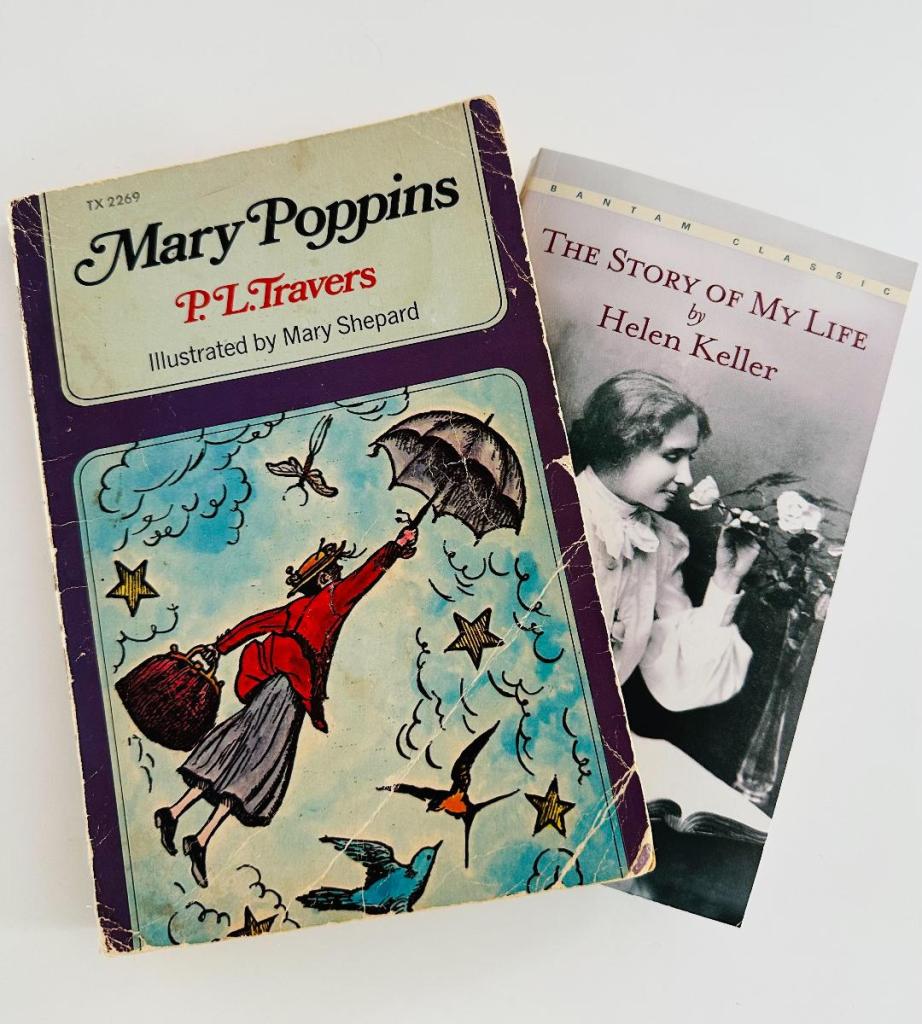
The friendship between P.L. Travers and Helen Keller is a little-known fact and one that was brought to my attention by a generous reader of this blog. I am forever grateful to my readers who share my interest in the world of P.L. Travers and Mary Poppins and freely share their knowledge with me.
A few letters kept in the archives of Helen Keller reveal that she and Polly Thomson stayed at P.L. Travers’s home during their visit to the UK in 1946. Helen Keller recollects the visit in these words:
“How often Polly and I recall the cozy evenings we spent with you, Camillus, and Moya by the fire in that dear, war-tried little house, surrounded by objects upon which your artistry has bestowed a fairy grace! “
And in another letter:
“I prefer to tell you how two pilgrims in search of ways to succor the war-blinded of Europe were rested and cheered by their visits with you, Moya and darling Camillius. Besides taking you to our hearts we loved your house, bomb-wounded yet warm and sweet to the core, your fire crackling with a cheery message of peace that shall someday inundate all homes, the simple hospitality making us feel natural and free instead of feeling “guests,” and the talk on whose wings the hours flew unnoticed.“
The connections I make from reading P.L. Travers’s interviews and writings usually require time and effort, and although I enjoy the process, I must admit that it is immensely satisfying, albeit I feel a little mischievous, to read P.L. Travers’s private thoughts on matters she never discussed in interviews.
Her correspondence with Helen Keller contains candid details about her relationship with her son, Camillus, and her feelings about single motherhood. In her interviews P.L. Travers rarely talked about Camillus and when she did, it was indirectly, by making references to a boy she knew well or a boy dear to her heart. This may appear strange, but I believe that she was trying to avoid questions about his adoption.
The adoption of Camillus is discussed in P.L. Travers’s biography Mary Poppins She Wrote by Valerie Lawson, as well as in the documentaries about her life, and so I am not going to delve into the details of the adoption here, but just mention briefly, for those of you who are not familiar with the story, that P.L. Travers never told Camillus that he was adopted and that he had a twin brother, and other siblings. At the age of seventeen he discovered the truth when his twin brother came knocking on P.L. Traver’s door.
As you can imagine Camillus was hurt and felt betrayed by the person he trusted most in life. His anger was mighty, and he never completely forgave her. This was a terribly sad and tragic event for both and P.L. Travers’s biggest regret in life was that she had not been a good enough mother for Camillus.
And maybe from the outside one can say that she should have made better choices when it came to her son, the truth is she could not have done differently because she did what she could, what she thought was best, based on the level of awareness she had at the time.
In her letters to Helen Keller, P.L. Travers writes about teaching Camillus how to swim and row during their summer vacation in Ireland and in the Wales, and how she is teaching him to handle a canoe on the Regent Park Lake. She mentions that he is taking violin lessons and “being very musical and with a good ear.”
But what I find most interesting in this correspondence is that P.L. Travers appears to have been nostalgic of Camillus’s earliest childhood years. It is almost as if she was grieving the loss of their deepest connection, feeling the bond between them beginning to weaken as he was growing up and losing touch with the dreamland of fairytales. In a way they no longer shared a common way of perceiving the world. Camillus, like most of us when growing up, was interested in the external affairs of life and of becoming, whereas P.L. Travers always kept one foot in the land of myth and fairy tales, and looked for a deeper meaning of life, beyond the illusion of the ordinary. She wrote to Helen Keller:
“He, when he first heard poetry, was enchanted by it, but now at the age of eight only wants it now and then. He is so busy being a gangster one moment, supervisor another, a policeman the next. Everything now is acting and there is very little dreaming. The house shakes with his thundering feet, he is always coming from or going somewhere and only at night remembers that he has a mother and is still small enough to sit in her lap and be rocked in the rocking chair.”
This sentiment of hers was so strong that it made its way in Every Goose a Swan in Mary Poppins in the Park. Camillus is the Boy in the story. The Boy is engrossed in pretend play, he is a fearsome one- eyed pirate, but then when the Tramp dares him to go to Dead Man’s Drop he suddenly remembers that he has a mother, that if he leaves she would be anxious and that after all she was making pancakes and it was better for him to stop acting and be his other self.
Another interesting aspect of this correspondence with Helen Keller is P.L. Travers’s frankness about her difficulties as a single parent, the frustrations of domestic life, and her difficulty at reconciling it all with her deep need to write.
“Helen, you will understand how sad I have been at having to face the possibilityof sending Camillus to boarding school. I aways wanted to keep him at homewith me and let him go to a day school. But daily living becomes ever moredifficult in England and the almost impossibility of finding anybody to help in thehouse will probably make it imperative. (…) I have broached the subject with himand his cheerful reply was “I will hit you if you do send me away!” However, as hegrows I think he will quite like the idea and I hope to find a simple loving schoolwhich will not try and mould his abundant nature into too conventional apattern.Then perhaps I shall have time to write.”
The boarding school she chose for Camillus was Dane Court Preparatory School for boys in Surrey. Joy Davidson, the wife of C.S. Lewis, sent her own two sons there after consulting P.L. Travers over tea. P.L. Travers’s high praise confirmed Joy Davidson’s impression of the school.
“The one she liked best was Dane Court, in Surrey, about twenty miles southeastof London. It was the most expensive, “gracious, well-established, comfortablewithout being luxurious and modern without being faddist,” having adopted aprogressive policy of not “whack(ing) the children.”
Poet, Seeker, and the Woman Who Captivated C.S. Lewis, by Abigail Santamaria.
In conlusions, P.L. Travers did what she could to give Camillus a good education and a good start in life.
There are other things in the letters that will probably prompt me to write other blogposts, but this is it for this one, and I sincerely hope you enjoyed reading it.
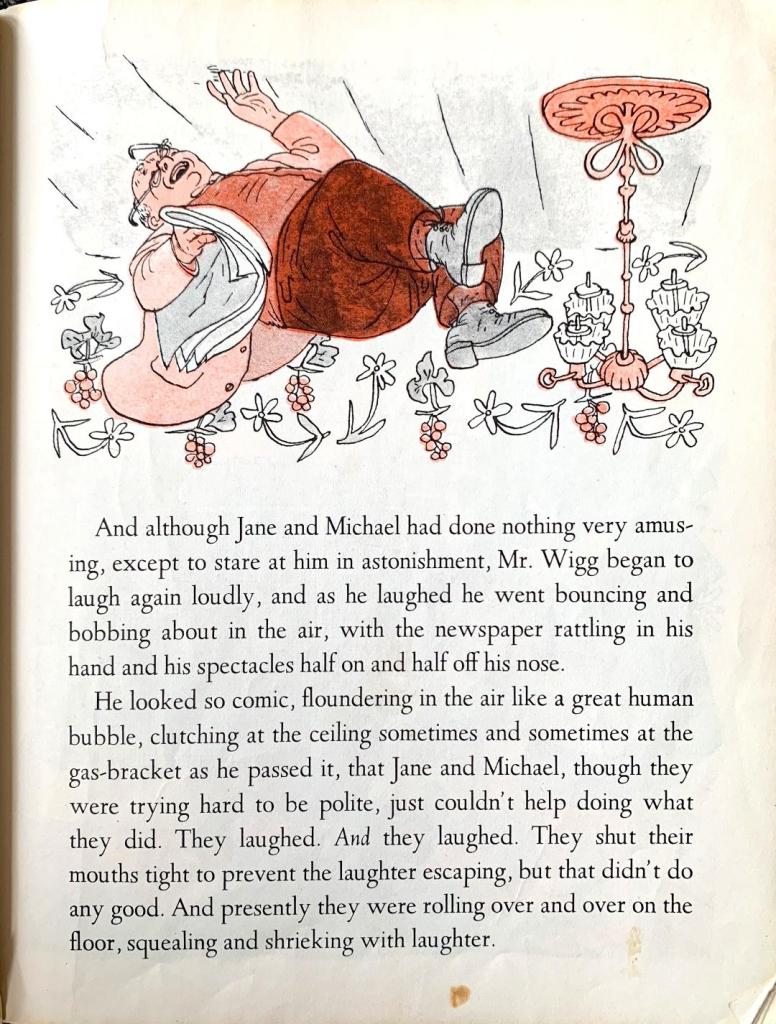
The Laughing Gas was my favorite Mary Poppins story as a kid. The scene where Mr. Wigg bounces and bobs about in the air like a balloon was the funniest thing that I had ever read. Imagining a round, fat, bald man wiggle in the air with his glasses half on and half off his nose, while holding a newspaper, was a vision I was not willing to let go of. I read and reread the passage until I had exhausted its last drop of funniness. Today, sadly, the same description no longer makes me burst into laughter, but I still enjoy the story, only for different reasons.
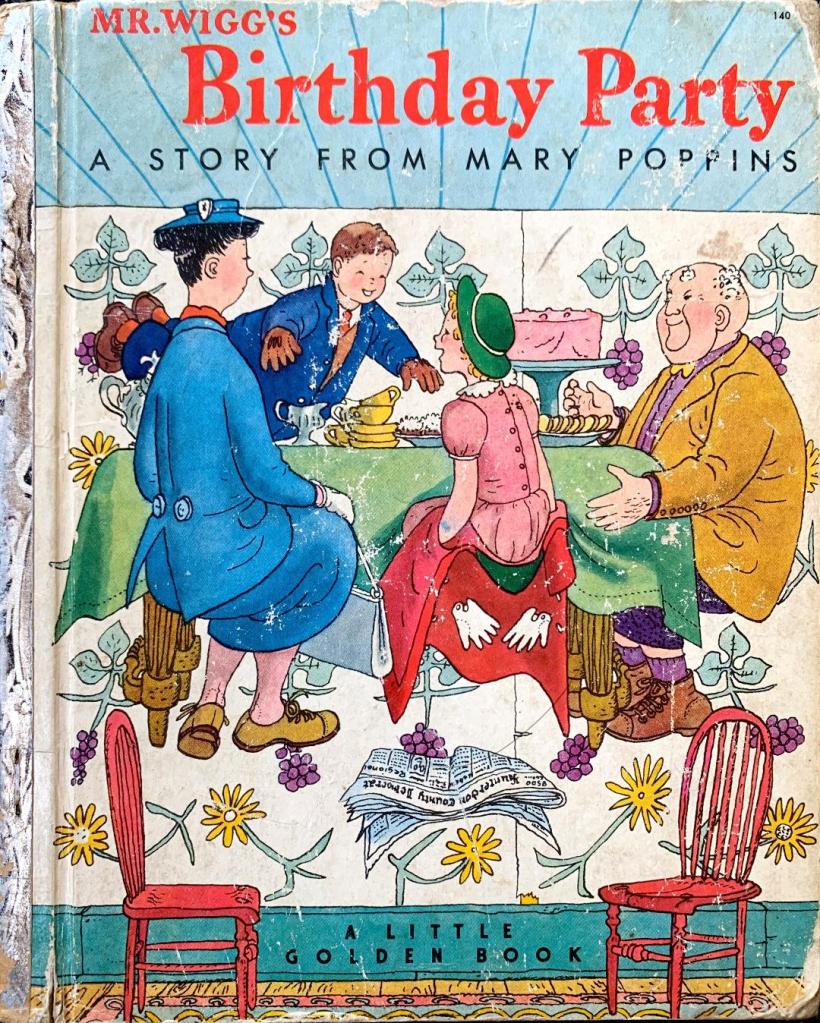
Recently, I saw a junk journal made from A Little Golden Book, Walt Disney’s Mary Poppins on social media. It was for sale, and I almost bought it, but then I changed my mind. I decided to make my own junk journal since I have the three Little Golden Books based on stories from the original Mary Poppins book (the first one in the series).
Mr. Wigg’s Birthday Party is an abridged version of The Laughing Gas. It was published in 1952 along with The Gingerbread Shop, an abridged version of Mrs. Corry. Then, in 1953 a third Little Golden Book based on Bad Tuesday was published under the title The Magic Compass.
I know, some of you will think this to be a sacrilegious act, cutting up a book and then inserting all kinds of bits and pieces in it, but I cannot help it. I feel compelled to play and interact with these stories in a different way. I promise to post pictures of my junk journals here, but only if they turn out nice.
I spent my early childhood years in Bulgaria in the 1980’s, and obviously, the Little Golden Books were not part of my early life. In line with my usual habit when something sparks my curiosity, I did some digging and learned a few interesting facts about the Little Golden Books Collection. Here they are.
Twelve Little Golden Book titles were first published in October of 1942 and were at once a tremendous success with 1.5 million copies sold during the first five months of their existence. Today, there are some 1400 Little Golden Book titles available, and the collection continues to expand.
Before the existence of the Little Golden Books, books for children in the United States were expensive and not vastly available to children in small towns and remote rural areas. In the 1930’s the average children’s book cost $2.00 (which today corresponds to $40.00) and in comparison, a loaf of bread cost 10 cents.
The Little Golden Books came into existence because of the collaboration of three groups: The Artist and Writers Guild, Simon & Schuster (the new kid on the publishing block back then) and Western Printing and Lithographing Publishing Company, Racine Wisconsin. Their goal was to publish affordable children’s picture books for 25 cents, an idea unheard of at the time.
Simon & Schuster were up for the challenge and their partnership with Western Printing allowed for mass production of colorful picture books because Western had big printing presses unlike the other publishing houses of that period. They were also printing maps for the US Army and had a large allotment of paper and were not much bothered by all the rationing during the war.
The first twelve Little Golden Books published in 1942 had forty-two pages in total, twenty-eight of which had colored illustrations, and the remaining fourteen pages were illustrated in black and white. However, in 1943 because of the war, The Little Golden Books were reduced to twenty-eight pages.
In 1944 Little Golden Books signed a licensing agreement with Disney which continues to this day. According to this licensing agreement, each release of a new Disney movie coincides with the publication of a Little Golden Book with the characters from the movie. This is how in 1964 the Little Golden Book Walt Disney’s Mary Poppins came to be.
The letters of the alphabet, printed on the bottom right corner of the last page of each Little Golden Book, identify its edition. I have the first edition of Mr. Wigg’s Birthday Party and that suggests the book did not sell as many copies as other Little Golden Book titles since there are no further reprints.
The covers of my used copy are worn, but that just adds to the charm, and as for the rest of the pages, they are in good condition.
All three Little Golden Books based on the Mary Poppins stories were illustrated by Gertrude Elliott, one of the illustrators of the Little Golden Books Collection. The pictures in Mr. Wigg’s Birthday Party show a plain and stern Mary Poppins, and I think that P.L. Travers must have been pleased by Elliott’s execution.
Now, for those who are unfamiliar with the story The Laughing Gas (and Mr. Wigg’s Birthday Party) here is a short summary of the plot. Mary Poppins takes Jane and Michael Banks to her uncle’s house for an afternoon tea. As it happens, their visit coincides with Mr. Wigg’s birthday, only when his birthday falls on a Friday, well, it is all up with him; the first funny thought that pops into his head fills him with laughing gas and he is up in the air, just like a balloon.
Jane and Michael find the situation so irresistibly funny that they too fill up with laughing gas and float up to the ceiling. At this point in the story, the characters are faced with a fantastic problem; the table set for their tea party is down and they are all up. How on earth are they going to have tea? Of course, Mary Poppins’s magic solves the problem, the table rises up to the ceiling and they all end up sitting comfortably in the air eating bread and butter, and sipping tea.
As a kid I enjoyed the story for its whimsicality alone, and it goes without saying that I too wished to be filled up with laughing gas. Yet no matter how hard I laughed reading the story, I stayed firmly put on the couch in the living room of my grandparent’s apartment. (That is where I read Mary Poppins for the first time.) The deeper meanings of the Mary Poppins stories became apparent only when I reread them as an adult.
The Laughing Gas is a beautiful allegory of the uplifting powers of joy and the price we pay when we take ourselves and life too seriously. However, this valuable lesson is missing from Mr. Wigg’s Birthday Party, because an important character had to be cut out in order to allow the story to fit into the preestablished length of a Little Golden Book.
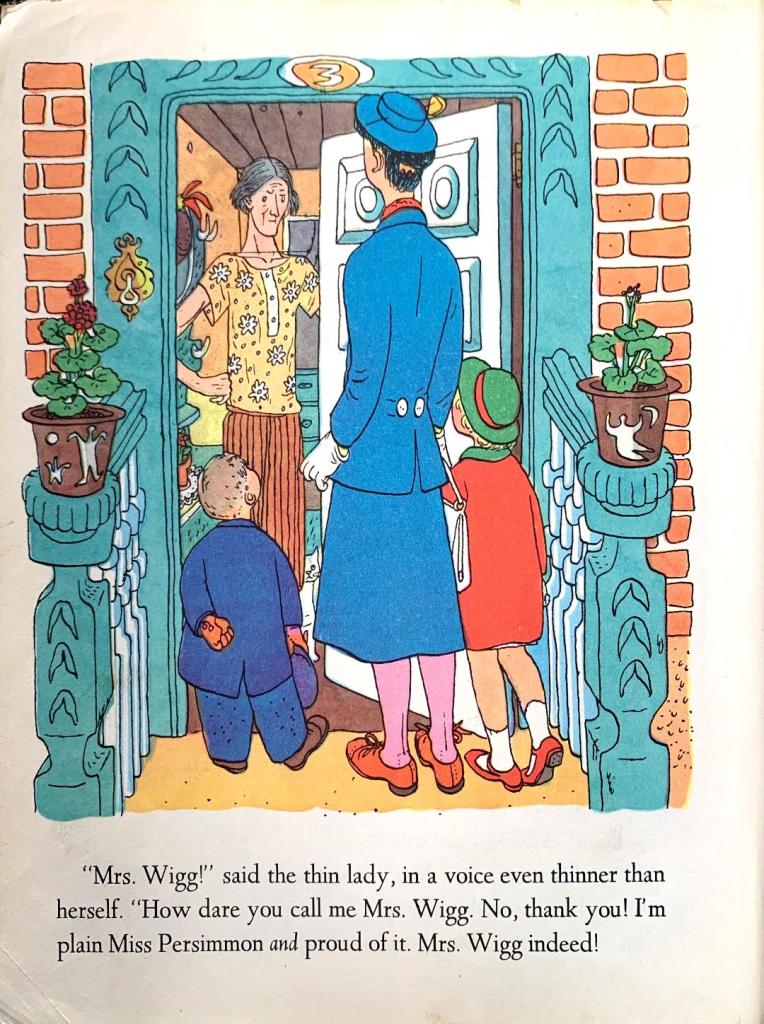
That character is the housekeeper Miss Persimmon. The reader of Mr. Wigg’s Birthday Party meets her briefly at the beginning of the story as she is the one who opens the door for the guests, but we don’t learn anything about her, except that she is not too fond of Mr. Wigg.
In The Laughing Gas Miss Persimmon comes into Mr. Wigg’s room with a jug of hot water for the guests and is stunned by the sight of them all sitting on the air around the table. She is disturbed by Mr. Wigg’s undignified behavior and when Michael Banks suggests to her that she too might catch the laughing gas she exclaims haughtily “I have more respect for myself than to go bouncing about in the air like a rubber ball on the end of a bat. I’ll stay on my own two feet, thank you, or my name’s not Amy Persimmon (…)”
As soon as the words come out of her mouth, Miss Persimmon, against her will, is propelled up in the air. After all, the guests need the hot water for their tea. The poor woman stumbles through the air and weeps in distress as she puts the jug of water on the table. On her way down to the floor she mutters to herself that she needs to see a doctor because she is a well-behaved, steady going woman, and the experience that she just had is beyond her understanding.
Mary Poppins gives an opportunity to Miss Persimmon to loosen up a bit, to let go of her judgmental ways, yet Miss. Persimmon resists. Why? Because tells us P.L. Travers, our social conditioning, if never questioned, will overpower us and cause us to experience nervous breakdowns whenever we are presented with a situation that conflicts with our narrow views. Miss Persimmon has lost her playfulness and her social conditioning has suppressed her ability to experience spontaneous joy.
As for the children, well, they learn that joy and sadness go hand in hand; you can’t have one without the other. That lesson too is missing form Mr. Wiggs’s Birthday Party, but I will write a separate blogpost about it.
Last week’s post finished with the following quote from Pamela L. Travers:
I am glad, therefore, to have kept my terror whole and thus retained a strong link with the child’s things-as-they-are, where all things relate to one another and all are congruous.
These potent feelings of terror, reinforced by the early and sudden death of her father and the subsequent suicide attempt of her mother, remained Pamela’s connection to her inner child. However, even before these tragic events, her sensitive mind was predisposed to bursts of anxiety. Snippets of enigmatic adult conversations and the blood freezing fairy tales of the Brothers Grimm fueled her imagination. Pamela, by her own words, developed a fascination with the dark characters of these stories. She wrote:
It was the dark ones, after all, on whom everything depended. They awoke the virtues, imposed the conflict and, by strictly throwing the story forward, brought it to its strict end – the achievement of Happy Ever After.
Yet, this vision of the battle between Good and Evil and the necessity of Evil as the hero’s teacher, was not accessible to Pamela L. Travers at the time when the Grimms presented her with the great dark forces of our human nature; evil so dark that it lit her childhood’s nightmares.
And, what else but nightmarish images could have a story such as How some Children Played at Slaughtering project in her mind? Now, a note of warning, if you have a sensitive stomach I suggest you jump over the next four paragraphs.
In the first part of this story, a group of children led by the butcher’s son decide to play at slaughtering a pig. And who plays the pig? A little boy who gets his throat cut by the butcher’s son while another little girl gathers his blood in a bowl. A councilman walking nearby sees the terrible scene and takes the butcher’s son to the house of the Major who summons the council. An old wise man advisees the council to offer the boy an apple and a golden coin. If the boy takes the coin, he is to be killed. When presented with the gifts, the boy joyfully picks the apple and thus can run free.
What an apparent injustice! I assume that would be the moral of the story for a child like Pamela, left alone to deal with the matter as well as she could. No one was there to explain the deeper meaning of the story or to tell her that the boy was simply imitating his father. And, no one was there to tell her that the boy did not understand the irreversibility of death nor his own mortality and that he was immature thus had no clear understanding of his actions and even less so about the consequences of these actions. And, that what seems to be unjust, is in fact just because the butcher’s son had no ill intention and therefor was undeserving of punishment. But what is to be said about the victim, the boy who played the pig? The story also deals with the apparent randomness of life events; of simply being at the wrong place, at the wrong time. It tells us that, sometimes, bad things happen without there being a guilty party. Or that one bad decision (accepting to play the role of the pig) can have fatal consequences.
In the second part of this Grimm’s story, the reader is taken to an even much darker sequence of events, at the butcher’s house, where the butcher’s wife is bathing her baby while her other two sons are playing the pig and the butcher outside in the yard. The older brother cuts the throat of his younger brother who plays the pig in the story. When the mother hears the cries, she comes outside, and horrified and enraged by the scene, she takes the knife from her son and kills him. Then she goes back upstairs to her baby, only to find him drowned in the bathtub. What else is left for her to do but kill herself? When the father comes back home and sees what had happened, he becomes so despondent that he dies soon afterward.
Now, how do you explain such a tragic story to a child? Because even if one explains the dynamics in play; a child still remains a child and is simply not ready for certain truths.
Maybe, if Pamela didn’t read these stories at such a tender age, she would not have experienced the panic attacks that often occurred at sunset. When the day was over, and darkness was on it’s way, Pamela knew she would be left alone in her bed with the monsters in her head.
“Will the sun come up tomorrow?” Pamela kept asking her parents. The question was simply brushed off. “If someone knew and understood how anxious I was about the sun, what a help it would have been for me.”
Unfortunately, her parents did not understand what it all meant.
Pamela L. Travers wrote once that if only she bothered to bring her questions to her parents they would have explained things as they are and released her from the grips of her anxieties. However, the following recollection contradicts that assertion.
Pamela’s voracious reading appetite extended itself to the Bible and “Of course, if you let a child read the Bible it will inevitably put the grown-ups in precarious positions.”
This is an example of one such precarisous position.
“What,” I asked my father once, “what is a concubine?”
“Er-hum -!” he responded. “Why do you ask?” Clearly, he was playing for time.
“Well, it says in the Bible that David took him more concubines and Solomon had three hundred.”
He inwardly groaned, but grappled with it. “Well, David was the head of the house, he needed people to look after him and the concubines-er-did.”
Three hundred! I thought to myself. One would need a very big house.
“What a pity, father, that you have only two!”
He was astonished. “Two what?”
“Two concubines-Kate and Bella to cook and make beds.”
“Katie and Bella are not my concubines.” Here was a child being childish, which was something he did not like.
“Then, Nellie, what about her?” Nelly was slightly wanting, and came to help with the washing.
“Certainly not.” The idea was repugnant.
“Well, father, who are your concubines?”
“I have no concubines!” he roared and stormed out of the room. And so I was left to deal with the mighty question myself.
Reading was Pamela’s exploration tool. Her inquisitive mind needed to make sense of the world. So, she read, without discrimination nor restriction. She read everything that came into her hand, even the missionary tracks of her piano teacher.
“When I was a child the only way I could learn about other countries was by reading missionary tracks given by my pious piano-teacher, so that today almost every quarter of the globe has for me a faint flavor of old hymn-books.”
These tracks and her fathers’ Celtic fantasies might have caused her thirst to see other lands. Undoubtedly, the foreign worlds seemed more attractive and alluring to her than the ordinary day-to-day of the Travers household.
There must be something else I would say, not at all knowing what it was, but knowing, too, that as far as the wind blows and the sky is blue I would go and find it.