Jane Yolen: Behind the Scenes of a Visit with the Real Mary Poppins

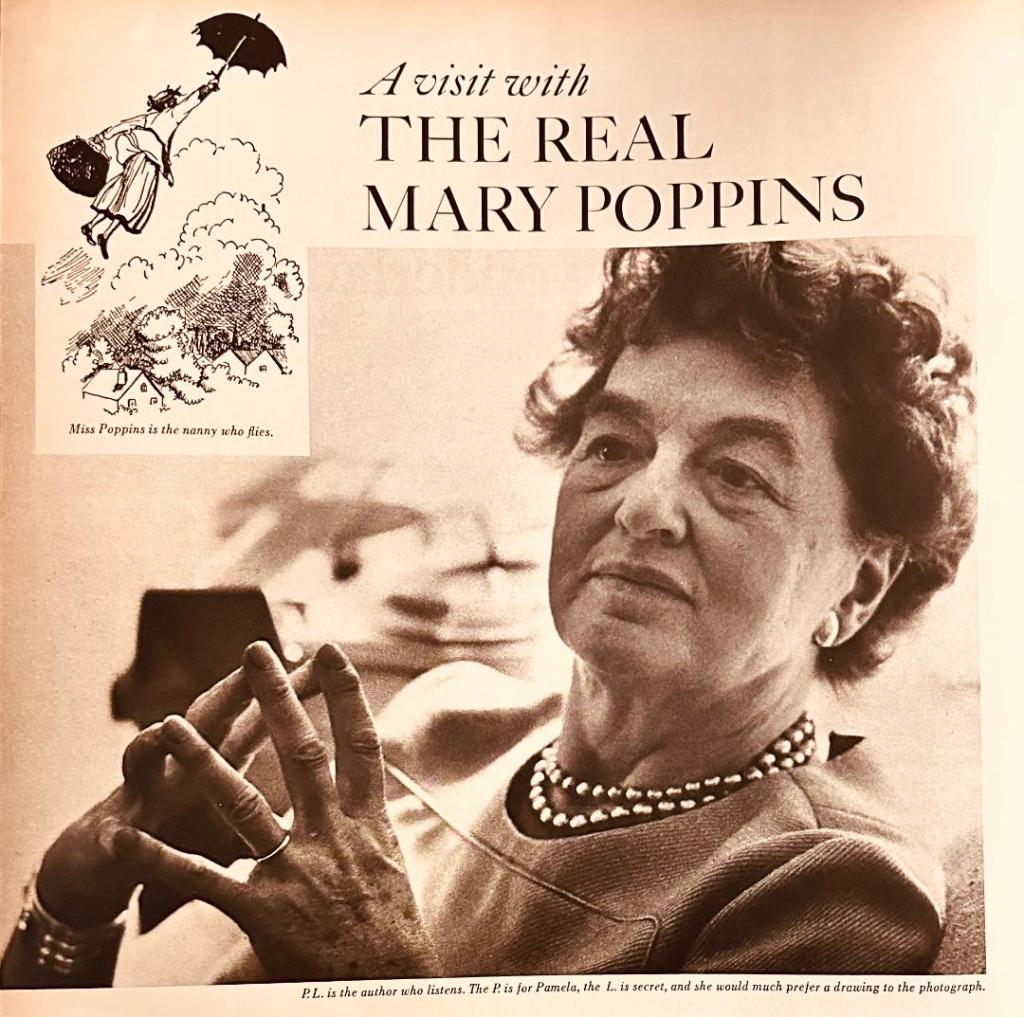
Picture from Look Magazine, December 13, 1966

Dear Reader, 

I am thrilled to tell you all about my recent conversation with renowned author Jane Yolen who had the opportunity to meet with P.L. Travers on two occasions, the first of which happened back in 1966. But first, let me share a bit about Yolen’s literary work.  

Yolen has written over 400 books for children and adults and is the recipient of many literary awards among which are the Caldecott Medal, two Nebula Awards, three World Fantasy Awards, the World Fantasy Association’s Lifetime Achievement Award and the Science Fiction Writers of America’s Grand Master Award.

She, like P.L. Travers, is a poet with a deep love for fairy tales and has penned several unique retellings and re-imaginings of these timeless stories, infusing them with her own creative touch.  I’ll delve deeper into her retelling of Sleeping Beauty and her novel Curse of the Thirteenth Fey in a future blog post. As you may know, Sleeping Beauty was P.L. Travers’s favorite fairy tale, which she explored and analysed (pondered) in her 1975 book, About Sleeping Beauty.  

Yolen first met P.L. Travers in 1966 on the famous night when Look Magazine was covering an open house evening with her and a few students from Smith College. At the time P.L. Travers was a writer-in-residence at Smith College and, according to Valerie Lawson, she was not having a good time there.  

An article titled “A Visit with the Real Mary Poppins” by Joseph Roddy, was published in Look Magazine on December 13, 1966. A hint of P.L. Travers’s difficulty to connect with the students echoes in the lines of Roddy’s article: ‘P.L. – she would prefer being Anon but will endure the initials – gets the ones who memorized Blake, pondered Camus, are awash in The Hobbit and know every move Mary Poppins made.’ He goes on to write: ‘The talk leaps across centuries every night P.L. has open house in a dormitory suite brightened only by handsome girls and snappy lines.’   

According to Yolen’s recollections, there were about fifteen women present, along with the journalist and the photographer from Look Magazine. Yolen was a sort of VIP guest that evening. She, her husband, and their four-month-old baby were accompanying P.L. Travers’s goddaughter, who had a personal invitation to the event.   

Yolen’s first impression of P.L. Travers was that she behaved much like the Mary Poppins from the books—whom Yolen had read and loved as a child.  

Today, people who have not read the books think of Mary Poppins as the pleasant and charming character from the movies. Then, if they read the books, they are taken aback by the harsher version of the original character. I notice this contrast frequently on social media and I think that it is unfortunate because the expectations set by the movies prevent the readers from appreciating the depths and complexities of the original character.  

Mary Poppins is more than just a caregiver in the stories; she acts as a mediator between worlds, initiating the Banks children to the mysteries of life. This dual role creates a fascinating split-personality dynamic that captivates children and adds to the mystery of Mary Poppins’s magic. As a child I never questioned why Mary Poppins could be strict and abrupt with the Banks children; I instinctively understood that it was all part of a playful facade. Beneath it all, she was a good fairy, and I knew that the Banks children felt the same way.  

As an adult rereading the Mary Poppins stories and learning about P.L. Travers’s life and spiritual beliefs, I realize that Mary Poppins could be no other way in our world. While others may have different interpretations of the character, the true magic of Mary Poppins lies precisely in her paradoxical nature. The same is true for P.L. Travers herself. 

According to Yolen’s recollections of that memorable night, both aspects of P.L. Travers’s character came to the forefront. The anecdotes that follow are not reported in Roddy’s article. 

A young student, who had the audacity to begin a question by admitting she hadn’t read the books but had only seen the film, was administered a spoon full of vinegar by P.L. Travers: ‘Then Dear, you KNOW NOTHING, and I suggest you do not say another word.’  ‘It felt almost like she had cursed the poor girl,’ said Yolen, ‘she was reduced to stunned silence’.  

Admittedly, there might have been a gentler way to handle the situation, but the fact is that, two years earlier, the Disney film had left a deep wound in P.L. Travers’ psyche—one that had not yet begun to heal (no matter how much money she got out of it, people keep bringing up this argument all the time…) The young student was likely unaware of all this, but who attends a writer’s event without having read their work and then feels entitled to express opinions? Isn’t that rather rude as well?

As for the movie, Yolen recalls watching it with her husband in London and enjoying the music. She did however find Dick Van Dyke’s Cockney accent rather strange, and she thought that the Mary Poppins of her childhood would never sing, “A spoonful of sugar makes the medicine go down.” She was right. 

Mary Poppins never explains or sugarcoats anything. If medicine is required, it is administered with a stern demeanor that accepts no opposition, as the Banks children discover in the very first story “East Wind”. It is only after they swallow the medicine that they realize that it has magically transformed into their favorite flavor. For Jane it is lime-juice cordial, for Mickael it is strawberry ice and for the twins John and Barbara it is milk. This is the way of the real Mary Poppins.  

Another amusing incident during the screening of the film by Yolen and her husband – and one that I’m sure P.L. Travers would have enjoyed hearing about – occurred when Yolen’s husband, a passionate bird watcher, suddenly stood up and exclaimed loudly during the scene where Julie Andrews is singing with the chirping audio-animatronic bird on her finger, ‘But this isn’t a British robin; it’s an American robin!’ The audience responded with laughter and approval. 

Now let’s go back to the open house evening of 1966. After casting her chilling spell on the poor girl who knew nothing about Mary Poppins, P.L. Travers shape-shifted into a protective, motherly figure toward  Yolen and her 4-month-old baby. When the baby began to cry, Yolen, not wanting to disturb the event, considered leaving, but P.L. Travers wouldn’t hear of it. She directed Yolen to her bedroom, where she could use the rocking chair and feed her daughter in peace. “She didn’t ask,” Yolen recalled, “she told,” and that, in fact, felt comforting. “It felt like I was in safe hands,” just as the Banks children felt safe in the care of Mary Poppins.   

Years later, Yolen participated in a fundraising event for Parabola, a magazine co-founded by Ellen Dooling Draper and P.L. Travers. The event took place in New York, and Joseph Campbell was also in attendance. As a young writer and a collaborator of the magazine, Yolen was invited to the event. Unfortunately, her opportunities to engage with P.L. Travers were limited to brief exchanges of greetings, as P.L. Travers was busy hosting and entertaining the magazine’s patrons, revealing yet another side of her personality, the practical, business side! 

Yolen recalls how Joseph Campbell leaped onto a chair and captivated the audience for more than half an hour with stories from around the world on the theme of giving. As I listened to Yolen’s vivid recounting, (she really is a great storyteller) I couldn’t help but yearn to travel back in time and experience the event firsthand. I wish I could have witnessed P.L. Travers’s reaction to Campbell’s performance. She, for some unknown reason, disliked him. It may have been motivated by feelings of rivalry; she was human, after all. Campbell was a scholar and a recognized expert in mythology, while she was self-taught, and although equally knowledgeable about myths and fairy tales, was not as popular as him. There may have been other reasons, but for now, they remain unknown.  

It is fascinating to me how the paths of these two women writers intersected and how they were connected by their shared interests in fairy tales and love of poetry. One of Yolen’s poems, “Land of Miracles,” would certainly have been enjoyed by P.L. Travers, both for its origins and its message. 

The poem was inspired by a serendipitous incident during a walk in a cemetery in Ireland. Yolen, who enjoys strolling in cemeteries, remembers how, on one such walk, she stumbled and steadied herself by leaning on a gravestone. She felt a sudden, electrifying sense of otherworldlines and then she realized with astonishment that the gravestone she had leaned on was that of the great magician and poet W.B. Yeats. This unexpected encounter inspired Yolen to write: 

‘Yes, poetry matters. 
Words matter. 
Great buildings tumble. 
But story remains.’ 

You can read the full poem here:

I am deeply grateful for Jane Yolen’s generosity and for taking the time to reminisce about P.L.Travers, and I hope you enjoyed reading this blog post as much as I enjoyed writing it. 

Until next time…

About a Forthcoming Biography of P.L. Travers 

Dear Reader, 

A new biography of P.L. Travers is scheduled for release in 2025 by Pen & Swords, a British publisher specializing in history and true crime. The author of this biography is Elisabeth Galvin, a British journalist and author who currently resides with her family in Brisbane, Australia.   

Last year after discovering this blog, Elisabeth reached out to me, sparking a correspondence that eventually, to my delight, culminated in my contribution of a chapter about P.L. Travers’s spiritual beliefs. 

Elisabeth Galvin has written two other biographies of famous children’s writers. The first one, “The Extraordinary Life of E. Nesbit”, which will be the subject of this blog post, was published in 2018.   The second, “The Real Kenneth Graham”, was published in 2021.  

P.L. Travers was in her own words “a tremendous Nesbit fan” and read her books again and again even as an adult.  

I think so highly of her, and I’m absolutely sure that such writers as C.S. Lewis, for instance, good though his books are, could never have existed without Nesbit.” 

Transcripts of A Talk About Sorrow, July 1965 

P.L. Travers and Janet Rance 

Elisabeth Galvin drew some interesting similarities between the two writers during a recent conversation we had, and I’ve decided to share some snippets of it here for the benefit of the readers of this blog. But just before, let me provide a brief note about the life of E. Nesbit for those of you who are not familiar with her work.  

E. (Edith) Nesbit was an English author and poet. She was born in 1858 and died in 1924, the year when P. Travers first came to London, so the two women never met.  Edith lost her father when she was only four years old and had to change homes and schools often as her mother traveled frequently to France and Spain seeking a cure to the ailments of Edith’s older sister Mary.  

Edith married Hubert Bland who later became an influential socialist journalist and with whom she co-founded the Fabian Society, a socialist organization in the late 19th and early 20th centuries.  

She wrote numerous short stories, poems and novels both for children and adults. Her most well-known works for children include “The Railway Children”, “Five Children and It”, “The Story of the Treasure Seekers”, “The Phoenix and the Carpet”, and “The Enchanted Castle”. 

Her ability to blend fantasy with everyday experiences resonated with readers and contributed to the evolution of children’s literature and as such had a significant influence on later writers, including C.S. Lewis, J.K. Rowling, and Jacqueline Wilson. 

Now to my conversation with Elisabeth Galvin.  

LS: Why did you choose to write a biography about E. Nesbit? 

EG: Well, I always wanted to be an author, and I became a magazine journalist, and I absolutely loved my job. Then, when the opportunity came to submit some ideas for biographies about children’s authors to a publisher, I knew I had to take that chance. I thought about all the stories that I loved when I was younger, and Railway Children was one of my favorite stories.  I still have the book that my parents gave me, a red leather-bound book with a gold spine – it’s such a lovely story, and E. Nesbit led such an interesting life as well, and I believe that is why I chose to write about her.   

LS: Yes, she did have a tumultuous life, and I really enjoyed reading your book because you recreate the atmosphere of that period so vividly. I imagine you had to visit some of the places you write about in your book.   Could you share some insights into your research process for the book?  

EG: Yes, of course. It was an exciting process because as a journalist, I love meeting and talking with people and exploring different places. A notable experience was visiting Well Hall, where E. Nesbit lived with her family for some twenty years. I had the privilege of exploring it in the company of a member of the E. Nesbit Society, which truly brought the whole experience to life. We walked around Well Hall; while the original house was demolished in 1930, parts of the original gardens still remain and I saw the wooden statues portraying characters from E. Nesbit’s books, so yes, her spirit was definitely there. 

(Picture taken from “The Extraordinary Life of E. Nesbit” by Elisabeth Galvin. Dame Jacqueline Wilson at Well Hall unveiling the wooden sculpture of the Psammead, commissioned by the E. Nesbit Society in 2013.)

I visited another one of E. Nesbit’s residences, Halstead Hall in Kent (click on the link to see the pictures). It was one of her childhood’s homes. It was lovely, it had the quintessential English garden and that is where she loved to spend time reading during her teenage years. I think she was 13 when she was there.  The vicar who lived in the village at that time lent her his books and that is when she first came across Shakespeare.  I could imagine this impressionable young girl lying in her garden looking at the apple trees and the roses and get a picture of her character, so it was very helpful going to those places. 

Surprisingly, after E. Nesbit’s death, her personal papers were sold to The University of Tulsa in Oklahoma. She never went to America but was published there too, so I had to go there. I spent five intense days reading letters and other materials from the late eighteen hundreds and early nineteen hundreds and then suddenly came outside to see a Taco Bell and fire engines. It was a funny experience.   

LS: Yes, I can imagine, it sounds like a real time travelling experience. Now, what proved to be the most difficult part in writing the book? 

EG: The most difficult was knowing that I would never meet her, or talk to her or hear her voice, or ask her questions. A lot of biographies really are speculation, even if it is unintentional, your natural biases do come out. As a journalist you always want to tell the truth and be as fair as you can, and there is a sense of responsibility when delving into someone else’s life. 

LS: Definitely, and this also applies to P.L. Travers, especially considering she did not want people to inquire about her private affairs. You mentioned previously that during your research on both women you noticed certain similarities between them. Could you tell us more? 

EG: Well, it is amazing, actually.  The more you think about it, the more similarities there are – both physically and in terms of their personalities. The way they approach life, the events that unfolded in their early childhood as well as their literary works exhibit striking similarities.  

Firstly, both were very tall women with short curly hair. They possessed a somewhat androgynous appearance, attracting men and women. They were both, in a sense, single parents.  E. Nesbit was married, but her husband was not particularly supportive. 

They both had a “get up and go” attitude toward life. They experienced significant hardships, losing their fathers at a young age, and both had a nomadic childhood—P.L. Travers throughout Australia, and E. Nesbit across Europe, attending school in France and Spain.  

Despite the disarray of their early years, they shared a deep love for reading, voraciously consuming any available books. Their affection for Shakespeare and a natural flair for writing emerged early in their lives. Both harbored aspirations to become poets, and perhaps even experienced a tinge of disappointment for not receiving the recognition they desired. 

And they both wrote about ordinary children and everyday magic. Their skill was to remember what it was to be a child and to transpose the essence of childhood into their writings. And I don’t know if it is because they had such unusual childhoods, losing a parent at a very young age, but they always had an idealized version of family life.  

LS: Do you think they would have gotten along if they had met? 

EG: I am sure they would have had a lot in common to talk about. E. Nesbit loved bohemian parties and thrived on that kind of energy. Similarly, P.L. Travers loved to meet new people and make new friends. They were not solo writers, they loved sharing their knowledge and taking part in artistic gatherings.  

And I believe they would have connected on the fairy tale aspect as well. P.L. Travers wrote about Sleeping Beauty in the 1970s, and E. Nesbit was also deeply interested in fairy tales, writing her own collection of fairy stories. 

LS: I agree, they would have had a lot to talk about. They even shared common acquaintances, George Bernard Shaw for example. Their lives and literary contributions provide an endless well of discussion and we can go on for hours.

I want to thank you for taking the time to share your thoughts with the readers of the Mary Poppins Effect blog, and I hope to share more about our collaboration and your forthcoming biography of P.L. Travers in the coming months. 

‘Paper Stars’ a Musical About P.L. Travers, the Creator of Mary Poppins 

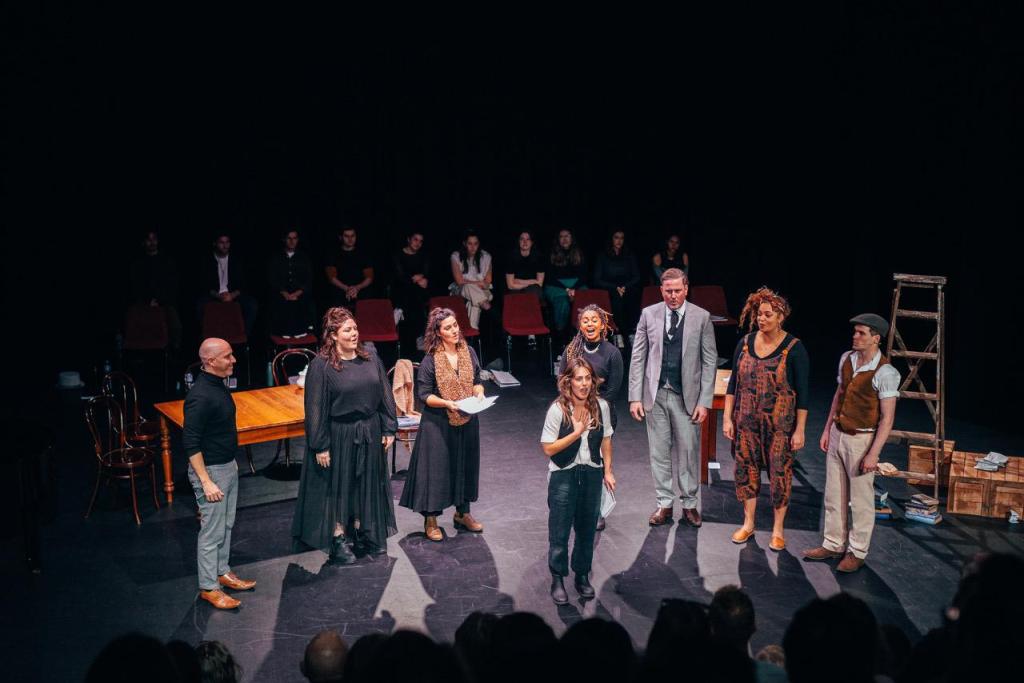
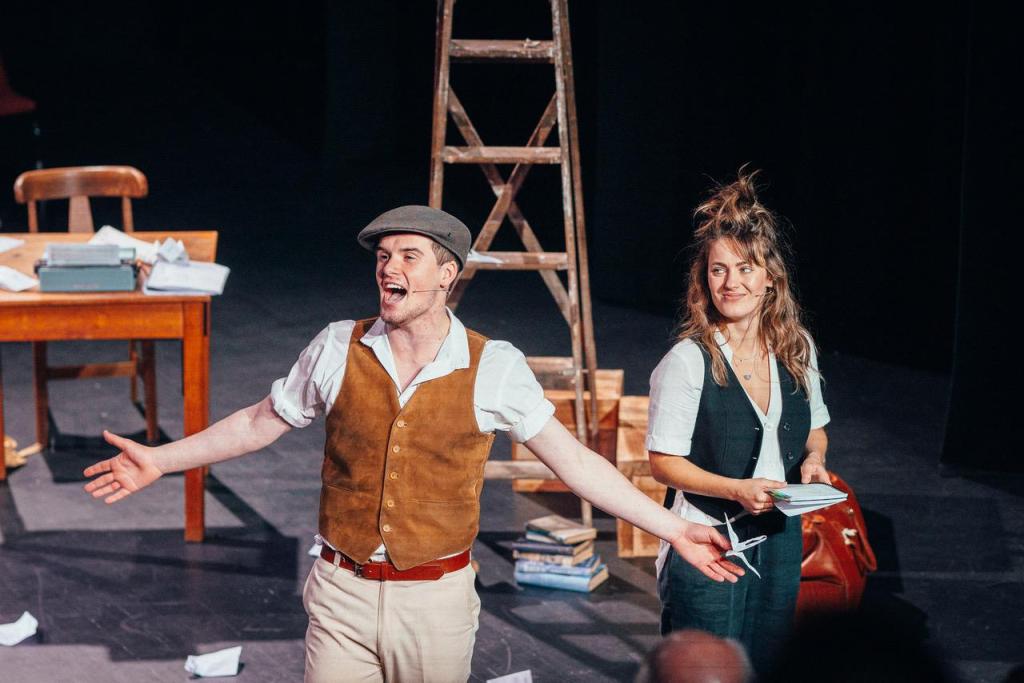
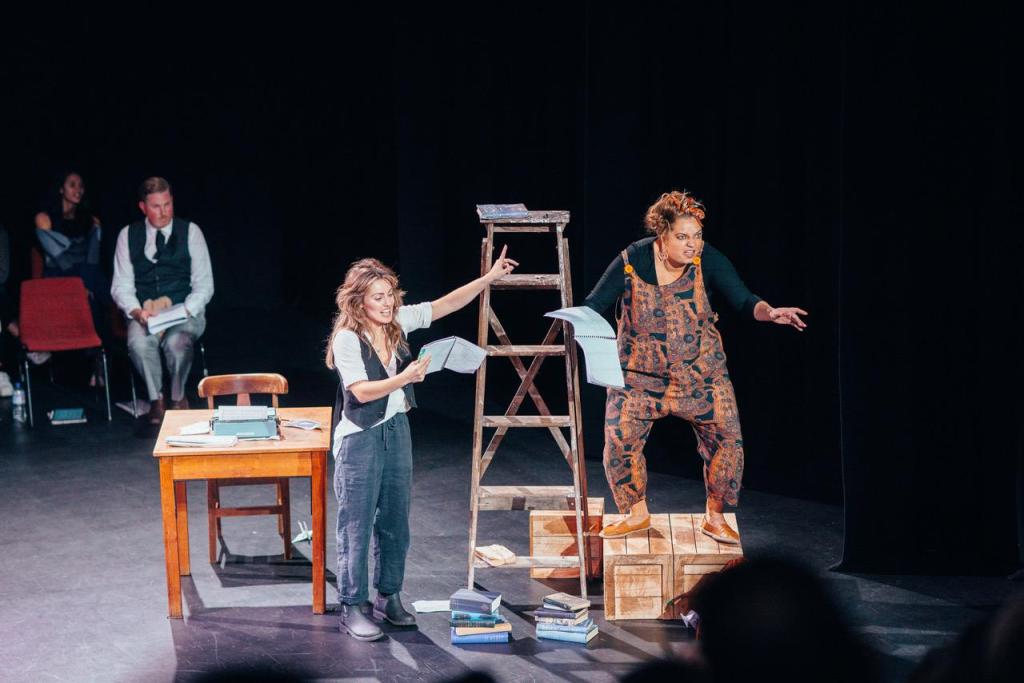
Photo: Cameron Jones

Three years ago, Miranda Middleton, a young writer and theatre director from Australia had the brilliant idea of a theatrical production centered around P.L. Travers and the writing of the Mary Poppins books.  

The initial idea has now crystalized into ‘Paper Stars’, a musical first developed by The Hatch Lab Musical Theatre Residency Program at Salty Theatre in 2021. From there ‘Paper Stars’ was further workshopped at the Victorian College of the Arts, and last May a stage reading was presented at the Australian Musical Theatre Festival in Tasmania. 

By a fluke of circumstances, I got the chance to meet with Miranda Middleton via Zoom and talk about ‘Paper Stars’ and all things P.L. Travers and Mary Poppins. I am sharing here some snippets from our conversation which begins with a predictable question, and one that was despised by P.L. Travers, but one that honestly, we cannot help but ask creators. 

LS: How did you come up with the idea of ‘Paper Stars’? 

MM: I was quite a theatrical child with a big imagination, so naturally I adored the ‘Mary Poppins’ film, even though it made me sob at the end! I was totally devastated by the fact that Mary Poppins had to leave, and I think I carried that grief for the character into my adulthood, as I too lost people in my life that I loved. Then I saw the film ‘Saving Mr. Banks’ and I discovered that in fact P.L. Travers – the author of ‘Mary Poppins’- was Australian.  I couldn’t believe that I didn’t know she was Australian! And this is basically how the idea for ‘Paper Stars’ was born. From there I recruited my playwright friend Grace Chapple to develop the story with me, and she said, “I think it needs to be a musical.” So, then we asked Luke Byrne to write the music and it has just kind of gone from there. 

LS: ‘Paper Stars’ is not a biographical piece, is it? 

MM: I guess we set out to write ‘Paper Stars’ to add to the canon of biographical material about P.L. Travers. We wanted to cover the period of her life when she was creating this magical character so that gave us the period between 1925 and 1935, during which there really isn’t much written about what was going on for her internally. But that was also interesting for us as writers because it meant that we could bring out our own imaginations to the table. I think the way that we describe ‘Paper Stars’ is that there is a HUGE spoon full of creative license in there So…  it is the somewhat true story of how Mary Poppins came to be, but we are not calling it biographical –it is probably more fictional than biographical.  

LS: ‘Paper Stars’ explores the difficult relationship between P.L. Travers and her mother, their painful separation back in Australia, and then also P.L. Travers’s relationship with Madge Burnand. 

MM: Yes, we were very interested in this idea that Pamela was living with a woman in the 1920’s which was controversial and unconventional – it is those qualities about her that we loved. We were also interested in her relationship with her mother because ‘Mary Poppins’ (the first book in the series) is dedicated to her, not to her father, who she purportedly adored. We were just so fascinated by that fact. So, I guess we dreamt into that backstory. 

LS: Another insight that I gained from ‘Paper Stars’ is that P.L. Travers wanted to be taken seriously as a writer and this is the reason why she kept her Australian origins secret. 

MM: Yes – the cultural cringe! It is a big thing for us Australians, we are very cautious and aware of being kind of looked down upon by the mother land or people overseas. 

LS: Back then or now? 

MM: Even now, I think Australians are kind of still conscious of it. 

LS: The songs are quite touching and emotional. I enjoyed all of them, but my favorites are “Great Story” and “Everyday Magic.” 

MM: Luke who wrote all the music is so clever! The emotional impact of the songs and the story on the audience (at the staged presentation in Tasmania) was really touching to me. Lots of people were crying and wanted to stay around afterwards to talk about the show. I’ve received a number of messages since  saying: “I think this is a really important story to tell.” “It really touched me.” Yes, so I was surprised by how emotionally impactful the story was and so, I am excited to take it to the next stage. 

LS: And what happens now, what are the next steps? 

MM: We are in an interesting phase now where we are talking to various venues about its eventual premiere. It is not official yet, but we are hoping that something will happen next year, because 2024 is the centenary of P.L. Travers leaving Australia. We’ll see what the stars have in store! 

LS: Well, I hope the musical goes into production soon and maybe one day I will get to go to Australia too and see it! 

The Adventures of a Witch

AE Exhibition 4

This month’s blogpost is a guest post by Brian McKernan who has a specialist knowledge of George (AE) Russell – the literary mentor of P.L. Travers.

Brian says that although he had heard of AE since the days of his undergraduate Irish history tutorials, no-one seemed to be properly aware AE’s significance during the ‘birth of modern Ireland’ period. Within thirty years of AE’s passing, and across the following half century, AE became largely overlooked and regarded as a minor peripheral figure. Over the last four years Brian has played a central role in creating and developing an AE Group and the ‘AE Festival’ in Lurgan (Northern Ireland) where AE was born. Following the work of McKernan and his associates, the truth of this forgotten genius is once again beginning to be heard.

The group, known as The Lurgan & North Armagh George Russell Festival Society hold their festival in Lurgan each April to mark AE’s birth. The festival, which includes talks, walks, tours, creative workshops, exhibitions, school events and live music, has been developing at pace and aims to place AE back alongside some of the more readily recalled names in Irish history. The AE group have published articles and books on AE, created an active Facebook presence (AE Russell Appreciation Society – Lurgan), and have various local authorities now interested in supporting AE heritage. Plans for the creation of a large ‘AE Centre’ are currently at an early stage.

Brian McKernan’s post:

AE was a great believer in reincarnation and held that the ultimate purpose in life is perfection of the soul. Accordingly, he devoted himself to others, to society, to making the world a better place for everyone. He sought no fame, wealth or recognition for his brilliant talents and constant outpouring of good deeds.

My interest in Pamela Travers resulted from my research on AE. She made barely an appearance in my early studies – the chief AE biographer only giving her a passing mention at the end of his book, as a ‘young poetess who appointed herself his devoted nurse‘ when AE was dying. In hindsight, it is a wonder that I ever discovered the truth that Pamela and AE were immense friends from the time they met, up to his death, and for Pamela – across the following sixty years of her life. I have no doubt that both benefitted greatly from their mutual companionship, and now I sense that their bond is eternal.  As Pamela, a girl from so far away, became AE’s close friend in life, Lina (author of ‘The Mary Poppins Effect’) and I have reunited them in memory through our cross-Atlantic connection.

George William Russell, known simply as AE, was a benevolent genius who dedicated his life and energies to advancing a number of causes, in the main, related to the well-being of the people of Ireland. He did this through the Arts, Politics/Economics, the Co-operative movement, Social Reform, journalism, and his deep beliefs in the connectivity between the inner and outer worlds. And into this mix, in 1925, came a bright and lively young woman, who had more questions than answers, in her search for purpose, identity, love, home and success. AE loved unearthing, promoting and supporting new energetic and vibrant talent. Pamela was right up his street!

She was soon embraced by the Dublin literary scene,  where AE opened doors of opportunity for her both in London and America.  In the words of Pamela, “AE fished up friends for me from his inexhaustible cauldron.” AE understood that Pamela had an interest in mysticism and fairy tales long before she left Australia, so he helped her along the spirtual path and introduced her to the study of the spirit world, theosophy, mythology and Eastern Religions – all of which fascinated Pamela for the rest of her life.

AE liked her poetry and her Irish connection which was not just some romantic childhood fantasy. Her father’s parents were Irish, and he had been schooled in Ireland before eventually going to Australia. Pamela had relatives in Ireland, and she became acquainted with them when she visited AE in Dublin. After AE’s death, Pamela’s associations with Gurdjieff  and his followers can be seen as the continuum of the mystic elements she first explored with AE. 

Pamela was an exceptional person, determined and forthright, creative and intelligent, yet also delicate, unable to heal her childhood wounds, and searching for meaning in her life. AE was greatly impressed by her imagination and her fiercely rebellious nature. She was by no means an empty vessel into which he poured his ideas, but he had answers and directions which from the start helped her to explore and crystallise her core.

She was never his trainee or follower. He helped her. He connected with her. He raised her spirits and she raised his. Pamela admired AE, loved his company, and valued being educated by him. Such a warm and loyal mutuality grew between them that she became AE’s closest companion and comfort during his final days, taking charge of his personal affairs and final letters. She later wrote a beautiful piece about his passing, in ‘The Death of AE: Irish Hero and Mystic’

Pamela  accompanied AE’s remains from England back to Ireland, and was at his side as the mile long procession of mourners walked from AE’s famous office in the heart of Dublin, to his burial place close to 17 Rathgar Avenue where he had lived for thirty years. A little later, grieving deeply, she went back to Ireland and spent six weeks in Donegal, staying where she and AE had holidayed, to absorb what lingered of his spirit there. This was a special coastal place, complete with a fairytale cottage, hidden in a deep wood which overlooked the scenic Marble Hill Strand, where AE loved to paint and write poetry, and where they had been able to be alone together. In ‘The Death of AE: Irish Hero and Mystic’ Pamela offers glimpses of this holiday:

I stayed with him often in his beloved Donegal, at Janie’s-on-the-Hill above Dunfanaghy – a white washed cottage where at night one would hear the cows moving about in their stalls below the attic bedroom and in the daytime Janie churning butter or clanging the lid of the iron cauldron that swung on a chain above the peat fire and in which everything was cooked: bread, meat, cake, soup. … From Janie’s, he would take me with him on his excursions to friends in the neighbourhood or to those parts of woodland or strand that set up in him the strongest vibrations. Was he intentionally educating me, I wondered! No matter: it was being done, with or without intent.

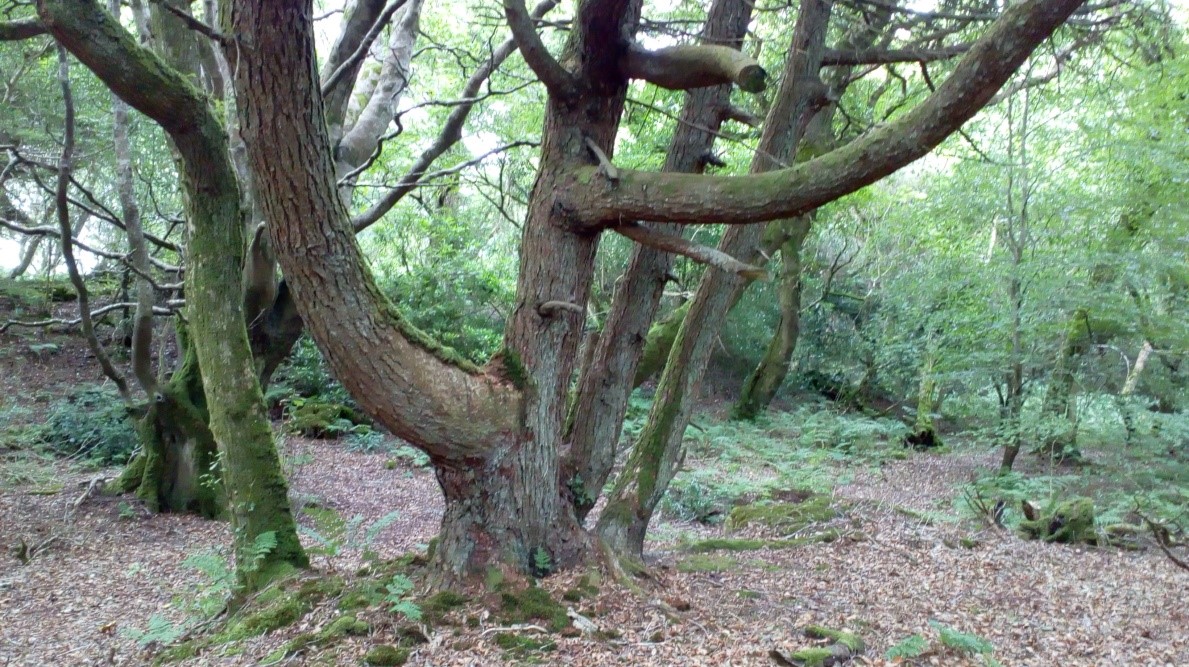
Ninety years later, I went in search of these places, no doubt drawn there by AE’s spiritual gravitation. I found Janie’s farmhouse, fully matching Pamela’s description. I walked through the bog looking for the boots  she had left behind after getting stuck in the mud on a walk with AE, and I climbed up the trees overlooking the strand. I asked at Janie’s for directions to the fairy house but was told that it had been removed after it had fallen into disrepair, and the stone reused elsewhere. Despite this setback, I wanted at least to stand at the site of this sacred oasis where Pamela had soaked up AE’s strongest vibrations following his death. I made my way into the woods to the general area and walked in every direction, stopping and stirring – searching for any clue to its original location. I was drawn to a clearing in the woods with fairytale trees – magically shaped, like no trees I had ever seen before.

Tree near the Fairy House

However far I went, in any direction, I kept returning to this spot, as a fixed point to guide me safely back out of the woods. After a most unsuccessful and tiring hour, I decided to take one last look from where I now stood. I would turn round, one full circle on this spot, and then give up my quest. Halfway round, and looking as carefully and intently as possible, I saw something that seemed to be out of place. It was something ‘blue’. AE’s favourite colour was blue, and this looked like his favourite shade of blue.

As I tried to focus on this through the wiry tangled thicket, what I saw began to resemble a post, perhaps an old direction sign. I pressed slowly forward trying to get closer to the sign, one difficult step after another, trying not to get too badly scraped by thorns. My eyes scanned the tangled mass of branches and briars to the left of the post, and as I neared, things suddenly began to appear which I had not seen from further back. Right in front of me was a metre high wall. I clambered around the post and recognised (from my memory of an old photograph) that the post and the wall were parts of the porch of the Fairy House. I had found  it, on my very last attempt, and as I forced my way closer so much more became clear. The roof had collapsed in on the building and some parts of the walls were missing. Although the forest had worked hard to gobble up this magical abode, I was able to clamber into the large room, examine the crumbling fireplace and peer out through a side window. I was completely alone, but bursting to share my discovery. I thought of AE and Pamela being here and wondered if they had somehow played a part in my finding – could this have been spiritual gravitation at play?

Fairy House

I took photographs of these places and sent some to Lina along with a brief account of my Donegal adventure. We exchanged a series of emails, back and forth between Canada and Ireland, in which we shared our knowledge of Pamela, the Mary Poppins books and AE . I found myself seeing more and more of AE and his connection with Pamela in the Mary Poppins books.

Although AE spent much of his time writing thousands of serious journalistic articles about society, political turmoil and economic issues, it is practically impossible to find one complete piece which is not warmly wrapped in a blanket of spiritual wonder and mystical magic. He was tremendously imaginative and creative, and whimsical beyond compare, and exceptionally witty.

Myriad hidden spiritual thoughts, talking objects, life within pictures and a oneness with nature, flowed effortlessly and constantly from his mind. AE helped Pamela to explore unknown possibilities and imaginations primarily in conversation across the ten years friendship which saw her become a highly respected writer. They also wrote numerous letters back and forth across the Irish Sea when they were not together.

In early 1932 AE suggested in a letter that she should write a fantastic tale about a young witch.

When you go to your Cottage drop me a postcard with the address of that abode of the vulture witch with her broomstick. It would be rather a nice subject for a fantastic tale of a young witch who found that by white magic the broomstick would fly as well as by the black art & she went here and there doing good deeds or looking at loveliness & wonders. So think over a tale which would use all your powers of fantasy ‘The Adventures of a Witch’ and it may be the idea for letting you say all you want to say.

I see so much of AE and Pamela in the characters of Bert and Mary Poppins. From their first outing in a short 1926 story, in which Mary is a young and inexperienced nanny and where the magic emanates from Bert the Matchman, to the end of the second Mary Poppins book, when Mary has transformed into an older, wiser, and self-assured magical figure, I see how Pamela herself had grown aided by her great friend AE. At the close of Mary Poppins Comes Back, completed shortly after AE’s death, Pamela creates a personal element of closure between herself and AE. In 1926, in the story Mary Poppins and the Match-Man and then in 1934 in the story The Day Out, they rode the Merry-go round together, she on a black horse and AE on a white one, but then in 1935, with him gone, Pamela (Mary Poppins)  rides alone on a dappled horse, possibly symbolising a shared spiritual unity. The text includes utterances denoting finality – ‘Never again! Never again!’ .. ‘If only we could have gone on forever!‘ .. Mary gazes down at the children – ‘Her eyes were strangely soft and gentle in the gathering dusk‘ (AE’s favourite time of day) and says for the second time that day ‘All good things come to an end.

Mary Poppins chooses a return ticket (which is a strange option for such a ride, but may well relate to AE’s deep belief in reincarnation) thoughtfully saying ‘You never know’. The Merry-go-round spins and rises up beyond the trees and soon a new star appears in the night sky. Could this new star be her AE? On the final page Pamela writes –‘And high above them the great shape circled and wheeled through the darkening sky, shining and keeping its secret for ever and ever and ever…

On one occasion, Lina asked me if I had any thoughts on who Pamela could have been referring to when she dedicated Mary Poppins Comes Back ‘To PIP This Keepsake’. I immediately swung into action, thinking this would be a nice puzzle to try solving. I noticed that Pamela had also written ‘P-p! P-p!‘ to describe the sound  made by  Mr Bank’s pipe and I was drawn to the similarity between ‘PIP’, pipe, and P-p. As AE was very much on Pamela’s mind during the writing and completion of the book I wondered if this could all relate to AE. I factored in my belief that Pamela used to refer to AE as ‘the matchman’ due to him constantly leaving a trail or puddle of spent matchsticks wherever he went or sat. This messy habit was common knowledge to all who knew him, and he even had to have a special supply of matches arranged in advance of going on holiday to an isolated location. AE was never without his pipe, and I suppose his two most noticeable features were always his marvellous beard and the pipe. Then I remembered how Pamela had been the one who had sorted through AE’s belongings after he died, and thought that the best keepsake she could possibly have would be his pipe, as I believe he had taken his beard with him to the grave. I think the answer lies within these thoughts and would love to ask Pamela if that is correct. Of course, I could not ask her, so instead I asked Lina, who appreciated my imaginative proposition.

Perhaps a light sprinkle of AE  and Pamela’s magical stardust helped me to discover the connection between them, and find my way to Lina’s blog. But if so, it may not be the first time this magic has come my way. Considering how I only really came across Pamela Travers through my uncommonly rigorous approach to studying AE’s life, I have recently discovered my own personal connection with her, which also links to AE. Remembering how  says, ‘Your own will come to you‘, I must tell you – the first poem AE published by Pamela was titled Christopher, and my son, named Christopher, was born on the very day  Pamela died – 23rd April 1996.

Mary Poppins in the Publishing World

In the early 1930s, a magical nanny popped into the mind of a writer who had just taken up residence in Pound Cottage outside of Mayfield, East Sussex. That writer was Pamela L. Travers and the nanny, Mary Poppins. In her mid-thirties at the time, Pamela was struggling with a respiratory illness coupled with severe anxiety. She had chosen the secluded life in the countryside, following her doctor’s prescription, to avoid London’s smoggy air.

Pound Cottage was not just any cottage. It was a small, medieval, timber-framed construction, thickly glazed with mortar, and lidded with a large, sloping thatched roof. The tiny windows and narrow front door accentuating the whimsical aspect of the cottage. In other words, it was the perfect birthplace for a fairy tale. 

Pound Cottage, just out of Mayfield, might have been the home of the wicked fairy in “Hansel and Gretel,” or Farmer Hoggett and his sweet pig, Babe. …. the cottage looked as though a romantic heroine like Giselle might step through its rustic door to dance among the roses in the garden…..

Mary Poppins She Wrote, Valerie Lawson

Poud Cottage

Picture from the Archive of P.L. Travers and Mary Shepard at Cotsen Children’s Library.

Here is a description of Pound Cottage given by Pamela herself when she was asked where she had written Mary Poppins:

In the country, in a very old house, that was older than William the Conqueror. It was built before 1066, and we know that because William the Conqueror made lists of all the houses that were in England when he arrived, and this house was on that list. It’s called the Doomsday Book.  It’s still there. (…) It was bought by an anthropologist who was very interested in very old things. Maybe he will preserve it and give it to the nation one day. I don’t know.

Pamela L. Travers, Library of Congress Performance. Interview. 1966-11-01. Visit with P.L. Travers, Author of the Mary Poppins stories

One wonders, could the bucolic backdrop and the history infused cottage have been part of the necessary ingredients for Pamela to conjure a character such as Mary Poppins into our world? Or, was it Mary Poppins who summoned Pamela instead? Who can tell? Although, according to Pamela, the latter hypothesis is the correct answer to these questions:

I didn’t even think her up. She just brushed past me and said, ‘You take it down.’ The late Hendrik van Loon, who used to take me out to lunch and draw elephants for me, had the right idea. ‘How you happened to think of Mary Poppins doesn’t interest me,’ he said. ‘What interests me is how Mary Poppins happened to think of you.’  

Mary Poppins by Geoffrey T. Hellman, The New Yorker, October 12, 1962

Be it one way or the other, magic did happen in that small medieval cottage. The proof is that since Mary Poppins was first published in 1934, the stories have never been out of print. By 1965, Mary Poppins was translated into seventeen languages, and in 1968, even a Latin translation of Mary Poppins from A to Z was added to the list of translations. Since then, many more editions were published all over the world demonstrating the everlasting interest of the pubic in this fictional character.

Obviously, I was curious to learn about today’s publishing process of a children’s classic like Mary Poppins. Luck was on my side and I am excited to share with the readers of this blog that Ms. Bethany Vinhateiro, the Mary Poppins editor at Houghton Mifflin Harcourt (HMH), kindly accepted to answer a few questions about HMH’s publishing program of the Mary Poppins books in North America. So, without further ado, I lift the curtain and offer you a glimpse of Mary Poppins in the publishing world:

LS: What motivated HMH’s decision to publish a new edition of the Mary Poppins books?

BV: The Mary Poppins series is one of our most prized backlist properties and we tend to it regularly, republishing around major anniversaries and other events, like the debut of the stage show and film adaptations. Our most recent crop of books, new editions of the original by P. L. Travers and movie tie-in editions from Disney’s Mary Poppins Returns, were timed for the excitement around the 2018 film.

mary poppins box set

LS: Was the Estate of P.L. Travers involved in the decision?

BV: We work closely with the Travers estate on all of our Poppins publishing. HMH, along with the Estate, feel a responsibility to try to do for her character and work as Travers would have done herself.

LS: Has HMH noticed an increase of interest from the readers in the original Mary Poppins stories?

BV: As with any cultural event like a film adaptation, the source material sees renewed interest from readers. Though Mary Poppins was already a classic and one that sells perennially, our previously published editions of Mary Poppins saw an increase in sales around the film. The increased awareness was an exciting opportunity to get the original story into the hands of new readers, and to bring out a beautiful collector’s edition and a first-ever picture book edition which could be enjoyed by people who may have already loved the story in another format. It’s been wonderful to see the enthusiasm for the original books that inspired the films.

mary popins collector edition

LS:  Do you know how many editions of the Mary Poppins books have been published since the first book came out in 1934?

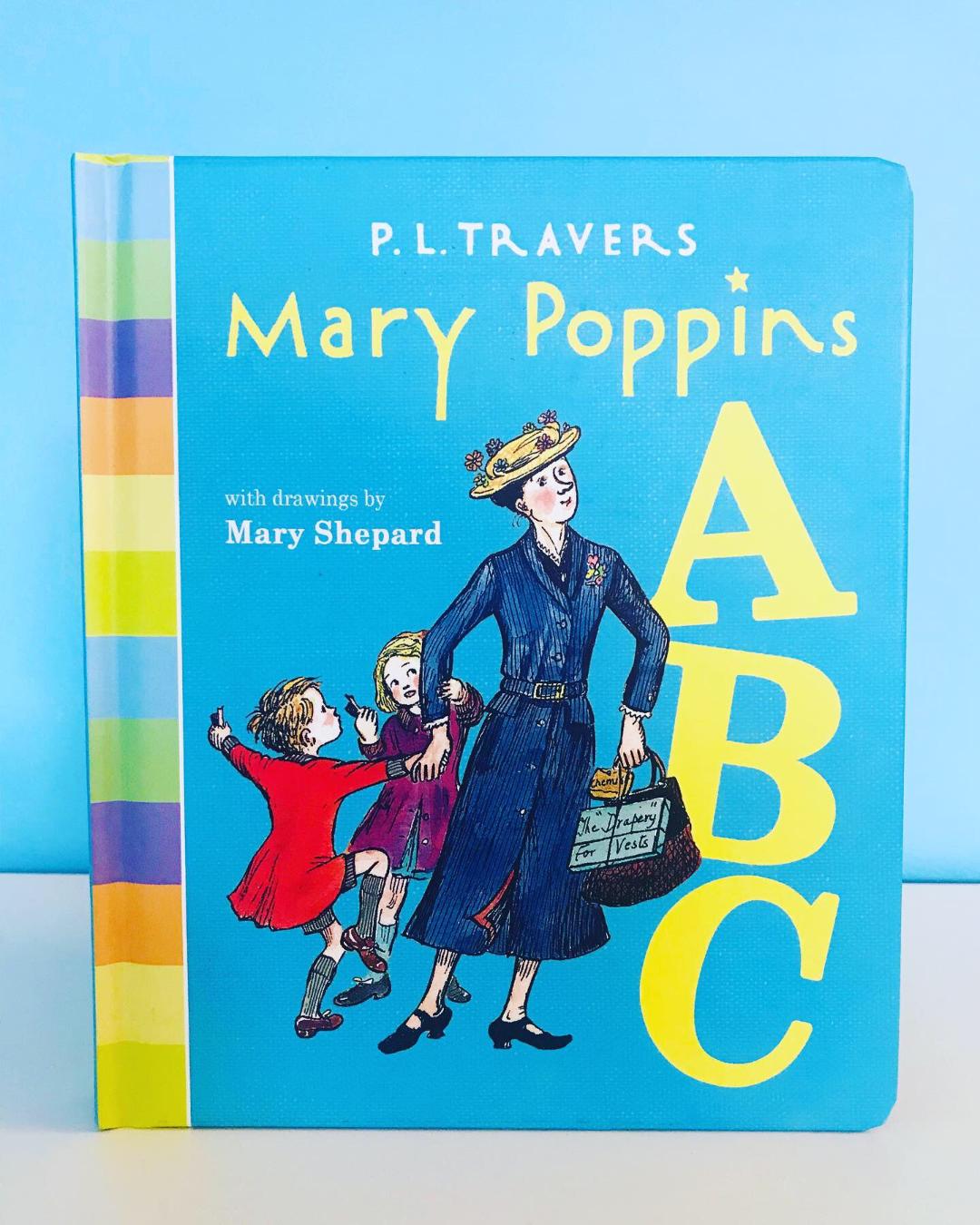
BV: There have been many editions of the original novels published over the years. We currently offer them in hardcover and paperback, a paperback boxed set, and a hardcover collection. Travers’ novellas Mary Poppins in the Kitchen and Mary Poppins from A-Z are also in print. New in 2018 are the Mary Poppins ABC board book adapted from the A-Z book, the Illustrated Gift Edition of Mary Poppins and the Mary Poppins Picture Book. 

mary poppins abc

LS: Is Houghton Mifflin Harcourt the only authorised publisher of the Mary Poppins books? 

BV: HMH holds publishing rights to Mary Poppins in North America, with other publishers publishing the books around the world.

Now, I hope you enjoyed this post and come back to read more about the original book Mary Poppins From A to Z and the new adaptation for the very young readers, Mary Poppins ABC which will be the subject of the next post on this blog. If you liked this blog post, I invite you to read about my meeting with the illustrator of the very first Mary Poppins Picture Book:  Meeting Geneviève Godbout, the Illustrator of the New Mary Poppins Picture Book.

Meeting Geneviève Godbout, the Illustrator of the New Mary Poppins Picture Book

Chapter 1

Jane and Michael could see that the newcomer had shiny black hair – “Rather like a wooden Dutch doll” whispered Jane. And that she was thin, with large feet and hands, and small, rather peering blue eyes.

Pamela L. Travers, Mary Poppins

Mary Poppins’s magic bends and spins reality as a pastry chef twists dough into pretzels. The delicious adventures on which Mary Poppins embarks the Banks children are marvelous treats for the imagination of young readers not yet familiar with the laws of gravity and conventional social norms. Since Pamela L. Travers first channelled Mary on the pages of her book in 1934, Mary continues to come and go through the gates of time and space and into our world in an attempt to expand our minds and connect us to our most potent human feature, our imagination.

In 2015, Houghton Mifflin Harcourt (HMH) published a new edition of the first four Mary Poppins books.

MPoppins_OpenstheDoor


MPoppins_Park


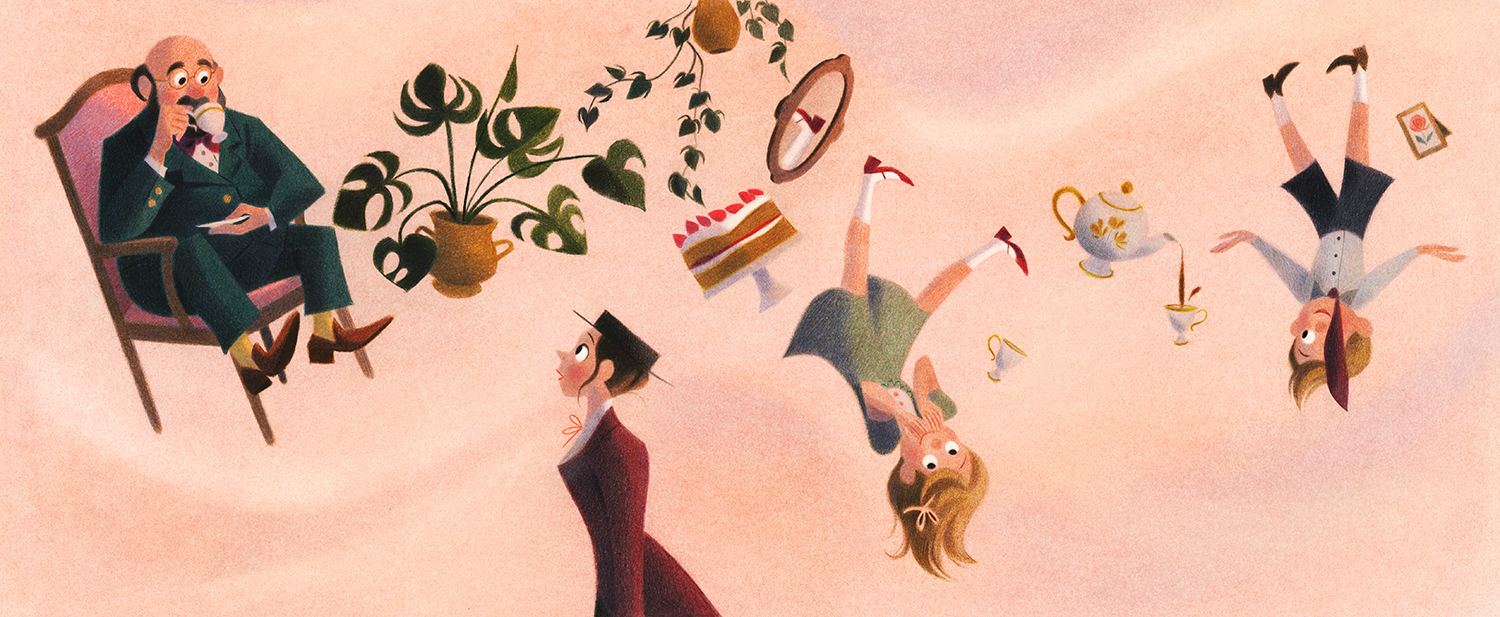
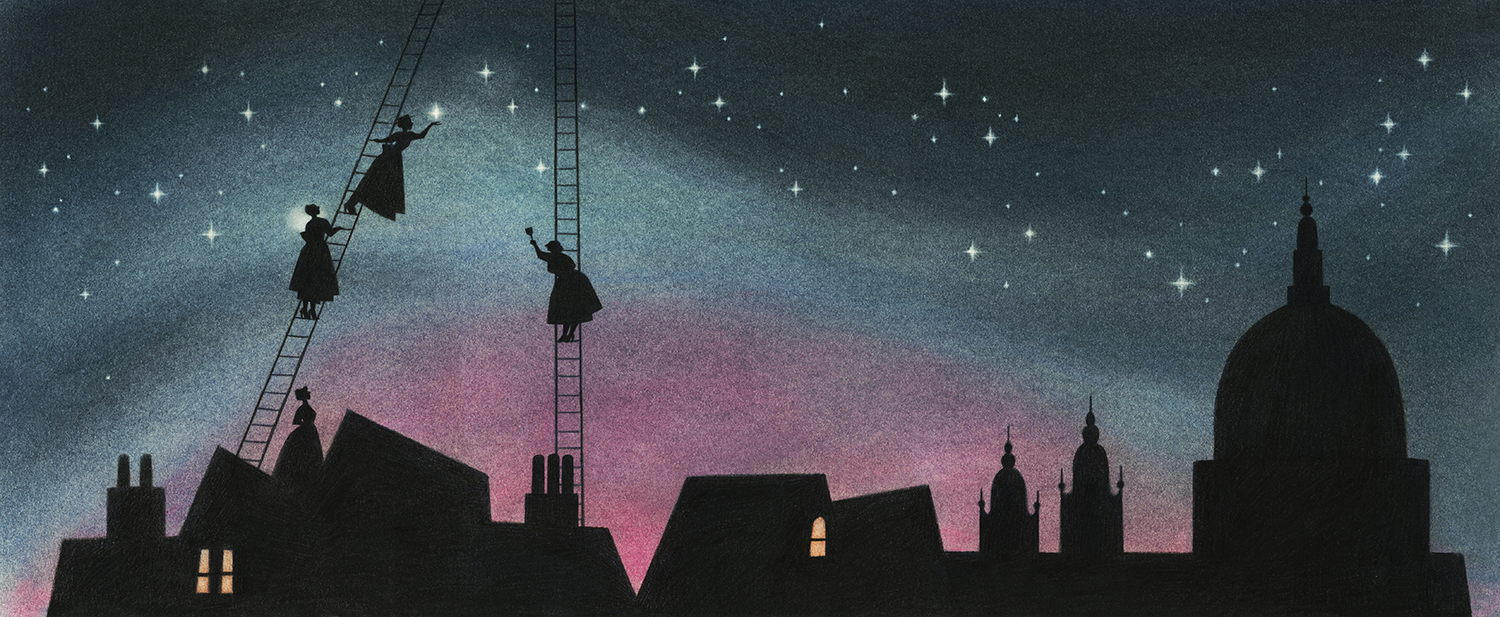
Then in October 2018, in the anticipation of the release of the movie Mary Poppins Returns, HMH published the first ever Mary Poppins picture book destined for the very young readers. A cheerful Mary Poppins with big, almond shaped eyes, red cheeks, and an explicitly playful attitude appears on the pages of the picture book. The illustrator of this fresh vision of Mary Poppins is Genevieve Godbout, who is also an author of children’s picture books.

MP_cover-template-01-FINAL-color

I met Godbout for the first time in October 2018 at a Mary Poppins tea party, an organised promotional event for the launch of the Mary Poppins picture book. The invitation came unexpectedly from a friend who knew about my fascination with Mary Poppins and Pamela L. Travers.  

The tea party took place in a charming little bookstore in the style of the Shop Around the Corner in the movie You’ve Got Mail.  I don’t know if you have seen this romantic comedy with Meg Ryan and Tom Hanks, but there is a scene where Kate (Meg Ryan), with a princess hat on her head, reads a picture book in her bookstore to a crowd of small kids gathered at her feet (by the way, this is one of my favorite scenes in the movie).  So, there I was in real life, standing amongst small children, magic wands and sparkling tiaras, the tallest kid in the crowd waiting for the reading of the Mary Poppins picture book to begin. A door in the back of the room opened and Mary Poppins walked in followed by a friend who she introduced to the audience as being the illustrator of the Mary Poppins picture book, Godbout.

Mary Poppins Tea Party

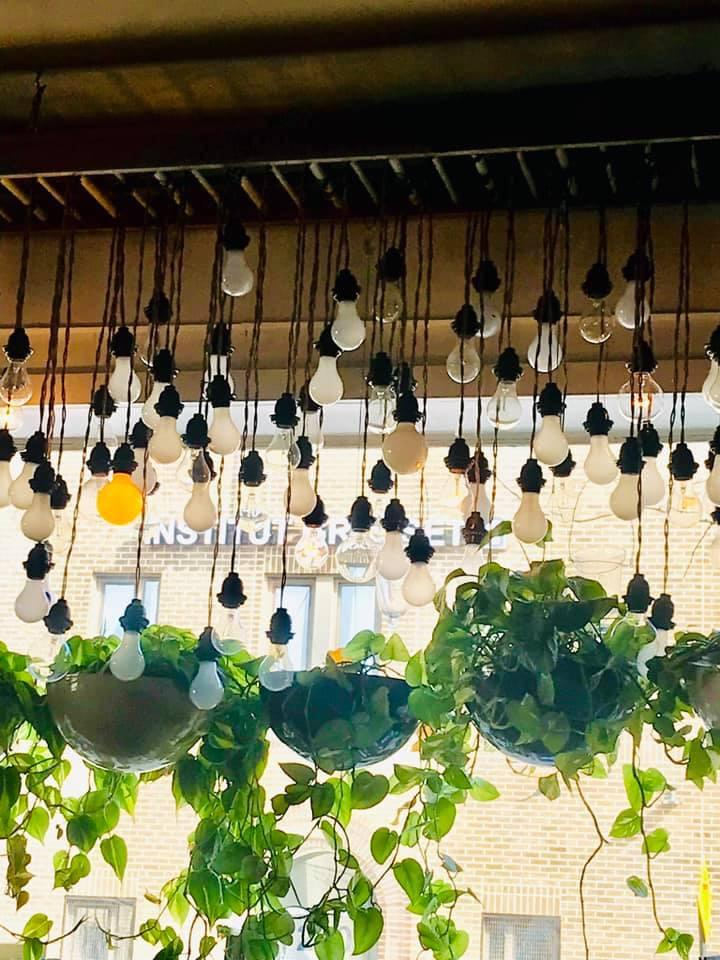
A few months later I met Godbout in a small coffeeshop where green plants and various lightbulbs were swaying from the ceiling, sharing the available window space and demonstrating the bohemian allegiance of the establishment. In this artsy atmosphere we talked for more than an hour, between bites of the most delicious blueberry scones, about Godbout’s creative process of illustrating the famous character of Mary Poppins.

Arts Cafe 1

Art Cafe 2

Art Cafe 3

Godbout explained that before illustrating the Mary Poppins picture book she worked on the illustrations of the covers of the first four Mary Poppins books published by HMH in 2015. For this project HMH provided precise guidelines for the elements that needed to be incorporated into the images on the book covers. The choice of colors and style of drawings were left to the illustrator. However, the publisher’s instructions were clear, the goal was to modernise the look of Mary Poppins and make her visually attractive for today’s young readership. Godbout submitted her sketches along with other illustrators and was chosen by HMH to complete the project.

Interestingly, the 2015 edition of the first four Mary Poppins books still contains the original illustrations by Mary Shepard; a fact that rendered Godbout slightly anxious at the beginning of the project. She candidly confided in being intimidated by the task of illustrating the book covers of a classic children’s book that came with its original illustrations. In contrast, at that same time, she was working on another picture book about another famous character, Anne of Green Gables. The difference between these two projects was that the original novel of Anne of Green Gables had no illustrations. There was nothing to compete and compare with. But once the initial self-doubt so familiar to artists was overcome, Godbout materialized a beautiful pastel colored vision of Mary Poppins.

Her successful illustrations of the book covers in 2015 led HMH to contact her in 2017 and ask her to retell in images the Mary Poppins story in a picture book destined to initiate small kids to the fantastic adventures of Mary Poppins.  

The pastel and colored pencil drawings of Godbout’s Mary Poppins are largely inspired by Julie Andrew’s interpretation of Mary Poppins because as it happened, Godbout fell under the spell of Disney’s Mary Poppins when she was a child.

Mary Poppins Laughing Gas

MaryPoppins_HC_INT_Dummyv2-12

MaryPoppins_HC_INT_Dummyv2-13

MaryPoppins_HC_INT_Dummyv2-16

Because Godbout didn’t want to immerse herself in the original illustrations by Mary Shepard to avoid any influence on her own work, she didn’t read the original stories at the time she illustrated the book covers in 2015. She only recently started reading the books, and as many who are not familiar with the original artwork, she admitted being flabbergasted by the immense gap between the movie and the books. Godbout accurately assesses the situation: “Mary Poppins has a double personality.”  

Serendipitously enough, Godbout, without knowing it, already had connections to the Mary Poppins world even before she became a full-time freelance illustrator and author of picture books.

At the beginning of her career, Godbout made illustrations for Disney commercial products and a big part of her work involved the character of Winnie-the-Pooh. Godbout was pleasantly surprised to learn that Mary Shepard, the illustrator of Mary Poppins chosen by P.L. Travers, was the daughter of Ernest Howard Shepard, the illustrator of Winnie-the-Pooh. And what was Godbout’s last assignment before making the leap towards an independent artistic career? Mary Poppins of course!

Mary Poppins has undoubtedly kept Godbout busy with book readings and signing events in bookstores in Montreal and recently at the Walt Disney Family Museum in San Francisco, where she talked about her illustrations and answered kid-friendly questions from the audience. However, Godbout has also other projects on the go. She recently published, here in Quebec, her first authored picture book titled Malou, which tells the story of a little kangaroo who loses its hop. The picture book will soon be published in France, and in the spring of 2020, it will also be published in the rest of Canada and in the United States under the title What’s Up, Maloo? And, that is not all! Godbout is currently in the process of completing a picture book illustrating a poem about gratitude titled Apple Cake. As for me, I am grateful to Ms. Godbout for taking the time to discuss her illustrations of Mary Poppins, and I sincerely hope that her drawings will bring new readers to the original books of P.L. Travers!

Corresponding with a Friend of Pamela L. Travers

Mary Poppins Anything Can Happen If You Let It

Last November marked the end of the second year of my blog project. The Mary Poppins Effect is now officially two years old and what started as a part-time hobby has now become an all-consuming fascination with the inner world of Pamela L. Travers and her Mary Poppins. Now, after spending two years with Mrs. Travers, I am giving myself the permission, at least for this blogpost, to call her simply Pamela.

One of Pamela’s friends, author Jenny Koralek, wrote about the character of Mary Poppins “…that as far as this so-called nanny is concerned “Appearances are Deceptive,” well, I dare say, the same conclusion can be drawn about Pamela herself.

She seems to have led quite an unconventional life, but unfortunately, the unusual aspects of her personal life are presented to the public in a rather narrow-minded way. However, her complex, rebellious nature deserves to be examined in a more compassionate manner.

Obviously, I would have loved to meet Pamela, but since that wish will remain just that, a wish, I consoled myself for the last two years with her writings. However, at one point it simply became imperative for me to reach out to someone who knew her well. So, after some hesitation, I mustered up my courage and a wrote a long email to British author Brian Sibley. I wanted to get closer to Pamela with the hope of gaining some new insights, and Brian Sibley is, in my opinion, one of the rare people who seemed, judging by the interviews I saw, to have had an enormous respect for her. What’s more, in the 1980s, Brian Sibley and Pamela worked together on a sequel to the Mary Poppins movie (unfortunately, that project never came to be).

You can imagine my exhilaration when I saw Brian Sibley’s name pop up in my inbox!

In my correspondence to him, I expressed the concern that people who have documented Pamela’s life, be it in a book or on screen, seem to have completely misunderstood her and simply labelled her as being an eccentric person. Brian Sibley responded quite wisely that even if my assertion was true, the fact is that “Of course, few of them knew her… Indeed, few of us who thought we knew her, truly did...”

And, this is exactly what is so upsetting and at the same time so fascinating about Pamela. Who was she? She was so self-contained and yet her vessel was so deep. Luckily, her writings remain and, as she said on many occasions, if one wants to learn about a writer one must study the writings. Only she did her best to cover her tracks.

I wanted to know what it was to be a friend of Pamela; especially when her friends and acquaintances who were interviewed for different documentaries seem to agree that she was not an easy person to be friends with. Even Brian Sibley mentioned in an interview that Pamela was a “demanding friend.” But she had great wisdom and great knowledge of so many things: literature, life, love, faith. She was prickly and difficult at times. But she was also someone of a towering intellect whose friendship I really valued.”  I asked Brian Sibley if he could share an anecdote or two to illustrate the nature of her expectations in a friendship relationship? This is what he generously accepted to reveal:

 B.S.     I guess I mean that she expected you to be the one who did all the running in the relationship and she could be prickly, or act ‘hurt,’ even with people she knew well if they said or did something that displeased her. I remember getting a note after I had not turned up for afternoon tea, following what had been a vague and unconfirmed invitation. The note said, in words to this effect: “For some reason, I had taken it into my head that you were coming for tea yesterday. If I were mistaken, I apologise.” The implication, of course, was that I needed to apologise!  There was always a sense in which you were ‘courting’ her… Also, although she made much of only being a ‘conduit’ for her writings, she was vain enough (like Mary Poppins) to enjoy praise even as she brushed it aside.

This last comment reminded me of what Jenny Koralek wrote about the character of Mary Poppins:

 Brusque as well as brisk, unbending, a “snappy dresser,” extremely vain, with absolutely no sense of humor and easily offended, she never “tells anyone anything” and is a convincing incarnation of the author’s deep understanding that not answering, not explaining leaves the possibility of going further.

I can’t help it but think that there is a lot more of Pamela in Mary Poppins than Pamela ever wanted to admit.

Difficult as she might have been, Brian Sibley was a true friend.

B.S.     Her friends – her real friends – were amused by and tolerated her eccentricities; others could find her overbearing, apt to play the grande dame. Despite these occasional irritants, I loved her and only now realise how privileged I was to spend so much time with her and just how many opportunities I missed to ask the right questions – to discover, as she might have said, “What the Bee Knows.”

Well, maybe Brian Sibley didn’t ask her the right questions (and even if he did, who knows if she would have answered), but he must have done something right because one thing is certain: Pamela liked him. Or why would she introduce him to her family? From what I have learned about her, she was an extremely private and secretive person.

B.S.     There was one very curious afternoon when I was invited to tea and turned up only to find Camillus (Pamela’s adopted son), his wife, and their children all present. In fact, the wife opened the front door to me: I was taken aback and made apologies and tried to excuse myself. But, “No,” I was told Pamela is expecting you.” I then realised that she had engineered the meeting for some reason of her own…

Well, the reason is obvious isn’t it? She wanted to let him in her inner circle, and this peculiar and clumsy way of doing it could be suggestive of her fear of rejection. It seems to me that she simply didn’t leave him the chance to refuse the invitation. I suspect that in general intimacy must have been a challenge for Pamela.

When I asked Brian Sibley if Pamela talked about Gurdjieff’s Work and her spiritual beliefs or spiritual work, he responded that their conversations were mostly about story, myth, and poetry.

B.S. She talked a lot about the Irish poets: Yeats, of course, and her beloved ‘AE’ and James Stephens (author of The Crock of Gold and 19 years Travers’ senior) who, she once told me in a uncharacteristically candid moment, had made an unwanted romantic overture to her. I asked her how she handled it and she replied: “I simply told him that the fragility of my youth would be crushed beneath the weight of his talent and intellect.”   

This memory reveals a quick-witted and funny Pamela and the response is definitely not something Mary Poppins would have said. Of course, intertwined as they may be, Pamela and Mary Poppins are two different characters.

Mary Poppins feels at home wherever she is. But, when in a recorded conversation with Pamela, Brian Sibley asked her where her true home is, she said that she would like to be able to answer just as Mary Poppins, but that she hadn’t achieved that yet!

This caused me to ask Brian Sibley if he would say that Pamela was a happy person.

B.S      Ah! Were you to have asked her that question, I suspect, you would have been given a lecture on unanswerable questions! I think she was ‘content’ which is not quite the same thing...

And indeed, it is not the same thing…

I am infinitely grateful to Brian Sibley for these lovely anecdotes and for making me feel a little closer to Pamela. Needless to say, my mind is now fired up with more questions to which I must find the answers.

Conversation with Olga Mäeots, the Russian Translator of P.L. Travers’s Moscow Excursion

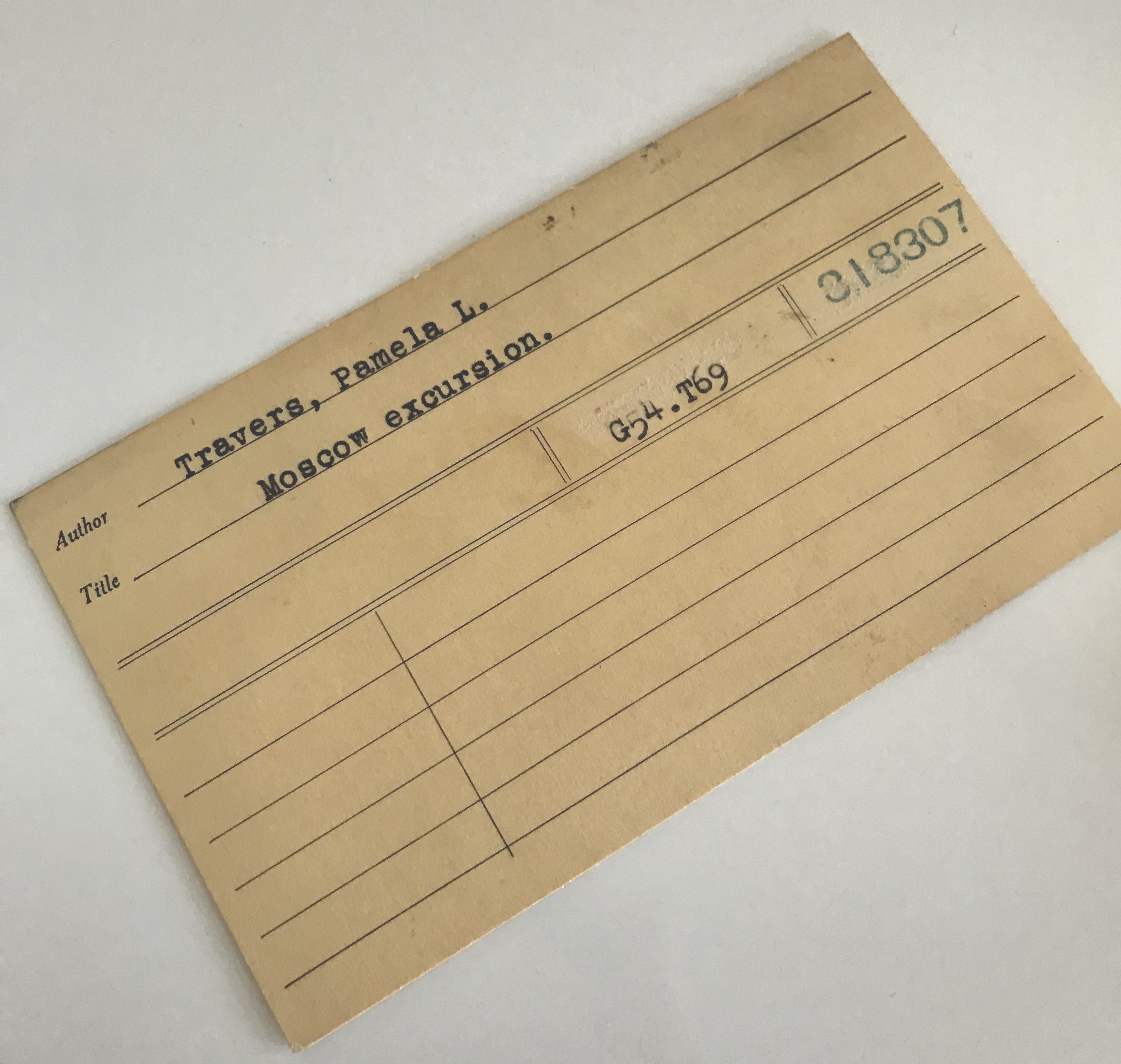
Moscow Excursion Pamela L. Travers

Do you know Mary Poppins? Not the Disney character, but the magical nanny originally created by the Australian born author Pamela L. Travers? Probably not. And, most of you probably don’t know much about the life of Pamela L. Travers and her literary work unless, of course, you have seen Disney’s Saving Mr. Banks; and in that case, your perception of Pamela L. Travers has been, for entertaining purposes, distorted.

The publication of Pamela L. Travers’s first biography, Mary Poppins, She Wrote, by Valerie Lawson (first published in Australia in 1999) rekindled the interest in both Mary Poppins and Pamela L. Travers. It inspired the screen writers of Saving Mr. Banks, and the making of two documentaries: The Secret Life of Mary Poppins and The Shadow of Mary Poppins. And, Mary Poppins, She Wrote still continues to make ripples in the awareness of its readers. One such recent ripple is the rediscovery of Pamela L. Travers’s first book, Moscow Excursion, by the Russian librarian and translator Olga Mäeots.

Moscow Excursion was first published in 1934, a few months prior to Pamela L. Travers’s first Mary Poppins book, and it consisted of a collection of letters recording the author’s visit to Stalin’s Russia in the autumn of 1932. However, in her letters Pamela L. Travers obscured the identities of the people she met during her travel and only designated them by the letters A, M, T, Z, V. Olga Mäeots, a true fan of Mary Poppins and Pamela L. Travers succeeded, after many years of research, to identify some of these characters and to shed light on some important historical data. The translated and annotated Russian edition of Moscow Excursion was published in Russia in 2016 and was very well received by the public. 

Olga Mäeots agreed to answer a few questions about her experience of translating and commenting Moscow Excursion for the benefit of the English-speaking readership.  

LS: Not many people know about Pamela L. Travers’s first book Moscow Excursion. How did you discover it? 

OM: Many years ago, I was writing an article about Pamela L. Travers and saw this title in her bibliography. Of course, I got curious: it was PLT’s first book and she wrote about Moscow! I kept this fact in mind for some years and finally found the book, read it, and realized that it is full of enigmas.

LS: Indeed, at the very beginning of the book, Pamela L. Travers tells the reader that all the characters are “synthesized personages” and that she had given them fictitious initials for names throughout the book.” What made you doubt her statement?

OM: To translate a book, a translator needs to understand what the author has been writing about. Very often I had to stop and check myself to see whether I understand the text adequately or not. There are so many strange details and remarks that could be considered as exaggeration or a caricature, but finally it became obvious that PLT was very precise in her descriptions; one just has to find the facts that matched them. It was so with the description of a film British tourists were shown on their way to Russia. And with horseshoes in a palace, in the office of Tsar Nikolai, and with a cemetery in Leningrad. If these details were real, the people should be real, too. Historical facts I have learned helped me to check my translation and proved its adequacy.

LS: What motivated your decision to translate the book in Russian and did you decide to investigate these hidden identities right from the start?

OM: Moscow Excursion is an interesting well-written book and I wanted other people to read it  as historical evidence, and as talented fiction. I was not going to make any research at first. Research starts as a part of the translation process and the evidence I had found made me understand how little I knew – about PLT, about that period in history. (Cultural relations between the Soviet Union and the rest of the world in the 1930-ies still needs research. In Soviet Union, there are only friendly, positive memoirs, for example, G.B. Shaw’s or Romain Rolland’s which were published during Soviet times when books got official approval – critics were never mentioned.) 

LS: How much time did it take you to complete your investigations? And are they really completed? 

OM: The project is not completed as new data appears from time to time. It took me about 5-6 years to translate and make commentary. 

LS: I understand that your translation of Pamela L. Travers’s book was very well received by the Russian readers. To what do you attribute this success? 

OM: In the post-Soviet times, we have become aware that we know not all, we do not know enough about our history, and that new evidence is important. Also, a foreign view is always intriguing. I was afraid that PLT’s critical position would arise indignation of Russian readers but it never happened. First of all, she is protected by her popularity as a famous and beloved children’s author. Secondly, the book brings new interesting facts about our nearest past. And finally, what is more important for me, the reception of the book proves that Russian society is not any more unanimous in its opinions as it was in Soviet times. So, every reader could find something positive in PLT’s book to balance the blow on one’s patriotic feelings. Religious people approve of her remarks on the neglected state of churches; theater goers are interested in her theatrical impressions; anti-communists are happy with her critics of Bolshevism, and so on. Anyhow, my task in the commentary was to help readers realize that PLT was an interested traveler, though she was disappointed to a considerable extent. 

LS: What do you think is the value for the Western world of all the information you have uncovered? 

OM: First of all, the facts I have found contribute a lot to the portrait of the famous writer and present an almost unknown period in her biography; a period that was crucial for the shaping of her views, and her attitude to the contemporary world. But what is more important, PLT’s book proves to be an important evidence about the state of minds in the1930s. The book returns us (to a considerable extent due to my research and commentary) to many forgotten names (or supply new evidence about them) such as Hubert Butler or Herbert Marshall and cultural events which are important for our understanding of the epoch. The Russian-Soviet theme seems to be very inspiring at that time.

I hope that the book, with my commentary, will be published some day in some English-speaking countries. I don’t cherish any vanity hopes but am sure that it will be an interesting and important reading. 

Hopefully, Olga Mäoets’s dream will soon come true.