Dear Reader,
Have you ever wished you could time travel? I have, many times, since I first began my journey into the world of P. L. Travers and her Mary Poppins. At first, I dreamed of having tea with P. L. Travers in her townhouse in Chelsea, London, and talking about all things Mary Poppins. But as time went on and I delved deeper into her universe, I began to dream of a particular kind of time travel; time travel under a cloak of invisibility.
I would love to witness the events of her life firsthand instead of relying on the filtered perceptions of those who knew (or thought they knew) her. Just think how enlightening it would be, for example, to observe her interactions with her spiritual teacher, G. I. Gurdjieff, who, by the way, was a fascinating figure in his own right. Imagine what it would be like if I could see his apartment in Paris, hear the voices, see who sat where, notice what nobody back then thought important enough to record, and then come back to tell the tale.
Since I have no supernatural powers, all I could do to come somewhat closer to realising my impossible wish was to travel, in real time, to Paris and visit number 6, rue des Colonels-Renard, where Gurdjieff dispensed his wisdom while entertaining his pupils with exotic dishes he cooked himself, Armagnac toasts, readings from his manuscripts, and music played on his harmonium.
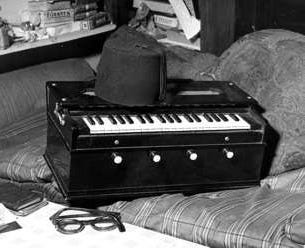
(Gurdjieff’s harmonium. Image reproduced from Jessmin and Dushka Howarth, It’s Up to Ourselves: A Mother, a Daughter, and Gurdjieff, via The Gurdjieff International Review.)
Rue des Colonels-Renard is a quiet street in Paris’s 17th arrondissement, close to the Arc de Triomphe and just a short walk from the bustle of the Champs-Élysées. Number 6 is an elegant five-story limestone building with an ornamented stone facade, tall windows, and wrought-iron balconies adorned with flower boxes.
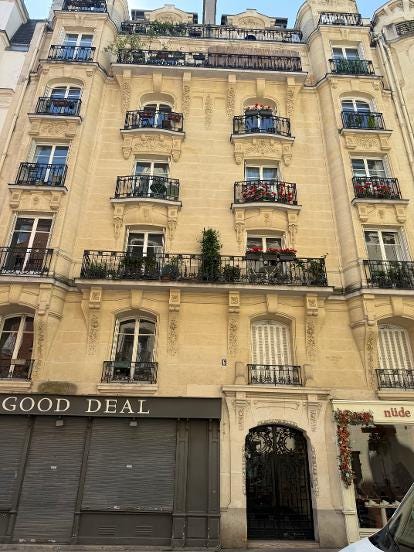
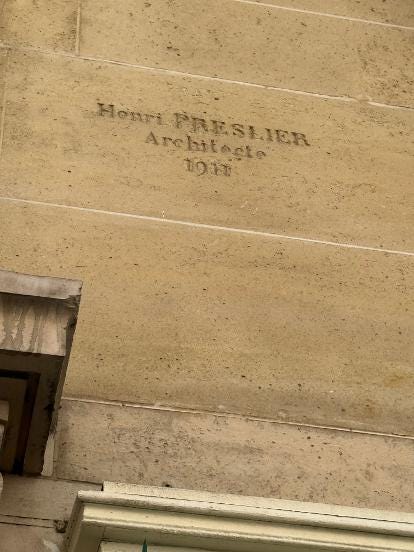
The building was constructed in 1911, and the name of its architect, Henri Preslier, is immortalised on its facade.
My daughter and I arrived there a little after lunch on a hot and sunny day in early June. The absence of other pedestrians on the street made it easy for me to pretend that we were stepping back in time. All I had to do was ignore the cars parked along the sidewalk and focus on the building.
I knew that I would not be able to see the actual apartment, but I was hoping to get inside the building, feel the atmosphere of the vestibule, and climb the staircase. Alas, to my great disappointment, it was not meant to be. The wrought-iron entrance gate was locked.
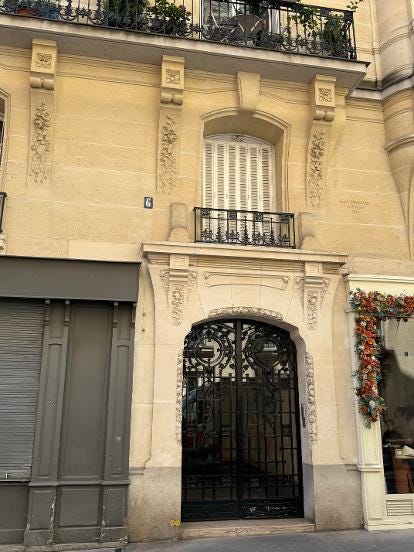
There was, however, a small consolation. The entrance gate was not a conventional solid door, but a combination of glass and elaborate black wrought iron, which allowed me to catch a glimpse of the vestibule beyond. After first pressing my nose between the ornamental ironwork and peering through the glass portion of the door, I pulled out my cell phone and pressed the camera lens against the glass.
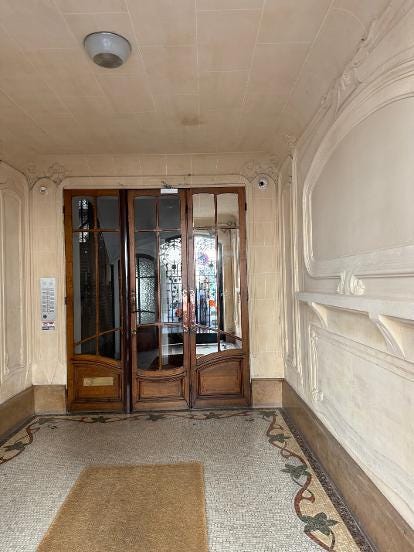
I don’t know whether the entrance gate is the original one from 1911. The building must have undergone some changes over the years, but the vestibule, with its patterned mosaic floor and tall, glazed wooden inner door, certainly retains the appearance of an early-twentieth-century Parisian apartment building. It is possible, then, that the space looks much as it did when Gurdjieff lived here, and P. L. Travers came to visit.
Still hoping to somehow get inside the building, we sat on the sidewalk across the street and waited to see if someone would come in or out. No one did. As we sat there, I wondered whether the entrance gate had been locked back then too, or whether that was a consequence of modern-day security concerns. Somehow, I had a feeling that things had been a little different in Gurdjieff’s time.
I imagined P. L. Travers walking along the sidewalk with her adopted son Camillus, who was around ten years old when he first met Gurdjieff. They came to visit him in September 1949, just a few weeks before his death the following month. I wondered, did P. L. Travers scold Camillus in the manner of Mary Poppins and instruct him to be on his best behaviour? And did Camillus display the same sense of excitement and anticipation as Jane and Michael Banks when Mary Poppins took them to visit her relatives?
My reverie was suddenly interrupted by the chiming of a church bell. You can hear it in the video below.
The solemnity of the moment did not last long. My daughter, who, quite understandably, was beginning to lose patience with my facade-gazing decided to ask me a perfectly ordinary question and catapulted me back right into ordinary reality. You can hear her talking in the background and me insistently shushing her.
Then, as if to confirm my sense of reverence, a pigeon flew overhead and circled the balconies on the top floor of the building before continuing its way. Somehow, the sight of it, combined with the chiming of the bell, made me feel at peace with the fact that I could not get inside the building.
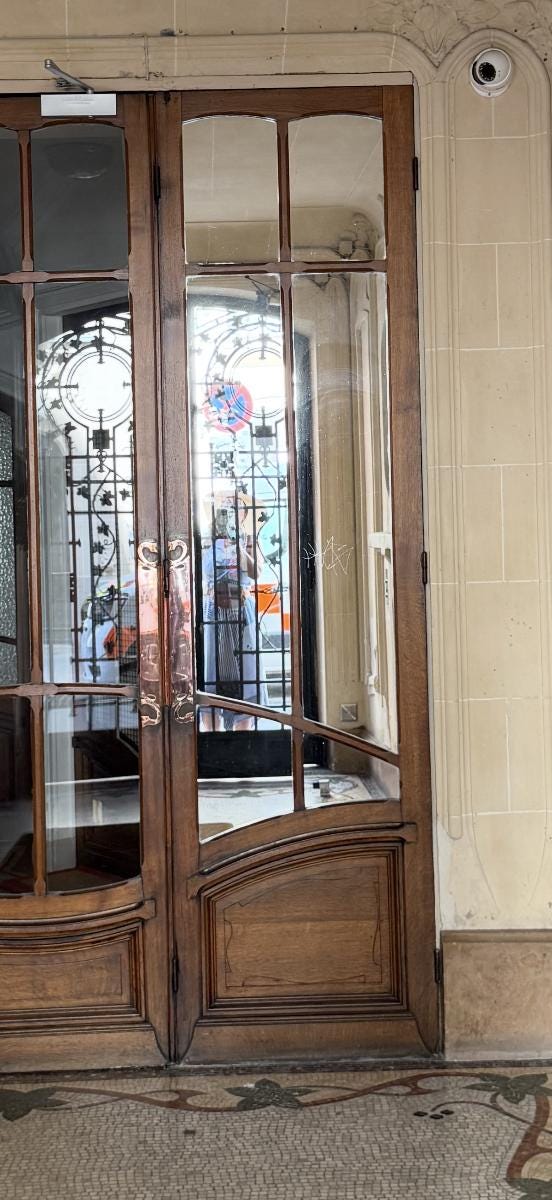
And as I am writing this and looking again at the picture of the vestibule, I notice something that I had not noticed before. If you look closely, you can see my reflection in one of the glass panes of the inner wooden door. In a way, I was inside the building, albeit not in the manner I had expected. Maybe, even though I could not physically cross that threshold, I was allowed to see enough.
Descriptions of the interior of Gurdjieff’s apartment can be found in the written accounts of his pupils. I have not read them all, of course, but last year I discovered Margaret Anderson’s The Unknowable Gurdjieff and was thrilled to find brief descriptions of what his home looked and felt like.
Margaret Anderson was an American writer and editor of the influential avant-garde literary magazine The Little Review and one of Gurdjieff’s pupils. She later became a member of the Rope, a small group of lesbian women whom Gurdjieff brought together for special work. Her account in The Unknowable Gurdjieff includes recollections from the period after the Second World War, when Gurdjieff’s American pupils began returning to Paris, along with others, like P. L. Travers, who had spent the war years in the United States.
It was in May 1948 that Anderson returned to Gurdjieff’s apartment in Paris.
“It was May in Paris, but for us there was no spring. There was no time to notice the horse-chestnut trees blossoming in the Bois, or the illuminated fountains sparkling in the Place de la Concorde in the soft sweet light. There was time only to drive as fast as possible by the shortest route to Gurdjieff’s flat in the rue Colonel Renard – a street with as little French distinction as a page in a dictionary; a flat without sunlight or a single flower, where the motionless air reeked of Asiatic cooking and the heat was almost unbearable.”
“Gurdjieff’s small dingy familiar apartement in the rue Colonels Renard had not changed – details of destruction only emphasized its changelessness: the colours had faded, the furniture was shabbier, the dining-room carpet had worn through and now had big patches on it. (…) The pictures on the walls were new, but they had the same quality as the old ones – ‘everything but art’ as Jane had said long ago.”
Jane was Jane Heap, Anderson’s co-editor of The Little Review and her partner for many years. Heap became particularly devoted to Gurdjieff’s teaching and eventually taught his work herself, leading Gurdjieff groups in London. P. L. Travers belonged to one of these groups.
I found this observation about the pictures on his walls particularly interesting because Gurdjieff had strong opinions about art. He taught that true art must be objective, transmit spiritual truths, and cosmological laws. He disliked what he called subjective art which arose largely from the artist’s personality, emotions, associations, and unconscious impulses. And, yet he covered his walls with art that his pupils, many of whom were artistically sophisticated, considered dreadful.
The kitchen was a central room in Gurdjieff’s apartment, as food played an important role in his teaching. He used different teaching methods at different periods of his life, but during his final years, meals became an essential ritual for the transmission of his ideas.
Gurdjieff concocted exotic dishes and turned his table into a dramatic stage where he acted as a master tamer of egos, administering the external shocks he believed were necessary to awaken his pupils from their identification with their thoughts and emotions. His provocative remarks, the famous ritual of the Armagnac Toasts to the Idiots, readings from his manuscripts, and the music he played on his harmonium after meals all served to open his pupils to new “impressions.”
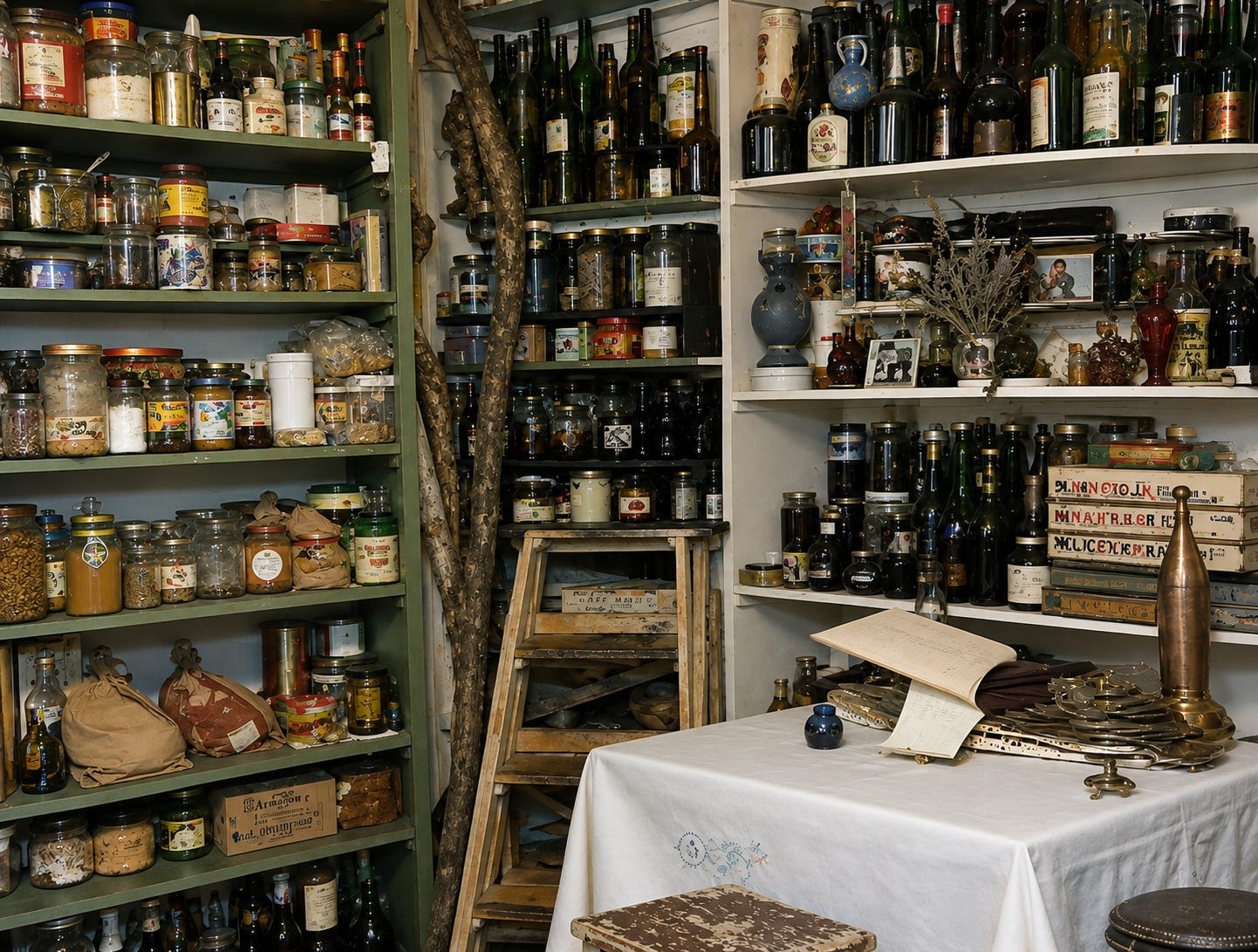
Beyond the kitchen, there was also a storeroom in the apartment where Gurdjieff kept his victuals and the spices he used in his cooking. On occasion, he also took pupils there for private conversations. Here is a description from Margaret Anderson’s book:
“There, in the midst of fruits and sweets and wines, with slender sausages of camel’s meat, bunches of scarlet peppers and sprays of rosemary and mint suspended like canopy above, as I watched him pouring coffee out of the old battered old thermos (…)”
I found this photograph of his storeroom in It’s Up to Ourselves: A Mother, a Daughter, and Gurdjieff, by Jessmin and Dushka Howarth. The photograph, however, is black and white, and the resolution is poor, so I find it a little difficult to mentally project myself into the room.
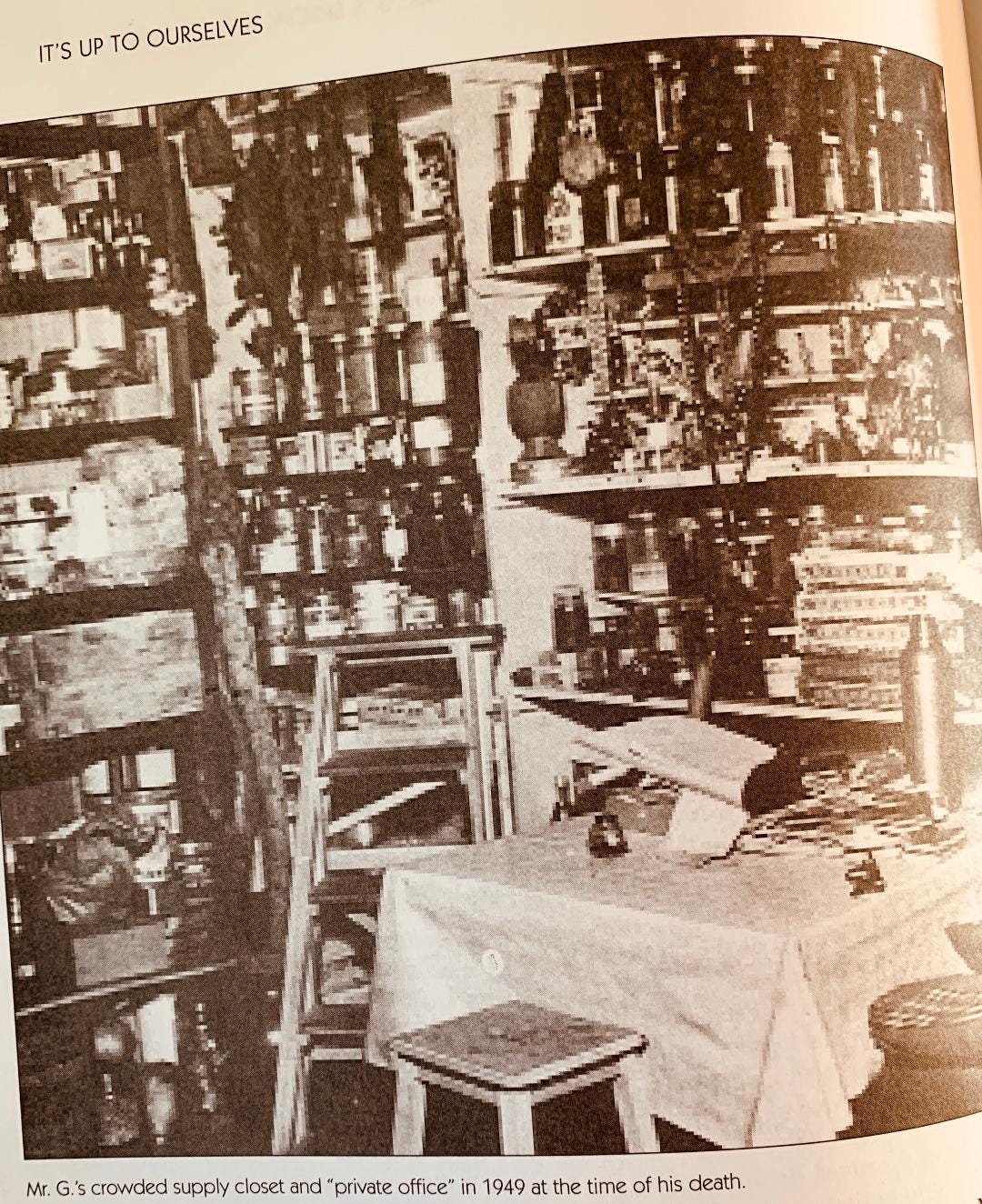
I used AI to reconstruct the photograph. The result is not entirely accurate. There are labels, objects, decorative items, and other details that cannot be established from the original photograph, while the sausages and herbs suspended from above are missing. Overall, however, the picture remains reasonably close to the original and, for me at least, the colours add liveliness and make it easier to get a sense of the place.
And with that, my attempt to step inside Gurdjieff’s apartment comes to an end.
This is all for now. Next time, I will take you to Alexander Nevsky Cathedral in Paris, where we will attempt to go back in time to 1949 and witness the day of Gurdjieff’s funeral, at which, of course, P. L. Travers was present.
Until then, be well.
Lina