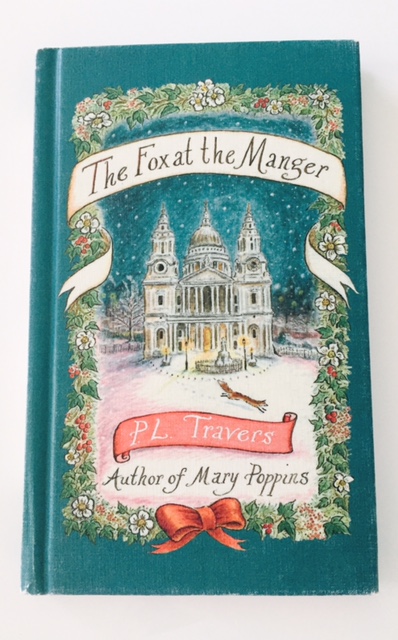
Pamela L. Travers and The Fox at the Manger (Part I)

FullSizeRender

The last two posts on this blog (analysis of the story of “Ah Wong” published in 1943 and analysis of the story of “Johnny Delaney” published in 1944) revealed Pamela L. Travers’s religious upbringing and the signs of her losing her religion after the early and sudden death of her father. These two stories were written during Pamela L. Travers’s war time evacuation to the United States, and as Christmas gifts for her friends; thus published privately.

The story of “The Fox at the Manger,” which is the subject of this week’s post, was published at large in 1963, almost twenty years after the end of the war and in my opinion, it expresses the same sentiment of rejection of the main-stream Christianity and the spiritual void experienced by Pamela L. Travers as the stories of “Ah Wong” and “Johnny Delaney“.

The “Fox at the Manger” is an account of the first Christmas service at St. Paul’s cathedral in post-war London when people were just beginning to settle back into their normal lives. The narrator (who is obviously Pamela L. Travers) takes three boys to the Christmas service. One of the little boys is dear to her heart and is obviously her son Camillus. By the way, the story is dedicated “To C. to remind him of his childhood.” 

Each of the boys are bringing one of their favorite toys with the intention of offering them as presents for the poor children in London. But when the moment comes for the boys to part with their precious possessions, they remorselessly change their minds. To this, the narrator (Pamela L. Travers) wisely concludes “A gift must come from the heart or nowhere.” 

Obviously, the story is about giving and about loss. As Patricia Demers writes in her book, “P.L. Travers,” “The Fox at the Manger” is “an affective meditation on gift giving.” But there are also other layers woven into the story which deserve closer exploration. So, let’s explore them.

The story begins with, and is wrapped around, the Christmas carol of the Friendly Beast.

Carol of the friendly beast

(Here sang by Peter, Paul and Mary)

 Jesus, our brother, strong and good

Was humbly born in stable rude

And the friendly beasts around him stood

Jesus, our brother, kind and good.


I, said the donkey, shaggy and brown,

Carried his mother uphill and down,

I carried her safe to Bethlehem town,

I, said the donkey, shaggy and brown.


I, said the cow, all white and red,

Gave him manger for his bed,

I gave him my hay to pillow his head,

I, said the cow, all white and red.


I, said the sheep with curly horn,

Gave him my wool to keep him warm,

He wore my coat on Christmas morn,

I, said the sheep with curly horn.


I, said the dove, in the rafters high,

Cooed him to sleep with a lullaby,

We cooed him to sleep, my mate and I,

I, said the dove in the rafters high.


Thus, every beast by some good spell

In the stable dark was glad to tell

Of the gift he gave Immanuel

Of the gift he gave Immanuel.

 As a side note, I learned that this song probably originated in 12th-century France and was sung during the Fete de l’Ane (Festival of the Ass or Donkey), and the focus was the flight into Egypt by the Holy Family. At some point over the centuries, the scene shifted from the flight into Egypt to the journey to Bethlehem. Robert Davis (1881-1950) is attributed with writing the English words, probably in the 1920s. 

And now back to the story. The children in the story prove themselves to be keen observers. When the Church choir sings I, said the donkey, shabby and brown one of the boys remarks that the donkey in the Nativity scene is actually quite grey and smooth. Then another boy candidly demands: “Why, he asked, are they (the clergymen) wearing nightgowns? They look like Wee Willie Winkie.

Now, I didn’t know who Wee Willie Winkie was, so for those who may be ignorant of the character, here is a link to Wikipedia. Basically, Wee Willie Winkie is a character from a nursery rhyme (Pamela loved nursery rhymes) dressed in a night-gown and running around town tapping on windows and reminding children to go to bed. Therefore, it is not  exactly a dignifying comparison for the clergymen.

Although seemingly embarrassed by the attention from the congregation caused by the children’s comments, the narrator does not find the words to contradict them. She herself wonders, looking at the bishop lip-syncing the carol, “through what town of the mind this paunchy Wee Willie Winkie was running.” And then, to continue with her own meditation on the nativity scene:

 The rose-bloom faces of the kings gave no hint of the discipline, the labors, that must surely be the lot of any group of Magi.

And what disappoints her the most, is the absence of a black sheep amongst the white lambs:

And I dearly wanted a black lamb. For without him, where are the ninety and nine? Flocks, like families, have need of their black sheep he carries their sorrow for them. He is the other side of their whiteness. Does anybody understand I wandered, that a crib without a black lamb is an incomplete statement?

This passage in the story reminded me of another one of Pamela L. Travers’s essays published in Parabola in 1965, “The Black Sheep:”

What was a black sheep, I asked myself. Obviously, in the general view, one full of iniquity. If so, might I not be one myself, in spite of the tireless efforts of parents, teachers and friends.

The expressed feelings of not belonging to a tribe and being somewhat flawed are so obvious and ever recurring in her writings; even in the stories of Mary Poppins. But that will be explored at another time on this blog.

So, from the dialogues between the boys and the narrator, and the narrator’s own reflections of the religious service, one can easily deduce Pamela L. Travers’s general dissatisfaction with the religious concepts from her childhood. The worship rituals are portrayed in the story as a thoughtless mimic and mindless repetitions by some slightly ridiculous clergymen.  Clearly, Christianity did not provide answers to her questions nor did its teachings reflect what she perceived as being the truth.

So again, as in the previous stories, we can trace Pamela L. Travers’s rejection of the Christian religious beliefs. Yet, at the same time, the reader can feel a deep sense of her spiritual sensibility. She writes about the passage of time, which is associated to the flow of life, as something deeply mysterious and undisturbed by human actions:

Whenever the bombs fell in London, reinforcements in the shape of sycamore, rose-bay     willow, and fern came to fill the gaps. …. What had been here- some stately office? A bank?   A merchant’s hall? And before that, what? I wondered. If it is true the print and form of things remains forever, as they say invulnerable and invisible -surely these children were dancing now through long forgotten board meetings, and shades of accountants, lawyers, clerks. Or if one went back further, through the flames of the Fire in London in 1666. Further still, the marble floor would be mud and marshland and all around us brontozors; and beyond that we would whirl in lava, turning fierily through the air, nothing but elements.

Contrariwise, would not the City lords to come, in rooms that would rise from this fern and rubble start up in astonishment at the fancied sight of willow-herb breaking through the carpet. And old cashiers scratch their heads, wondering if they were out of their wits or whether they had really seen three boys run through the cash desk? Are we here? Are we there? Is it now? Is it then? They will not know and neither do we (Insert last name of author, page of quote).

Reading this, one feels the brevity of one own’s life and the impermanence of our human creations (or destructions for that matter). Pamela L. Travers must have felt rather small and insignificant, lost in a vastness of something beyond human comprehension. What is the meaning of it all? Pamela L. Travers does not know but the pain of the question remains forever present in her writings.

 After the service, the children ask the narrator why there were no wild animals at the crib. “Haven’t they got something to give?  In response, the narrator finds herself, like in a dreamlike state, telling the children the missing verse in the carol; the verse about the Fox.  She then proceeds to tell them the story of the “Fox at the Manger,” which can be compared to a sort of fable where the dialogues between the animals convey a moral to the reader. What is the moral? And who does the Fox personify?  I will tell you more in next week’s post.

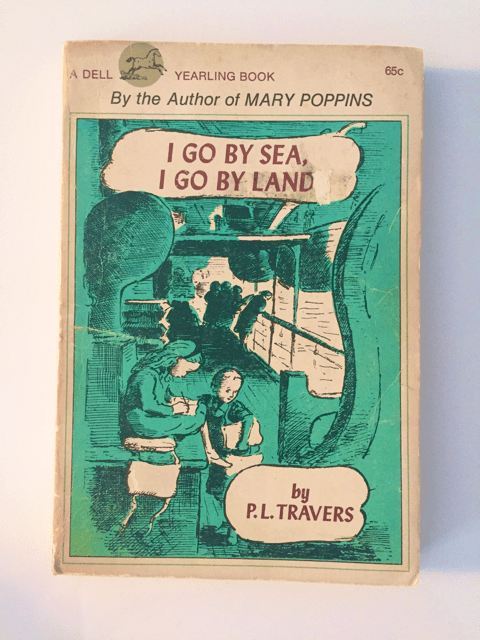
Pamela L. Travers Goes By Sea, She Goes By Land

Pamela L. Travers I Go by Sea.PNG

The previous two posts focused on the religious references in Pamela L. Travers’s writings.  One of these posts analysed the story of “Ah Wong” which was written for a private readership in 1943, and then the second one was about the story of “Johnny Delaney” which was also written for a private readership in 1944.

These two stories were composed during Pamela L. Travers’s war time evacuation to the United States. At that time, she was quite depressed and homesick. Her emotional state pushed her to revisit her early childhood memories, probably as an attempt to relieve her from the psychological pain.

In the story of “Ah Wong,” the reader first gets a glimpse of Pamela’s early religious upbringing, and then witnesses the change in the narrator’s beliefs which occurs after her father’s sudden death. There is no longer a reference to a personified benevolent God but a mystic flow of life; a river that sends the narrator into life and Ah Wong to his death.

In the second story, the character, Johnny Delaney, is described as a bitter man with deep seeded feelings of unworthiness. Johnny feels betrayed by God and the Church.  I believe that all of Johnny’s feelings to have been Pamela’s own as well.

In both stories, there is a sense of ambiguity towards God. In the story of the Fox and the Manger published in 1963 (when Pamela was in her sixties), and which will be the subject of next week’s post, the same ambivalence towards her religious upbringing is also apparent.

I was surprised at the religious references in I Go By Sea, I Go By Land, a book written by Pamela L. Travers and published in 1941. This story has an uncharacteristic frame of hope. It possesses an overall sense of trust in a benign providence, something that Pamela L. Travers totally lacked.

It helped me to interpret this peculiar discrepancy when I learned that Pamela herself dismissed the book as “a mere bibelot…. written at the request of my publisher…all of us took assignments which weren’t properly in our line.”

The publisher in question was Eugene Reynal from W.W. Norton, and he suggested Pamela write an account of her experience of evacuation to the United States. We can speculate that the motivation behind the writing of this books was not so much a spontaneous self expression; but rather, a conscious effort to write something hopeful for her readers in a time of hopelessness. And this all came about because of her publisher’s demand.

Again, just as in the stories of “Ah Wong” and “Johnny Delaney,” the narrator in this story is a child. In this instance the child’s name is revealed to the reader. The eleven-year-old girl, Sabrina, keeps a diary of her adventure. Sabrina and her brother James, who is nine, are accompanied on this journey by a family friend named Pel, and Pel’s baby Romulus. 

The book is separated in two sections. The first, I Go by Sea, is about the experience of the war, leaving one’s homeland and one’s family, and the actual crossing of the ocean. The second part, I Go by Land, is about the children’s adaptation to their new life in America.

It is interesting to note that the book begins with a religious hymn, a prayer for protection, which reappears a few times in the first part of the story and which has inspired the title of the book. Here it is:

Matthew, Mark, Luke and John,

Bless the bed that I lie on.

Before I lay me down to sleep

I give my soul to Christ to keep.

Four corners to my bed

Four angels round me spread.

Two to foot and two to head

And four to carry me when I’m dead.

I go by sea, I go by land

The Lord made me with His right hand

If any danger come to me,

Sweet Jesus Christ deliver me

He is the branch and I am the flower

Pray God send me a happy hour

And if I die before I wake

I pray that Christ my soul will take.


Now, I don’t know much about religion so I had to do a quick search about the religious references in the book, and I found some interesting information.

The hymn’s origin is Thomas Ady’s collection A candle in the Dark (1656) and was written to speak out against the Catholic Church and the atrocities inflicted on witches and other poor souls by the inquisition. Somehow, this hymn, known also as the “black paternoster,” escaped the anti-witchcraft and anti-Catholic sentiments of the 17th century to become a favorite children’s rhyme in England, especially in the 20th century. Some believe that this may be credited to Anglican priest, scholar and hymn-writer, Sabine Baring-Gould. (Pamela was brought up Anglican).

There are no religious references in the second portion of the story apart from a visit to a Cathedral in Montreal at the evacuee’s arrival in Canada. Pel takes the children to the Cathedral to light some candles even though she mentions they are not Catholics. Then, at the very end of the book, the characters sing the famous Victorian berceuse “Now the day is over” composed by the above-mentioned Anglican priest, Sabine-Baring-Gould.  

Now the day is over

Night is drawing night

Shadows of the evening

Steal across the sky.

Jesus give the weary

Calm and sweet repose

With thy tendering blessing

May our eyelids close.


Grant to little children

Visions bright of thee,

Gard the sailors tossing

On the deep blue sea.


Through the long night-watches

May thine angels spread

Their white wings above me

Watching round my bed.


When the morning wakens

Then may I rise

Pure and fresh and sinless

In the holy eyes.


Glory to the Father

Glory to the Son,

And to thee, blessed Spirit,

While the ages run.

Despite the hopeful notes in the story, there are still signs of Pamela’s own lack of faith in an external benevolent force.

Additionaly, I found the character of Pel almost as interesting as Sabrina. Pel is a writer and travels with a baby, in a bassinette, named Romulus. Of course, it is obvious that the name Pel stands for P.L. and the baby Romulus in the story stands for Pamela’s adopted baby Camillus. Once you realize that, then Pel’s advice to Sabrina takes on a new significance: “Nobody can help you, you have to do it on your own. And it takes time, I am only learning it now.” So much for faith in a benevolent force.

The character Pel expresses Pamela’s vision of her Higher Self, the ideal she wanted to embody: “She (Pel) makes you laugh and dance inside yourself and at the same time you feel that she is somebody who will always be there and that is a very safe feeling.”

The character Sabrina, on the other hand, is the bearer of Pamela’s emotional scars from her childhood. When you know that Pamela L. Travers’s mother tried to commit suicide when Pamela was ten years old, the following passage about Sabrina’s anxieties (while watching Pel sleep) is heartbreaking because it probably unveils Pamela’s real-life experiences as a child:

I am frightened when I see grown-ups asleep. They look as though they have forgotten everybody and gone right away into themselves. I feel that perhaps they will never wake up again and we shall be left quite alone and I kept going close to Pel to make sure she was still breathing. She has a very small breath just like mother’s. No sound at all and hardly a movement. Mother makes me very anxious. Sometimes when she is asleep I am afraid she is dead and I think of it in the night. Once, I thought of that and went into her room. It was dark and very still and I was afraid to go near the bed.

I am convinced that this is an autobiographic element. I believe Pamela truly experienced this sort of anxiety. Her father fell ill when she was seven years old and the last time she saw him was before going to bed; he was dead the next morning.

The same split between a vision of a Higher Self and a little girl with painful memories is present in the story Friend Monkey which was written some thirty years later;  thus unresolved issues from her childhood followed Pamela L. Travers until her very end.

I have the third edition of the book which was printed in 1967 and contains Pamela L. Travers’s Foreword. The end of the foreword is quite melancholic and it encapsulates Pamela L. Travers’s belief about life:

After childhood, our lives are no longer our very own. The world comes in and demands its share and unless we are cleaver or – lucky, perhaps – we forget a very great deal.

Pamela L. Travers


Pamela L. Travers and Johnny Delaney

Pamela L. Travers Johnny Delaney 2

The story of Johnny Delaney, another character from Pamela L. Travers’s Australian childhood, and the meaning of the religious references in that story are the subject of this week’s post.

Just as in the story of Ah Wong, which was the subject of last week’s post, the story of Johnny Delaney was written as a Christmas gift for Pamela L. Travers’s friends and was not intended for the public eye. It was only in November 2014 that the story became available for the general reader. Virago Press, with the authorization of Pamela’s estate, published Aunt Sass a compilation of three stories: “Aunt Sass,” “Ah Wong,” and “Johnny Delaney.”

“Johnny Delaney” was published privately during Pamela’s war-time evacuation to the United States. It is dedicated to a mysterious woman by the name of Frieda Heidecke Stern whom Pamela’s biographer, Valerie Lawson, could not identify. Underneath that dedication there is a German sentence which translates to: “If one door closes, another opens.

What door had closed back then for Pamela and what door was she hoping would open? Chance did not write that sentence, it meant something. EVERYTHING was a metaphor for Pamela. Then it is only logical to ask, what was Johnny Delaney a metaphor for? This post is an attempt to answer that question.

Pamela wrote the story of “Johnny Delaney” at a time when she was profoundly homesick. Likely, it was her longing to return home to a safe and familiar place that prompted her to turn mentally to the earliest memories of her childhood. Probably to the happiest ones, the more magical ones, and the ones that appealed most to her imagination.

The “real” Johnny Delaney worked as a stable boy and a carpenter but to Pamela he appeared as creature from a fairy tale. It is possible that he taught her, just like the children in the story, to spit with artistry, to make whistles from bamboo sticks, and to read the night starry sky. Although small and crippled physically, Johnny’s presence seems to have been magnified by his shadowy personality:

He was before anything else, an antisocial being. He was a man made entirely of blackness and shadow, the quickest-tempered, arrogantest, bitter-heartedest creature that ever stepped out of the County Clare.

But did the real Johnny have a second sight?  Did he forcefully and unsolicitedly dispense his piece of mind to all who met him? Did he die as told in the story, of binge drinking? And above all, was his “life’s work” real? Somehow that last element in the story feels to me too romantic to have been true. It bears too much of a symbolic resemblance to Pamela’s own relationship with the God from her childhood. I will get back to that. But first, let me give you a summary of the story itself.

Come to think about it, “Johnny Delaney” is not a genuine story because there is not really a plot in it. It is a character study; a retelling of a childhood memory about a tormented creature. “His spirit glared through his dark eyes, a fierce, tormented prisoner.

He was a man who apparently had lost his religion because of some secret pain, and  a man betrayed by God just as Pamela herself felt betrayed by God. Truly, he was a man with His love heavy and silent within him just like Pamela and he also rejected the Church and the priests and kept to himself, just like Pamela:

 The mere sight of a priest enraged him; and he deliberately pressed his hat a little further on his head when he met Mr. Preston, the vicar.

 Ah, what do they know of life at all, them ignorant white angels? Sittin’ an’ sthrummin’ their harps of gold with never a shadow upon them.

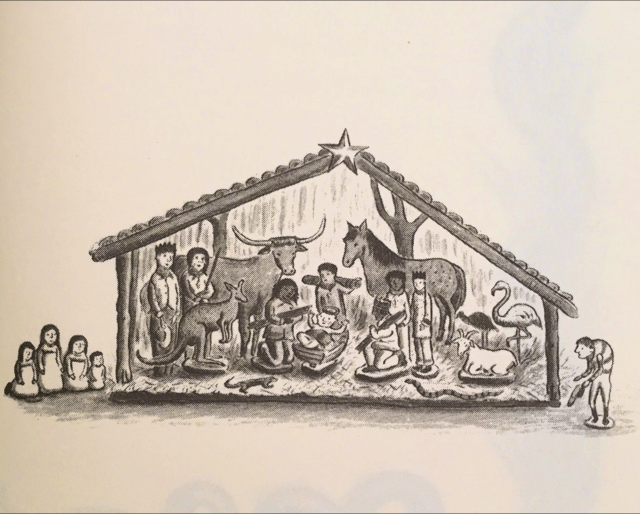
But despite his antisocial behaviours and his heavy drinking, the reader learns at the end of the story that Johnny’s religion was love; love for the family he worked for, love for the people with whom he worked, and love for the wild life that surrounded him. And although he rejected the organised Christian religion, his life’s work (which is discovered only at his death) was a carving of the nativity scene. This is a nativity scene quite different from its traditional representation which dates to 1223 when Saint Francis of Assisi created the very first one to promote the true meaning of Christmas and worship of Jesus Christ.

This is what Johnny’s nativity scene looks like:

There were carved and painted kings and children kneeling beside a stable. No shepherds with flocks of snowy lambs, no angels with folded wings. Instead there were little native creatures – kangaroos, emus, red flamingos; horses and lizards and goats. The kneeling men were cane cutters, offering green cane boughs; …And alone-apart from men and beasts-stood a little bowed hump-backed figure, with a jockey hat in its hand. It seemed to be gazing at the crib…

Even though his love was strong, Johnny did not believe himself worthy of love. He was forever the observer, the outsider, the misfit. Just like Pamela L. Travers.

The observations about the nature of love in this story have probably more to do with Pamela’s own beliefs than the actual character of Johnny.

Throughout the story, there is a feeling of connection between the child narrator and Johnny. It is as if each one of them recognises himself in the other and a connection that lies between their “blackened by love” hearts.

Now, I don’t know how much of Johnny’s story is true and how much of it is the writer’s imagination. What I know for sure is that Pamela’s early childhood years were not spent on a sugar plantation as narrated in both “Ah Wong and “Johnny Delaney.” I also know that Pamela fancied the idea of telling people that that was the case, and that her father was the owner of a sugar plantation. This is what she told Patricia Demers who wrote a short literary analysis of her works in the early nineties, before Valerie Lawson’s biography Mary Poppins, She Wrote. This is also what some newspapers wrote as her obituary in 1996. Here is an example from the obituary that was published in the New York Times :  Her father was a sugar planter, and Miss Travers recalled growing up near the Great Barrier Reef in a tropical world of sugar cane, shells and mangoes.”

The truth was different. Pamela’s father was a bank clerk who in his youth worked on a tea plantation in Ceylon. During the first three years of her childhood Pamela’s family lived in Maryborough, near the Mary River, in a two-story home from where Pamela could see the town’s sugar factory. So, there is an imaginative and mischievous stretch of reality on Pamela’s part. She did intentionally mislead people but, then again, people asked for it. She never wanted to be known for the facts of her personal life. She wanted to be understood through her art.

I believe her resistance to reveal the personal details of her life were motivated by fear: fear of being judged, fear of being misunderstood, and a fear of being rejected. She needed to surround herself with a cloak of mystery so to appear worthy of people’s attention and, at the same time, to hide behind it as a protective shield. It was all just a defensive mechanism. What she wrote in “Zen Moments,” an article published in Parabola, confirms just that:

“We sit on our heels on the tatami, the Japanese woman and myself, telling the stories of our lives. One can do this with a stranger. Too near, and the perspective is lost. Only the far can be near.” 

So, what was “Johnny Delaney’ a metaphor for?  I believe him to be the expression of Pamela’s emotional inadequacy and her unfulfilled need to belong to a family, and above all, her need for a spiritual life after the loss of her faith.

Pamela L. Travers and Ah Wong

Mary Poppins Ah Wong

Pamela L. Travers stemmed from a religious soil. She heard readings from the Bible and attended church services on Sundays at St. David’s Anglican Church of England in Allora, Queensland, Australia.

Her parents were pious churchgoers; thus, God was an absolute and uncontestable part of Pamela’s reality:

…God ubiquitously worked among us, forever unespied – playing the organ on Sundays, his feet bare on the pedals…..Once He looked me at through the gap in the fence with the face of a golden sunflower, awesome, quizzical, resolute. I put up my hand and I picked Him.

Curious enough, despite her parents’ piety, this almost transcendental experience once shared was dismissed as inappropriate: No one, they said, could pick God and if they could they would not. It was socially, if not ethically, unacceptable and not the kind of thing people did.” 

Yet, it was not these insensitive comments but her father’s sudden death that shook the foundations of Pamela L. Travers’s religious beliefs. She had no choice but to accept her father’s death, even if the process took her several years. What she failed to accept, however, was a God who allowed for such a loss.  By losing her father she also lost her religion.

Alas, she did not lose her spiritual needs. A deep inner void remained to be filled. And that explains her lifelong following of the esoteric teachings of George Ivanovich Gurdjieff (whom she met in her late thirties), as well as her general restlessness and search for spiritual masters.

Strangely, despite her rejection of the God from her childhood, Pamela kept a faint connection to her Christian upbringing. Some of her less known writings (“Ah Wong,” “Johnny Delaney,” “I Go By Sea, I Go By Land,” and “Fox at the Manger”) contain religious references which leave a vague impression of an ambiguous belief system.  And it is to be noted that Gurdjieff himself called his system esoteric Christianity because of his ideas about sacrifice and voluntary suffering. A similar conclusion can be drawn about her interest in the Durkheim’s system which is a combination of Christian and Zen concepts.  

However, the major difference between her earlier religious training and the Gurdjieff’s and Durkheim’s teachings is that in these teachings the divine is described in a more mystical manner. There is also a strong emphasis on physical exercises as a gateway to a higher level of consciousness; ritual dances in the case of Gurdjieff and yoga and breathing exercises with Durkheim. In both systems, the process of personal growth is entirely the individual’s responsibility; an experiential inner process to be discovered by the individual on the spiritual path. Truth is to be experienced not known.

In 1943, Pamela L. Travers (at that time already a follower of Gurdjieff) wrote the story of “Ah Wong” as a Christmas present for her friends. She did not intend the story for the public eye and it was only in November 2014 that it became available for the general reader. Virago Press, with the authorization of Pamela’s estate, published Aunt Sass a compilation of three stories: “Aunt Sass,” “Ah Wong,” and “Johnny Delaney.” The story of “Aunt Sass” was previously discussed on this blog. It features Pamela L. Travers’s great-aunt Ellie (under the name of Aunt Sass) who was, to a certain extent, the inspiration of the character of Mary Poppins.

Also, just as in “Aunt Sass,” a child’s voice tells the story of “Ah Wong” and again, as in “Aunt Sass,” it contains some biographical elements form Pamela’s Australian childhood.

The Travers’s household in the early years, before her father’s death, employed a Chinese cook who left a lifelong impression on Pamela’s heart.

In the story, Ah Wong arrives out of nowhere, as an angel of providence, just at the right time when the family has lost their incompetent Chinese cook to a work-related injury.  Ah Wong, thin and wrinkled with a long, black pigtail swinging underneath his hat, is described as a benevolent, energetic, and caring force:

 For Ah Wong did not merely cook for the family. It soon became apparent that he owned the family. He darted like lightning about the house, dusting, making beds, sweeping and polishing.

Pamela L.Travers presents Ah Wang as the ultimate house elf: “Flowers bloomed, green rows of vegetables appeared, watermelons swelled like balloons. It was our belief that Ah Wong blew them up at night.”    

Now, this sweet man remained profoundly engraved in Pamela’s memory not only because of his loving care for the family, but also and probably more so, because he was different in a time and place of Christian homogeneity. Something mysterious was hidden behind a beaded curtain in his room; Ah Wong was bowing to a “heathen idol.

Mary Poppins Ah Wong 2.PNG

Thus, Pamela and her siblings found themselves on a quest:

We were going to convert Ah Wang. At this period, we were immersed in those old stories wherein small children of extreme physical debility set so saintly an example that grown-up sinners were thereby brought to repentance.

The rest of the story goes on in a humorous way to describe the children’s efforts to teach Ah Wong the basics of Christianity and get him christened, of course, all without any success. It is in this story of Ay Wong that we glean Pamela L. Travers’s early religious education:

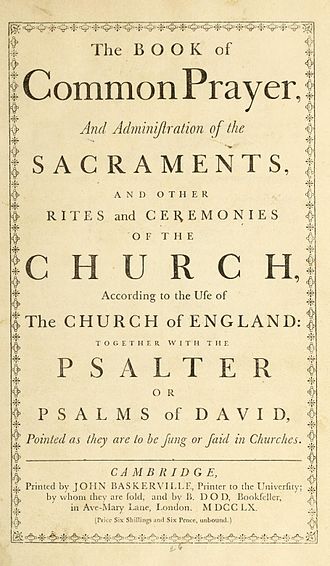
First, she mentions The Book of Common Prayers which I learned is a compilation of related prayer books used in the Anglican Communion, as well as by the Continuing Anglican, the “Anglican realignment,” and other Anglican churches. The book also includes the complete forms of service for daily and Sunday worship.

Book_of_Common_Prayer_1760.jpg

Then, she tells us that her Bible primer was the Peep of Day and that Ah Wong succeeded in learning the prayers. So, I looked it up, and Peep of Day turns out to be a series of religious instructions for young children with illustrative verses written by Favell Lee Mortimer.

Peep of Day

The book is separated in sections as follows:

Section 1: My Family and Me – Body, Parents, Soul

Section 2: Angels – Good Angels, Wicked Angels

Section 3: God’s World – The World (3 lessons), Adam & Eve, The first sin, The Son of God

Section 4: Jesus has Arrived – Virgin Mary, Birth of Jesus, Shepherds, Wise Men, King Herod

Section 5: Jesus at Work – The Temptation, 12 disciples, First miracle, Several miracles, Sinner & Simon, Storm at Sea, Jairus’ daughter, Loaves and fishes, Kindness of Jesus, Lord’s prayer, Jesus foretells his death, Lazarus, Jesus in Jerusalem, The Temple, Judas

Section 6: The Last Meal – The Last Supper (3 lessons)

Section 7: The Final Night – The Garden, Peter’s denial, Pontius Pilate, Death of Judas

Section 8: Jesus Dies – The Cross (3 lessons), The Soldiers, The Grave

And here is a verse from the Peep of Day which we can imagine Ah Wong and the Children sang together:

My little body’s made by God

Of soft warm flesh and crimson blood;

The slender bones are placed within,

And over all is laid the skin

My little body’s very weak;

A fall or blow my bones might break;

The water soon might stop my breath;

The fire might close my eyes in death.

 But God can keep me by his care.

 Ah Wong indulged the children by playing and listening to their stories, but when they described to him the glorious picture of their father at the Church service, trying to convince him to come with them, Ah Wong found the idea of giving money at the end of the service completely ludicrous.

 ….our father, in his white silk suit with the crimson cummerbund, taking round the plate. This, to us, was a sight ever glorious. Sunday after Sunday we thrilled with pride as, singing the last hymn in a roaring baritone, Father took up the collection.

Whassa dam-silly-fellow nonsins? he shouted wrathfull. ‘Boss take-im money? I don’t tink so. Boss not take-im Ah Wong’s money.”  

After this incident, we learn that Ah Wong is saving his money to return to China. Soon after that, the tone of the story abruptly changes and becomes darker. The father suddenly dies and the family must leave its sugar plantation and its Chinese cook. Many years later, the child narrator, now a young journalist, meets Ah Wong on board of a ship sailing to China. Ah Wong is part of the ship’s cargo, a dying stock of old Chinese men on the way to their homeland. The story ends on a somewhat lyrical reflection about life and death being one river: “The same flood that was flinging me into life was taking Ah Wong home…

Pamela L. Travers and the Rebel Archetype (Part II)

way-of-transformation

When it happens that a human being grows up under difficult circumstances, or from lack of loving and understanding he inevitably becomes distorted. He is thrown back upon himself. Inevitably, he reacts to such conditions by developing postures which are the result of continuous adaptation. By means of this he protects its natural ego, but always at the expense of the growth of his individual essence.

                                                                  Karlfreid von Dürckheim

Pamela L. Travers did grow up in difficult circumstances and she never felt loved nor understood by her family. And, as discussed in last week’s post, I believe that one of the major causes for Pamela’s psychological blockages stems from her repressed feelings of resentment towards her mother.

A bothersome question now arises.

Did Dürckheim, who was aware of the consequential dynamics of the unresolved relationships between a child and a mother, identify the issue? This is quite possible, if we assume that during their meetings Pamela L. Travers opened up about her childhood experiences, something that she was reluctant to do, at least in her writings, until she was in her seventies and eighties.

But if he did identify the cause of her blockages, did he point them out to her? Or did he choose to “…. call him (her) to enter upon his (her) innate Way in order that his (her) essential self may begin its struggle towards the light?” 

Translated in ordinary language, did he encourage her to recognize her inner nature by delving deeply into herself by means of breathing and meditating exercises, hoping that she would eventually experience healing inner insights? He seems to have privileged that route: “The man who feels himself lost in utter darkness in the world which, so long as he is caught in his ego, thrusts him into fear, despair and loneliness, may be the one uniquely ready to hear the call of his essential being -ready to respond to the summons that, breaking through his ego-shell, brings him to awareness of his inner core.” Did he feel that Pamela was ready to break through her Dark Night of the Soul? Did he anticipate that a more directive approach would only strengthen the defense mechanisms of her ego?

Of course, there are no certain answers to these questions; no answers at all actually. There can only be speculations.  

Dürckheim held that to go trough the Wheel of Transformation (his model of spiritual and psychological growth which will not be discussed in this post) a person must first be firmly grounded in himself and in life.

And proper grounding begins with a proper nurturing. He also believed that the body needs to adapt a proper posture so to allow the life energy from the earth to circulate through the body and allow a person to adapt to the forces from above.

The physical grounding center, the gravity center of a person according to a concept Dürckheim borrowed from Zen teachings, is located in the belly.

This is what he writes about that center: That power which enables us to be truly centered lies, physically, in the middle of the body, in Hara, or more accurately, in the pelvic region. Hara refers to an attitude by means of which man is anchored ‘below’ in such a way that he is freed from habitual restrictions brought about by being tip-heavily centered ‘above’ in his world-ego. This setting-down into strength within man’s own being to support and mould him, and to give direction to his life.”

Curious enough, Pamela L. Travers experienced health issues related to the lower parts of her body. She had digestive troubles and bowel problems which affected her throughout her life. She also wrote notes to herself about the fear she experienced in her body. Her biographer, who was so fortunate to read her personal papers reports:

…the fear within often felt impenetrable, solid, separating the upper parts and lower parts of her body. She felt as if she was becoming this black fear, which at its worst extended dark rays into the other parts of her. Even when she wrote of the fear, to herself, her breath came up too quickly to her chest.

Valerie Lawson


Pamela L. Travers and the Rebel Archetype (Part I)


Rebel Archetype.PNG


The Rebel

Pamela L. Travers’s psychological resilience in the face of her family’s unsupportiveness is astonishing.  We all know that it is not easy for a child to withstand the pressures of the family mold (it is difficult for many adults), and yet somehow Pamela L.Travers succeeded in just that! How did she do it? Well, she explained her refusal to give up on her dreams as follows:

Families, perhaps luckily, have a unique facility for minimizing capacities and aspirations simply by disbelieving in them, making them butts for witticisms. The wise child quickly learns to dissemble and keep its dream safe and intact. 

Pamela L. Travers

However, if you examine closely the last sentence of this quote you’ll probably agree that it does not really make any sense. Children cannot be wise; they lack the necessary life experience. It seems to me that it would be more appropriate, and closer to Pamela’s personal truth, to reword the last sentence as follows:

The rebellious child quickly learns to dissemble and keep its dream safe and intact.

After the early death of her father, great-aunt Ellie became the authority figure in Pamela’s life. And Pamela attributed her dislike of authority to Ellie and the rest of the old relatives in the family:

It was not my parents but the generation before them, great-aunts and their kind, who sat like black crows on my horizon, old, rich, and righteous. My lifelong dislike of authoritarianism and my predilection for seeing life through my own eyes – these I owe to them.

Personally, I doubt that one becomes rebellious because of another person’s behaviour no matter how unjust that behaviour might be. Rebelliousness, as far as my own experience of that personality trait goes, is that it is something innate, a deeply ingrained temperamental feature or energetical pattern. Call it what you want. It is something you either have or you don’t.

Pamela rejected the expected role of the helper and supporter of the family. It was precisely her inner rebel that gave her the strength, at the age of twenty-four, to leave her family behind and cross the ocean in search of her true purpose in life. She returned to Australia only once for a brief visit. At the age of fifty-eight, her mother died and Pamela dedicated her first Mary Poppins book in her memory.

After rejecting the family’s expectations, Pamela’s rebellious nature also disregarded the pressures of the social conventions of her time. She socialized mostly with male artists in smoky pubs; she drove a convertible car with her dog alongside, she lived with a woman for ten years, and when she was forty adopted a child all on her own.

On the surface, at least, it looks like the rebel provided her with the freedom that comes from living authentically. But was it truly so?  Despite the obvious fact that she lived her life on her own terms, and made her own life experiences, there is another undeniable fact: her own terms did not make her happy nor the people around her. Why?

The answer to that question popped out from the pages of the book The Way of Transformation written by Karlfried von Dürckheim. He was a renowned German psychoanalyst and Zen master whom Pamela (in her sixties) consulted at his Existential Psychological Training and Encounter Institute in Todtmos, Germany.

Dürckheim, many years ago, worded in psychological/spiritual terms what I intuitively felt to be the result of the inadequate nurturing provided by Pamela’s mother:

Psychologically understood, the transforming Ground is, in terms of human existence, the ‘realm of the mother.’ Any unresolved relationship between child and mother causes an obstruction in this sphere and hinders development. The effect is the same when the mother denies the warmth necessary for the child’s growth …. In the first instance, when the child becomes a man, he is inhibited and depressed because he rejects the protests that rise from his depths, defending himself against them by thrusting them down into the unconscious. …. Thus, he becomes wholly dependent on his world-ego, experiencing his repressed depths as frightening forces that either inexplicably attract him or demonically turn against him.”

It was the rebellion against the demands of her mother’s needs and the repressed resentment towards her (and probably some guilt for leaving her behind) that caused Pamela L.Travers’s inner conflict which remained unresolved throughout her entire life.

As a young adult, Pamela chose the path of her father. As soon as she could, she left her family for Ireland, the land of her father’s fantasies, where she rapidly established contact with the poets whom he admired. Now, that pattern reminded me of something Joseph Campbell said in The Power of Myth, about the journey of the young boy into manhood: She (the young girl) becomes a woman whether she intends it or not, but the little boy has to intend to be a man. …. The boy first has to disengage himself from his mother, get his energy into himself, and then start forth. That’s what the myth of “Young man, go find your father” is all about.

Pamela did just that; she disengaged from her mother and went on a quest to find her father, all for the purposes of finding herself. Obvisouly Campbell’s assumption is sexist and since he was not a woman himself he couldn’t understant that a girl just like a boy must intend to become a woman. Menstruation, chidlbirth and social expectations do not make a real woman out of a little girl. What’s more, there are many ways of being a woman in the world.


Published
Categorized as Biography

Pamela L. Travers and the Explorer

What the bee knows Mary Poppins

Following on the theme from last week’s post, Pamela’s search for that enigmatic “something else” began early in her childhood.

The ordinary day-to-day of the Travers’s household appears to have had a numbing effect on her sensitive little heart.

And as I grew, amidst all the abundance, I began to feel a wanting. Lacking nothing, I came to know lack – a longing, even nostalgia for something I had never known. In all the completeness, I was incomplete, a cup only half full. This ache, this lonely weight of heart came upon me always at sunset. There would be Something Else! I would say. Aching, I would say it. But all I knew was Here and Now, and of all, then within the all that Something Else awaited me, unfolded, implicate. Was it an answer to an unheard question? If a question, how would I know the answer?

This longing for that something she had never known could very well have been the expression of her unsatisfied need for affection and validation from her parents.  She felt the pain of her heart but she didn’t understand its calling; the call for self-love, compassion, and self-acceptance. Her inquisitive mind took her, on what Mark Nepo calls, the longest journey, the journey from one’s mind to one’s heart. In Pamela’s case, this journey proved to be lifelong and sadly uncompleted.

In 1985 (when she was 86 years old) she wrote again about that “something else:

I am here, Now, a lost child found, with that Something Else, that painful riddle, again at work upon me. Perhaps it is not, indeed, a riddle but rather an intimation. There are things that may not be understood, except by standing under them, watching, waiting and empty, as a shell that the bird has flown.

But for now, let’s go back to her early childhood when Pamela’s inner explorer manifested itself for the first time.

Pamela’s recollections of her precocious attempts to embark on her hero’s journey of exploration are so well written that I would not dare to retell them in my own words. I am transcribing here Pamela’s own writings so you can appreciate the depth of her longing to escape her ordinary life experience and the charming combination of a child’s naiveté and fierce audacity. 

I was also very pleased to read Patricia Demers’s description of Pamela’s childhood memories in her book “P.L. Travers” because it translates perfectly my own perceptual experience while reading Pamela’s childhood memories.

Among the most engaging of Travers’s essays are those which, without resorting to any contemporary event or pretext, reanimate scenes from her childhood. The perspective is that of the adult looking back. The sense of disclosure and drama is writerly. But for all these marks of the professional, such essays as “Name and No Name” and “Miss Quigley” preserve a certain ingenuousness which takes the reader directly into the world of the child.

Patricia Demers

So, here we go!

The Children’s Encyclopedia episode from Pamela L. Travers’s childhood  can be found in What the Bee Knows.

 “One (opportunity to leave home) came when a special issue of the Children’s Encyclopedia – sent by some relative from England -slipped from the postman’s saddlebags and disgorged a letter addressed to me “Dear Child”, it began sweetly, in a manly human hand, and went on to outline the delectable subjects the editor was preparing, inviting me to explore with him the worlds that were opening up before me and earnestly wishing for my future happiness. It was signed affectionately, Arthur Mee. I had received my first love letter. In vain did the grown-ups rudely assure me that it wasn’t written to me. Thousands of children would receive the same letter which, moreover, was not written by hand but by some sort of machine. I did not believe them. To do so would be to accept betrayal. Here was a man who understood exactly what I needed. So I wrote to this Arthur Mee, explaining my situation -as far as I then understood it – and asked him to send me the fare to England.  (How else could I go exploring with him?) He would not have to provide for me, I assured him, for I planned to sweep crossings, like Little Joe.

The answer was long in coming – and when it came unsatisfactory. He had no real wish, apparently, to go with me anywhere, he had no continuing concern for my welfare; there was no sign of cheque or postal order; merely an injunction to – great’s aunt rather than a lover’s – to be a good girl and help my mother. Signed Somebody Something, Secretary. And not even by hand.

Naturally, I was reprimanded. Not for Soliciting Strange Men but for Bothering That Dear Mr. Lee.

Years later, I was to learn that Dear Mr. Mee had detested children but, according to someone who had worked with him, had delighted in Mary Poppins.”

“It was a setback. But children take such things in their stride. They are familiar with the word NO from the time they are in the womb. Another door, I knew, would open.”

How I wish I could read that letter…

 The Gypsies Episode can also be found in What the Bee Knows.

 Walking on the hillside one day, I came upon a group of gypsies. Now, gypsies, I knew, were apt to steal children. The juxtaposition of two such facts seemed to me auspicious. But these were not tinker gypsies. They were creatures such as I had never seen – tall, stately men in blue gowns and women veiled in black. Looking back, I see that they must have been Mohammedans, with their peaked tents and a camel browsing. Any child stolen by such people would be taking part in a pilgrimage – or perhaps a circus, I wasn’t sure which, that would, without doubt, end up in England. So, I stationed myself on the edge of the camp, waiting, like something on a bargain counter, to be speedily snapped up. Nothing happened. The noble people went about their chores, quietly, taking no notice of me and addressing each other in some strange tongue. Shocked at this lack of enterprise, I took the affair into my own hands, marched towards the tallest man and – prompted by an atavistic impulse very far from childish – unlatched my sandals and offered them to him. If he took those-obscurely, I was sure of it – he would certainly take me. A veiled woman gave me a kindly smile as he turned the sandals in his hands to see how they were made. Then he bent down, deftly buckled them on my feet and gently but determinedly directed me to the road. It was impossible to misunderstand. They were not going to take me across the world. I was there for the plucking and the gypsies did not want me.

Not surprisingly, was the dry comment when I reached home.

There are two significant elements in these episodes. First, there is Pamela’s intense and precocious desire to leave her home and her family which suggests that her bond to her parents was deficient. And second, the inadequate reactions of her parents which also suggest of a flawed bond.  

I would have asked Pamela what beliefs did she think she might have formed as a child from these experiences? Was it a confirmation of her parent’s inability to understand her emotional life? Or was it a confirmation that she was somewhat strange and flawed? Or both?

Apparently though, it was clear to Pamela that her parents were not supportive of her dreams:

Families, perhaps luckily, have a unique facility for minimizing capacities and aspirations simply by disbelieving in them, making of them butts for witticisms. The wise child quickly learns to dissemble and keep its dream safe and intact.”

While reading the episode about young Pamela’s encounter with the Gypsies, a passage from Friend Monkey (another book written by Pamela L. Travers) came to mind:

And at last she (Mrs. Brown-Potter as a child) came to realise that what she wanted most in the world was to go and explore those places. She would have to approach her parents, of course and ask for their permission. They would think it a very odd idea, even unsuitable perhaps. But eventually they would agree – and never miss her she was sure.

I am convinced that Pamela was talking about herself and of her parents. How conscious this link was for her when she wrote these lines will remain forever a mystery.

Her parents (doubtlessly with no such intention) failed her by not allowing her to create a clear self-image. They failed to acknowledge her strengths, her sensitive heart, her inquisitive mind, and her whimsical imagination and thus they failed to reinforce her self-esteem. Her desire to explore the world was, in fact, a symptom of this need to find herself, to feel grounded in her own person. Pamela never explored the world for the sake of its beauty and wonders. She never really praised those in her writings. She traveled the world compulsively asking questions about her own existence.       

The realization that this outer exploration might have been a road towards an inner place entered her mind only at the very end of her life.

Back then, the stubbornness of her inner rebel was all the support she needed.

“Never for a moment was my intention shaken. But gradually I came to see that “Ask and ye shall receive” is no penny-in-the-slot affair, request at one end, gift-package at the other.”


Pamela L. Travers and the Magical Child (Part II)

brothers-grimm

Last week’s post finished with the following quote from Pamela L. Travers:

I am glad, therefore, to have kept my terror whole and thus retained a strong link with the child’s things-as-they-are, where all things relate to one another and all are congruous.

These potent feelings of terror, reinforced by the early and sudden death of her father and the subsequent suicide attempt of her mother, remained Pamela’s connection to her inner child. However, even before these tragic events, her sensitive mind was predisposed to bursts of anxiety. Snippets of enigmatic adult conversations and the blood freezing fairy tales of the Brothers Grimm fueled her imagination. Pamela, by her own words, developed a fascination with the dark characters of these stories.  She wrote:

 It was the dark ones, after all, on whom everything depended. They awoke the virtues, imposed the conflict and, by strictly throwing the story forward, brought it to its strict end – the achievement of Happy Ever After.

Yet, this vision of the battle between Good and Evil and the necessity of Evil as the hero’s teacher, was not accessible to Pamela L. Travers at the time when the Grimms presented her with the great dark forces of our human nature; evil so dark that it lit her childhood’s nightmares.

And, what else but nightmarish images could have a story such as How some Children Played at Slaughtering project in her mind? Now, a note of warning,  if you have a sensitive stomach I suggest you jump over the next four paragraphs.

In the first part of this story, a group of children led by the butcher’s son decide to play at slaughtering a pig. And who plays the pig? A little boy who gets his throat cut by the butcher’s son while another little girl gathers his blood in a bowl. A councilman walking nearby sees the terrible scene and takes the butcher’s son to the house of the Major who summons the council. An old wise man advisees the council to offer the boy an apple and a golden coin. If the boy takes the coin, he is to be killed. When presented with the gifts, the boy joyfully picks the apple and thus can run free.

What an apparent injustice! I assume that would be the moral of the story for a child like Pamela, left alone to deal with the matter as well as she could. No one was there to explain the deeper meaning of the story or to tell her that the boy was simply imitating his father. And, no one was there to tell her that the boy did not understand the irreversibility of death nor his own mortality and that he was immature thus had no clear understanding of his actions and even less so about the consequences of these actions. And, that what seems to be unjust, is in fact just because the butcher’s son had no ill intention and therefor was undeserving of punishment. But what is to be said about the victim, the boy who played the pig? The story also deals with the apparent randomness of life events; of simply being at the wrong place, at the wrong time. It tells us that, sometimes, bad things happen without there being a guilty party. Or that one bad decision (accepting to play the role of the pig) can have fatal consequences.

In the second part of this Grimm’s story, the reader is taken to an even much darker sequence of events, at the butcher’s house, where the butcher’s wife is bathing her baby while her other two sons are playing the pig and the butcher outside in the yard. The older brother cuts the throat of his younger brother who plays the pig in the story.  When the mother hears the cries, she comes outside, and horrified and enraged by the scene, she takes the knife from her son and kills him. Then she goes back upstairs to her baby, only to find him drowned in the bathtub. What else is left for her to do but kill herself? When the father comes back home and sees what had happened, he becomes so despondent that he dies soon afterward.

Now, how do you explain such a tragic story to a child? Because even if one explains the dynamics in play; a child still remains a child and is simply not ready for certain truths.

Maybe, if Pamela didn’t read these stories at such a tender age, she would not have experienced the panic attacks that often occurred at sunset. When the day was over, and darkness was on it’s way, Pamela knew she would be left alone in her bed with the monsters in her head.

 “Will the sun come up tomorrow?” Pamela kept asking her parents. The question was simply brushed off.If someone knew and understood how anxious I was about the sun, what a help it would have been for me.

Unfortunately, her parents did not understand what it all meant. 

Pamela L. Travers wrote once that if only she bothered to bring her questions to her parents they would have explained things as they are and released her from the grips of her anxieties. However, the following recollection contradicts that assertion.

Pamela’s voracious reading appetite extended itself to the Bible and Of course, if you let a child read the Bible it will inevitably put the grown-ups in precarious positions.”

This is an example of one such precarisous position. 

“What,” I asked my father once, “what is a concubine?”

“Er-hum -!” he responded. “Why do you ask?” Clearly, he was playing for time.

“Well, it says in the Bible that David took him more concubines and Solomon had three hundred.”

He inwardly groaned, but grappled with it. “Well, David was the head of the house, he needed people to look after him and the concubines-er-did.”

Three hundred! I thought to myself. One would need a very big house.

“What a pity, father, that you have only two!”

He was astonished. “Two what?”

“Two concubines-Kate and Bella to cook and make beds.”

“Katie and Bella are not my concubines.” Here was a child being childish, which was something he did not like.

“Then, Nellie, what about her?” Nelly was slightly wanting, and came to help with the washing.

“Certainly not.” The idea was repugnant.

“Well, father, who are your concubines?”

“I have no concubines!” he roared and stormed out of the room. And so I was left to deal with the mighty question myself.

Reading was Pamela’s exploration tool. Her inquisitive mind needed to make sense of the world. So, she read, without discrimination nor restriction. She read everything that came into her hand, even the missionary tracks of her piano teacher.

When I was a child the only way I could learn about other countries was by reading missionary tracks given by my pious piano-teacher, so that today almost every quarter of the globe has for me a faint flavor of old hymn-books.

These tracks and her fathers’ Celtic fantasies might have caused her thirst to see other lands. Undoubtedly, the foreign worlds seemed more attractive and alluring to her than the ordinary day-to-day of the Travers household.  

There must be something else I would say, not at all knowing what it was, but knowing, too, that as far as the wind blows and the sky is blue I would go and find it.

Pamela L.Travers

Pamela L. Travers and the Magical Child (Part I)

Grimm 2.PNG

As a young child, Pamela L. Travres believed in magic; as an adult, she wrote about it.

As a young child, she believed that everything was possible; as an adult, she deemed nothing was to be expected from life.

As a young child, she believed in God; as an adult, she practiced a more impersonal cosmic oriented spirituality.

The reasons for theses drastic changes in her outlook on life will be explored in future posts. For now, let’s concentrate on her childhood experience of magic.

Pamela L.Travers was the oldest of three children. Her younger siblings occupied most of her mother’s time while Pamela was dispatched to her great aunt Ellie (the inspiration of the Mary Poppins character) and to other friends and relatives. As for her father, he struggled with his alcohol addiction, a battle which cost him his life.

Pamela was a lonely child, misunderstood, and often cast aside by her parents. She always knew her mother favoured her sister Biddy, the prettiest one, and she secretly hoped to be her father’s favourite. 

Her biographer, Valerie Lawson, reports that Pamela found solace in books. Stories stirred her soul, and the first stories she heard came from the washerwoman of the household, Matilda, who was notorious for telling the “Grims.”  

As soon as Pamela learned to read (at the early age of three or four), she discovered that “Grims” was not a generic word for narrative but a collection of fairy tales by the Brothers Grimm. And were a collection of two volumes, “squat, red, sturdy volumes, coarse of paper, close of print, discovered in my father’s bookcase.”

Now, I don’t know if you are familiar with the folk stories collected by the Brothers Grimm, I am only discovering them now, and let me tell you, they are grim and sometimes downright bizarre: a nightmare kind of bizarre or subconscious waters bizarre.

Children cannot easily grasp the meaning of these folk stories. And, even as adults, we can find the task difficult. To understand folk stories and myths, one needs to have accumulated at least some life experience.

Pamela held that: “Fairy -tale is at once the pattern of man and then chart for his journey.

That might be so; however, young children are incapable of understanding patterns of human behaviour, even less so when they are expressed in metaphors. Pamela admitted that she was left to deal with the “Grims” as well as she could:

 “…I seem to remember that I was grateful for books that did not speak to my childishness, books that treated me with respect, that spread out the story just as it was – Grimm’s fairy-tales for instance- and left me to deal with the matter as well as I could.”

Pamela fancied the idea that “children have strong stomachs” and that they can handle “the unbowdlerized truth of the fairy tales” . I lovingly disagree with her. Young children are not equipped to understand metaphors and allegories. Thus, when she read the Brothers Grimm, she wasn’t equipped either.

It is quite possible that her knowledge of fairy-tales and myth, acquired later in her life, influenced her recollection of her early reading experience. Scientific research indicates that memories are not stored somewhere in our brain but reconstructed each time, and that with each reconstruction we alter the structure of the memory. How exactly we reconstruct the memories is still a mystery, but it appears that our knowledge influences our recollection. We alter memories to reflect our current understanding of the recollected circumstances.  

Nevertheless, these folk-tales had a strong imprint on Pamela’s fertile imagination and it is probably because of this early experience that later in her life she wrote:

Those who have heard the fairy-tales have a very different understanding of what they hear from those who have only read them. As a child listens, the story goes in simply as a story. But there is an ear behind the ear which conserves meaning and gives it out much later. It is then that the listener, if he is lucky, understands the nature of the dragon, the necessity of the hero’s labors and who it is that lives happily ever after.

She admits that the meaning of these stories was revealed to her many years later, under the mentorship of George Russel (AE). And, what is notable is that after his death, she spent the rest of her life studying myths and fairy tales.

Luckily for us, when Pamela, in her later writings, slightly opened the door to her childhood, she allowed us a few glimpses of the inner workings of her imaginative little head; glimpses that appear to have remained authentic and unaltered by her life experience.  And what’s more:  these recollections prove exactly my point! Back then she was not equipped to interpret the information she was ingurgitating so avidly through her reading. Everything was taken literally on its first level of meaning, which is quite charming and endearing. 

This is how Pamela described the dynamics of her inner child: “By putting two and two together – fragments of talk and his own logic -he (the child) will fashion the themes for himself.” And this is how she solved this mathematical equation:

Go and play, children” Grown-up talk was not for our ears. Therefore, since like all children we were natively scandalmongers, we lusted eagerly after it. So, we crept back, whenever we could, to hear how they lived in that other world – how for instance Major “Bingo” Battle had a habit of lifting his elbow, which mysteriously was why he was so often seen holding on to tree or fence as he staggered along the road; how Mrs. Scott-Campbell’s baby not being wanted by Mrs. Scott-Campbell – the nods and becks made it clear to us- was not allowed to be born; we thought of that infant with commiseration, sitting forever in its cramped dark place, no exit allowed to it through Mrs. Scott-Campbell’s navel; how Mr. Farquhar “wasted his substance away”, and yet, to our eyes, grew not thinner but fatter. And how Mrs. Quigley’s broken heart had to do with a fair-haired soldier whose portrait hung on her drawing room wall. Crack! Like a Dresden cup it fell; we could almost hear it shattering against the wall of her bosom.

Or:

One of them (talking about one of her great aunts), it was said – or rather, it was whispered, the rumour being so hideous – one of them lived on her capital. What was capital, I wondered, wild with conjecture, full of concern. And the dreadful answer came bubbling up – it was herself, her substance. Each day she disappeared to her room, it was not to rest, like anyone else, but secretly to live on her person, to gnaw, perhaps a toe or a finger or to wolf down some inner organ.

Well, believing that a baby is trapped in a dark whole without any hope of ever seeing the light, or imagining her aunt eating her bodily parts must have been a profoundly terrifying experience. And reading the “Grims” and other apparently dark writings (Twelve Deathbed Scenes and Heinrich Hoffmann’s Struwwepeter) only increased her fears.  At night, Pamela watched the shadows climb up the walls and slip along the ceiling and listened to the old house’s noises. She imagined that a cruel army captain was hidden behind the bedroom door, scraping the wall with a pencil. Her mother’s reassurances were lost on her. Pamela’s mind was filled with the most frightening monsters and creatures.

Pamela wrote once that she might have taken away her anxiety by taking the questions to her parents. They could have explained things as they are but she didn’t. She seems to imply that it was by choice; she didn’t want a rational explanation because she liked her own world, “this world is infinite, the sun shines up from the abyss as well as down from the sky, the time is always now and endless and the only way to explain a thing is to say that it cannot be explained.”

And then she goes on and adds:

I am glad, therefore, to have kept my terror whole and thus retained a strong link with the child’s things-as-they-are, where all things relate to one another and all are congruous.”

Friend Monkey

Friend Monkey 2.jpg


The writing of Friend Monkey

In 1966, when Pamela L. Travers was just starting to write the story of Friend Monkey, some friends asked her to look after a family of three Tibetans visiting London. The visitors stayed in her writing studio for a few weeks and after they left, her manuscript of two-hundred pages had mysteriously vanished.

Her biographer, Valerie Lawson, reports that Pamela even called in two dowsers, who went over the house with two pendulums. They searched everywhere, even in hatboxes and luggage, in the bathroom, the garden, under the sofa. Nothing.” The manuscript was gone. Pamela was dispirited.

However, whoever or whatever wanted to prevent Pamela from writing that book underestimated her zeal. Eventually, she rewrote Friend Monkey and the book was published in 1971.

The book did not attain much success at the time of its publishing, especially in the United States, and today few people know about the story of Friend Monkey. This lack of success crushed Pamela and she wrote to  friends:

Here it is not understood except by rare people…I feel that I have written a sort of testament. In England, it is much better understood but the U.S. reception has thrown me into the deeps. That something so clear, so obviously to do with love and loving isn’t seen!  So that I have lost a lot of faith in myself. Am I a writer? Do I know anything about the myths? Who am I? And what? Shall I ever write anything else? (This is a common sickness among writers but I am having a bad bout of it and no medicine or reassurance seems to assuage it. I need a whole new set of impressions, I expect.)

Pamela L.Travers

The reference in the last sentence in the quote above about the “set of impressions” alludes to the teachings of Pamela’s spiritual teacher Gurdjieff but her allegiance to his work and its influence on her writings will be explored in future posts on this blog.

The story of Friend Monkey

The main characters of the story are Friend Monkey, a little monkey abandoned by its tribe, and Mr. Alfred Linnet, a ship-checking clerk. Mr. Linnet is a powerless family man living with his wife and three young kids in the house of the old and grumpy Uncle Trehunsey. One day, Mr. Linnet discovers in the cargo of one of the ships on dock a little monkey and takes him home instead of giving him to the suspicious Professor McWhirter who presents himself as animal fancier and collector. While in their home, Friend Monkey, quite unintentionally, sets the house of Uncle Trehunsey on fire. Mr. Linnet’s unconventional neighbor, Mrs. Brown-Potter (a former explorer), shelters the family. Meanwhile, Professor McWhirter follows Friend Monkey and tries to snatch him from his adoptive family. Then, one day, Friend Monkey runs out of the house and disrupts the Jubilee Parade of the Queen which becomes the cause of Mr. Linnet’s down fall. The family is left without resources and no one wants to hire disgraced Mr. Linnet. Thus a difficult decision must be made. The family, along with Friend Monkey, Mrs. Brown-Potter, and her adoptive little African boy Stanley, embark on a ship sailing to Umtota with the intention of starting a new life in a new place. In a turn of fortune, the ship never reaches the intended destination. The ship’s crew is employed by Professor McWhirter who is in the business of stealing animals from zoos and freeing them on a deserted island. At the end of the story, Mr. Linnet’s new job is to be the watchman of the island. And as for Friend Monkey, he is greeted by his monkey tribe and treated as their King.

The plot is  not particularly engaging and the stories has some slow moments. It also lacks the magic of the Mary Poppins stories because, in my opinion, Pamela L. Travers is at her best when she channels her unconsciosuness. And this book was a more consciously directed writing. The descriptions of the characters and their emotional states sounded a little preachy at times.  I can see why the book did not receive the expected praise. It is not Pamela’s best work; although, it was her favorite one.  

Nevertheless, there are a lot of interesting hints about Pamela’s inner workings that seem to have escaped everybody’s attention.

First, let’s talk about the character of Miss Brown-Potter.

Valerie Lawson, Pamela L. Travers’s biographer, finds similarities between Mrs. Brown-Potter, Mary Poppins, and Pamela’s Great Aunt Ellie.  

And, although it is true that the personality of Mary Poppins reflects to a certain extent that of Aunt Ellie as discussed in a previous post, and that some aspects of Aunt Ellie’s upbringing coincide with the upbringing of Mrs. Brown-Potter, the resemblances stop there. The discrepancies between the temperaments of Mary Poppins and of Mrs. Brown-Potter make this assumption implausible.

Instead, the similarities between Pamela L. Travers and Mrs. Brown Potter are much more striking.

Mrs. Brown-Potter is unconventional just like Pamela L. Travers, she travels to explore the world just like Pamela (although Pamela traveled the world to explore herself), and lives alone with her African adopted son just like Pamela lived alone with her adoptive Irish boy Camillus.

At the same time, there are striking opposites in the characteristics of Pamela L. Travers and Mrs. Brown Potter and these contradictions in character make me believe that Mrs. Brown-Potter plays a double role and thus expresses an ideal Pamela L. Travers was striving to achieve.

Mrs. Brown Potter is calm and content. Pamela was anxious and restless. Mrs. Brown-Potter is loving and compassionate, even to the unlovable Uncle Trehunsey. Mrs. Brown-Potter has no expectations of reciprocation, she just does what needs to be done. Pamela was demanding and self-pitying at times.

Another interesting aspect in Friend Monkey is the relationship between Mrs. Brown-Potter and her adoptive son, Stanley. Stanley is deaf and cannot speak but he and Mrs. Brown-Potter share a deep connection and understanding which lacked in Pamela L. Travers’s relationship with her son Camillus. Pamela L. Travers’s heart must have ached when she wrote: 

For twelve years they have lived together in harmony and mutual affection…

She and Stanley exchanged glances, and at once, working as one person, they set about getting bowls of soup, gathering up the scattered bundles, lighting lamps, making beds.

The part about little Mrs. Brown-Potter is the most unconscious expression of Pamela’s psyche in the book. Little Mrs. Brown-Potter is the portrait of Mrs. Brown-Potter at the age of ten. The little girl comes momentarily alive and steps down from the frame to commiserate with Friend Monkey.

He wrapped his arms more closely about him, not so much remembering as feeling in his whole body that he had been left alone.

And Miss Brow-Potter at the age of ten, mumpish in her white muslin, stepped down from her portrait frame and came and stood beside him. For a long time or a short time-neither could have measured it – the two of them communed together, motionless as a painted child and a painted monkey.

It is conspicuous that the little girl in the story is framed in time and space at the age of ten, the age at which Pamela’s mother attempted suicide. It is almost as if little Helen Lyndon (Pamela’s real name) was showing a glimpse of herself. I believe both Friend Monkey and little Mrs. Brown-Potter express the emotions of the inner orphan child.