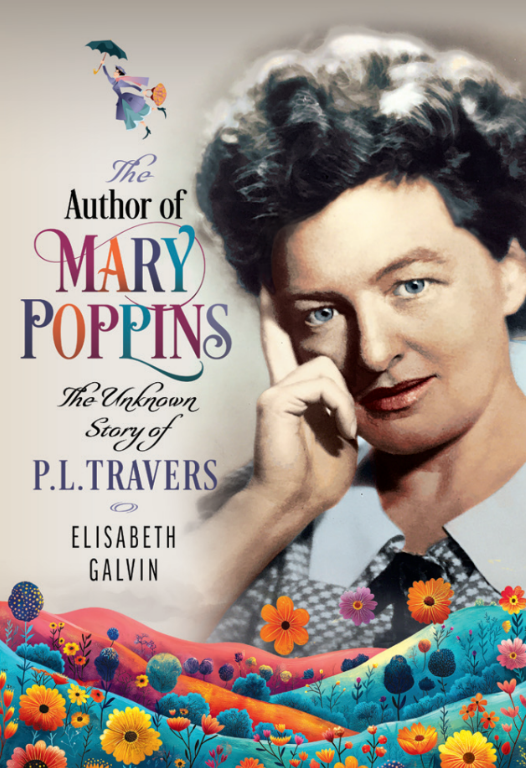
I am very excited to share my conversation with Elisabeth Galvin about her upcoming biography of P. L. Travers, the creator of Mary Poppins. This time, our conversation takes place in video form, a medium I avoided for a long time but have now come to accept as one I need to embrace.
In this interview, which I am sharing below, Elisabeth and I explore what first drew her to Travers, her research process, and the unexpected material she uncovered while tracing the life of a writer who has fascinated readers for generations.
We also talk about the people she met along the way who knew Travers personally, and how their memories and stories brought new texture and meaning to this biography. Travers’s complexity is portrayed in a gentle and respectful way, as Elisabeth is keenly aware of the responsibility that comes with writing a biography and of the difficulty of portraying with care and honesty a person one has never met. Elisabeth’s writing is also deeply atmospheric, carrying the reader through an almost visual experience of time and place. It is a delightful read, and I sincerely hope this book finds its way into the hands of many readers.
There is an additional reason for my excitement. I had the honor of writing the introduction to this biography, as well as an entire chapter on Travers’s spiritual beliefs, a subject very dear to my heart. I have been immersed in the world of Travers and Mary Poppins for over ten years, and I am convinced there is still much left to uncover. Travers lived a long and productive creative life, yet today she is often remembered only for Mary Poppins. I believe she is an author worth rediscovering. I also believe she was truthful when she said she did not write Mary Poppins with children in mind, and that these stories continue to hold important lessons for adult readers.
I hope you enjoy my conversation with Elisabeth Galvin, and that you will consider subscribing to The Mary Poppins Effect for more reflections and stories exploring the world of Mary Poppins and its connections to other literary worlds.
I am thrilled to share with you some biographical facts hidden in P.L. Travers’s book ‘I Go by Sea, I Go by Land’. I first read this fictionalized account of her evacuation from the UK to the United States during WWII in 2018.
Briefly, for those who are unfamiliar with the book, it is written in the form of diary entries from 11-year-old Sabrina who recounts her and her brothers’ evacuation to the United States during the Second World War. Sabrina and her brother are accompanied on their journey by Pel, a family friend who is a writer and the mother of a baby named Romulus. As revealed by Valerie Lawson in her biography of P.L. Travers, ‘Mary Poppins She Wrote’ Pel stands for P.L. and Romulus for P.L. Travers’s adopted son Camilus.
My second reading of ‘I Go by Sea, I Go by Land’ proved more fruitful than my first one. (This tends to happen when revisiting books.) At the very beginning of the book P.L. Travers writes that ‘the experiences recorded in the book are authentic’ and as the story is ‘a personal record (…) certain names have necessarily been altered.’ Taking P.L. Travers’s statement to the letter, I approached the story with the mindset of a detective, meticulously following every clue and detail. What follows is what I discovered about P.L. Travers’s visit to Montreal in the autumn of 1940.
Montreal is where my parents and I settled after leaving Bulgaria in the early 1990s, and although I no longer live in the city, it is where I work during the week and where I often spend time with friends. You can imagine the excitement I felt when I connected the dots between the hints in the book about the locations P.L. Travers visited and the people she encountered during her stay.
During her visit to Montreal, P.L. Travers stayed at the Windsor Hotel, where other famous authors, such as Charles Dickens and Mark Twain, had sojourned before her, although the story doesn’t say if she was aware of it. This is how she described the lobby of the hotel in ‘I Go by Sea, I Go by Land’ in the words of Sabrina who writes in her diary that the Hotel ‘is just like a Cathedral inside’.
Below is a picture of the lobby of the Windsor Hotel in 1878 taken by William Notmam and you can see why Sabrina (P.L. Travers) compares it to a Cathedral.
The Windsor Hotel was one of Canada’s most impressive buildings of the Second Empire style and was considered the best hotel in all the Dominion. It was a magnificent nine-story structure of sandstone and granite which span along the entire block of René-Lévesque (then Dorchester) Boulevard and Cypress Street, between Stanley and Peel (then Windsor) streets. To its guests it offered “palatial splendor with its gold-embossed lobby, six restaurants, two ballrooms, concert hall and 382 luxurious guest-rooms”.
Unfortunately, a fire devastated the hotel in 1957 and “the damages caused to the South wing were so great that the structure had to be demolished on August 12, 1959. All that remained was its 1908 North Annex – this portion of the former hotel still stands today.”
Below is a picture I took of it for this blog post.
Now, let’s turn to another revealing entry in Sabrina’s diary. She writes about how, upon their arrival at the hotel, they are greeted by the Red Cross. When Pel signs her name, a Red Cross representative named Letty recognizes her, suggesting that Pel is a famous author, and invites her to lunch at her home. Then the reader learns that Letty has four children, all boys and that her husband is ‘a famous doctor’ called Kent.
When Dr. Kent comes home, he offers the guests “cocktails of lemonade and coco-cola” and then takes Pel and the children for a drive to show them the river (Saint Lawrence River). At the end of the drive, at Pel’s request, he drops them off at the Cathedral. This is what Sabrina writes in her diary: ‘So she and James and I went in and there was water in two enormous sea-shells, very beautiful and fluted.’
The Cathedral in question is Mary Queen of the World Cathedral, which stands diagonally opposite form the Windsor building.
At its entrance stand two seashells filled with holy water. Below are the pictures I took for this blog:
Who was Dr. Kent?
Well, in my opinion, he could only have been Dr. Wilder Penfield, a neurosurgeon who revolutionized brain treatment. He became famous for his epilepsy operation, which came to be known as the “Montreal Procedure”.
I find his physical description in the book quite perceptive; it is exactly the impression Dr. Penfield gave me when I watched a documentary about him.
“He has the kind of face that makes you want to keep on looking at him. Very kind and twinkly and it seems to say to you ‘There now. Everything is all right. Don’t worry.’”
Dr. Penfield was born in 1891 in a middle-class family in Wisconsin, United States. He studied at Princeton and Oxford. He initially sought to establish his career in the United States, but it was not easy for a junior surgeon in an emerging medical field. At that time Montreal was a city with an internationally famous medical community but with no full-time brain surgeon. The only full-time brain surgeon in Canada had set up in Toronto.
The Royal Victoria Hospital went shopping for a brain surgeon in New York and in 1928 Dr. Penfield came to Montreal. In 1934, with the combined help of the Rockefeller Foundation, the City of Montreal and the Quebec government, he founded the Montreal Neurological Institute which is still in existence today.
Dr. Penfield had four children, two boys and two girls, who in 1940 were aged 22, 21, 14 and 13. In my opinion, P.L. Travers tried to keep Dr. Penfield’s identity anonymous by changing the genders of two of his children in the story.
But, there is another clue in “I Go by Sea, I Go by Land” that points in the direction of Dr. Penfield. During WWII his wife, Helen Kermott Penfield, was deeply engaged with a volunteer group helping émigrés from war-stricken Europe. She had joined the circle of the bourgeois Christian women of the United Church on February 20, 1940. In affiliation with St. James Church this group started a refugee committee which met on regular basis and Mrs. Penfield became very active from 1940 until 1943. On a pragmatic level she liaised with the Canadian Red Cross and arranged for collections of clothes and groceries. It seems more than likely that Letty was, in fact, Mrs. Penfield.
When considered together, these elements make a compelling case for a meeting between P.L. Travers and Dr. Penfield. Unfortunately, Dr. Penfield’s children have all passed away, so I couldn’t validate my theory. However, the coincidences are too significant to dismiss.
I hope you enjoyed reading this blogpost as much as I enjoyed writing it, and that you will come back to read more about P.L. Travers and Mary Poppins.
I am thrilled to tell you all about my recent conversation with renowned author Jane Yolen who had the opportunity to meet with P.L. Travers on two occasions, the first of which happened back in 1966. But first, let me share a bit about Yolen’s literary work.
Yolen has written over 400 books for children and adults and is the recipient of many literary awards among which are the Caldecott Medal, two Nebula Awards, three World Fantasy Awards, the World Fantasy Association’s Lifetime Achievement Award and the Science Fiction Writers of America’s Grand Master Award.
She, like P.L. Travers, is a poet with a deep love for fairy tales and has penned several unique retellings and re-imaginings of these timeless stories, infusing them with her own creative touch. I’ll delve deeper into her retelling of Sleeping Beauty and her novel Curse of the Thirteenth Fey in a future blog post. As you may know, Sleeping Beauty was P.L. Travers’s favorite fairy tale, which she explored and analysed (pondered) in her 1975 book, About Sleeping Beauty.
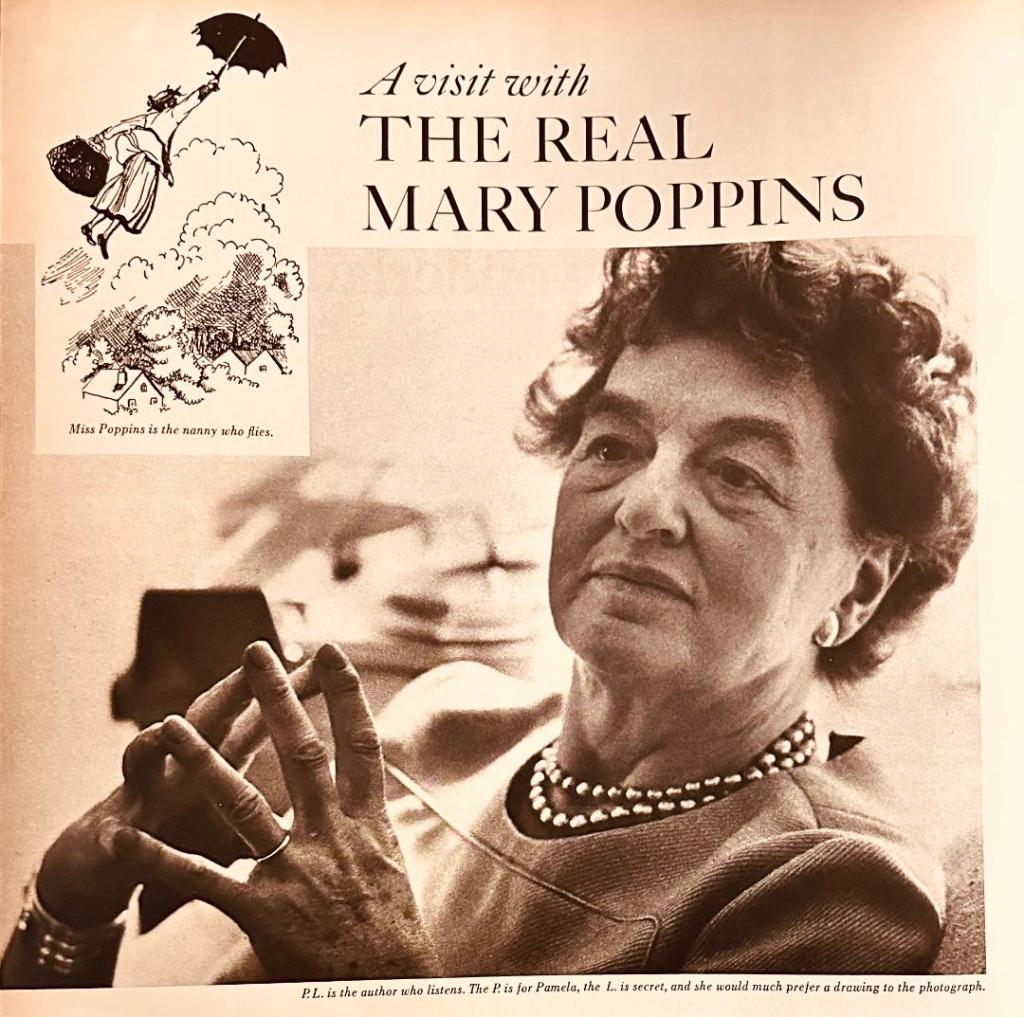
Yolen first met P.L. Travers in 1966 on the famous night when Look Magazine was covering an open house evening with her and a few students from Smith College. At the time P.L. Travers was a writer-in-residence at Smith College and, according to Valerie Lawson, she was not having a good time there.
An article titled “A Visit with the Real Mary Poppins” by Joseph Roddy, was published in Look Magazine on December 13, 1966. A hint of P.L. Travers’s difficulty to connect with the students echoes in the lines of Roddy’s article: ‘P.L. – she would prefer being Anon but will endure the initials – gets the ones who memorized Blake, pondered Camus, are awash in The Hobbit and know every move Mary Poppins made.’ He goes on to write: ‘The talk leaps across centuries every night P.L. has open house in a dormitory suite brightened only by handsome girls and snappy lines.’
According to Yolen’s recollections, there were about fifteen women present, along with the journalist and the photographer from Look Magazine. Yolen was a sort of VIP guest that evening. She, her husband, and their four-month-old baby were accompanying P.L. Travers’s goddaughter, who had a personal invitation to the event.
Yolen’s first impression of P.L. Travers was that she behaved much like the Mary Poppins from the books—whom Yolen had read and loved as a child.
Today, people who have not read the books think of Mary Poppins as the pleasant and charming character from the movies. Then, if they read the books, they are taken aback by the harsher version of the original character. I notice this contrast frequently on social media and I think that it is unfortunate because the expectations set by the movies prevent the readers from appreciating the depths and complexities of the original character.
Mary Poppins is more than just a caregiver in the stories; she acts as a mediator between worlds, initiating the Banks children to the mysteries of life. This dual role creates a fascinating split-personality dynamic that captivates children and adds to the mystery of Mary Poppins’s magic. As a child I never questioned why Mary Poppins could be strict and abrupt with the Banks children; I instinctively understood that it was all part of a playful facade. Beneath it all, she was a good fairy, and I knew that the Banks children felt the same way.
As an adult rereading the Mary Poppins stories and learning about P.L. Travers’s life and spiritual beliefs, I realize that Mary Poppins could be no other way in our world. While others may have different interpretations of the character, the true magic of Mary Poppins lies precisely in her paradoxical nature. The same is true for P.L. Travers herself.
According to Yolen’s recollections of that memorable night, both aspects of P.L. Travers’s character came to the forefront. The anecdotes that follow are not reported in Roddy’s article.
A young student, who had the audacity to begin a question by admitting she hadn’t read the books but had only seen the film, was administered a spoon full of vinegar by P.L. Travers: ‘Then Dear, you KNOW NOTHING, and I suggest you do not say another word.’ ‘It felt almost like she had cursed the poor girl,’ said Yolen, ‘she was reduced to stunned silence’.
Admittedly, there might have been a gentler way to handle the situation, but the fact is that, two years earlier, the Disney film had left a deep wound in P.L. Travers’ psyche—one that had not yet begun to heal (no matter how much money she got out of it, people keep bringing up this argument all the time…) The young student was likely unaware of all this, but who attends a writer’s event without having read their work and then feels entitled to express opinions? Isn’t that rather rude as well?
As for the movie, Yolen recalls watching it with her husband in London and enjoying the music. She did however find Dick Van Dyke’s Cockney accent rather strange, and she thought that the Mary Poppins of her childhood would never sing, “A spoonful of sugar makes the medicine go down.” She was right.
Mary Poppins never explains or sugarcoats anything. If medicine is required, it is administered with a stern demeanor that accepts no opposition, as the Banks children discover in the very first story “East Wind”. It is only after they swallow the medicine that they realize that it has magically transformed into their favorite flavor. For Jane it is lime-juice cordial, for Mickael it is strawberry ice and for the twins John and Barbara it is milk. This is the way of the real Mary Poppins.
Another amusing incident during the screening of the film by Yolen and her husband – and one that I’m sure P.L. Travers would have enjoyed hearing about – occurred when Yolen’s husband, a passionate bird watcher, suddenly stood up and exclaimed loudly during the scene where Julie Andrews is singing with the chirping audio-animatronic bird on her finger, ‘But this isn’t a British robin; it’s an American robin!’ The audience responded with laughter and approval.
Now let’s go back to the open house evening of 1966. After casting her chilling spell on the poor girl who knew nothing about Mary Poppins, P.L. Travers shape-shifted into a protective, motherly figure toward Yolen and her 4-month-old baby. When the baby began to cry, Yolen, not wanting to disturb the event, considered leaving, but P.L. Travers wouldn’t hear of it. She directed Yolen to her bedroom, where she could use the rocking chair and feed her daughter in peace. “She didn’t ask,” Yolen recalled, “she told,” and that, in fact, felt comforting. “It felt like I was in safe hands,” just as the Banks children felt safe in the care of Mary Poppins.
Years later, Yolen participated in a fundraising event for Parabola, a magazine co-founded by Ellen Dooling Draper and P.L. Travers. The event took place in New York, and Joseph Campbell was also in attendance. As a young writer and a collaborator of the magazine, Yolen was invited to the event. Unfortunately, her opportunities to engage with P.L. Travers were limited to brief exchanges of greetings, as P.L. Travers was busy hosting and entertaining the magazine’s patrons, revealing yet another side of her personality, the practical, business side!
Yolen recalls how Joseph Campbell leaped onto a chair and captivated the audience for more than half an hour with stories from around the world on the theme of giving. As I listened to Yolen’s vivid recounting, (she really is a great storyteller) I couldn’t help but yearn to travel back in time and experience the event firsthand. I wish I could have witnessed P.L. Travers’s reaction to Campbell’s performance. She, for some unknown reason, disliked him. It may have been motivated by feelings of rivalry; she was human, after all. Campbell was a scholar and a recognized expert in mythology, while she was self-taught, and although equally knowledgeable about myths and fairy tales, was not as popular as him. There may have been other reasons, but for now, they remain unknown.
It is fascinating to me how the paths of these two women writers intersected and how they were connected by their shared interests in fairy tales and love of poetry. One of Yolen’s poems, “Land of Miracles,” would certainly have been enjoyed by P.L. Travers, both for its origins and its message.
The poem was inspired by a serendipitous incident during a walk in a cemetery in Ireland. Yolen, who enjoys strolling in cemeteries, remembers how, on one such walk, she stumbled and steadied herself by leaning on a gravestone. She felt a sudden, electrifying sense of otherworldlines and then she realized with astonishment that the gravestone she had leaned on was that of the great magician and poet W.B. Yeats. This unexpected encounter inspired Yolen to write:
‘Yes, poetry matters. Words matter. Great buildings tumble. But story remains.’
I am deeply grateful for Jane Yolen’s generosity and for taking the time to reminisce about P.L.Travers, and I hope you enjoyed reading this blog post as much as I enjoyed writing it.
A new biography of P.L. Travers is scheduled for release in 2025 by Pen & Swords, a British publisher specializing in history and true crime. The author of this biography is Elisabeth Galvin, a British journalist and author who currently resides with her family in Brisbane, Australia.
Last year after discovering this blog, Elisabeth reached out to me, sparking a correspondence that eventually, to my delight, culminated in my contribution of a chapter about P.L. Travers’s spiritual beliefs.
Elisabeth Galvin has written two other biographies of famous children’s writers. The first one, “The Extraordinary Life of E. Nesbit”, which will be the subject of this blog post, was published in 2018. The second, “The Real Kenneth Graham”, was published in 2021.
P.L. Travers was in her own words “a tremendous Nesbit fan” and read her books again and again even as an adult.
I think so highly of her, and I’m absolutely sure that such writers as C.S. Lewis, forinstance, good though his books are, could never have existed without Nesbit.”
Transcripts of A Talk About Sorrow, July 1965
P.L. Travers and Janet Rance
Elisabeth Galvin drew some interesting similarities between the two writers during a recent conversation we had, and I’ve decided to share some snippets of it here for the benefit of the readers of this blog. But just before, let me provide a brief note about the life of E. Nesbit for those of you who are not familiar with her work.
E. (Edith) Nesbit was an English author and poet. She was born in 1858 and died in 1924, the year when P. Travers first came to London, so the two women never met. Edith lost her father when she was only four years old and had to change homes and schools often as her mother traveled frequently to France and Spain seeking a cure to the ailments of Edith’s older sister Mary.
Edith married Hubert Bland who later became an influential socialist journalist and with whom she co-founded the Fabian Society, a socialist organization in the late 19th and early 20th centuries.
She wrote numerous short stories, poems and novels both for children and adults. Her most well-known works for children include “The Railway Children”, “Five Children and It”, “The Story of the Treasure Seekers”, “The Phoenix and the Carpet”, and “The Enchanted Castle”.
Her ability to blend fantasy with everyday experiences resonated with readers and contributed to the evolution of children’s literature and as such had a significant influence on later writers, including C.S. Lewis, J.K. Rowling, and Jacqueline Wilson.
Now to my conversation with Elisabeth Galvin.
LS: Why did you choose to write a biography about E. Nesbit?
EG: Well, I always wanted to be an author, and I became a magazine journalist, and I absolutely loved my job. Then, when the opportunity came to submit some ideas for biographies about children’s authors to a publisher, I knew I had to take that chance. I thought about all the stories that I loved when I was younger, and Railway Children was one of my favorite stories. I still have the book that my parents gave me, a red leather-bound book with a gold spine – it’s such a lovely story, and E. Nesbit led such an interesting life as well, and I believe that is why I chose to write about her.
LS: Yes, she did have a tumultuous life, and I really enjoyed reading your book because you recreate the atmosphere of that period so vividly. I imagine you had to visit some of the places you write about in your book. Could you share some insights into your research process for the book?
EG: Yes, of course. It was an exciting process because as a journalist, I love meeting and talking with people and exploring different places. A notable experience was visiting Well Hall, where E. Nesbit lived with her family for some twenty years. I had the privilege of exploring it in the company of a member of the E. Nesbit Society, which truly brought the whole experience to life. We walked around Well Hall; while the original house was demolished in 1930, parts of the original gardens still remain and I saw the wooden statues portraying characters from E. Nesbit’s books, so yes, her spirit was definitely there.
(Picture taken from “The Extraordinary Life of E. Nesbit” by Elisabeth Galvin. Dame Jacqueline Wilson at Well Hall unveiling the wooden sculpture of the Psammead, commissioned by the E. Nesbit Society in 2013.)
I visited another one of E. Nesbit’s residences, Halstead Hall in Kent (click on the link to see the pictures). It was one of her childhood’s homes. It was lovely, it had the quintessential English garden and that is where she loved to spend time reading during her teenage years. I think she was 13 when she was there. The vicar who lived in the village at that time lent her his books and that is when she first came across Shakespeare. I could imagine this impressionable young girl lying in her garden looking at the apple trees and the roses and get a picture of her character, so it was very helpful going to those places.
Surprisingly, after E. Nesbit’s death, her personal papers were sold to The University of Tulsa in Oklahoma. She never went to America but was published there too, so I had to go there. I spent five intense days reading letters and other materials from the late eighteen hundreds and early nineteen hundreds and then suddenly came outside to see a Taco Bell and fire engines. It was a funny experience.
LS: Yes, I can imagine, it sounds like a real time travelling experience.Now, what proved to be the most difficult part in writing the book?
EG: The most difficult was knowing that I would never meet her, or talk to her or hear her voice, or ask her questions. A lot of biographies really are speculation, even if it is unintentional, your natural biases do come out. As a journalist you always want to tell the truth and be as fair as you can, and there is a sense of responsibility when delving into someone else’s life.
LS: Definitely, and this also applies to P.L. Travers, especially considering she did not want people to inquire about her private affairs. You mentioned previously that during your research on both women you noticed certain similarities between them. Could you tell us more?
EG: Well, it is amazing, actually. The more you think about it, the more similarities there are – both physically and in terms of their personalities. The way they approach life, the events that unfolded in their early childhood as well as their literary works exhibit striking similarities.
Firstly, both were very tall women with short curly hair. They possessed a somewhat androgynous appearance, attracting men and women. They were both, in a sense, single parents. E. Nesbit was married, but her husband was not particularly supportive.
They both had a “get up and go” attitude toward life. They experienced significant hardships, losing their fathers at a young age, and both had a nomadic childhood—P.L. Travers throughout Australia, and E. Nesbit across Europe, attending school in France and Spain.
Despite the disarray of their early years, they shared a deep love for reading, voraciously consuming any available books. Their affection for Shakespeare and a natural flair for writing emerged early in their lives. Both harbored aspirations to become poets, and perhaps even experienced a tinge of disappointment for not receiving the recognition they desired.
And they both wrote about ordinary children and everyday magic. Their skill was to remember what it was to be a child and to transpose the essence of childhood into their writings. And I don’t know if it is because they had such unusual childhoods, losing a parent at a very young age, but they always had an idealized version of family life.
LS: Do you think they would have gotten along if they had met?
EG: I am sure they would have had a lot in common to talk about. E. Nesbit loved bohemian parties and thrived on that kind of energy. Similarly, P.L. Travers loved to meet new people and make new friends. They were not solo writers, they loved sharing their knowledge and taking part in artistic gatherings.
And I believe they would have connected on the fairy tale aspect as well. P.L. Travers wrote about Sleeping Beauty in the 1970s, and E. Nesbit was also deeply interested in fairy tales, writing her own collection of fairy stories.
LS: I agree, they would have had a lot to talk about. They even shared common acquaintances, George Bernard Shaw for example. Their lives and literary contributions provide an endless well of discussion and we can go on for hours.
I want to thank you for taking the time to share your thoughts with the readers of the Mary Poppins Effect blog, and I hope to share more about our collaboration and your forthcoming biography of P.L. Travers in the coming months.