
Dear Reader,
Recently, I revisited a transcript of a conversation between P.L. Travers and Janet Graham that took place in P.L. Travers’s home on June 23, 1965. I like to do that occasionally. Although I love discovering new information about P.L. Travers and Mary Poppins, and all things related to them, rereading materials I’ve gathered over the years allows me to notice things I did not see the first time. Frequently, and to my enjoyment, the information I glean sends me into another tunnel in the rabbit hole in which I fell nine years ago, and I hope you enjoy being taken along on this exploratory journey.
The title of the interview is “A Conversation About Sorrow,” and it is one of my favorite P.L. Travers interviews. All her interviews are interesting and provide much food for thought, but I notice that their quality depended a lot on the chemistry between her and the interviewer. Luckily for us readers, when she liked the journalist, she was more talkative, and I get the impression from this conversation that she did like Janet Graham.
Today, I want to tell you about “The Three Little Foxes” by Mary Tourtel, a book that P.L. Travers kept with her since she was 7 years old. On the flyleaf of her book someone wrote the name of Mary Poppins, but according to P.L. Travers, it was not she who wrote it.

In the transcript “A Conversation About Sorrow” there is a handwritten note in the margin: “start of Mary Poppins”. It is right next to the passage in the interview where P.L. Travers told Janet Graham that her sister had mentioned that, as a child, P.L Travers told her siblings stories about Mary Poppins. However, P.L. Travers didn’t believe her sister to be right. She said, “I think she is having very clever hindsight”.
We will never know who wrote the name of Mary Poppins on the flyleaf. It is possible that her son Camillus wrote it when he was a young boy. He must have seen the book in his mother’s library and, knowing that she wrote the Mary Poppins stories, could have written it himself. I know I used to scribble things in books as a child, but of course, all this is just a speculation on my part.
P.L. Travers loved the story of “The Three Little Foxes”. She said, “It was a lovely story. Three Foxes called Ringo, Bingo and Lubilee – What beautiful names, Ringo Bingo and Lubilee. They were great family names; my mother was always calling us those names. She had the kind of mind quotations stuck in.”
And that is all she said about the story in the interview. What was it about? What did the little foxes do? Why did she like it so much to keep it with her all this time? Was it because of her fond memories of her mother, or was it something else?
I wanted to find out, and luckily, I managed to find an old (and affordable) copy on the Internet. It did not have ‘Mary Poppins’ written on its flyleaf, (I secretly wished it did!), but at least I now know the story and can speculate about why she might have liked it. I wonder who has her copy of the book now?

“The Three Little Foxes” tells the story of three brothers who decide to leave their cozy home and seek adventure in the world. In fact, it is the two oldest brothers, Ringo and Bingo, who are bored and need a change of scenery. Meanwhile Lubilee, the youngest brother, is quite content at home and doesn’t really have time for boredom. He is busy in the kitchen cooking and taking care of his brothers. But when the older brothers decide to leave their home, he must follow them, albeit unwillingly.
The three brothers meet a frog who tells them that if they are in search of adventure, maybe they could rescue the Fox Princess, who is kept hostage by the Old Bear Ogre. The three little foxes must go see the Queen of the Rabbits, who knows of a secret entrance to the grounds of the Bear Ogre’s castle. The Queen agrees to help them and orders one of her guards to lead the brothers through a secret passage leading to the garden where the Fox Princess likes to spend time.
When the three brothers arrive at the entrance of the passage, which turns out to be a long and winding tunnel, it is only Lubilee who musters enough courage to follow the guard. Scared Ringo and Bingo remain behind.

Lubilee succeeds in finding the garden and meets with the Fox Princess who, at that precise moment, happens to be strolling there. He tells the princess that he and his brothers have come to save her, but she warns him that the task is going to be difficult. The Ogre keeps her locked up in a lonely tower.
It was at this point in the narrative that I failed to follow the logic of the story. It is unclear (and frankly does not make much sense) why the Princess does not run off with Lubilee towards the secret tunnel and out of the garden right there and then. Instead, she tells Lubilee where the Ogre hides the key to her tower. It is in a box he uses as a footstool while sitting on his chair.
Lubilee goes back to his brothers, tells them all about the Princess and the key, and they come up with a plan on how to gain entrance into the Ogre Castle. They present themselves as acrobats who want to perform before the Bear Ogre.
During their performance, which consists of the two older brothers standing on their heads while Lubilee spins plates on sticks, the Bear Ogre sits comfortably in his chair with his feet on the footstool. However, their chance comes when Bear Ogre invites them to stay over for dinner and a little dance.
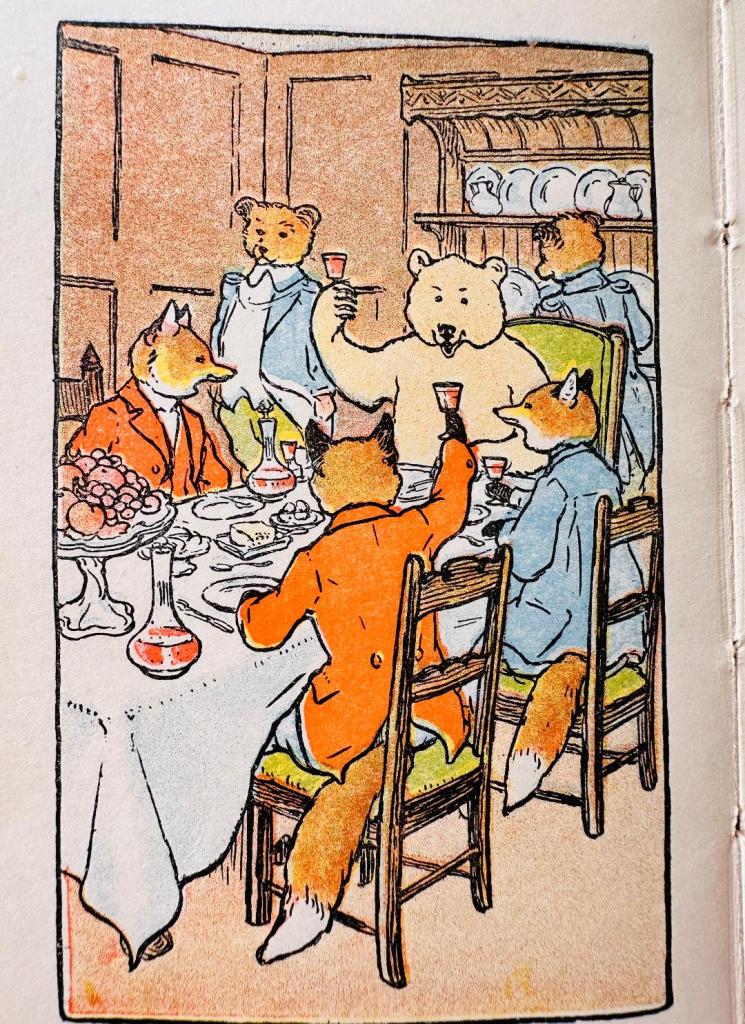
After dinner, the Bear Ogre wants to show his abilities too and he begins to dance the Keel Row. He is so taken by his dancing that he does not notice little Lubilee taking the key from the box in the footstool.
As soon as the little foxes find themselves outside of the castle, Ringo and Bingo start quarrelling over who should marry the Princess. In the meantime, Lubilee runs towards the tower and frees the Princess.
The Fox King was so glad that he called his Queen, gathered his court together and made Lubilee a Prince on the spot. Lubilee and the Princess become husband and wife.
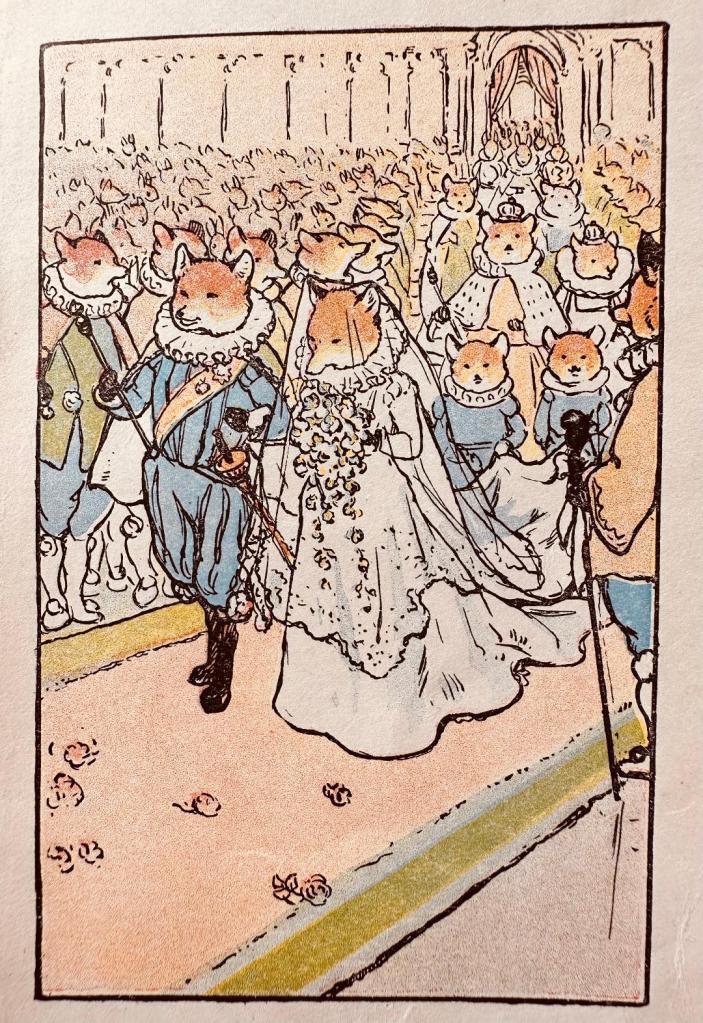
When Ringo and Bingo finally find their way to the Fox King’s City, they begin to tell everyone who wants to hear that they were the ones who saved the Princess, and that Prince Lubilee is an impostor. Their slander lands them in a dungeon, but then good-hearted Lubilee frees them and appoints Ringo his Prime Minister, and Bingo the Commander-in-Chief of his Army. This decision seems very unwise to me…and could potentially propel Lubilee on another hero’s journey. Maybe I will try my hand at writing a sequel…but who will illustrate it?
P.L. Travers wrote an essay titled “The Youngest Brother”, it was first published in ‘Parabola’ on the theme of the Trickster in 1979 and then in “What the Bee Knows” in 1989. She reflects on the character of the youngest brother in fairy tales, who is often depicted as a simpleton, meaning, as she tells us, innocent and blessed. He is not yet burdened with knowledge and pride. He eagerly offers and accepts help from others, no matter how strange they may appear.
She goes on to explain the usual sequence in these types of stories, which “The Three Little Foxes” follows closely.
The stories always begin with a quest, something that only the three brothers can undertake. However, the usual mistake of the two older brothers is that they believe success in their quest depends solely on themselves. Consequently, they often find themselves imprisoned at the beginning of the story, unable to continue their quest.
In these stories, P.L. Travers tells us, there is also an imprisoned princess who is the youngest brother’s complementary figure. Then, the youngest brother is wronged by the older brothers who are envious and greedy, just like Ringo and Bingo in the story, and things can become quite dangerous; all can be lost.
In the end, the youngest brother forgives his brothers’ sins. P.L. Travers links this pattern of forgiveness to Plato’s myth of the Cave: “... where those who have risen to the light go down again to rescue others who still live with the shadows.”
The third and youngest brother in fairy tales is always in service of something else than himself and does not think he knows it all like his older brothers, who consider themselves to be men of the world who know their way about it.
Knowing tells us P.L. Travers is achieved through unknowing. Learning through experience, the man becomes a child – pure at heart.
She also links the progress of the youngest brother through his quest to Gurdjieff’s Law of Seven and the concept of repairing the past in the present. Although original and interesting, this calls for a separate blog post.
I hope you enjoyed this post and will come back again to read some more about P.L. Travers and Mary Poppins.
Until next time…
