
Dear Reader,
Words can hardly describe my surprise and excitement when I found an email in my inbox from the American historian and author Benson Bobrick, telling me that he had been friends with P. L. Travers and had written about their friendship in his memoir, Returning From Afar: A Memoir.

(Benson Bobrick with his beloved Samson.)
Obviously, the first thing I did even before responding to his email was to order a copy of his book. Then, after composing myself, for this lucky occurrence felt almost miraculous, I responded to Bobrick, and what followed was a wonderful correspondence that offered me unexpected insights into the life and personality of P. L. Travers.
In Returning From Afar, Bobrick reflects on his life and his journey towards building a fulfilling career as a writer, tracing his family history back to his maternal great-grandfather. He shares the few memories he has retained of his mother, whom he lost when he was only eight years old, and reflects on his difficult relationship with his father. He revisits his years at boarding school as a young boy, then his college years, recalling the events and people who helped shape him into the man he became. Beneath the account of Bobrick’s personal and professional life runs a deeper current of longing to understand its meaning, to integrate the events and choices of the past into a coherent whole, offering the reader an authentic account of a life deeply examined.
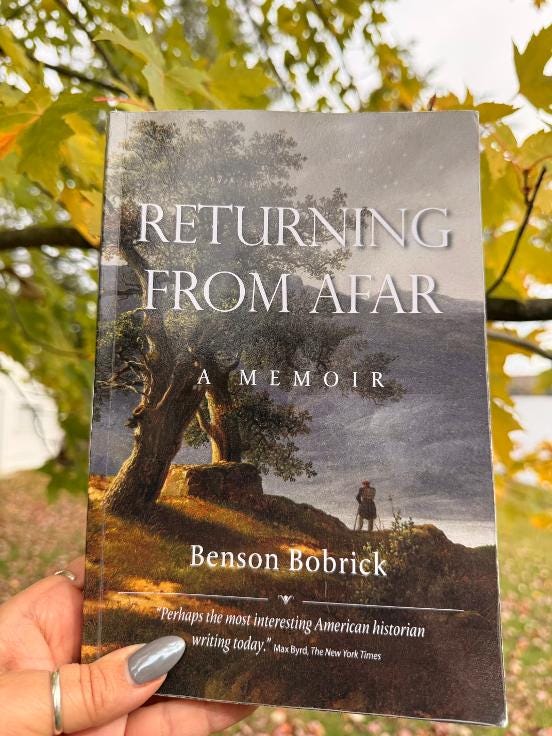
Bobrick devotes a full chapter in his memoir to his relationship with P. L. Travers and the impact she had on his spiritual development. To my delight, he generously includes excerpts from the correspondence they maintained throughout their friendship, which lasted for many years.
Letters from writers addressed to friends often reveal more of an author’s personality than interviews could ever do. Yet, in the case of P. L. Travers, there is a remarkable thread of consistency running through her writings, interviews, and personal letters, suggesting a genuine authenticity in the way she expressed herself.
Bobrick was in his thirties when he first encountered P. L. Travers, then in her late seventies and already an established figure within the Gurdjieff Society. Their first meeting took place in New York, in her appartement on York Avenue. (P. L. Travers travelled regularly to the United States, where she gave lectures and completed several writers’ residencies at various colleges.)
This is how Bobrick describes his first impression of her in his memoir:
(…) she was seated in an erect and stately fashion, neatly attired in a white linen dress, her wrists and fingers bedecked with silver jewelry. Her hair was not abundant but seemed more so by being curled; and when she turned to greet me, I was struck by the bright blue clarity of her eyes. At the same time, their concentrated core had a kind of metallic luster, like polished orbs of hematite. Her knowing gaze was full of expectation, perhaps assessment: I felt at once I must not disappoint.
They forged a bond through literature, discussing T. S. Eliot (whom she knew personally), Blake (one of her favourite poets), and Sir Thomas Browne, whom I discovered she also admired. They shared spiritual sensibilities, and as Bobrick writes in his memoir, she completely transformed his understanding of what it meant to be alive. Her imprint is evident from this passage at the very beginning of Returning from Afar:
The most interesting part of life is the growth of the soul. The rest, in the main is theater – names, dates, adventures, masquerades, escapes. A memoir can be – as I hope this is –not only a record of events, but of the stages of an evolution, in so far as that can be grasped. The light that sheds on the life means more than any cavalcade of facts. “What use is the right fact,” as a character remarks in a story by P.L. Travers, “when the point of view is wrong?” The process of self-discovery makes living worthwhile.
This echoes P.L. Travers’s view on autobiographies:
Being born, going to school, having measles or not, being married or not, wouldn’t really be an autobiography for me – it would be more of an inner statement, how one grew within, the hopes, the difficulties, the aim.
P.L. Travers in conversation with W.H. Auden, The Island No.2, March 1966
Bobrick writes in his memoir that P.L. Travers embraced the doctrine of Gurdjieff “as divining profound truths, which she found reflected in other great teachings as well as timeless tales”. She saw in the fairy tale of Sleeping Beauty the motif of “the slumbering, unclaimed Self, enclosed within “the automatically growing forest of hour habitual nature.” On this subject he added in our correspondence that “her reading of The Sleeping Beauty, for example, was profoundly affected by Gurdjieff’s teaching, yet in a sense exceeds it, by being allusive, rather than presenting a dogmatic idea.”
It was P. L. Travers’s signature, both as a writer and, as I now understand, as a spiritual mentor, to refrain from being prescriptive. She taught through indirection and firmly believed in the power of questioning and pondering, allowing understanding to reveal itself in its own time.
For those unfamiliar with Gurdjieff’s teachings, Bobrick summarizes succinctly the main concept around which Gurdjieff organized his system. He held that the state of the average person is “marked psychologically, by mechanical and associative thoughts; that our thoughts, sensations and emotions belong to as many shifting selves; and among them there is no coherent, reliable “I”. Man according to Gurdjieff is asleep and must work towards the harmonisation of his conflicting impulses.
The way out of this inner disharmony, according to Gurdjieff, is through the disciplined process of “self-remembering”. Or in other words, the practice of being consciously aware of oneself while, at the same time, remaining aware of what one is experiencing. By this, Gurdjieff meant not merely intellectual self-awareness or introspection, but a particular state of divided attention in which one is simultaneously aware of oneself and of what one is experiencing in the present moment. This bi-directional attention interrupts the habitual mechanical state in a person by creating moments of genuine consciousness. It creates a state where a person is being aware of what they are doing, feeling, or perceiving while simultaneously maintaining the sense “I am here.”
Bobrick’s encounter with P. L. Travers had the backdrop of Gurdjieff’s teachings, but at the end, he never became an official member of the Gurdjieff Society. He did, however, come to appreciate certain aspects of Gurdjieff’s thought, particularly self-remembering and the idea of repairing the past, both of which continue to resonate with him today and which he found embodied in the person of P. L. Travers: “In her own extraordinary alert, forthright presence she seemed to exemplify what self-study might achieve.”
Gurdjieff’s idea of repairing the past has affinities with the Christian concept of repentance, but places the emphasis not on seeking forgiveness, but on becoming conscious of one’s past mechanical behaviour. He encouraged his pupils to awaken from their habitual patterns of reaction, emotion, and identification and to recognize the moments in which they had acted unconsciously. Once they could see what they had been unable to see at the time, they were asked to confront the consequences and contradictions of their actions and experience what Gurdjieff called remorse of conscience. This conscious suffering could then become material for inner transformation. In this sense, the past could be revisited and repaired in the present.
On this subject, Bobrick shares in his memoir that P.L. Travers once wrote to him that “she believed in a dialogue with the dead – in the need, as she advised in a letter, “to work with and repair the past – (both for ourselves and the past).
While the rest of Gurdjieff cosmology did not find inner resonance with Bobrick, his friendship with P.L. Travers remained intact as she allowed his development to follow its own course, evidence to her non dogmatic approach to spirituality.
In our correspondence, Bobrick shared his belief that P. L. Travers “surpassed Gurdjieff in understanding, with a knowledge drawn from the whole Canon of Western and Eastern literature and culture, which gave her a wider lens.” He also acknowledges that P.L. Travers would have disagreed with this statement, but I share his reverence for her wisdom and her gifts of observation.
P. L. Travers has often been described as difficult and demanding, and I’ve always felt that such descriptions read more like labels, particularly when they are offered without specific examples of what made her so. Knowing, too, how readily strong women can be labelled as difficult, I have always been resistant to this characterization of her personality. That is, until I read Bobrick’s illuminating explanation in our correspondence:
Though she was ever demanding, she was also loving and kind and above all yearned to serve. She expected you at any and every moment to be present: alert, conscious, and self-possessed. At the very least she wanted you to aspire to that state. For only in such a state can one make deliberate choices that reflect a consciousness.
It is no wonder, then, that people felt challenged in their interactions with her.
Service was an important part of P. L. Travers’s spiritual outlook, particularly in the later years of her life. In a 1982 interview with The Paris Review, she spoke of the human search for something that we cannot possess but serve, something higher than ourselves adding that this search had been her own throughout her life.
But what did service mean to her in practice? When I asked Bobrick how P.L.Travers understood service, and how this yearning to serve expressed itself in her life, he wrote back: “Her idea of service was to help others gain conscious possession of their lives.”
That is not an easy task, either on the giving end or on the receiving end. It also makes me wonder whether some of what others perceived as difficult in P. L. Travers was, at least in part, an expression of what she understood as service.
If you think about it, service is also at the heart of Mary Poppins’s character, both in her role within the Banks family and in the lives of her readers. I believe this is also how P. L. Travers eventually came to understand her fictional creation, although I suspect that the idea of Mary Poppins as a servant was not consciously articulated from the beginning. In my view, making Mary Poppins the children’s caregiver was an inspired choice. It allowed her to be close to the children without being their parent, giving her the freedom to introduce them to the mysteries of life in ways their parents could not. In her 1962 interview with Geoffrey T. Hellman in The New Yorker she said: “Parents don’t bring magic to children, but servants do, and sometimes an aunt or an uncle.”
In her later interviews, P.L. Travers herself spoke of Mary Poppins as a servant, a role that seems to me to extend far beyond her domestic duties. Mary Poppins comes not only to reveal the mysteries of life to the Banks children, but also to disrupt the habitual ways of thinking and behaving of the adults around her. But that is the subject for another post.
I could tell you more about Bobrick’s friendship with P. L. Travers, but instead I invite you to read his memoir, Returning From Afar, a fascinating book in its own right and what I see as Bobrick’s own exercise in repairing the past. In the chapter devoted to P. L. Travers, you will also find a wonderful poem he composed for her, inspired by the image of the seeker she had evoked in one of her talks.
I am forever grateful to Bobrick for offering me this glimpse of P. L. Travers at a time in her life when her accumulated experience and lifelong study of myth, fairy tales, and world religions had been distilled into wisdom that she was willing to share with those who were receptive to it.
That’s all for now. I hope you enjoyed this post, and if you would like to join me as I continue exploring the many paths of the Mary Poppins rabbit hole I fell into ten years ago, you are very welcome to subscribe.
Until next time, be well.
Lina
Discover more from LINA SLAVOVA
Subscribe to get the latest posts sent to your email.


Thank you, Lina. Just ordered it!
LikeLike