Dear Reader,
One of the things I enjoy most is uncovering subtle connections that link different literary worlds, and today, I invite you to explore the connections between the Mary Poppins stories and the adventures of Alice as imagined by Lewis Carroll.
The creation of Alice’s world precedes that of Mary Poppins, and it is therefore no surprise that P.L. Travers, consciously or unconsciously, drew on elements from the Alice stories. Not in the sense of direct borrowing, but rather that certain moments in Mary Poppins seem clearly inspired by Alice’s Adventures in Wonderland and Through the Looking-Glass, and What Alice Found There.
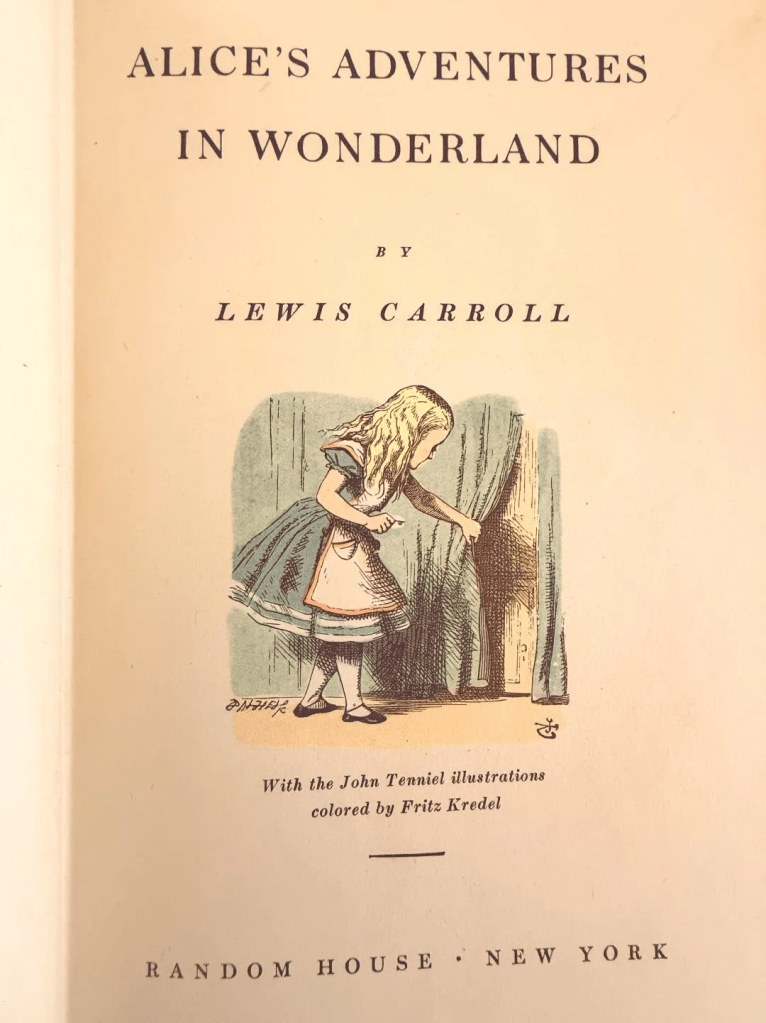
Alice’s Adventures in Wonderland and Through the Looking-Glass were among P. L. Travers’s favourite childhood books. She later remarked that while she revered Alice, she harbored a “lurking, sneakish lack of liking” for Lewis Carroll. She did not elaborate further on her dislike, but it may have been related to his unusual attraction to young children. I must admit that I, too, felt deeply uncomfortable reading the sections of Carroll’s biography by Morton N. Cohen that address his relationships with children, even though Cohen clearly admired Carroll’s mind and imagination and attempted to approach this aspect of his personality with empathy for the suffering it caused him.
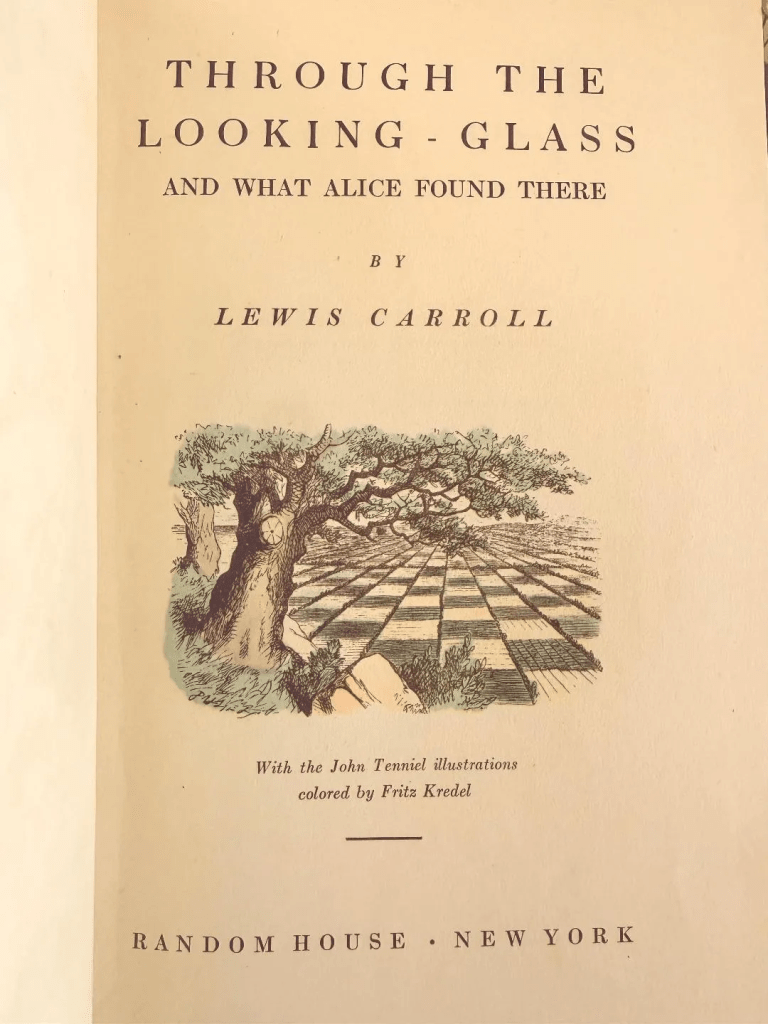
P. L. Travers repeatedly told interviewers that she did not write Mary Poppins with children in mind. To illustrate her point that books are not necessarily written for children, she referred to the creation of Alice’s Adventures in Wonderland. In her interview with Edwina Burness and Jerry Griswold for The Paris Review (The Art of Fiction No. 63), she said:
“If you look at other so-called children’s authors, you’ll see they never wrote directly for children. Though Lewis Carroll dedicated his book to Alice, I feel it was an afterthought, once the whole was already committed to paper.”
This, however, is not entirely accurate. Carroll did write the first version of the story, Alice’s Adventures Underground, at the request of Alice Liddell, and it was later revised and expanded. This is Carroll’s own account of the creation of Alice in Wonderland:
“The germ of Alice was an extempore story, told in a boat to the three children of Dean Liddell: it was afterwards, at the request of Miss Alice Liddell, written out for her… without the least idea, at the time, that it would ever be published. But friends urged me to print it, so it was re-written, enlarged, and published.”
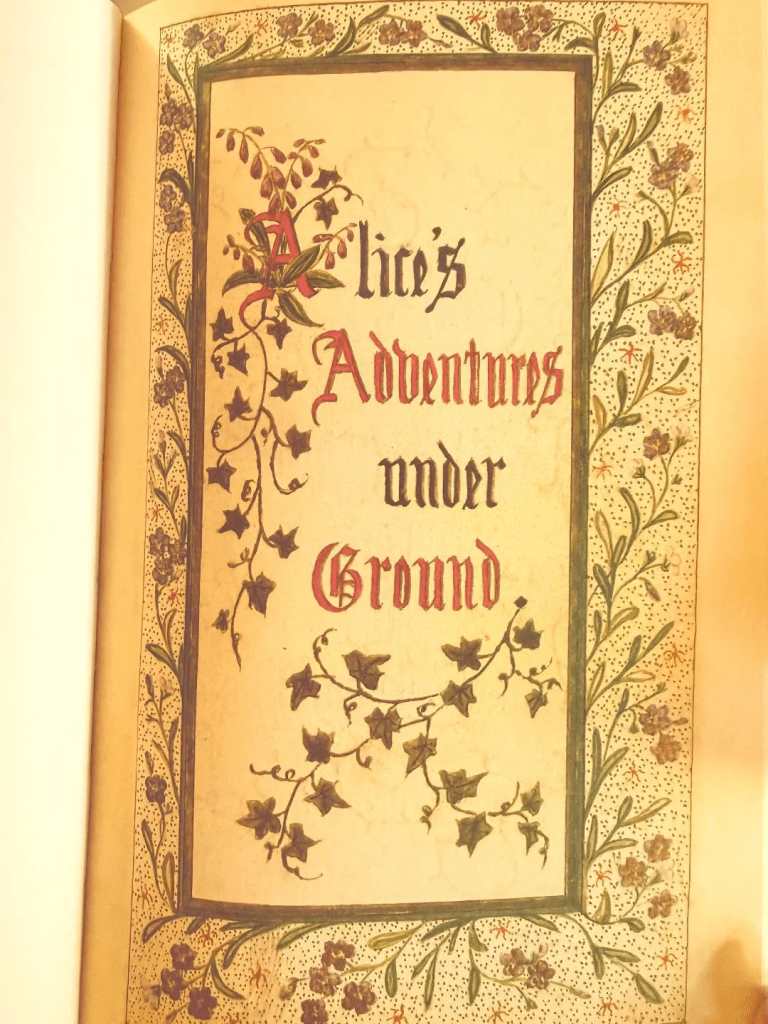
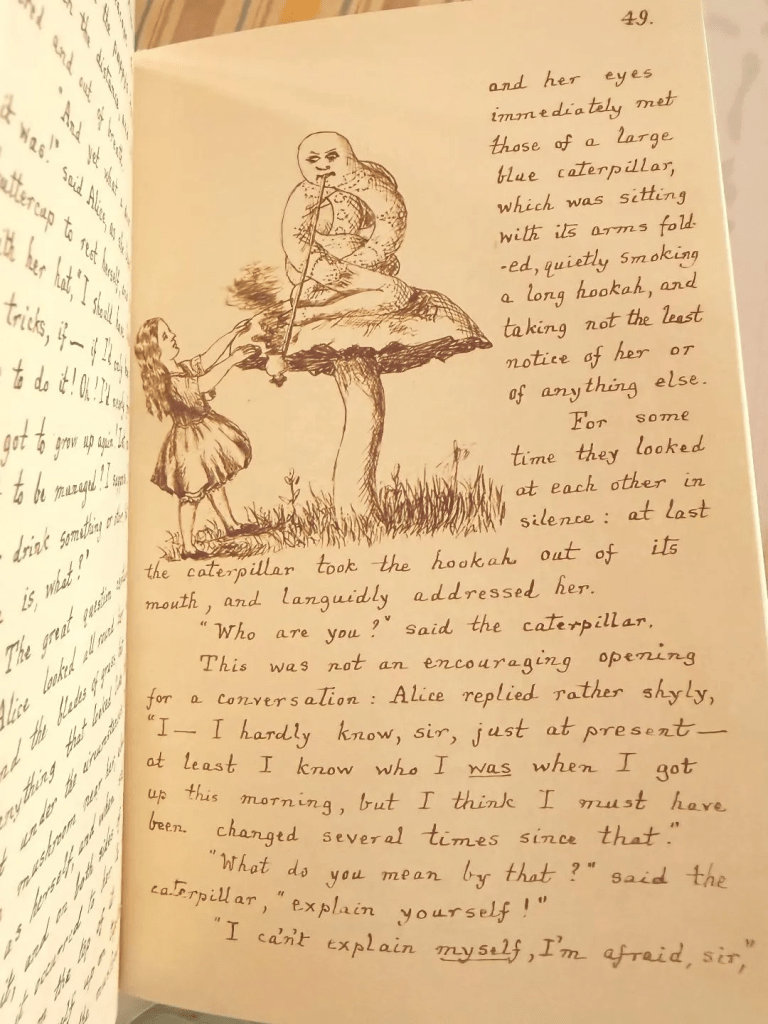
This is how Alice’s Adventures in Wonderland came to be. And even though it began as a story told for the amusement of children, it is undoubtedly much more than that. As with Mary Poppins and many other enduring works of children’s literature, these stories contain deeper layers of meaning that are accessible only to adult readers who bring the necessary depth of experience.
But for now, let us consider how the imagination of one writer may have quietly nourished the imagination of another. For no human creation, however original it may appear, emerges in isolation. It grows from what has come before.
Scholar Julia Kunts, in Intertextuality and Psychology in P. L. Travers’s Mary Poppins Books, draws a number of perceptive connections between Alice and the Mary Poppins stories. She identifies the first echo in the opening chapter, “East Wind,” when Mary Poppins arrives at 17 Cherry Tree Lane.
As Mary Poppins unpacks her carpet bag in the nursery, Jane and Michael watch with great curiosity. Among the items she produces is a bottle labelled “One Tea-Spoon to be taken at Bed-Time,” recalling the bottle marked “Drink Me” that Alice finds on the glass table in the long hall she finds herself in once down the rabbit hole. And just as Alice discovers a liquid with a curious “mixture of flavours, cherry-tart, custard, pineapple, roast turkey, toffee, and hot buttered toast’, the contents of Mary Poppins’s bottle transform according to each child’s taste: strawberry ice for Michael, lime-juice cordial for Jane, milk for the twins John and Barbara, and rum punch for Mary Poppins herself.
Kunts also observes that, much like the characters in Alice who subvert and mock the logic of the ordinary world, Mary Poppins repeatedly unsettles the expected order of things, much to the distress of the Park Keeper, who is determined to keep everything properly arranged.
Another obvious parallel between the two fictional worlds is the use of characters from nursery rhymes. Just as Lewis Carroll incorporates nursery rhyme figures in Through the Looking-Glass, P. L. Travers introduces similar characters in the story “Happy Ever After” from Mary Poppins Opens the Door. Among them are Humpty Dumpty and the Lion and the Unicorn, who appear in both worlds.
When Alice meets Humpty Dumpty, he is perched on a high wall so narrow that she wonders how he manages to keep his balance. He, however, is entirely unconcerned. Having secured the King’s promise that all his men will put him back together again should he fall, he speaks with great confidence. Yet, in the end, there is a great crash that echoes through the forest.
When Michael Banks encounters Humpty Dumpty in “Happy Ever After,” he is surprised to find him in one piece. Humpty Dumpty replies: “Pooh — horses! What do they know about it? And as for the King’s men — stupid creatures! — they only know about horses! And because they couldn’t put me together, it doesn’t say no one else could, does it?”
In Through the Looking-Glass, Alice witnesses the battle for the crown between the Lion and the Unicorn, interrupted by a pause for refreshments of white and brown bread. In Mary Poppins’s story, however, the Unicorn and the Lion dance instead of fighting, as they find themselves in the Crack, the moment between the first and last stroke of midnight on New Year’s Eve, a brief interval in which all opposites are harmonised and held in balance.
But beyond the parallels noted by Julia Kunts, one detail struck me in particular. I believe the origin of Mary Poppins’s bottomless carpet bag to lie in Haigha’s bag in the chapter “The Lion and the Unicorn” in Through the Looking-Glass:
“Haigha took a large cake out of the bag and gave it to Alice to hold, while he got out a dish and carving knife. How they all came out of it Alice couldn’t guess. It was just like a conjuring trick, she thought.”
The resemblance is difficult to dismiss. What appears in Carroll as a conjuring trick re-emerges in Travers as a defining attribute of Mary Poppins: a magic bag that appears empty but contains a surprising number of items.
Building on these parallels, I would argue that P.L. Travers’s imagination does not merely echo Carroll’s but transforms it in a distinctly original way and what matters is that, despite these subtle echoes of another enchanted world, her imagination remains entirely her own. She does not imitate. She transforms.
Thank you for reading. If you enjoyed this article, I invite you to subscribe to The Mary Poppins Effect, where I explore the work of P.L. Travers, the world of Mary Poppins, its connections to other literary worlds, and the symbolic imagination at the heart of classic children’s literature.
Until next time, be well.
Lina
Discover more from LINA SLAVOVA
Subscribe to get the latest posts sent to your email.


Aw thank you ever so much for this most enriching and delightful voyage into the literary mysteries of PL Travers. As one who is also a fan of Lewis Carroll, this has especially touched my heart. Shared as widely as possible:-)
LikeLike