
Dear Reader,
This weekend I visited an immersive exhibition in Montreal devoted to the world of Sherlock Holmes, the legendary detective created by Sir Arthur Conan Doyle. It was both fun and educational, but as any bookworm would probably agree, there is something almost transcendental about seeing in real life the desk at which Conan Doyle wrote the Sherlock Holmes stories. I only wish I could have touched it. There was also his richly ornate inkwell set, along with many other interesting objects.
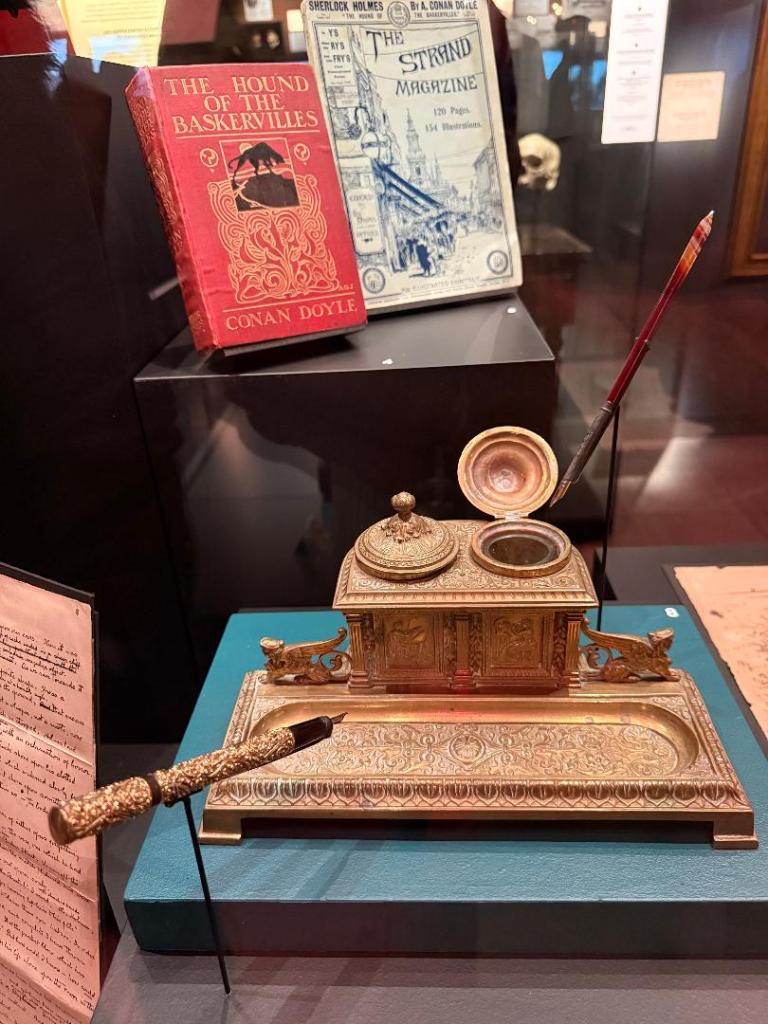
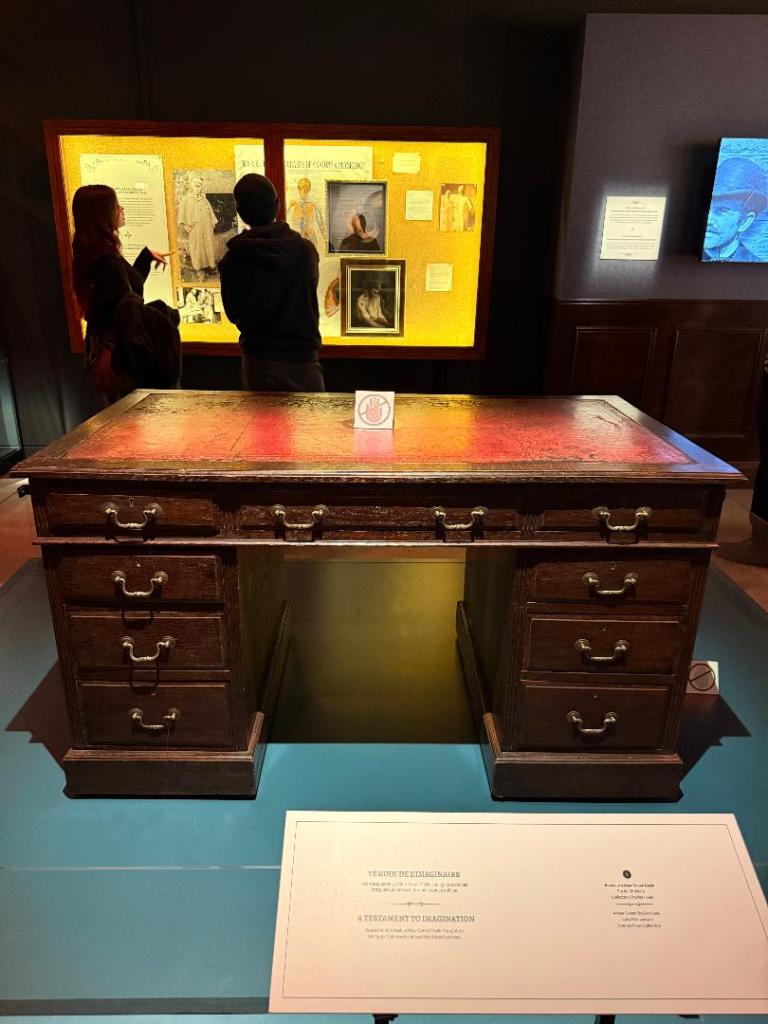
Beyond the objects themselves, the exhibition led me to reflect on an unexpected connection between Sherlock Holmes and Mary Poppins. One section included a video recording of Conan Doyle speaking about his creation and about the correspondence he received from readers. He explained that he was surprised by the number of people who were convinced that Sherlock Holmes was a real, living human being. He received letters addressed directly to Holmes, letters requesting his autograph, letters written to his friend Dr. Watson, and even letters from women offering to become his housekeepers.
This immediately reminded me of an interview with P. L. Travers in which she said that people wrote to her asking whether Mary Poppins could be sent to their home to help with the raising of their young children. When I first read this, I assumed that people were simply being whimsical and indulging in wishful thinking, but were still aware that Mary Poppins is a fictional character. Surely they could not truly believe that Mary Poppins was a living, breathing being in our world, even though I was convinced of it myself as a child.
Now, hearing that readers reacted in the same way to another fictional character, I have come to a different conclusion. This longing to meet such characters in person may be the strongest proof of a truly successful literary creation, one that feels original and extraordinary. It makes me wonder whether P. L. Travers was aware of this striking similarity between her experience as an author and that of Conan Doyle.
There are other curious parallels as well. Both writers were interested in the occult, though in different forms, and both shared a belief in an invisible dimension beyond ordinary perception. Both authors refused to treat imagination as mere fantasy. They seemed to believe that imagined figures could carry truth, presence, and meaning that felt real to readers. That kind of openness allows characters to feel alive rather than invented, which may explain why readers wrote letters as if Sherlock Holmes and Mary Poppins actually existed.
And lastly, Sherlock Holmes’s creator wanted recognition for his historical novels and did not want to write as many Sherlock stories as he did. Similarly, P. L. Travers wrote other books and essays on myth and fairy tales and complained that people only wanted Mary Poppins stories from her. Both fictional characters became larger than their creators, and the relationship between creator and creation was riddled with ambiguous feelings. Isn’t it funny how what brings outer success does not always equate to inner fulfilment?
I hope you enjoyed reading this post and will consider subscribing to The Mary Poppins Effect for more stories exploring the world of Mary Poppins and its connections to other literary worlds.
Until next time, be well.
Lina
