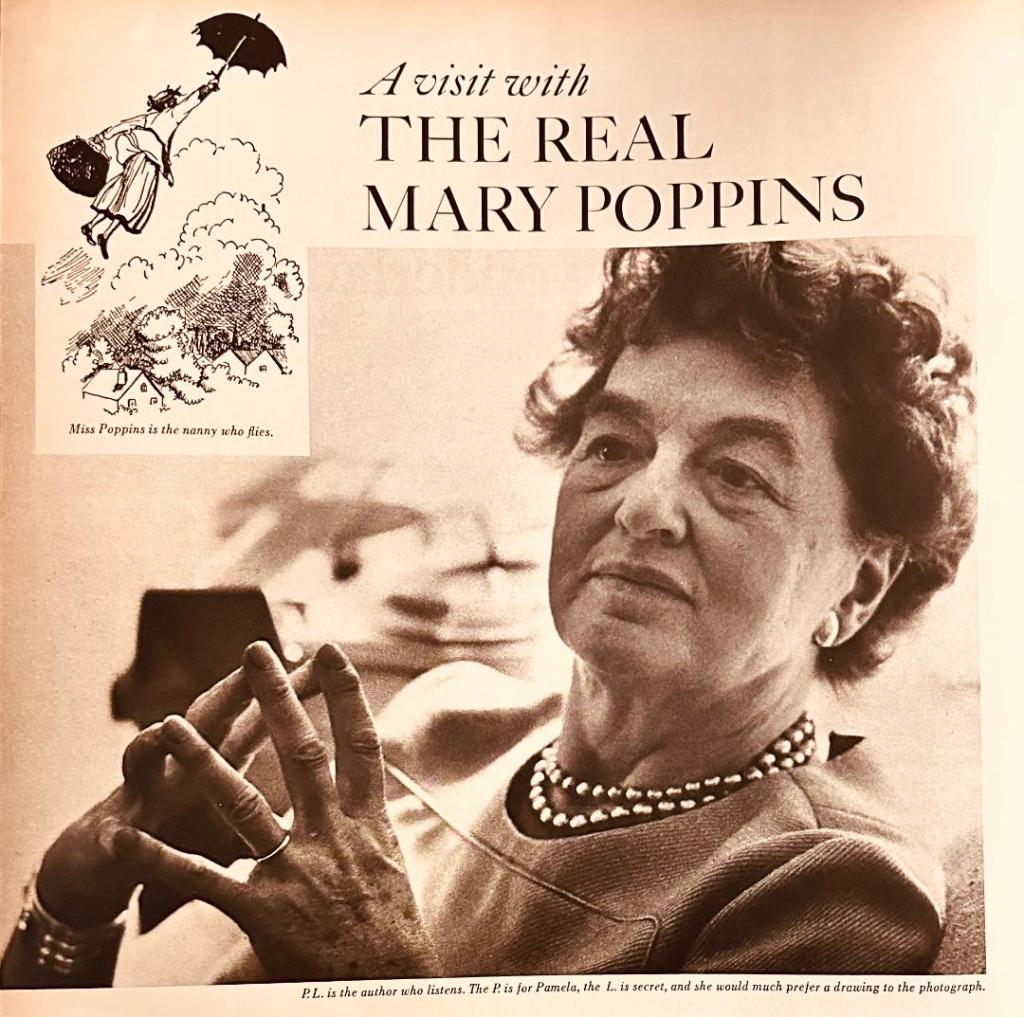
Picture from Look Magazine, December 13, 1966
Dear Reader,
I am thrilled to tell you all about my recent conversation with renowned author Jane Yolen who had the opportunity to meet with P.L. Travers on two occasions, the first of which happened back in 1966. But first, let me share a bit about Yolen’s literary work.
Yolen has written over 400 books for children and adults and is the recipient of many literary awards among which are the Caldecott Medal, two Nebula Awards, three World Fantasy Awards, the World Fantasy Association’s Lifetime Achievement Award and the Science Fiction Writers of America’s Grand Master Award.
She, like P.L. Travers, is a poet with a deep love for fairy tales and has penned several unique retellings and re-imaginings of these timeless stories, infusing them with her own creative touch. I’ll delve deeper into her retelling of Sleeping Beauty and her novel Curse of the Thirteenth Fey in a future blog post. As you may know, Sleeping Beauty was P.L. Travers’s favorite fairy tale, which she explored and analysed (pondered) in her 1975 book, About Sleeping Beauty.
Yolen first met P.L. Travers in 1966 on the famous night when Look Magazine was covering an open house evening with her and a few students from Smith College. At the time P.L. Travers was a writer-in-residence at Smith College and, according to Valerie Lawson, she was not having a good time there.
An article titled “A Visit with the Real Mary Poppins” by Joseph Roddy, was published in Look Magazine on December 13, 1966. A hint of P.L. Travers’s difficulty to connect with the students echoes in the lines of Roddy’s article: ‘P.L. – she would prefer being Anon but will endure the initials – gets the ones who memorized Blake, pondered Camus, are awash in The Hobbit and know every move Mary Poppins made.’ He goes on to write: ‘The talk leaps across centuries every night P.L. has open house in a dormitory suite brightened only by handsome girls and snappy lines.’
According to Yolen’s recollections, there were about fifteen women present, along with the journalist and the photographer from Look Magazine. Yolen was a sort of VIP guest that evening. She, her husband, and their four-month-old baby were accompanying P.L. Travers’s goddaughter, who had a personal invitation to the event.
Yolen’s first impression of P.L. Travers was that she behaved much like the Mary Poppins from the books—whom Yolen had read and loved as a child.
Today, people who have not read the books think of Mary Poppins as the pleasant and charming character from the movies. Then, if they read the books, they are taken aback by the harsher version of the original character. I notice this contrast frequently on social media and I think that it is unfortunate because the expectations set by the movies prevent the readers from appreciating the depths and complexities of the original character.
Mary Poppins is more than just a caregiver in the stories; she acts as a mediator between worlds, initiating the Banks children to the mysteries of life. This dual role creates a fascinating split-personality dynamic that captivates children and adds to the mystery of Mary Poppins’s magic. As a child I never questioned why Mary Poppins could be strict and abrupt with the Banks children; I instinctively understood that it was all part of a playful facade. Beneath it all, she was a good fairy, and I knew that the Banks children felt the same way.
As an adult rereading the Mary Poppins stories and learning about P.L. Travers’s life and spiritual beliefs, I realize that Mary Poppins could be no other way in our world. While others may have different interpretations of the character, the true magic of Mary Poppins lies precisely in her paradoxical nature. The same is true for P.L. Travers herself.
According to Yolen’s recollections of that memorable night, both aspects of P.L. Travers’s character came to the forefront. The anecdotes that follow are not reported in Roddy’s article.
A young student, who had the audacity to begin a question by admitting she hadn’t read the books but had only seen the film, was administered a spoon full of vinegar by P.L. Travers: ‘Then Dear, you KNOW NOTHING, and I suggest you do not say another word.’ ‘It felt almost like she had cursed the poor girl,’ said Yolen, ‘she was reduced to stunned silence’.
Admittedly, there might have been a gentler way to handle the situation, but the fact is that, two years earlier, the Disney film had left a deep wound in P.L. Travers’ psyche—one that had not yet begun to heal (no matter how much money she got out of it, people keep bringing up this argument all the time…) The young student was likely unaware of all this, but who attends a writer’s event without having read their work and then feels entitled to express opinions? Isn’t that rather rude as well?
As for the movie, Yolen recalls watching it with her husband in London and enjoying the music. She did however find Dick Van Dyke’s Cockney accent rather strange, and she thought that the Mary Poppins of her childhood would never sing, “A spoonful of sugar makes the medicine go down.” She was right.
Mary Poppins never explains or sugarcoats anything. If medicine is required, it is administered with a stern demeanor that accepts no opposition, as the Banks children discover in the very first story “East Wind”. It is only after they swallow the medicine that they realize that it has magically transformed into their favorite flavor. For Jane it is lime-juice cordial, for Mickael it is strawberry ice and for the twins John and Barbara it is milk. This is the way of the real Mary Poppins.
Another amusing incident during the screening of the film by Yolen and her husband – and one that I’m sure P.L. Travers would have enjoyed hearing about – occurred when Yolen’s husband, a passionate bird watcher, suddenly stood up and exclaimed loudly during the scene where Julie Andrews is singing with the chirping audio-animatronic bird on her finger, ‘But this isn’t a British robin; it’s an American robin!’ The audience responded with laughter and approval.
Now let’s go back to the open house evening of 1966. After casting her chilling spell on the poor girl who knew nothing about Mary Poppins, P.L. Travers shape-shifted into a protective, motherly figure toward Yolen and her 4-month-old baby. When the baby began to cry, Yolen, not wanting to disturb the event, considered leaving, but P.L. Travers wouldn’t hear of it. She directed Yolen to her bedroom, where she could use the rocking chair and feed her daughter in peace. “She didn’t ask,” Yolen recalled, “she told,” and that, in fact, felt comforting. “It felt like I was in safe hands,” just as the Banks children felt safe in the care of Mary Poppins.
Years later, Yolen participated in a fundraising event for Parabola, a magazine co-founded by Ellen Dooling Draper and P.L. Travers. The event took place in New York, and Joseph Campbell was also in attendance. As a young writer and a collaborator of the magazine, Yolen was invited to the event. Unfortunately, her opportunities to engage with P.L. Travers were limited to brief exchanges of greetings, as P.L. Travers was busy hosting and entertaining the magazine’s patrons, revealing yet another side of her personality, the practical, business side!
Yolen recalls how Joseph Campbell leaped onto a chair and captivated the audience for more than half an hour with stories from around the world on the theme of giving. As I listened to Yolen’s vivid recounting, (she really is a great storyteller) I couldn’t help but yearn to travel back in time and experience the event firsthand. I wish I could have witnessed P.L. Travers’s reaction to Campbell’s performance. She, for some unknown reason, disliked him. It may have been motivated by feelings of rivalry; she was human, after all. Campbell was a scholar and a recognized expert in mythology, while she was self-taught, and although equally knowledgeable about myths and fairy tales, was not as popular as him. There may have been other reasons, but for now, they remain unknown.
It is fascinating to me how the paths of these two women writers intersected and how they were connected by their shared interests in fairy tales and love of poetry. One of Yolen’s poems, “Land of Miracles,” would certainly have been enjoyed by P.L. Travers, both for its origins and its message.
The poem was inspired by a serendipitous incident during a walk in a cemetery in Ireland. Yolen, who enjoys strolling in cemeteries, remembers how, on one such walk, she stumbled and steadied herself by leaning on a gravestone. She felt a sudden, electrifying sense of otherworldlines and then she realized with astonishment that the gravestone she had leaned on was that of the great magician and poet W.B. Yeats. This unexpected encounter inspired Yolen to write:
‘Yes, poetry matters.
Words matter.
Great buildings tumble.
But story remains.’
You can read the full poem here:
I am deeply grateful for Jane Yolen’s generosity and for taking the time to reminisce about P.L.Travers, and I hope you enjoyed reading this blog post as much as I enjoyed writing it.
Until next time…
Discover more from LINA SLAVOVA
Subscribe to get the latest posts sent to your email.

