
Dear Reader,
I feel like “Lucky Thursday,” one of the stories in Mary Poppins in the Park (the fourth book in the series) published in 1952, is the perfect story to revisit during this misty time of year. Hopefully you will find my musings entertaining enough to forget the grey hues of November at least for a little while.
“Lucky Thursday,” is one of four stories in the Mary Poppins books in which P.L. Travers explores the tricky nature of wishes and the unsettling truth that they sometimes come true in ways we never intended. However, as much as this theme deserves a deeper dive and one that I will certainly take on another occasion, in this post I want to show you something a bit different. I want to tell you about a curious connection between the eerie elements in this Mary Poppins story and a French fairy tale written by Madame d’Aulnoy in the late seventeenth century.
In “Lucky Thursday,” Michael Banks, who has been stuck alone all day with a cold in the nursery, makes three wishes on the first star in the night sky. The next day, strange events begin to unfold, but he does not realize the connection between them and the wishes he made the night before in a moment of frustration until it is almost too late. One of his three wishes is to be far away from his siblings. That wish is granted, and he soon finds himself in a very strange place, as you will see.
I did not have the chance to read Mary Poppins in the Park as a child. My copy of Mary Poppins included only the first two books in the series, so I cannot compare my reading experiences, but the strong uncanny elements in “Lucky Thursday” impressed me even as an adult reader. I couldn’t stop wondering how on earth P. L. Travers dreamed up the idea of an alien abduction of Michael Banks who lands on a planet ruled by cats. (You see, practical questions like this often pop into my head while I’m stuck in traffic on my daily commute.) For a long time, and until quite recently, I had no answer to this question as P. L. Travers was famously private about the inspiration behind her stories.
Let me give you a little bit of context. After a day stuck in the nursery, Michael Banks is feeling better and joins Mary Poppins and his siblings on their usual visit to the Park. There, while Mary Poppins sits quietly reading What a Lady Should Know, he takes a silver whistle from her open handbag without asking permission and strolls farther into the park, where he can enjoy playing with it undisturbed.
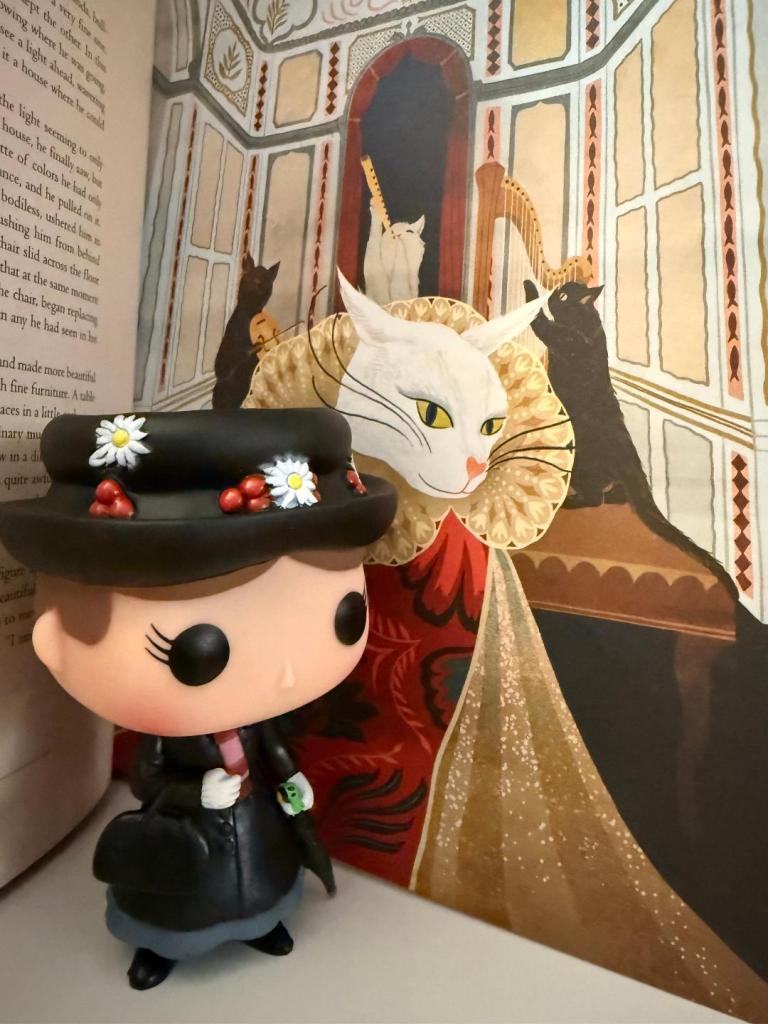
A cat with a “black and yellow coat” that “shone in the sunny mist, more like dapples of light and shadow than ordinary fur,” which Michael had noticed on the windowsill the night before, guides him farther into the Park. A steaming vapor rises from the earth and envelops them both. Prompted by the cat, Michael jumps into the air and suddenly feels himself lifted upward into empty space. Moments later, he lands on the steps of a golden palace on the Cat Planet, which turns out to be the very first star on which he had made his three wishes the night before.
The golden castle is inhabited by the Cat King, the Cat Queen, their three daughters, and many cat courtiers. At first, everything seems amusing to Michael until he is offered a meal of a dead mouse, a bat, and small raw fish, all served on golden plates, along with milk in a saucer. It is then that he realizes the cats are far from friendly. Soon after, he discovers the horrifying truth about his position at their court: all the cats’ food is prepared by enslaved children who, like him, had wished upon a star to be away from their families.
Michael is offered a chance to escape his predicament, but only if he can solve three riddles. Should he succeed, he is told, he must marry one of the King’s daughters. Michael finds the answers to the riddles easily enough, but he has no desire at all to marry a cat. His refusal is not well received by his hosts. The offended cats begin to hiss and close in on him, and they might have torn him to pieces had he not blown the silver whistle to summon Mary Poppins to his aid.
“Lucky Thursday” is a strange and uncanny story, and it is not impossible that P. L. Travers came up with the idea of a royal court of cats on her own. However, when I recently read Madame d’Aulnoy’s fairy tale The White Cat, the similarity of the setting made me wonder: could P. L. Travers, who was deeply immersed in fairy tale lore, have borrowed this motif from Madame d’Aulnoy’s tale? Writers often draw inspiration from one another. Human creativity does not exist in a vacuum, for ideas, like bees, cross-pollinate among our minds.
The fairy tale The White Cat unfolds in a distant kingdom where a prince, sent on a quest by his father, meets the White Cat, a princess presiding over a court of cats and bodiless hands serving as attendants. Unlike Michael, the prince is offered human food while the cats dine on dead mice and the White Cat helps the prince in his quest. He eventually falls in love with her and when he declares his love, she asks him to cut off her head and tail. He initially refuses to do so, but at last he complies, and by doing so, he breaks the spell that bound her, revealing that the White Cat is, in fact, a princess.
The similarities between the settings in these two stories, a golden palace in one and a castle of gleaming gemstones in the other, each with a royal court of cats and both situated in distant locations, are too striking in my opinion to be mere coincidence.
As is often the case with P. L. Travers, one question leads to another. If she knew about the fairy tales of Madame d’Aulnoy, why didn’t she mention her in her writings? She often spoke of the Brothers Grimm. A possible explanation might be that she dismissed Madame d’Aulnoy because she was inventing her stories rather than retelling old tales from anonymous sources, as the Brothers Grimm did.
But little did she know that even the Brothers Grimm and Charles Perrault had taken inspiration from Madame d’Aulnoy and her circle of women writers, who called themselves “the fairies” and were, in fact, the first to coin the term fairy tales.

I learned about Madame D’Aulnoy and the other fairies, Henriette-Julie Murat, Charlotte-Rose La Force, Marie-Jeanne L’Heriter, Catherine Bernard, Catherine Duran and Louise D’Auneil from Jane Harrington’s wonderful new book Women of the Fairy Tale Resistence, The Forgotten Founding Mothers of the Fairy Tale and the Stories That They Spun.
Harrington’s book is a must-read for any fairy tale aficionado. I was deeply fascinated to discover the lives of these women writers in Paris who challenged social norms during the reign of Louis XIV, the Sun King. Their lives were far from easy, yet despite the many obstacles they faced, their voices sustained them. Although men tried to erase their names from history, their writings have endured, offering a vivid glimpse into their struggles to find true love and live happily ever after.
The research conducted by Harrington is truly remarkable. I was astonished to learn that Charles Perrault, whose fairy tales I devoured as a child (I still have my old Bulgarian editions), borrowed from her stories without giving her any credit. According to Harrington, L’Héritier often remarked that Perrault had plundered her work. One of the tales I loved as a child, “Diamonds and Toads,” is in fact a simplified retelling of “Blanche,” a story written by Marie-Jeanne L’Héritier, who, incidentally, was also his relative.
I wonder what P. L. Travers would have thought of Harrington’s book and of the lives of these women writers. If she dismissed Madame d’Aulnoy because she was a writer of fairy tales rather than a “reteller,” that only adds to the paradoxes in Travers’s thinking. After all, she herself was a writer of fairy tales. Of course, she would have argued that the Mary Poppins stories are not fairy tales, and perhaps from an academic standpoint they do not fit the definition, not even as literary fairy tales, which are often written adaptations of stories from oral traditions.
P.L. Travers was influenced by myth, mysticism, and Gurdjieff’s spiritual teachings. She thought in mythic rather than folkloric terms, but her stories are an original combination of fairy-tale motifs with mythic cosmology and spiritual allegory.
In conclusion, the Mary Poppins stories are not traditional fairy tales but rather hybrid modern literary wonder tales that adapt the structure and spirit of fairy tales to explore mythic and metaphysical themes within a domestic setting. And this is why they are so fascinating to explore.
I wish I could talk about all this with P. L. Travers, but even if that were possible, there is no guarantee she would answer my questions.
After all, she was known for avoiding direct answers.
That’s it for now—thanks so much for reading! If this post brought you a little joy, go ahead and click the subscribe button in the bottom-right corner of your screen so you don’t miss any future posts. You can also follow me on Facebook, Instagram, and Substack for more peeks into the magical world of Mary Poppins, P. L. Travers, and other enchanting literary adventures.
Until next time, take care and be well!
Discover more from LINA SLAVOVA
Subscribe to get the latest posts sent to your email.

